Authors: Aditi Singh, Anjali Koranga, Ashutosh Mishra, Jayagayathri E., Masoomi Santosh Nevgi, Nikhil, Pramit Singh
Abstract
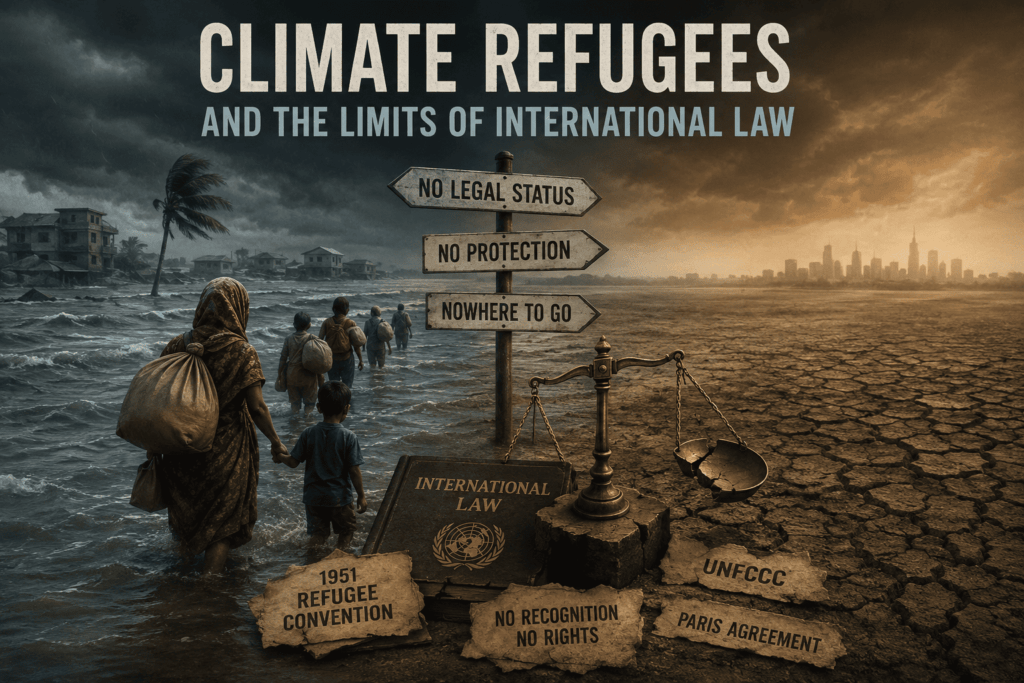
Climate change has become one of the most significant drivers of human displacement in the twenty-first century, forcing millions of people to leave their homes because of rising sea levels, extreme weather events, environmental degradation, and the loss of sustainable livelihoods. Despite the growing scale of climate-induced displacement, international refugee law continues to provide only limited protection to affected populations. Individuals displaced by climate-related causes remain outside the legal definition of a refugee under the 1951 Convention Relating to the Status of Refugees, leaving them without a comprehensive international protection framework. This paper critically examines the legal and governance challenges associated with climate-induced displacement by analysing the adequacy of existing international legal instruments and climate governance mechanisms. Employing a qualitative and doctrinal research methodology based on the analysis of international treaties, United Nations documents, policy reports, judicial developments, and academic literature, the study evaluates the structural limitations of international refugee law in responding to emerging patterns of climate migration. Bangladesh is adopted as the principal case study because of its exceptional vulnerability to sea-level rise, cyclones, riverbank erosion, and internal displacement. The paper argues that although international institutions increasingly acknowledge the relationship between climate change and human mobility, legal protection remains fragmented and largely non-binding. It further demonstrates how legal invisibility, weak institutional coordination, and inadequate policy implementation continue to expose climate-displaced populations to prolong humanitarian insecurity. The study concludes by advocating for stronger international legal recognition of climate-displaced persons, greater regional cooperation, and rights-based reforms capable of addressing one of the most pressing humanitarian challenges of the twenty-first century.
Keywords: Climate Change, Climate Refugees, Climate Migration, International Law, Bangladesh, Human Rights, Refugee Law, Environmental Displacement
Introduction
Climate change is no longer solely an environmental concern; it has evolved into one of the defining humanitarian, developmental, and legal challenges of the twenty-first century. Rising global temperatures have intensified extreme weather events, accelerated sea-level rise, disrupted ecosystems, and undermined livelihoods across the world. These changes increasingly compel individuals and communities to migrate, either temporarily or permanently, in search of safety and sustainable living conditions. Consequently, climate change has emerged as a significant driver of human mobility, giving rise to growing debates surrounding climate migrants, environmentally displaced persons, and climate refugees.
Unlike conventional migration, climate-induced displacement is rarely driven by voluntary choice. Instead, it results from the gradual or sudden deterioration of environmental conditions that make continued habitation increasingly difficult or impossible. Slow-onset processes such as desertification, salinity intrusion, coastal erosion, and prolonged drought often force households to abandon traditional livelihoods, while sudden disasters including floods, cyclones, and storm surges trigger immediate displacement on a massive scale. According to the United Nations High Commissioner for Refugees (UNHCR), weather-related disasters have displaced millions of people over the past decade, making climate-induced mobility an increasingly permanent feature of global migration patterns.
Despite the rapidly expanding scale of climate-induced displacement, international law has struggled to keep pace with changing patterns of human mobility. The 1951 Convention Relating to the Status of Refugees and its 1967 Protocol continue to define refugee status primarily in terms of persecution based on race, religion, nationality, political opinion, or membership of a particular social group. Individuals displaced primarily because of environmental degradation or climate-related disasters therefore remain outside the scope of this legal framework. Although international organisations such as the United Nations High Commissioner for Refugees (UNHCR), the International Organization for Migration (IOM), and the United Nations Framework Convention on Climate Change (UNFCCC) increasingly acknowledge the relationship between climate change and migration, the absence of legally binding protection mechanisms has resulted in a significant protection gap.
Existing scholarship has extensively documented both the increasing scale of climate-induced displacement and the inadequacies of international refugee law. However, comparatively fewer studies critically integrate these legal shortcomings with the lived experiences of climate-displaced populations in highly vulnerable regions of the Global South. Much of the literature continues to examine either international legal frameworks in isolation or focuses primarily on disaster management and climate adaptation without sufficiently addressing the legal invisibility of climate-displaced persons. This disconnect limits the development of practical legal reforms capable of responding to contemporary patterns of displacement.
This study seeks to address that gap by examining climate-induced displacement through both legal and governance perspectives while situating Bangladesh as a representative case study. Bangladesh provides a particularly significant context because of its extreme exposure to sea-level rise, cyclones, flooding, riverbank erosion, and salinity intrusion, all of which have contributed to large-scale internal displacement and increasing migration pressures. Rather than treating Bangladesh merely as an example of climate vulnerability, this paper analyses how its experience exposes the structural limitations of existing international refugee law and global climate governance.
Drawing upon the principles of Climate Justice, Environmental Justice, and Global Governance, this paper argues that climate-induced displacement represents not only an environmental crisis but also a crisis of legal recognition and human rights protection. It contends that existing international legal frameworks remain fundamentally inadequate for addressing the realities of climate migration and require significant reform to ensure effective protection for displaced populations.
The objectives of this study are:
- To examine the relationship between climate change and human displacement within contemporary international law.
- To critically evaluate the limitations of the 1951 Refugee Convention and existing international climate governance frameworks in protecting climate-displaced populations.
- To analyse Bangladesh as a case study illustrating the legal, humanitarian, and governance challenges associated with climate-induced displacement.
- To propose legal and policy reforms capable of strengthening international protection mechanisms for climate-displaced persons.
Research Methodology
This study adopts a qualitative, descriptive, and doctrinal legal research methodology to examine the relationship between climate change, human displacement, and international law. Rather than generating primary empirical data, the research relies on a systematic analysis of secondary sources to evaluate the adequacy of existing international legal and policy frameworks governing climate-induced displacement.
The doctrinal component of the research involves a critical examination of international legal instruments, including the 1951 Convention Relating to the Status of Refugees, the 1967 Protocol, the United Nations Framework Convention on Climate Change (UNFCCC), the Paris Agreement, and relevant United Nations human rights frameworks. In addition, reports published by the United Nations High Commissioner for Refugees (UNHCR), the International Organization for Migration (IOM), the Internal Displacement Monitoring Centre (IDMC), the Intergovernmental Panel on Climate Change (IPCC), and the Office of the United Nations High Commissioner for Human Rights (OHCHR) have been analysed to understand recent developments in climate-induced displacement and international governance.
The study further incorporates peer-reviewed books, journal articles, policy reports, and scholarly legal analyses that examine climate migration, refugee law, environmental governance, and human rights. Sources were selected based on their academic credibility, relevance to climate-induced displacement, authority within international law, and contribution to contemporary legal debates. Emphasis has been placed on literature addressing South Asia and climate vulnerability in developing countries.
Bangladesh was selected as the principal case study because it represents one of the world’s most climate-vulnerable countries. Its exposure to sea-level rise, recurrent cyclones, flooding, salinity intrusion, and riverbank erosion has generated large-scale internal displacement and increasing migration pressures. The Bangladeshi experience provides an appropriate legal and policy context for examining how existing international refugee law fails to adequately recognise and protect populations displaced by climate change.
The collected material has been analysed through doctrinal interpretation and thematic analysis. International legal provisions have been critically assessed alongside empirical evidence relating to climate displacement to identify protection gaps, governance limitations, and emerging legal challenges. This approach enables the study to move beyond descriptive analysis by evaluating both the effectiveness and limitations of current international legal frameworks while proposing evidence-based recommendations for future legal reform.
Literature Review
The scholarship on climate-induced displacement has grown considerably over the past two decades, though it remains fragmented across disciplines and unevenly distributed in its regional focus. Early contributions to the field were largely conceptual in nature. Richard Black (2001), in his foundational critique, challenged the very premise of the “environmental refugee,” arguing that the term was analytically imprecise and risked conflating voluntary economic migration with forced displacement driven by environmental stress. While Black’s skepticism was an important corrective to overly deterministic readings of climate-migration links, subsequent empirical scholarship has demonstrated that the relationship, though complex and mediated by social and economic factors, is nonetheless real and intensifying.
Jane McAdam’s Climate Change, Forced Migration, and International Law (2012) remains the most rigorous legal treatment of the subject. McAdam systematically demonstrates that the 1951 Refugee Convention, with its persecution-centred definition, is structurally ill-suited to accommodate climate-displaced populations, whose movement is often gradual, internally focused, and economically intertwined with environmental degradation rather than politically motivated. This insight has since been echoed and extended by a range of legal scholars who argue that the Convention’s original post-war European architecture was never designed to reckon with the scale or character of environmentally induced displacement. Alongside this legal critique, the UNHCR (2024) has increasingly acknowledged the growing intersection between climate change and forced migration, even as it maintains an institutional reluctance to extend formal refugee status to climate-displaced populations- a tension that remains largely unresolved in both policy and practice.
At the empirical level, the World Bank’s Groundswell Report (2021) brought quantitative weight to what had previously been primarily qualitative arguments, projecting that over 216 million people across six world regions could become internal climate migrants by 2050 under pessimistic scenarios. For South Asia specifically, the report estimates that Bangladesh alone could see up to 13.3 million internal climate migrants by mid-century which is a figure that puts the region squarely at the epicentre of what is fast becoming a global governance crisis. The Internal Displacement Monitoring Centre (IDMC, 2025) has further documented that disaster-related internal displacements reached 45.8 million globally in 2024, the highest figure recorded since 2008, with weather-related events accounting for the overwhelming majority. These data points underscore not only the scale of the phenomenon but also its accelerating trajectory.
Regional data on South Asia has contributed significantly to understanding the granular dynamics of climate displacement. Islam and Hasan’s (2016) study of Cyclone Aila revealed how a single sudden-onset event can trigger prolonged displacement cycles, with affected communities in coastal Bangladesh remaining unable to return to their homes years after the storm. Mallick and Vogt (2014) similarly documented how displacement in the Sundarbans region is not a discrete event, but an accumulative process of livelihood erosion driven by salinity intrusion, riverbank erosion, and reduced agricultural viability. These micro-level findings are important because they reveal that displacement often operates well below the threshold of formal recognition, neither dramatic enough to generate media attention nor legally legible under existing frameworks. The International Organization for Migration (IOM, 2024) has likewise stressed that climate mobility must be understood as a spectrum ranging from temporary relocation to permanent resettlement, and that policy responses must be calibrated accordingly rather than defaulting to a single protective category.
At the level of international governance, literature is broadly critical. The OHCHR has repeatedly affirmed that climate change poses a direct threat to the enjoyment of human rights, including rights to life, food, water, and adequate housing, yet the translation of these normative commitments into binding legal obligations for climate-displaced persons remains elusive. Ahmed, Givens, and Arredondo (2024) offer a comprehensive review of climate-migration linkages in South Asia, concluding that while there is growing political acknowledgement of the problem, institutional responses remain fragmented, underfunded, and structurally incapable of addressing the scale of displacement already underway. Warner (2017) similarly identifies a persistent disconnect between the ambitions of frameworks such as the Paris Agreement and the practical protection gaps faced by displaced populations in the Global South.
A notable gap emerges from this body of literature. While the legal inadequacies of international refugee law and the empirical scale of climate displacement have both been well documented, the information that integrates these two strands remains limited. Much of the existing legal analysis is pitched at the level of international institutional design, often without engaging with the concrete lived realities of displaced populations at the national and sub-national level. Conversely, field-level studies in Bangladesh tend to focus on disaster response and adaptation rather than on the structural legal invisibility of climate-displaced persons within both domestic and international frameworks. This paper addresses that gap directly, situating Bangladesh not merely as a case study of climate vulnerability but as a critical test of whether international legal frameworks can be meaningfully reformed to offer protection to those most devastated by a crisis they have done the least to create.
Climate Change and Human Displacement
Climate change has increasingly become one of the most significant drivers of human displacement in the twenty-first century. What was once regarded primarily as an environmental concern has now evolved into a humanitarian, developmental, and legal challenge with global implications. Rising sea levels, extreme weather events, prolonged droughts, and environmental degradation are forcing people to leave their homes, often without the legal protections traditionally available to displaced populations. Unlike voluntary migration, climate-induced movement is rarely driven by choice. Instead, it results from the gradual or sudden loss of livelihoods, housing, and environmental security.
At the same time, it is important to recognise that climate change rarely acts in isolation. Displacement usually occurs because environmental pressures interact with existing problems such as poverty, weak governance, inadequate infrastructure, and limited adaptive capacity. Consequently, climate migration should not be understood simply as an environmental phenomenon but as the outcome of multiple intersecting vulnerabilities. This complexity also explains why existing international legal frameworks struggle to respond effectively, as they were largely designed to address displacement caused by persecution or armed conflict rather than environmental change.
According to the United Nations High Commissioner for Refugees (UNHCR, 2024), weather-related disasters have triggered nearly 220 million internal displacements over the past decade. These figures demonstrate that climate-induced mobility is no longer an exceptional occurrence but an increasingly regular feature of global migration patterns. Despite this growing reality, international law continues to provide only fragmented protection for those displaced by environmental causes, exposing a widening gap between contemporary migration patterns and existing legal frameworks.
Sudden-Onset Climate Disasters
One of the most immediate ways in which climate change contributes to displacement is through sudden-onset disasters such as floods, cyclones, heatwaves, and storm surges. These events often force entire communities to evacuate within hours or days, leaving little opportunity to protect property, livelihoods, or essential documents. Although emergency relief measures may provide temporary assistance, recovery is often slow, and many affected families are unable to return to their homes.
South Asia is particularly vulnerable because of its geographical location, dense population, and dependence on climate-sensitive sectors such as agriculture and fisheries. According to the Internal Displacement Monitoring Centre (IDMC, 2025), disaster-related internal displacements reached 45.8 million globally in 2024, the highest number recorded since 2008, with weather-related disasters accounting for the overwhelming majority. India alone recorded approximately 5.4 million internal displacements during the same year, largely as a result of floods and cyclones.
The recurring floods in Assam and Bihar and the increasing intensity of cyclones in the Bay of Bengal illustrate how climate disasters repeatedly disrupt everyday life across the region. Cyclones Sidr (2007) and Amphan (2020), for example, caused widespread destruction across Bangladesh and eastern India, damaging homes, agricultural land, transport networks, and public infrastructure. However, the consequences of these disasters extend well beyond their immediate impact. Many families experience long-term displacement because rebuilding homes, restoring livelihoods, and recovering agricultural productivity often takes years. As a result, climate disasters should be understood not merely as isolated emergencies but as events capable of producing prolonged economic and social instability. This exposes an important weakness in current policy responses, which remain largely focused on immediate disaster relief rather than long-term rehabilitation and protection.
Slow-Onset Environmental Degradation
While sudden disasters attract considerable public attention, slow-onset environmental degradation represents an equally important, though less visible, driver of displacement. Rising sea levels, coastal erosion, desertification, prolonged droughts, and saline intrusion gradually reduce the viability of existing livelihoods until migration becomes the only realistic option. Unlike sudden disasters, these processes unfold over years or even decades, making it difficult to determine exactly when environmental migration begins.
Bangladesh provides one of the clearest examples of this phenomenon. Its low-lying geography makes it highly vulnerable to sea-level rise, while saline intrusion has increasingly contaminated freshwater sources and reduced agricultural productivity in coastal regions such as the Sundarbans. According to the Intergovernmental Panel on Climate Change (IPCC, 2022), climate change is expected to intensify these pressures across South Asia, increasing the number of people displaced by environmental degradation over the coming decades.
The gradual nature of these environmental changes also presents a significant legal challenge. Existing refugee law largely assumes that displacement occurs as a direct response to persecution or conflict. In contrast, climate-induced migration often results from the cumulative erosion of living conditions rather than a single identifiable event. By the time many households decide to migrate, their decision reflects years of declining agricultural yields, water scarcity, repeated crop failures, and loss of income. Consequently, individuals displaced by slow-onset climate change frequently remain outside the scope of existing international protection despite facing conditions that seriously threaten their livelihoods and dignity.
Climate Change as a “Threat Multiplier”
Climate change is frequently described as a “threat multiplier” because it intensifies existing economic, social, and political vulnerabilities instead of creating entirely new ones. Environmental degradation increases competition over scarce resources such as water, food, and cultivable land, placing additional pressure on communities that are already struggling with poverty, unemployment, or weak governance. In this sense, climate change rarely acts as the sole cause of displacement; rather, it accelerates existing patterns of insecurity until migration becomes unavoidable.
This is particularly evident in South Asia, where environmental pressures intersect with rapid population growth, uneven economic development, and limited institutional capacity. In Bangladesh, repeated flooding, riverbank erosion, and rising sea levels have contributed to large-scale rural-to-urban migration, placing enormous pressure on cities that already face shortages of housing, employment, and public services. At the regional level, concerns about cross-border migration have also shaped political debates surrounding border management, citizenship, and national security, particularly in relation to migration between Bangladesh and India.
These developments raise important questions about the adequacy of existing international legal frameworks. Although the 1951 Refugee Convention remains the foundation of international refugee protection, its persecution-based definition excludes people displaced primarily by environmental causes. As a result, millions of climate-displaced persons occupy a legal grey area: they are compelled to move because their environments can no longer sustain them, yet they do not qualify for refugee protection under existing international law. This gap illustrates that the challenge is not simply the increasing scale of climate displacement but also the inability of legal institutions to evolve alongside changing patterns of human mobility.
Ultimately, climate-induced displacement cannot be addressed through disaster management alone. It requires coordinated responses that combine climate adaptation, sustainable development, regional cooperation, and legal reform. Without strengthening both domestic and international protection mechanisms, climate change will continue to displace vulnerable populations while leaving many without meaningful legal recognition or long-term security.
Climate Law and Global Governance
Today, climate change is a global legal and governance challenge as its consequences including rising sea levels, extreme weather events, environmental degradation, and resource scarcity affect economies, human rights, environment and international security. A crisis of such magnitude requires coordinated action at multiple levels from local governments to international organizations. Consequently, international climate legislation and governance structures are crucial for regulating emissions, ensuring equality and responsibility across states, and promoting collaboration among nations.
Despite global agreements such as the Paris Agreement and UN frameworks targeting climate change and adaptation, significant governance gaps, inadequate accountability, and implementation challenges persist, hindering effective protection for climate migrants.
International Climate Agreements
In 1979, worldwide experts acknowledged climate change as a significant threat to humanity, reaching a consensus that a doubling of atmospheric CO2 levels may result in a 3°C increase in the Earth’s temperature relative to pre-industrial levels.
Policy responses to climate change commenced in 1988 with the establishment of the United Nations (UN) Intergovernmental Panel on Climate Change. Subsequently, in 1992, the United Nations Framework Convention on Climate Change was adopted, forming the foundational international framework governing climate change. Early international climate agreements, such as the Kyoto Protocol (1997) focused primarily on emissions mitigation and did not address human migration resulting from adverse climate events.
While the term ‘climate refugees’ is not mentioned, the Paris Agreement formally acknowledged climate migrants and created the Task Force on Displacement (TFD) under the Warsaw International Mechanism (WIM) to plan for and address climate induced displacement. It provided the legal stand and guaranteed human rights to the climate migrants.
These developments indicate that international climate governance increasingly acknowledges the relationship between climate change and human migration.
United Nations Frameworks
The United Nations addresses climate-induced displacement largely through fragmented and indirect legal and institutional mechanisms rather than through a binding international framework specifically recognizing climate migrants. As discussed above, the 1951 Refugee Convention and its 1967 Protocol remain limited in scope, excluding those displaced by environmental degradation or climate-related disasters. Consequently, the United Nations High Commissioner for Refugees (UNHCR) possesses restricted jurisdiction in protecting climate-displaced populations.
The International Organization for Migration (IOM) has emerged as a central institution addressing migration governance. The IOM advocates for the term “climate migrants” rather than “climate refugees”. In 2021, IOM launched a 10-year Institutional Strategy on Migration, Environment and Climate Change 2021–2030, providing a long-term approach to the problem.
Similarly, the Global Compact for Safe, Orderly and Regular Migration (GCM) acknowledges environmental degradation and climate change as major drivers of migration and encourages international cooperation in managing migration flows. The WIM, established in 2013 under the UNFCCC Loss and Damage mandate, focuses on climate-related displacement, adaptation, and financial assistance for vulnerable states.
The UN frameworks emphasize climate mitigation, funding for climate resilience, and addressing the primary drivers of climate migration. However, these frameworks remain fragmented, largely non-binding, and inadequate in ensuring comprehensive legal protection for climate-displaced populations.
South Asian Case Studies
Climate Change and Migration in Bangladesh
Rising sea levels in the Ganges-Brahmaputra Delta are effectively accelerating rural-to-urban migration flows, placing unprecedented strain on Dhaka’s already precarious urban infrastructure.
These demographic shifts exacerbate cross-border friction, as irregular migration trajectories into neighboring India prompt reactive securitization measures and the tightening of border control protocols.
This securitization paradigm is further compounded by the persistent legal precarity of these populations, who remain systematically excluded from the international refugee framework due to the lack of official “climate refugee” recognition.
Consequently, these individuals are frequently relegated to the status of undocumented internal migrants, stripped of state-mandated social protections and vulnerable to chronic socio-economic marginalization.
This administrative vacuum fosters systemic disenfranchisement, as displaced persons often lack the formal documentation required to access public healthcare or disaster relief services.
Furthermore, this institutional neglect forces many families into informal settlements, where the absence of tenure security compounds their susceptibility to recurring environmental hazards and cyclical displacement.
This lack of legal standing prevents the implementation of long-term integration strategies, leaving vulnerable communities caught in a perpetual cycle of precariousness without recourse to regional protection mechanisms.
Moreover, the absence of a comprehensive national legal framework forces these populations into a state of permanent liminality, rendering efforts to address their human rights concerns under existing international conventions largely ineffective.
The Legal Invisibility of Internally Displaced Populations
This lack of formal recognition within national statutes denies displaced persons the essential legal identity required to navigate administrative bureaucracy, effectively erasing their visibility in census data and development planning.
Bangladesh is one of the world’s most climate vulnerable countries, facing severe threats from sea-level rise, cyclones, floods, salinity intrusion, and riverbank erosion.
These environmental changes have forced millions of people to leave their homes and migrate internally, especially from coastal and flood-prone regions to urban slums in cities like Dhaka.
However, despite their increasing numbers, climate induced internally displaced persons (IDPs) remain largely “legally invisible”, meaning they lack formal legal recognition and adequate institutional protection Studies by the United Nations and Bangladeshi institutions show that displacement due to river erosion, flooding, and salinization has become increasingly common.
Many displaced persons permanently relocate to informal settlements where they experience poor living conditions, unemployment, lack of healthcare, and social exclusion.
The term “legal invisibility” refers to the absence of formal legal recognition and rights-based protections for climate-displaced populations.
In Bangladesh, no specific national law defines or protects climate induced IDPs. Existing frameworks such as the Disaster Management Act focus mainly on emergency response rather than long-term rehabilitation, compensation, housing rights, or livelihood restoration for displaced persons.
As a result, affected individuals often fall through legal and administrative gaps.
For example:
- Climate migrants are not officially recognized as a separate legal category.
- There is no national registry or monitoring mechanism for climate-displaced populations.
- Most policies treat displacement as a humanitarian or disaster issue rather than a legal rights issue.
- Many displaced families living in urban slums lack access to land ownership, education, healthcare, and social welfare protections.
Several factors contribute to this problem:
- Absence of international legal recognition for climate migrants.
- Lack of domestic legislation specifically addressing climate-induced displacement.
- Weak institutional coordination between climate, migration, and disaster-management agencies.
- Economic constraints limiting rehabilitation programs.
- Slow onset climate impacts (such as salinity and erosion) are harder to classify legally than sudden disasters.
To address legal invisibility, Bangladesh should:
- Enact a specific legal framework for climate-induced IDPs.
- Create a national database and identification system for displaced populations.
- Integrate climate migration into national adaptation and urban planning policies.
- Strengthen housing, livelihood, and social protection schemes for displaced communities.
- Promote regional cooperation in South Asia similar to the African Union’s approach to IDP protection.
Humanitarian and Legal Challenges
The displacement of climate migrants across South Asia generates a compounding crisis: one that is simultaneously legal, economic, and deeply human. Without formal recognition under international refugee law, those displaced by environmental catastrophe exist in a state of perpetual legal ambiguity, denied the protections and entitlements available to convention refugees. This invisibility does not merely reflect a definitional gap; it actively enables a cascade of humanitarian failures.
Livelihood Loss and Housing Insecurity
Climate displacement rarely arrives as a single, clean rupture. For most affected communities (Bangladeshi coastal farmers, Sundarbans fisherfolk, Assam floodplain families) it accumulates gradually through repeated cycles of loss. Seasonal floods destroy agricultural land, cyclones demolish homes, and saline water intrusion renders soil permanently uncultivable. Each episode strips away economic assets that were never abundant to begin with. Upon displacement, affected populations typically migrate to urban peripheries (Dhaka’s informal settlements, Kolkata’s slums) where they enter precarious labour markets without contracts, safety nets, or legal standing. Housing in destination areas is often temporary, overcrowded, and legally insecure, leaving displaced populations perpetually vulnerable to eviction and secondary displacement.
Documentation, Statelessness, and Legal Exclusion
One of the most acute legal challenges facing climate migrants in South Asia is the absence of documentation. Many displaced individuals (particularly in rural Bangladesh and India’s northeastern states) lack birth certificates, land records, or national identity documents. When displacement occurs, whatever documentation they possess is frequently lost to floodwater or fire. Without documentation, climate migrants cannot access state welfare services, enrol children in schools, register for employment, or assert any legal claim to shelter or assistance. In extreme cases, prolonged displacement combined with documentation failure creates conditions of effective statelessness- a situation particularly acute in Bangladesh, where politically charged national verification processes such as the National Register of Citizens in neighbouring Assam have rendered thousands technically stateless despite decades of residence. Statelessness compounds legal invisibility: without citizenship, there is no state obligated to protect.
Gendered Dimensions of Displacement
The humanitarian consequences of climate displacement fall with disproportionate severity on women and children. Women in displaced South Asian communities face heightened risks of gender-based violence during transit and in temporary settlements, where institutional oversight is minimal and community protection structures have collapsed. Access to reproductive healthcare, maternal services, and psychosocial support is severely curtailed in displacement contexts. Girls are frequently withdrawn from education during displacement, generating long-term consequences for social mobility and intergenerational poverty. It is a decision driven by economic necessity and safety concerns. Children separated from families during rapid-onset disasters are exposed to trafficking and exploitation, with limited legal mechanisms in place to ensure tracing, reunification, or protection.
Social Exclusion and Structural Vulnerability
Beyond immediate deprivation, climate migrants frequently encounter entrenched social exclusion in destination communities. Ethnic, linguistic, and religious differences between displaced populations and host communities generate friction, discrimination, and in some cases political hostility (India-Bangladesh border). The absence of legal recognition means that displaced persons have no formal channel through which to assert rights, lodge grievances, or access justice. Humanitarian organisations operating in the region face significant access constraints, funding shortfalls, and coordination failures that leave critical protection gaps unaddressed.
The humanitarian crisis generated by climate displacement in South Asia is therefore not incidental: it is structurally produced by the failure of legal frameworks to recognise, and thereby protect, one of the world’s most vulnerable populations.
Recommendations and Legal Reform
Attempts to legally recognize and confer protection upon different categories of refugees have historically been pursued primarily through the framework of the 1951 Refugee Convention. The Convention establishes two essential requirements for refugee status. First, Article 1A requires the existence of a “well-founded fear of persecution,” and second, such persecution must occur on grounds of race, religion, nationality, membership of a particular social group, or political opinion. The Convention does not explicitly provide protection for individuals displaced by natural or human-induced environmental disasters. The only potentially relevant provision is Article 33(1), which prohibits the refoulement of asylum seekers to territories where their life or freedom would be threatened. Some scholars have attempted to argue that environmentally displaced persons could already fall within the Convention framework by characterizing state-induced environmental degradation as a form of persecution. Others have explored incorporating environmental refugees within the existing refugee regime but have concluded that simply adding the term “environmental” to the refugee category is conceptually problematic because environmental change cannot easily be separated from political and economic conditions.
Such proposals have encountered substantial resistance from states concerned that expanding the refugee definition could effectively open “refugee floodgates” because of the enormous scale of environmentally induced displacement globally. There are also concerns that broadening the existing refugee definition may dilute the current legal protections available to convention refugees. This concern arises because migration caused by environmental factors is generally not the result of direct governmental oppression in the traditional sense contemplated under refugee law.
The United Nations High Commissioner for Refugees (UNHCR) has acknowledged the growing number of persons displaced by environmental degradation as well as the continuing international debate regarding possible expansion of the Refugee Convention to include environmental refugees. Although the UNHCR has shown limited engagement with environmental displacement issues over several years, it continues to maintain that fundamental distinctions exist between convention refugees and environmentally displaced populations. Nevertheless, certain regional legal instruments have adopted broader refugee definitions that incorporate environmental criteria. For example, the 1969 OAU Convention Governing the Specific Aspects of Refugee Problems in Africa includes within the refugee category individuals compelled to flee owing to events seriously disturbing public order. Similarly, the 1984 Cartagena Declaration on Refugees—which has significantly influenced refugee legislation in several Latin American states—extends protection to persons fleeing massive human rights violations and internal conflicts.
More recently, climate displacement has begun receiving increased attention at the international policy level. In particular, initiatives associated with the 2007 Bali Conference of Parties, including statements by the U.N. Deputy High Commissioner for Human Rights and the Office of the United Nations High Commissioner for Human Rights (OHCHR), highlighted the relationship between climate change and human rights protections. In January 2009, the OHCHR issued a landmark analytical report in response to Resolution 7/23 of the United Nations Human Rights Council. Subsequently, in March 2009, the Human Rights Council adopted Resolution 10/4, which recognized the effects of climate change on the enjoyment of human rights and reaffirmed that existing human rights obligations could help strengthen responses to climate-related harms. These rights include the rights to life, food, water, health, housing, and self-determination, as well as rights potentially threatened by climate-related conflict and displacement.
With regard to internal displacement, the International Committee of the Red Cross has developed guiding principles that may be applied to climate-induced displacement situations. These principles define internally displaced persons (IDPs) as individuals or groups compelled to flee their homes or habitual residences, particularly due to armed conflict, generalized violence, human rights violations, or natural and human-made disasters, without crossing internationally recognized state borders. The Guiding Principles affirm that IDPs are entitled to the same rights and freedoms under both international and domestic law as other persons within their country. They further establish that the state bears the primary responsibility for providing assistance and protection during all phases of internal displacement. The document comprehensively addresses internal displacement, including humanitarian protection, assistance, return, resettlement, and reintegration processes. These Guiding Principles provide an important normative framework for addressing internal displacement challenges. However, a comparable international framework remains absent for climate refugees crossing international borders. Under the present legal framework, climate refugees at the international level may only derive limited protection through the principle of non-refoulement and additional human rights protections applicable to non-citizens.
In recent years, numerous reports and scholarly proposals have emphasized the seriousness of climate displacement and advanced various legal and policy recommendations, ranging from the creation of a global treaty recognizing climate or environmental refugees to the establishment of temporary state protection mechanisms. One important emerging recommendation concerns anticipatory governance and disaster preparedness obligations. Contemporary policy frameworks increasingly argue that states possess positive obligations under international human rights law to prevent foreseeable displacement wherever possible. Such obligations include developing early warning systems, environmental monitoring mechanisms, evacuation planning procedures, and pre-designated humanitarian infrastructure. These recommendations are grounded in the growing recognition that climate-related displacement is increasingly predictable through scientific forecasting. Accordingly, legal scholars argue that failure to prepare adequately for foreseeable displacement may amount to a governance failure implicating socioeconomic rights, including the rights to life, housing, food, water, and health.
Additional proposals advocate the creation of a new international convention establishing a special migration status for climate-displaced persons and environmental migrants. Protection under such proposals would be limited primarily to populations residing on small islands and low-lying coastal regions whose habitats and livelihoods have been destroyed by climate impacts. Under this framework, populations living in areas projected to become uninhabitable would be granted the opportunity to migrate legally in proportions linked roughly to host countries’ cumulative greenhouse gas emissions. Scholars Frank Biermann and Ingrid Boas have also proposed establishing a Climate Refugee Protection and Resettlement Fund as a protocol under the United Nations Framework Convention on Climate Change (UNFCCC). Although the proposal does not clearly specify funding sources or responsibility allocation mechanisms, it suggests possible funding streams such as international air travel taxes and grants based on the principle of common but differentiated responsibilities.
At present, however, it appears unlikely that states would agree to a universally binding treaty formally recognizing climate displacement and imposing enforceable obligations for protection and assistance. This reluctance reflects the broader unwillingness of states to voluntarily undertake obligations that may significantly affect domestic economic, social, and political policy. Consequently, many scholars argue that regional cooperation agreements and bilateral arrangements built upon existing geopolitical and economic relationships may provide a more realistic and flexible model for addressing climate-induced displacement. Regional agreements may also secure higher levels of political commitment from participating states than broad multilateral treaties at the global level. One example frequently cited is the Regional Seas Programme, which has operated successfully for more than two decades. In the absence of a comprehensive international agreement concerning climate refugees, scholars therefore suggest that similar regional legal initiatives could provide a viable alternative framework for climate displacement governance.
Conclusion
Climate-induced displacement highlights the inadequacies of modern international laws and human rights frameworks in the face of environmental disaster, systematic discrimination, and socio-economic vulnerability. This paper argues that the problem of climate-induced migration cannot be solved solely by addressing environmental hazards; rather, it demands changes to the structure and implementation of international law regarding refugees and displacement, which fail to recognize or provide legal protection to the many displaced by climate change. While international organizations have started to recognize the connection between climate change and human displacement, these frameworks haven’t yet addressed this issue structurally and through legally binding mechanisms, especially in developing countries like South Asia.
The analysis highlights three central findings. First, the 1951 Refugee Convention remains fundamentally limited due to its persecution-based definition as it excludes individuals displaced by environmental degradation, thereby rendering millions of climate migrants legally invisible. Second, the Bangladesh case study reveals how climate displacement intersects with poverty, housing insecurity, documentation loss, urban marginalization, and weak institutional support, creating prolonged humanitarian crisis. Third, current climate governance mechanisms, including the Paris Agreement, UNHCR initiatives, and the Warsaw International Mechanism, acknowledge climate mobility but continue to rely heavily on voluntary cooperation and weak implementation structures, limiting their effectiveness in addressing long-term displacement and rehabilitation.
Overall, this study argues that the solution lies in restructuring international protection frameworks by prioritizing legal recognition of climate migrants, regional cooperation, and rights-based approaches toward climate displacement. Without implementing necessary changes to humanitarian laws and climate policies, any attempts at solving climate-induced displacement will largely remain aspirational.
References
- Ahmed, M. N. Q., Givens, J. E., & Arredondo, A. (2024). The links between climate change and migration: A review of South Asian experiences. SN Social Sciences, 4(3), Article 59. https://doi.org/10.1007/s43545-024-00860-0
- Biermann, F., & Boas, I. (2010). Preparing for a warmer world: Towards a global governance system to protect climate refugees. Global Environmental Politics, 10(1), 60–88. https://doi.org/10.1162/glep.2010.10.1.60
- Black, R. (2001). Environmental refugees: Myth or reality? (New Issues in Refugee Research Working Paper No. 34). United Nations High Commissioner for Refugees.
- Brunnenmeyer, J. (n.d.). The evolution of UNFCCC and climate change displacement: A case study of Conferences of the Parties (COPs). UC Davis Journal of International Law & Policy, 31(1), 1–5.
- Ghosh, R. C., & Orchiston, C. (2022). A systematic review of climate migration research: Gaps in existing literature. Discover Sustainability, 3(1), Article 21. https://doi.org/10.1007/s43621-022-00088-7
- Internal Displacement Monitoring Centre. (2025). Global report on internal displacement 2025. Internal Displacement Monitoring Centre. https://www.internal-displacement.org/global-report/grid2025
- Intergovernmental Panel on Climate Change. (2022). Climate change 2022: Impacts, adaptation and vulnerability. Cambridge University Press. https://doi.org/10.1017/9781009325844
- International Organization for Migration. (2021). IOM institutional strategy on migration, environment and climate change 2021–2030. IOM. https://environmentalmigration.iom.int/iom-strategy-migration-environment-and-climate-change-2021-2030
- International Organization for Migration. (2024). IOM environmental migration portal: Think of tomorrow, act today. IOM. https://environmentalmigration.iom.int
- Islam, M. R., & Hasan, M. M. (2016). Climate change-induced displacement and migration in Bangladesh: A review of the existing literature. Social Science, 5(8), 1–20. https://doi.org/10.3390/socsci5030055
- Mallick, B., & Vogt, J. (2014). Cyclone survivors’ resettlement in Bangladesh: Voluntary or forced? Population and Environment, 36(1), 83–110. https://doi.org/10.1007/s11111-013-0193-8
- McAdam, J. (2012). Climate change, forced migration, and international law. Oxford University Press. https://doi.org/10.1093/acprof:oso/9780199587087.001.0001
- Office of the United Nations High Commissioner for Human Rights. (2009). Report of the Office of the United Nations High Commissioner for Human Rights on the relationship between climate change and human rights (A/HRC/10/61). United Nations Human Rights Council. https://www.ohchr.org/en/climate-change/human-rights-climate-change-and-migration
- United Nations Framework Convention on Climate Change. (2015). Paris Agreement. UNFCCC. https://unfccc.int/process-and-meetings/the-paris-agreement
- United Nations High Commissioner for Refugees. (2024). No escape: On the frontlines of climate change, conflict and forced displacement. UNHCR. https://www.unhcr.org/reports/no-escape-frontlines-climate-change-conflict-and-forced-displacement
- United Nations High Commissioner for Refugees. (n.d.). Internally displaced people. UNHCR. https://www.unhcr.org/in/about-unhcr/who-we-protect/internally-displaced-people
- Warner, K. (2017). Human mobility and the Paris Agreement: Contribution of climate policy to the global compact for safe, orderly and regular migration. UN Climate Secretariat (UNFCCC). https://refugeesmigrants.un.org/sites/default/files/stocktaking_unfcc.pdf
- World Bank. (2021). Groundswell part 2: Acting on internal climate migration. World Bank. https://doi.org/10.1596/978-1-4648-1770-9
- Jaswal, Paramjit S., and Stellina Jolly. “CLIMATE REFUGEES: CHALLENGES AND OPPORTUNITIES FOR INTERNATIONAL LAW.” Journal of the Indian Law Institute, vol. 55, no. 1, 2013, pp. 45–58. JSTOR, http://www.jstor.org/stable/43953626. Accessed 22 May 2026.