Armando Estrella, Ruchi Bhavsar, Mireia Noriega Etxaide, Pernilla Rao, Prachee Bhardwaj
Abstract
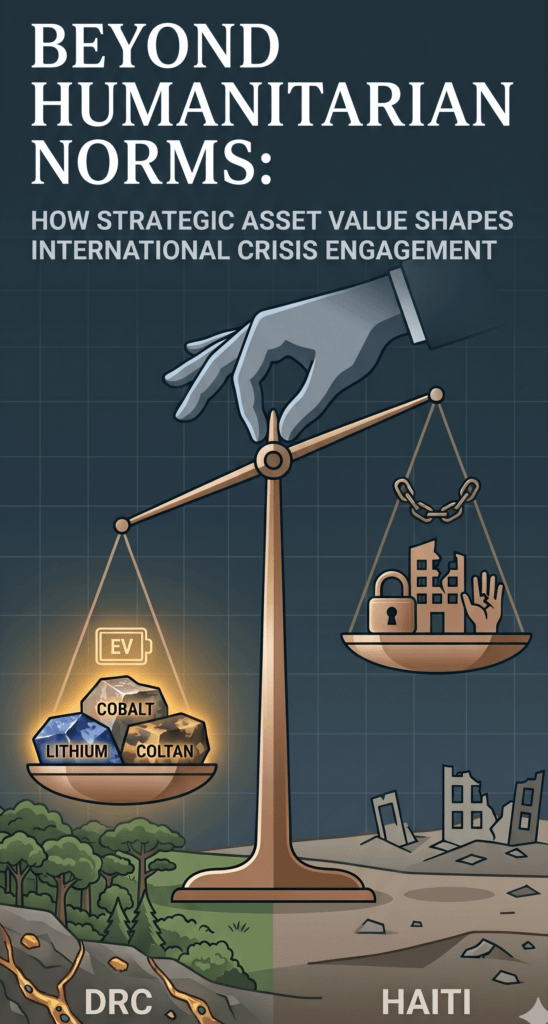
The global transition from hydrocarbons to critical minerals is often framed as a paradigm shift in material needs, yet the political logic of intervention remains driven by a consistent variable: Strategic Asset Value (SAV). SAV is operationalized in this study through three quantifiable indicators: (1) a state’s share of global critical mineral reserves, (2) the USD value of extractive exports as a percentage of world supply, and (3) the degree of great-power supply-chain dependency on those resources. This paper argues that the international response to political and humanitarian crises is not determined by the severity of human suffering, but by the strategic indispensability of the resources located within the crisis zone. By employing a Most Similar Systems Design (MSSD), this study contrasts the international responses to the Democratic Republic of the Congo (DRC) and Haiti, two states experiencing equivalent levels of severe institutional collapse and civilian distress. Utilizing quantitative Natural Language Processing (NLP) to analyze a corpus of 26 official UN Security Council Resolutions-13 per case-from 2021 to 2026, this research introduces the Moral-Material Ratio (MMR). The findings reveal a stark divergence in diplomatic framing. The resource-rich DRC is actively “morally securitized” using elevated normative concepts to justify long-term stabilization and supply chain access, yielding a high normative MMR of 1.41. Conversely, the resource-poor Haitian crisis triggers a logic of containment and neglect, dominated by tactical, depoliticized security rhetoric yielding a low material MMR of 0.53. Ultimately, this paper posits that great powers weaponize moral discourse selectively, demonstrating that extreme human suffering, absent strategic material value, is insufficient to trigger comprehensive international engagement.
Keywords: Strategic Asset Value (SAV), Moral-Material Ratio (MMR), Selective Moral Securitization, Humanitarian Intervention, Responsibility to Protect (R2P), United Nations Security Council, Democratic Republic of the Congo, Haiti.
1. Introduction
Despite the institutionalization of the Responsibility to Protect (R2P) doctrine (United Nations General Assembly, 2005) and the pervasive rhetoric of global human rights, the contemporary international system projects a profound illusion of normative parity. Global governance frameworks assert that the severity of human suffering is the primary catalyst for international intervention. Yet, empirical observation of state behavior reveals a glaring paradox: international responses to equivalent humanitarian crises exhibit extreme asymmetries in both diplomatic urgency and material commitment. For example, while the Democratic Republic of the Congo (DRC) and Haiti currently experience comparable levels of catastrophic institutional collapse and civilian distress (ECHO, 2025), the former triggers massive, heavily funded state-building operations, while the latter is relegated to outsourced, underfunded containment. This disparity raises a fundamental puzzle regarding the true drivers of global crisis management in the modern era.
The theoretical foundation of modern crisis intervention is heavily anchored in liberal constructivist paradigms, which argue that global norms dictate state behavior (Finnemore, 2003). However, this paradigm faces profound challenges from realist scholars who argue that moral frameworks frequently obscure underlying strategic objectives (O’Connell, 2011). Historically, the geopolitics of extraction has demonstrated a robust correlation between the presence of lucrative natural resources, primarily hydrocarbons, and foreign intervention. Today, as the global economy transitions toward renewable energy, the strategic chessboard has shifted toward the critical transition minerals necessary for advanced technologies and decarbonization (Cobalt Institute, 2025; U.S. Geological Survey, 2025).
While historical literature successfully deconstructs the moral justifications of previous resource-driven interventions, a critical gap remains in understanding the contemporary mechanics of this disparity. Much of the current discourse continues to treat humanitarian intervention as a universally applied norm, failing to systematically contrast how the strategic indispensability of a crisis zone dictates the exact nature and intensity of international engagement. Existing scholarship has yet to fully articulate how extreme human suffering is an insufficient catalyst for robust international engagement unless it occurs atop a foundation of strategic material wealth.
To address this gap, this study asks: How does the Strategic Asset Value (SAV) of a crisis zone-operationalized through measurable mineral reserve, export value, and supply-chain dependency indicators-rather than the severity of humanitarian distress, dictate the intensity and rhetorical framing of international interventions?
The central thesis of this paper is that the international response to global crises is determined not by the objective severity of human suffering, but by the strategic indispensability of the resources located within the conflict zone. Stemming from this thesis, we hypothesize that the international community engages in a process of “Selective Moral Securitization.” Specifically, we hypothesize that high-SAV environments will trigger the active weaponization of elevated moral imperatives to legally justify long-term state-building and secure supply chains, whereas low-SAV environments experiencing equivalent institutional collapse will be relegated to frameworks of depoliticized, underfunded containment.
Understanding this dynamic is critical for the future of international relations. By exposing the dual logic of international order-where normative discourse serves as a legitimating rhetorical framework for strategic resource considerations-this paper challenges the core assumptions of liberal global governance. As the global transition toward renewable energy accelerates, recognizing how intervention is tied to material utility is essential for anticipating the future architecture of international law and conflict resolution (Sen, 2024). It is acknowledged that SAV alone cannot account for the totality of intervention decisions; alternative structural factors-including P5 alliance ties, colonial legacies, and regional security externalities-are addressed as competing explanations in the discussion.
The paper proceeds as follows: Section 2 reviews the evolution of humanitarian norms, realist critiques, and introduces the conceptual framework of Selective Moral Securitization. Section 3 outlines the parameters of the comparative analysis. Section 4 presents the case study contrasting the international responses to the DRC and Haiti. Finally, Sections 5 and 6 discuss the broader theoretical and geopolitical implications.
2. Literature Review
The contemporary discourse surrounding international crisis engagement frequently presents a dichotomy between normative aspirations and strategic realities. Through a comprehensive review of existing literature, this section explores the evolution of humanitarian norms, historical realist critiques, and the emerging scholarship on critical transition minerals. It also introduces competing theoretical traditions-postcolonialism and dependency theory-that enrich the explanatory framework. Ultimately, it exposes a critical gap in the literature regarding the weaponization of moral discourse in the green energy era, laying the foundation for the theoretical framework of Selective Moral Securitization.
2.1 Humanitarian Norms and the R2P Illusion
The theoretical foundation of modern crisis management is heavily anchored in liberal constructivist paradigms, which assert that global norms and human rights dictate state behavior. Finnemore (2003) comprehensively maps this evolution, arguing that the normative justification for military and diplomatic intervention has shifted fundamentally over the past century. Where interventions were historically justified by debt collection or imperial expansion, modern interventions are theoretically legitimized by humanitarian imperatives.
This normative evolution reached its zenith with the institutionalization of the Responsibility to Protect (R2P) doctrine in 2005 (United Nations General Assembly, 2005). The R2P framework operates on the idealist assumption that state sovereignty is conditional, and when a state fails to protect its population from mass atrocities, the international community possesses a moral and legal obligation to intervene. Consequently, the prevailing liberal literature assumes a direct correlation between the severity of a humanitarian crisis and the likelihood of international engagement.
2.2 Realist Critiques and the Historical Geopolitics of Extraction
O’Connell (2011) highlights the inherent flaws of the doctrine, arguing that R2P often serves as a rhetorical shield that facilitates militarism rather than a genuine mechanism for sustainable peace. Critics argue that the application of humanitarian intervention is notoriously inconsistent, deployed selectively by great powers only when it aligns with their broader geopolitical interests.
This critique is bolstered by extensive literature on the “Resource Curse” and the geopolitics of extraction. Historically, scholars have demonstrated a robust correlation between the presence of lucrative natural resources and the frequency of foreign military and diplomatic intervention. In the context of the DRC, the United Nations has previously identified “elite networks of exploitation” that thrive during conflict (Kassem, 2002). Furthermore, reports have highlighted how the exploitation of natural resources is fundamentally challenged by security dynamics, often perpetuating violence rather than resolving it (OHCHR, 2009). In these paradigms, the true driver of intervention is not the alleviation of human suffering, but the stabilization of resource extraction ecosystems.
2.3 Competing Theoretical Frameworks
Beyond the realism-liberalism binary, two additional theoretical traditions substantially inform this study’s framework. First, postcolonial scholarship offers a structural critique of how the legacies of colonial extraction continue to determine which crises receive international attention. Ndlovu-Gatsheni (2013) argues that global governance institutions reproduce colonial hierarchies of value, wherein African states containing resources essential to Northern industrialization are governed through a logic of “extractive sovereignty,” while Caribbean states peripheral to these networks are governed through abandonment. This postcolonial lens illuminates why the DRC-Haiti asymmetry is not incidental but systemic. Second, dependency theory (Wallerstein, 1974; Frank, 1967) frames resource-rich developing states as structurally subordinated to core capitalist economies. Applied here, the theory suggests that MONUSCO-type interventions do not represent a deviation from normal international relations but are in fact the operational arm of core-periphery resource management. These frameworks complement the SAV variable by explaining why the strategic logic of intervention is not merely transactional but historically entrenched.
2.4 Identifying the Gap
While historical literature successfully deconstructs the moral justifications of previous resource-driven interventions, a profound academic gap remains regarding the empirical measurement of contemporary diplomatic rhetoric. The existing scholarship on the geopolitics of extraction and the resource curse relies almost exclusively on qualitative historical critiques. Consequently, the field lacks rigorous quantitative frameworks capable of measuring exactly how the strategic material value of a region dictates the normative language used by international institutions in real-time.
Current literature fails to systematically map the persistent illusion of humanitarian parity because it rarely contrasts the diplomatic responses to highly resourced zones directly against completely resource-poor environments experiencing equivalent levels of institutional collapse. This exposes a critical need for quantitative methodologies that can definitively track how normative discourse serves merely as a legitimating rhetorical framework for underlying strategic resource considerations.
2.5 Theoretical Framework: Selective Moral Securitization and Strategic Asset Value
Buzan and Wæver (1998) established Securitization Theory, which argues that “security” is not an objective reality but a socially constructed speech act. An issue becomes a security threat not because it is inherently existential, but because state actors discursively frame it as such to justify extraordinary measures outside the bounds of normal political procedure.
Building upon this foundation, this paper introduces its distinct theoretical contribution: the concept of Selective Moral Securitization. Selective Moral Securitization occurs when great powers weaponize elevated moral imperatives-such as peace, justice, or human rights-to securitize a crisis zone. This moral securitization is “selective” because it is not triggered universally by human suffering, but is activated exclusively when moral justifications are required to secure access to valuable material assets.
To operationalize Selective Moral Securitization within the contemporary geopolitical landscape, this study introduces the metric of Strategic Asset Value (SAV). SAV is defined through three measurable indicators: (1) Mineral Reserve Share-the percentage of global proven reserves of strategically critical minerals (cobalt, lithium, coltan) held within the state’s territory, sourced from U.S. Geological Survey data; (2) Export Supply Dependency-the share of great-power industrial supply chains (electric vehicles, advanced computing, renewable energy) dependent on the state’s extractive output, sourced from Cobalt Institute market reports; and (3) Great-Power Competition Index-the degree to which multiple P5 or emerging powers actively compete for preferential access to the state’s resources, evidenced by bilateral investment treaties, diplomatic missions, and state-sponsored extraction contracts. The DRC scores high across all three indicators: it holds approximately 70% of global cobalt reserves (USGS, 2025), supplies the majority of cobalt for EV battery production globally (Cobalt Institute, 2025), and is the subject of active U.S.-China mineral competition (Sen, 2024). Haiti scores near zero on all three indicators, possessing no significant strategic mineral reserves and attracting no great-power resource competition.
3. Methodology
3.1 Research Design and Variables
This analysis employs a Most Similar Systems Design (MSSD) to systematically isolate the impact of strategic resource value on international crisis intervention. The MSSD is appropriate here because it maximizes analytical control: by selecting two cases that are nearly identical across a wide range of potentially confounding variables, any observed divergence in the dependent variable can be attributed with greater confidence to the single differing independent variable-SAV. The selection of the DRC and Haiti satisfies this criterion along five dimensions: (1) both states have experienced near-total collapse of central government authority since 2021; (2) both are characterized by the proliferation of armed non-state actors operating within institutional vacuums; (3) both have comparable Human Development Index scores (DRC: 0.481; Haiti: 0.535, UNDP 2024); (4) official 2025 ECHO humanitarian data confirms equivalent per-capita need; and (5) both crises escalated within the same temporal window, enabling direct longitudinal comparison of UNSC responses. The sole structural divergence between the two cases-the presence of globally critical mineral wealth in the DRC versus its complete absence in Haiti-serves as the independent variable.
Within this framework, variables are strictly defined. Control variables include institutional collapse severity, the presence of armed non-state actors, and civilian displacement. The independent variable is SAV, coded as high global utility (DRC) versus low global utility (Haiti). The dependent variable is the nature of the international response, measured by the qualitative rhetorical framing (securitization versus depoliticization) and authorized strategic mandates.
3.2 Corpus Selection and Data Processing
The study constructed a corpus of 26 official UN Security Council resolutions, evenly distributed with 13 concerning the DRC and 13 concerning Haiti, spanning the target timeframe of 2021 to 2026. Limiting the corpus exclusively to UNSC resolutions captures the discourse of the highest binding international authority, which actively dictates international law, operational priorities, and force authorizations.
Text was extracted programmatically from official UN PDF files. The spaCy Natural Language Processing (NLP) library was used for tokenization and syntactic dependency parsing. Sentences were then extracted and filtered based on predefined keyword dictionaries grouped into two analytical domains:
(1) Normative/Moral domain: coded for ethical, legal, or moral justifications, including terms such as “democracy,” “human rights,” “peace,” “justice,” “sovereignty,” “good governance,” and “rule of law.”
(2) Material domain: coded for tangible assets, security concerns, or economic interests, including terms such as “security,” “resources,” “military,” “minerals,” “sanctions,” “economy,” and “borders.”
3.3 Lexical Classification and Word Bank
A defined vocabulary of 91 terms, comprising 50 normative keywords and 41 material keywords, was established. To capture the weight of these terms within International Relations theory, they were organized into five hierarchical tiers.
Table 1: Lexical Classification Tiers
| Tier | Normative Keywords (n=50) | Material Keywords (n=41) |
| 1 (10) | human rights, rule of law, intl humanitarian law | armed gang, gang |
| 2 (9) | protection, accountability, justice, intl law, protection of civilians, violations, impunity, war crimes, crimes against humanity | military, troops, weapons, arms embargo, deployment, multinational security support, organized crime, illicit trafficking |
| 3 (8) | humanitarian, civilian, democracy, sovereignty, legitimacy, dignity, peace, fundamental freedoms, self-determination, transitional justice, political process, constitutional, political settlement | force, sanctions, ceasefire, disarmament, patrol, police, law enforcement, armed group, violence, criminal |
| 4 (7) | monitoring, reconciliation, freedom, gender equality, good governance, intl norms, fair trial, non-discrimination, HR defenders, civil society, durable solution, refugee, sexual violence, child, stabilization, reintegration | resources, infrastructure, aid, minerals, border, territory, contingent, logistics, equipment, detention, kidnapping, humanitarian corridor |
| 5 (≤6) | solidarity, sustainable dev, electoral, political dialogue, inclusive, reparation, truth, national dialogue, state authority | security, finance, economy, budget, drug trafficking, asset freeze, travel ban, peacekeeping, mandate |
3.4 Scoring Algorithm and MMR Construction
To transcend the limitations of simple frequency counts, this study employs a multi-scalar weighted scoring algorithm. The MMR was developed to quantify not just the frequency, but the intensity of normative language relative to material language. Construction proceeded through the following five steps:
Step 1: Sentence Classification. Sentences within the corpus were parsed and tagged as either “Normative” or “Material” based on the presence of the keywords from the coding dictionaries described above.
Step 2: Kinetic Verb Weighting (Wv). Using dependency parsing, the main verb of each tagged sentence was isolated and assigned a predefined weight (1–10) based on the intensity of the kinetic action it denotes. For example: passive verbs like “note” = 2, moderate actions like “urge” = 5, strong actions like “condemn” = 8, and high-intensity directives like “deploy” = 10.
Step 3: Sentiment Intensity Calculation (S). The VADER (Valence Aware Dictionary and sEntiment Reasoner) tool (Hutto & Gilbert, 2014) was used to calculate a compound sentiment score for each sentence. This raw score (ranging from −1 to +1) was converted to an absolute magnitude (|S|) to capture the emotional intensity regardless of polarity.
Step 4: Sentence Scoring. Each sentence was assigned a final composite score by amplifying the verb’s weight by its sentiment intensity:
Score = Wv × (1 + |S|)
To illustrate: the sentence “We condemn this attack” with a verb weight of 8 and a negative sentiment of −0.8 yields a score of 8 × (1 + 0.8) = 14.4. A document-length multiplier (WL) is additionally applied to calibrate the relative significance of resolutions by length, as detailed in Table 2 below.
Table 2: Document Length-Weight Tiers
| Tier | Word Count | Multiplier | Description |
| Comprehensive | > 3,000 | 1.00 | Full substantive resolution |
| Standard | 1,200 – 3,000 | 0.85 | Substantive, moderate length |
| Brief | 400 – 1,200 | 0.55 | Partial or abbreviated resolution |
| Procedural | < 400 | 0.20 | Ultra-short technical renewal |
The full sentence scoring formula incorporating the document-length multiplier is therefore:
Score = Wv × (1 + |S|) × WL
Step 5: Final MMR Calculation. The final metric was calculated by aggregating the scores for each corpus:
MMR = Σ Normative Scores / Σ Material Scores
An MMR greater than 1.0 indicates a prevalence of normative/moral securitization; an MMR below 1.0 indicates a prevalence of material/pragmatic discourse. For reference, the DRC resolutions scored an MMR of 1.41, indicating heavy moral framing, while Haiti resolutions scored 0.54, reflecting a highly pragmatic focus on security and containment.
4. Case Study: The Democratic Republic of the Congo versus Haiti
4.1 Context and the Establishment of Control Variables
To satisfy the methodological requirements of an MSSD, the DRC and Haiti must share a robust baseline of equivalent crisis severity. In both nations, the central government has lost its monopoly on violence to armed non-state actors operating within vast institutional vacuums. The contemporary collapse in both states escalated sharply in 2021. In Haiti, the assassination of President Jovenel Moïse allowed gang alliances-such as the Viv Ansanm coalition-to seize control of Port-au-Prince and blockade critical infrastructure (Chatham House, 2026). Similarly, the DRC’s destabilization accelerated with the 2021 resurgence of the March 23 Movement (M23) rebel coalition, which has established a parallel administration in the eastern provinces (UN Security Council, 2021). Furthermore, state actors in both nations have actively compounded the violence, from Haitian political elites historically weaponizing gangs to the Congolese armed forces (FARDC) colluding with illicit militias (OHCHR, 2009).
Official 2025 and 2026 data from ECHO confirms equivalent humanitarian need: approximately 6 million Haitians require urgent humanitarian aid, with 1.4 million displaced and 5.7 million acutely food insecure (IPC, 2025). The DRC mirrors this on a larger demographic scale: 21 million require aid, 27.7 million face severe food insecurity, and over 7.3 million are internally displaced (IRC, 2025). Both populations endure systemic sexual violence, mass war crimes, and total collapse of localized rule of law. This parity of suffering is temporally consistent with the 2021–2026 study window; all humanitarian figures cited are drawn from reports published within this period, ensuring internal consistency with the resolution corpus.
Despite this parity, the UN mandates deployed reveal glaring structural disparities. In Haiti, the response has been characterized by outsourced containment rather than robust state-building-transitioning from the inadequate Multinational Security Support (MSS) mission to the UN Gang Suppression Force (GSF), which remains reliant on voluntary contributions rather than the obligatory UN assessed budget. In contrast, MONUSCO in the DRC operates as one of the world’s most heavily funded peacekeeping deployments, backed by an expansive Chapter VII state-building mandate (UN Security Council, 2023).
4.2 The Divergence of Strategic Asset Value
The DRC is unequivocally a High SAV zone. Measured against the three SAV indicators, the DRC holds approximately 70% of global cobalt reserves (USGS, 2025), supplies the majority of cobalt used in global EV battery manufacturing (Cobalt Institute, 2025), and is the site of active U.S.-China competition for extraction rights (Sen, 2024). Congolese stability is consequently tethered to the economic and security paradigms of the Global North.
Conversely, Haiti represents a quintessential Low SAV environment, scoring near zero on all three SAV indicators: it possesses no significant deposits of transition-critical minerals, holds no notable share of any global supply chain, and attracts no great-power resource competition. Because it occupies no critical node in international supply chains, Haiti remains entirely insulated from great power competition. The institutional collapse of Port-au-Prince, while devastating in human terms, poses zero threat to global material logistics. Consequently, the primary international objective is not resource preservation but the containment of negative spillover effects-specifically the destabilizing impact of irregular mass migration toward the United States and the Caribbean basin (Chatham House, 2026).
4.3 Quantitative Findings: The Rhetoric of Securitization versus Depoliticization
The aggregate corpus data exposes a significant divergence in how the Security Council conceptualizes crisis interventions. Resolutions addressing the resource-rich DRC demonstrate robust normative dominance, yielding a corpus-wide MMR of 1.41 (Total Normative Score: 6,873; Total Material Score: 4,886). Resolutions on Haiti yield a materially dominant MMR of 0.54 (Total Normative Score: 1,509; Total Material Score: 2,775). The absolute normative score for the DRC is 4.55 times higher than that of Haiti.
Table 3: Aggregate Moral-Material Ratio (MMR) across UNSC Corpora (2021–2026)
| Metric | DRC (High SAV) | Haiti (Low SAV) | Variance |
| Total Resolutions Analyzed | 13 | 13 | – |
| Total Normative Score | 6,873 | 1,509 | 4.55x |
| Total Material Score | 4,886 | 2,775 | 1.76x |
| Aggregate MMR | 1.41 (Normative Dominant) | 0.54 (Material Dominant) | 2.59x |
Note: An MMR > 1.0 indicates a discourse dominated by normative or legal securitization; an MMR < 1.0 indicates a discourse dominated by material or tactical containment.
To ground these quantitative findings in the actual language of the resolutions, representative excerpts illustrate the lexical divergence. In Resolution 2765 (2024) on the DRC, the Council strongly condemns all violations and abuses of international humanitarian law and demands the immediate and complete withdrawal of M23 from all occupied areas. These sentences register high normative scores due to the co-occurrence of Tier 1 keywords (“international humanitarian law,” “human rights”) with high-intensity kinetic verbs (“condemns,” “demands”). By contrast, Resolution 2699 (2023) on Haiti authorizes the MSS Mission’s personnel to use all necessary means to protect civilians from the threat of physical violence from armed gangs. This sentence generates a high material score dominated by Tier 2 material keywords (“armed gangs”) and operational framing, entirely absent normative legal vocabulary such as “human rights” or “accountability.” These contrasting excerpts validate the statistical divergence captured by the MMR.
A longitudinal analysis reveals this discursive divergence is a persistent institutional reality. For the DRC, normative dominance is maintained consistently across all five years. A temporary contraction of the MMR from 1.64 in 2021 to 1.23 in 2024 coincides with the structured drawdown of MONUSCO and the escalation of M23 offensives, yet the DRC discourse remained fundamentally anchored in normative justifications. For Haiti, the material score definitively eclipsed the normative baseline in 2022 and escalated sharply with the 2023 authorization of the MSS mission, reaching an annual MMR nadir of 0.50 in 2024.
Table 4: Lexical Disparity Analysis (Top Diagnostic Deviations)
| Keyword | Category | DRC (%) | Haiti (%) | Disparity (Δ) |
| Violations | Normative | 4.73% | 1.77% | ▲ +2.96% |
| Intl. Humanitarian Law | Normative | 3.11% | 0.29% | ▲ +2.82% |
| Resources | Material | 3.80% | 1.01% | ▲ +2.79% |
| Protection | Normative | 4.05% | 1.36% | ▲ +2.69% |
| Criminal | Material | 0.86% | 5.15% | ▼ -4.28% |
| Security | Material | 6.82% | 11.24% | ▼ -4.42% |
Note: Positive variance indicates prevalence in High SAV discourse; negative variance indicates prevalence in Low SAV discourse.
The disparity analysis demonstrates a clear bifurcation in lexical architecture. The discourse surrounding the DRC disproportionately emphasizes elevated, long-term legal frameworks, evidenced by terms like violations, international humanitarian law, and protection. Notably, the material term resources exhibits a positive disparity of 2.79 percent favoring the DRC-empirically linking the ethical framing directly to the underlying strategic asset base. In contrast, the diplomatic vocabulary applied to Haiti is acutely constrained to immediate threat suppression, with terms like gang, security, and criminal categorizing non-state actors outside traditional armed conflict frameworks, thereby negating the institutional relevance of human rights monitoring or transitional justice.
5. Discussion
This study set out to determine whether the severity of a humanitarian crisis or the Strategic Asset Value (SAV) of a nation dictates the nature of international intervention. The quantitative application of the MMR to UNSC resolutions from 2021 to 2026 yielded unambiguous results. Despite experiencing equivalent scales of institutional collapse and civilian distress, the DRC (High SAV) triggered a normatively dominant discourse (MMR 1.41) (ECHO, 2025; IPC, 2025), while Haiti (Low SAV) generated a materially dominant discourse anchored in depoliticized containment (MMR 0.54).
These findings indicate that the international community selectively weaponizes moral discourse. Extreme human suffering is demonstrably insufficient to catalyze robust state-building efforts unless that suffering occurs atop a foundation of strategic material wealth. The results directly challenge the liberal constructivist assumptions underpinning modern global governance and demonstrate that doctrines such as R2P function largely as an illusion of parity.
It is necessary to acknowledge competing explanations for the observed divergence. First, one could argue that the DRC’s larger population and geographic scale alone justify a more expansive UN mission irrespective of resources. However, MONUSCO’s mandate predates and substantially exceeds what demographic scale alone would justify; its Chapter VII state-building architecture was not similarly extended to countries of comparable size and crisis severity. Second, colonial legacy explanations suggest that French and Belgian historical ties to the DRC drive European engagement. While colonial relationships do shape diplomatic networks, this explanation cannot account for the active involvement of the United States and China-neither of which holds a colonial relationship with the DRC-in sustaining MONUSCO and competing for mineral access. Third, regional security spillover arguments suggest that DRC instability threatens a larger number of neighboring states. While geographically valid, this argument does not explain the rhetorical dimension of the divergence captured by the MMR-the systematic difference in normative versus material language cannot be explained by geography alone. These alternative explanations, while partially valid, are insufficient to account for the full pattern of findings; SAV remains the most parsimonious explanatory variable.
Theoretically, this research expands upon securitization theory by demonstrating that state actors explicitly construct moral speech acts not to resolve crises, but to legally justify long-term institutional footprints. Practically, these findings expose profound structural biases within the UNSC. Developing nations must recognize that comprehensive UN state-building operations are intimately tied to their resource utility to the Global North.
6. Conclusion
Empirical findings. The quantitative analysis of 26 official UN Security Council resolutions, 13 per case, demonstrates that the DRC and Haiti-matched cases of equivalent humanitarian crisis-received systematically different diplomatic framings. The DRC’s MMR of 1.41 and Haiti’s MMR of 0.54 reveal that the Security Council deploys normative, rights-based language 4.55 times more intensively in the high-SAV case. Lexical disparity analysis confirms that terms such as “violations,” “international humanitarian law,” and “protection” dominate DRC discourse, while “gang,” “security,” and “criminal” dominate Haiti discourse. These patterns are stable longitudinally and coincide with identifiable shifts in operational mandates. The data robustly support the hypothesis of Selective Moral Securitization as a measurable phenomenon in UNSC institutional behavior.
Normative implications. The evidence suggests that the international community’s application of R2P and human rights frameworks is systematically biased toward resource-valuable crises. This does not constitute a formal causal proof-MSSD comparisons inherently cannot establish causality-but the pattern is consistent with, and predictively generated by, the SAV framework. The implication for global governance is significant: states lacking strategic mineral wealth face a structural deficit of international protection that cannot be remedied by humanitarian advocacy alone. As the global economy accelerates its transition toward renewable energy, the competition for critical transition minerals will only intensify, and the architecture of selective engagement is likely to deepen.
7. Limitations and Future Research
While this study provides robust empirical insights, certain methodological limitations must be acknowledged. Primarily, employing an MSSD restricts this analysis to a binary comparison, naturally limiting the universal generalizability of the findings. Future research should expand this framework to broader comparative crisis pairings-such as analyzing the resource-rich conflict in Sudan against the geographically isolated crisis in Myanmar-to further validate the predictive power of Strategic Asset Value.
Furthermore, the textual corpus is restricted exclusively to official UNSC resolutions and closely related diplomatic documents. This institutional focus inherently excludes bilateral diplomatic discourse, national security strategies, and foreign direct investment rhetoric. Expanding the corpus to include the direct bilateral rhetoric of the United States and China would provide a more granular understanding of geopolitical competition.
Finally, the quantitative NLP methodology relies on a predefined lexical bank. Although the weighted scoring algorithm accounts for verb intensity and sentiment magnitude, rigid quantitative matrices may occasionally overlook highly contextual diplomatic nuances. Additionally, while VADER is well-validated for social media sentiment, its application to formal diplomatic texts is a methodological extension that future research should evaluate against domain-specific sentiment tools.
8. Bibliography
Buzan, B., Wæver, O., & de Wilde, J. (1998). Security: A new framework for analysis. Lynne Rienner Publishers. https://www.academia.edu/39047709/
Chatham House. (2026, January). Roadmap for security and governance reform in Haiti. https://www.chathamhouse.org/2026/01/roadmap-security-and-governance-reform-haiti
Cobalt Institute. (2025, May). Cobalt market report 2024.https://www.cobaltinstitute.org/wp-content/uploads/2025/05/Cobalt-Market-Report-2024.pdf
European Civil Protection and Humanitarian Aid Operations (ECHO). (2025). Democratic Republic of the Congo: Humanitarian situation and factsheet. European Commission. https://civil-protection-humanitarian-aid.ec.europa.eu/where/africa/democratic-republic-congo_en
European Civil Protection and Humanitarian Aid Operations (ECHO). (2025). Haiti: Humanitarian situation and factsheet. European Commission. https://civil-protection-humanitarian-aid.ec.europa.eu/where/latin-america-and-caribbean/haiti_en
Finnemore, M. (2003). The purpose of humanitarian intervention: Changing beliefs about the use of force. Cornell University Press. https://www.fb03.uni-frankfurt.de/45431166/FINNEMORE_2003_The-purpose-of-Intervention.pdf
Frank, A. G. (1967). Capitalism and underdevelopment in Latin America. Monthly Review Press. https://monthlyreview-org.translate.goog/9780853450931/?_x_tr_sl=en&_x_tr_tl=es&_x_tr_hl=es&_x_tr_pto=sc
Hutto, C. J., & Gilbert, E. (2014). VADER: A parsimonious rule-based model for sentiment analysis of social media text. Proceedings of ICWSM-14. https://ojs.aaai.org/index.php/ICWSM/article/view/14550/14399
International Rescue Committee. (2025, December). Watchlist 2026. https://www.rescue.org/sites/default/files/2025-12/Watchlist%202026.pdf
Kassem, M. (2002). Report of the Panel of Experts on the illegal exploitation of natural resources of the DRC (S/2002/1146). United Nations Security Council. https://www.securitycouncilreport.org/atf/cf/%7B65BFCF9B-6D27-4E9C-8CD3-CF6E4FF96FF9%7D/DRC%20S%202002%201146.pdf
Ndlovu-Gatsheni, S. J. (2013). Coloniality of power in postcolonial Africa: Myths of decolonization. CODESRIA. https://www.ohchr.org/en/press-releases/2009/10/report-exploitation-resources-democratic-republic-congo-challenged-security
O’Connell, M. E. (2011). Responsibility to Protect: A global norm? In M. C. Bassiouni (Ed.), The pursuit of international criminal justice. Intersentia. https://via.library.depaul.edu/lawfacpubs/590/
Office of the United Nations High Commissioner for Human Rights (OHCHR). (2009, October). Report on exploitation of resources in DRC challenged by security. https://www.ohchr.org/en/press-releases/2009/10/report-exploitation-resources-democratic-republic-congo-challenged-security
Sen. (2024). The emerging global market for energy transition critical minerals: Competition, cooperation or cartelisation. https://www.researchgate.net/publication/393870409
United Nations General Assembly. (2005, October 24). 2005 World Summit Outcome (A/RES/60/1). https://www.un.org/en/development/desa/population/migration/generalassembly/docs/globalcompact/A_RES_60_1.pdf
United Nations Security Council. (2021, June 29). Resolution 2582 (S/RES/2582). https://www.google.com/search?q=https://undocs.org/S/RES/2582(2021)
United Nations Security Council. (2021, October 15). Resolution 2600 (S/RES/2600). https://www.google.com/search?q=https://undocs.org/S/RES/2600(2021)
United Nations Security Council. (2021, December 20). Resolution 2612 (S/RES/2612). https://www.google.com/search?q=https://undocs.org/S/RES/2612(2021)
United Nations Security Council. (2022, June 30). Resolution 2641 (S/RES/2641). https://www.google.com/search?q=https://undocs.org/S/RES/2641(2022)
United Nations Security Council. (2022, July 15). Resolution 2645 (S/RES/2645). https://www.google.com/search?q=https://undocs.org/S/RES/2645(2022)
United Nations Security Council. (2022, October 21). Resolution 2653 (S/RES/2653). https://www.google.com/search?q=https://undocs.org/S/RES/2653(2022)
United Nations Security Council. (2022, December 19). Resolution 2666 (S/RES/2666). https://www.google.com/search?q=https://undocs.org/S/RES/2666(2022)
United Nations Security Council. (2022, December 20). Resolution 2667 (S/RES/2667). https://www.google.com/search?q=https://undocs.org/S/RES/2667(2022)
United Nations Security Council. (2023, June 27). Resolution 2688 (S/RES/2688). https://www.google.com/search?q=https://undocs.org/S/RES/2688(2023)
United Nations Security Council. (2023, July 14). Resolution 2692 (S/RES/2692). https://www.google.com/search?q=https://undocs.org/S/RES/2692(2023)
United Nations Security Council. (2023, October 2). Resolution 2699 (S/RES/2699). https://www.google.com/search?q=https://undocs.org/S/RES/2699(2023)
United Nations Security Council. (2023, October 19). Resolution 2700 (S/RES/2700). https://www.google.com/search?q=https://undocs.org/S/RES/2700(2023)
United Nations Security Council. (2023, December 19). Resolution 2717 (S/RES/2717). https://www.google.com/search?q=https://undocs.org/S/RES/2717(2023)
United Nations Security Council. (2024, June 27). Resolution 2738 (S/RES/2738). https://www.google.com/search?q=https://undocs.org/S/RES/2738(2024)
United Nations Security Council. (2024, July 12). Resolution 2743 (S/RES/2743). https://www.google.com/search?q=https://undocs.org/S/RES/2743(2024)
United Nations Security Council. (2024, August 6). Resolution 2746 (S/RES/2746). https://www.google.com/search?q=https://undocs.org/S/RES/2746(2024)
United Nations Security Council. (2024, September 10). Resolution 2751 (S/RES/2751). https://www.google.com/search?q=https://undocs.org/S/RES/2751(2024)
United Nations Security Council. (2024, October 18). Resolution 2752 (S/RES/2752). https://www.google.com/search?q=https://undocs.org/S/RES/2752(2024)
United Nations Security Council. (2024, December 20). Resolution 2765 (S/RES/2765). https://www.google.com/search?q=https://undocs.org/S/RES/2765(2024)
United Nations Security Council. (2025, February 21). Resolution 2773 (S/RES/2773). https://www.google.com/search?q=https://undocs.org/S/RES/2773(2025)
United Nations Security Council. (2025, June 30). Resolution 2783 (S/RES/2783). https://www.google.com/search?q=https://undocs.org/S/RES/2783(2025)
United Nations Security Council. (2025, July 14). Resolution 2785 (S/RES/2785). https://www.google.com/search?q=https://undocs.org/S/RES/2785(2025)
United Nations Security Council. (2025, September 30). Resolution 2793 (S/RES/2793). https://www.google.com/search?q=https://undocs.org/S/RES/2793(2025 )
United Nations Security Council. (2025, October 17). Resolution 2794 (S/RES/2794). https://www.google.com/search?q=https://undocs.org/S/RES/2794(2025)
United Nations Security Council. (2025, December 19). Resolution 2808 (S/RES/2808). https://www.google.com/search?q=https://undocs.org/S/RES/2808(2025)
United Nations Security Council. (2026, January 29). Resolution 2814 (S/RES/2814). https://www.google.com/search?q=https://undocs.org/S/RES/2814(2026)
U.S. Geological Survey. (2025). Mineral commodity summaries 2025: Cobalt. U.S. Department of the Interior. https://pubs.usgs.gov/periodicals/mcs2025/mcs2025.pdf
Wallerstein, I. (1974). The modern world-system I: Capitalist agriculture and the origins of the European world-economy. Academic Press. https://www.jstor.org/stable/10.1525/j.ctt1pnrj9