A Geopolitical and Structural Analysis of the Iran–Israel–United States Conflict and Its Impact on India’s Energy Security
Research Paper
Abstract
This paper examines the causal architecture of the ongoing West Asia conflict involving the United States, Israel, and Iran, and its cascading effects on global energy markets and India’s energy security. India’s structural dependence on imported hydrocarbons—crude oil import dependency reaching nearly 89 percent in FY 2023–24—renders it acutely vulnerable to disruptions along the Strait of Hormuz, a maritime chokepoint through which a substantial share of global oil and liquefied natural gas (LNG) trade transits. The paper argues that the crisis, and the resulting liquefied petroleum gas (LPG) supply shock in India, is not the product of unintended confrontation but of calculated escalation rooted in four interlocking causes: contested perceptions of Iran’s nuclear ambitions, the collapse of diplomatic mechanisms such as the Joint Comprehensive Plan of Action (JCPOA), militarization dynamics exemplified by the Twelve-Day War, and the broader theoretical relationship between petrostates and militarized interstate disputes. The analysis situates India’s energy predicament within a condition of “dual energy dependency,” in which continued reliance on fossil fuels coexists with an expanding renewable energy transition.
Keywords: Strait of Hormuz, Iran nuclear program, energy security, petrostates, India LPG crisis, JCPOA, geopolitical escalation
Introduction
Energy security has long occupied a central place in the study of international relations, particularly for import-dependent economies situated far from the world’s major hydrocarbon reserves. The ongoing conflict involving the United States, Israel, and Iran has reignited concerns over the fragility of global energy supply chains, especially those routed through the Strait of Hormuz—a chokepoint through which nearly one-fifth of global oil and gas trade passes. This paper investigates how the crisis was produced, tracing its proximate and structural causes, and examines the specific consequences for India, a country whose economic development is closely tied to uninterrupted access to imported energy.
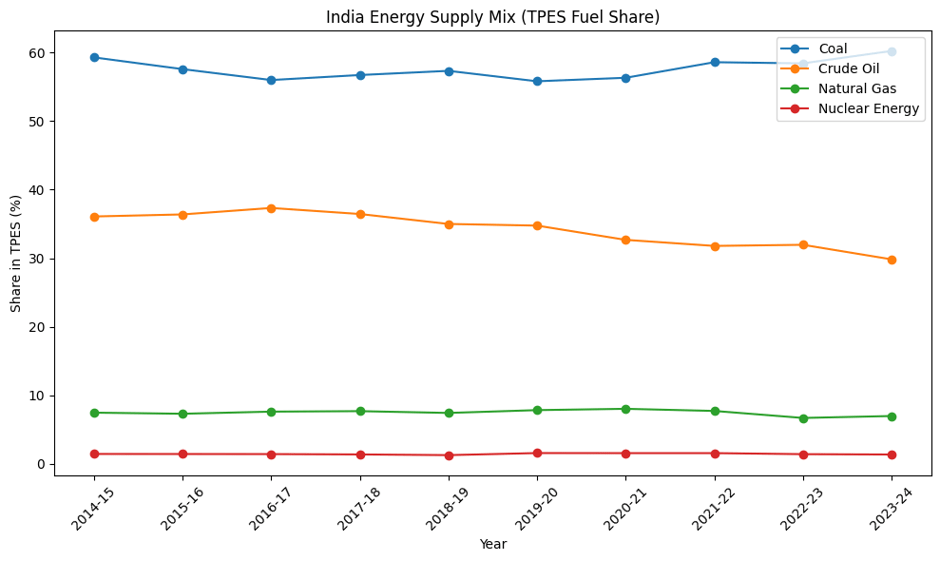
India remains structurally dependent on energy imports, with crude oil import dependency reaching nearly 89 percent in FY 2023–24, alongside significant dependence on natural gas and coal imports. Coal continues to dominate India’s domestic energy structure despite rapid renewable expansion, while rising industrialization, urbanization, and transport demand have sharply increased overall energy consumption. This has deepened India’s exposure to geopolitical disruptions, maritime chokepoints, and global price volatility. Although renewable capacity has expanded significantly, fossil fuels remain central to economic functioning—a condition this paper terms “dual energy dependency,” linking India’s development trajectory to both hydrocarbons and energy transition infrastructure.
Fig. 1: India’s Energy Supply Mix
This disruption has translated into an immediate supply shock in liquefied petroleum gas (LPG) in India, exposing deep structural dependencies within its energy system. The following section analyzes the proximate causes of the crisis, revealing a pattern of calculated escalation rather than unintended confrontation.
Causation: How the Crisis Was Produced
2.1 Iran’s Nuclear Ambitions and Global Security Concerns
A major question raised in contemporary international politics is why Iran’s nuclear ambitions generate significant global concern when several other countries—including the United States, Russia, China, France, the United Kingdom, India, Pakistan, and North Korea—already possess nuclear weapons.
Fig. 2: Trade Route of the Gulf Countries
Three points support this concern. First, Iran’s Supreme Leader has stated that Israel is a “cancerous terror” that must be eradicated, suggesting that while many states developed nuclear weapons for defense, peace, and stability, Iran’s nuclear capability is widely perceived as being oriented against Israel—a concern reinforced by the short flight time of Iranian ballistic missiles to Israeli territory.
Second, even without nuclear weapons, Iran has funded Hezbollah in Lebanon, the Houthis in Yemen, Hamas in Gaza, and militant groups in Syria. Through these alliances, Iran has strategically encircled Israel from multiple directions, a central reason Israel has remained on high alert for more than four decades since 1979.
Third, if Iran and Israel are regional adversaries, why is the United States involved in the conflict? The answer lies in the strategic importance of the Strait of Hormuz, a narrow sea route connecting the Persian Gulf with the Gulf of Oman and the Arabian Sea, and one of the world’s most important oil transit passages.
Strait of Hormuz
↓
Connects the Persian Gulf with the Gulf of Oman and the Arabian Sea
↓
Functions as a Critical Global Maritime Chokepoint
↓
Large Volume of Global Oil and LNG Trade Passes Through the Route
↓
Ensures Energy Supply to Major Import-Dependent Economies
(India, China, Japan, South Korea, and Europe)
↓
Any Conflict, Military Escalation, or Blockade in the Region
↓
Disruption of Global Energy Supply Chains
↓
Rise in Oil and Gas Prices Worldwide
↓
Economic Consequences:
Inflation • Trade Instability • Energy Crisis • Global Market Uncertainty
↓
Increases Strategic Involvement of Major Powers
(United States, China, India, and European Countries)
Fig. 3: Causal Chain from Strait of Hormuz Disruption to Global Economic Consequences
If Iran were to block this route, the entire world’s oil supply would be disrupted: prices would rise, energy supplies would contract, and the risks of global inflation and economic recession would significantly increase. The Strait of Hormuz is therefore not merely a chokepoint but the heartbeat of the global energy system. Should Iran acquire nuclear capability, it could gain substantial strategic influence over the Strait, potentially constraining the ability of even major powers such as the United States to act directly against it. In such a scenario, Iran could use its nuclear capability as an instrument of strategic pressure and geopolitical leverage—one of the principal reasons the United States seeks to restrict Iran’s nuclear program.
2.2 Collapse of Diplomatic Mechanisms
The Joint Comprehensive Plan of Action (JCPOA), signed in 2015 between Iran and the P5+1 countries, aimed to restrict Iran’s nuclear program in exchange for sanctions relief. Iran agreed to limit uranium enrichment and permit international inspections, with the agreement intended to prevent nuclear proliferation and maintain regional stability. However, the United States withdrew from the deal in 2018, triggering renewed sanctions and rising tensions across the Middle East.
2.3 Militarization and Escalation Dynamics
Subsequent geopolitical developments further intensified tensions. In particular, the Twelve-Day War marked a significant shift in regional security dynamics. The conflict—characterized by Israeli strikes on Iranian nuclear and military infrastructure followed by Iranian missile and drone retaliation—normalized the use of calibrated military action as an instrument of strategic signaling and coercive diplomacy.
Simultaneously, growing internal instability within Iran was widely interpreted by external powers as evidence of strategic fragility, encouraging further political and military pressure and reinforcing a cycle of confrontation. The subsequent late-February strikes therefore emerged not as isolated incidents but as part of a broader process of conflict escalation.
2.4 Petrostates and Conflict Theory
The crisis can also be understood through broader theoretical perspectives linking hydrocarbons and interstate conflict. Petrostates—countries in which oil export revenues constitute a substantial share of GDP—have historically shown a higher propensity for militarized interstate disputes (MIDs). Rather than acting solely as defensive targets, many petrostates have themselves pursued aggressive external policies, as illustrated by Iraq’s invasions of Iran and Kuwait, Libya’s incursions into Chad, and Venezuela’s military mobilization against Colombia in 2008.
These cases suggest that the relationship between oil and conflict is not merely one of resource vulnerability but also reflects the strategic behavior of states seeking regional influence, deterrence, and geopolitical leverage through militarized action. Scholarship on oil and revolutionary governments argues that international crises involving oil-producing states are often not accidental but structurally produced through the interaction of revolutionary politics, oil wealth, and aggressive foreign policy behavior. Petrostates are found to engage in militarized interstate disputes at significantly higher rates than non-oil states, because oil revenues increase state autonomy, military capacity, and geopolitical leverage. Revolutionary governments are particularly consequential in this dynamic, as they tend to select risk-acceptant leadership, weaken domestic institutional constraints, and normalize the use of force in foreign policy.
Conclusion
The West Asia energy crisis and its transmission into India’s domestic LPG supply shock cannot be attributed to a single triggering event. Rather, it is the product of a layered causal structure: contested threat perceptions surrounding Iran’s nuclear program, the collapse of the JCPOA and the diplomatic guardrails it once provided, an escalating cycle of calibrated militarization exemplified by the Twelve-Day War, and the structural tendency of petrostates toward militarized interstate disputes. For India, these dynamics converge at the Strait of Hormuz, exposing the vulnerabilities inherent in its dual energy dependency—continued reliance on imported fossil fuels even as renewable capacity expands. Understanding this causal chain is essential for policymakers seeking to insulate India’s energy security from future geopolitical shocks originating in the Gulf region.
References
Arms Control Association. (2025). The Joint Comprehensive Plan of Action (JCPOA) at a glance. https://www.armscontrol.org/factsheets/joint-comprehensive-plan-action-jcpoa-glance
Colgan, J. D. (2010). Oil and revolutionary governments: Fuel for international conflict. International Organization, 64(4), 661–694.
Council on Foreign Relations. (2025). What is the Iran nuclear deal? https://www.cfr.org/backgrounders/what-iran-nuclear-deal
OilPrice.com. (2025, April 21). India’s oil import dependence hits all-time high. https://oilprice.com/Latest-Energy-News/World-News/Indias-Oil-Import-Dependence-Hits-All-Time-High.html
U.S. Energy Information Administration. (2025, June). Amid regional conflict, the Strait of Hormuz remains critical oil chokepoint. https://www.eia.gov/todayinenergy/detail.php?id=65504
U.S. Energy Information Administration. (2025). About one-fifth of global liquefied natural gas trade flows through the Strait of Hormuz. https://www.eia.gov/todayinenergy/detail.php?id=65584
International Energy Agency. (2026). Strait of Hormuz. https://www.iea.org/about/oil-security-and-emergency-response/strait-of-hormuz
Wikipedia. (n.d.). Joint Comprehensive Plan of Action https://en.wikipedia.org/wiki/Joint_Comprehensive_Plan_of_Action
International Energy Agency. (2026, March 21). IEA key facts on the Strait of Hormuz, oil and gas markets, and IEA’s response. Insight EU Monitoring. https://ieu-monitoring.com/editorial/iea-key-facts-on-the-strait-of-hormuz-oil-and-gas-markets-and-ieas-response/908622