
Authors:
Ashutosh Sarkar¹, Shrishti Jangwan², Vatsal Katariya3, Palakpreet Kaurr4, Senthamizh V.5, Md. Rafin Absar6, and Bilal Abdou7
¹ Tribhuvan College, Nalanda University Centre
² University of Delhi
3University of Delhi
4 Sri Guru Gobind Singh College, Chandigarh
5Tamil Nadu Agricultural University
6Patuakhali Science and Technology University
7 AMCE, Nigeria
Abstract
Introduction:
Rapid urbanisation and deteriorating air quality in South Asian megacities have intensified the need for a transition toward sustainable urban mobility. While Electric vehicle (EVs) adoption has been widely examined in developed markets, similar comparative evidence from emerging economies is scarce. This study analyses EV adoption dynamics in two high-pollution capitals (Delhi and Dhaka) to identify city-specific drivers and constraints.
Research Methodology:
Using a comparative mixed-methods approach, the study combines a pilot primary survey data (n = 35) collected from the Delhi NCR region with a secondary qualitative analysis of market trends and policy frameworks in Dhaka. This design enables a contextual comparison between a policy-active EV market (Delhi) and a relatively new one (Dhaka).
Results:
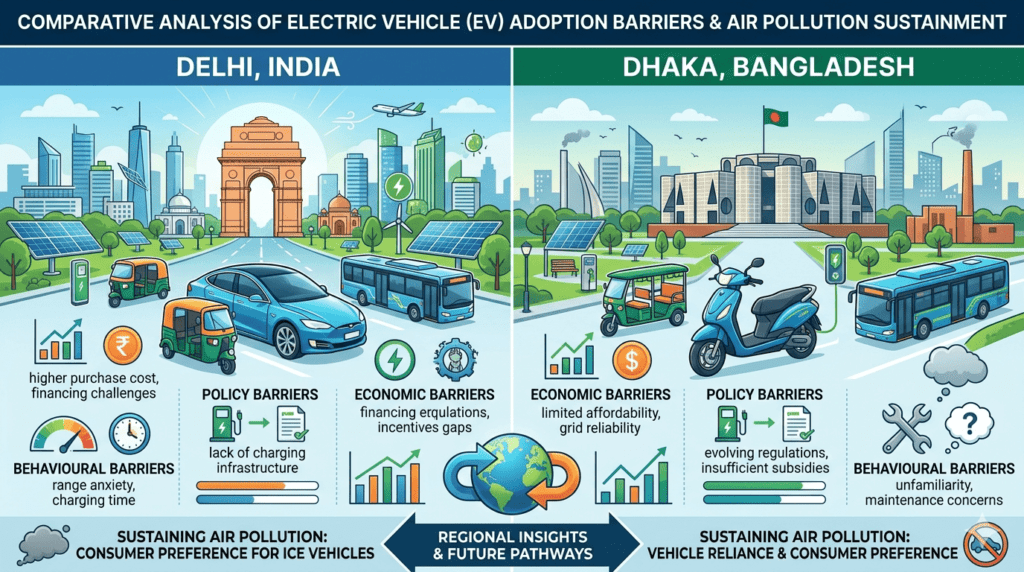
The findings show that environmental awareness functions as a shared foundational driver in both cities; however, adoption pathways diverge significantly. In Delhi, the EV adoption is largely accelerated by strong supply-side incentives and policy interventions, although infrastructure anxiety and preferences for fast-charging networks remain long-term barriers. In contrast, Dhaka exhibits a strong potential interest driven by social influence and environmental concern, but adoption remains constrained due to limited policy support and the absence of fiscal incentives.
Conclusion:
The study concludes that while relatively mature markets require expanded charging density and reliable after-sales ecosystems to sustain growth, early-stage markets such as Dhaka require foundational policy structuring alongside targeted consumer awareness strategies. These findings offer evidence-based insights for aligning environmental objectives with local consumer/on-ground realities in developing urban contexts.
Keywords: Electric Vehicles; Sustainable Urban Mobility; Consumer Perception; Comparative Analysis; Delhi; Dhaka
Introduction
Air pollution is a pressing environmental issue in South Asian megacities due to the rapid pace of urbanisation and the consequent reliance on fossil fuels, which has led to the deterioration in air quality (World Health Organisation [WHO], 2021). With the increasing use of motorised mobility, transport-related emissions have become a critical concern for both environmental sustainability and public health. As such, Electric Vehicles (EVs) are increasingly promoted as a cleaner alternative to internal combustion engine vehicles, especially in megacities with high population densities where road transport is a major source of pollution (Rahman et al., 2025).
Governments in the region have increasingly turned to the strategy of electrification. In the case of Delhi, the adoption of EVs is recognised as a policy tool for enhancing environmental quality (Government of NCT of Delhi, 2020). Similarly, there is an increasing discourse on cleaner transport in Bangladesh, where concerns over fossil fuel dependence have intensified (Hasan et al., 2025). However, despite these policy aspirations, actual adoption has remained limited. Empirical studies indicate that the mere availability of technology is not sufficient to initiate behavioural change, as adoption is shaped by a complex set of economic, infrastructural, and social factors (Rahman et al., 2025).
Existing literature tends to focus on quantitative issues such as cost and infrastructure, but often neglects the lived realities of urban residents (Hasan et al., 2024). Yet comparative analyses between Dhaka and Delhi remain limited. In this context, the present study proposes to use a mixed-methods approach. By combining primary survey data from Delhi NCR with secondary data from both cities, this study investigates the role of infrastructural limitations, economic realities, and the “dirty grid” controversy in shaping the transition to electric mobility in these high-pollution megacities.
Literature Review
Introduction: Approaching electrification – The Decarbonization Dilemma in South Asia.
The electric mobility or the transformation worldwide is predominantly shaped by Global North paradigms, which most often focus on the macro issues that persist globally – Climate Change, Green investments, Policy shift and related factors. Consequently, this Eurocentric framework frequently obscures what’s going on at the micro level, which ultimately decides what shape it takes at a broader scale.
In this study, we aim to analyse the limitations that middle- or lower-income countries, such as India, Bangladesh, and others in the Global South, often face and are often ignored. Research indicates that while both cities face catastrophic air quality crises—Delhi frequently topping global pollution charts (SAFAR, 2024) and Dhaka following closely (World Bank, 2023)—the pathways towards electrification are quite different in these distinct spheres.
This review synthesises existing literature to examine the environmental efficacy, economic viability, and policy maturity of Electric Vehicle (EV) adoption in these two distinct South Asian contexts.
Theoretical Framework: Innovation Diffusion and Behavioural Economics
- To situate the high rates of comparative adoption between Delhi and Dhaka, this study draws on Everett Rogers’ (Rogers, 2003) Diffusion of Innovations in conjunction with the principles of Behavioural Economics. Rogers’ model classifies markets according to the extent of their adoption or adoption maturity. Dhaka is the “pre-diffusion” stage since all consumer intentions are dependent upon a social influence and value-based perception as opposed to experience. In contrast, driven by new, aggressive demand-side policy interventions, Delhi is shifting into the “early majority” phase.
- Behavioural Economics relates closely to the idea of ‘Bounded Rationality’ (Simon, 1955) and ‘Loss Aversion’ (Kahneman & Tversky, 1979) and thus can be used as an important additional angle from which to explore consumer hesitancy. As an example, Delhi-based empirical studies show that the impact of ‘Infrastructure Anxiety’ will deter consumers more so than the actual battery range limitation. Consumers place disproportionate weighting on the potential ‘loss’ associated with being stranded (i.e. not being able to align battery charge with available infrastructure) relative to the statistical likelihood of requiring an additional charge mid-trip. Thus, consumer adoption decisions are shaped by both psychological heuristics and rational economic calculations. Following the dual application of these theoretical lenses, the next section of this report will assess the barriers to EV adoption across three primary domains: environmental efficacy, economic viability, and policy frameworks.
Environmental efficacy: The “Dirty Grid” Debate
A very prominent theme in recent literature which often highlights the “net environmental benefit” of EVs in regions that are still highly dependent on fossil fuel-based power grids. To critically assess this, the literature must balance opposing life-cycle assessments (LCA).
-
The Opposing Viewpoint: Carbon Debt and Emission Displacement:
Sceptics of rapid electrification argue that the carbon intensity of battery manufacturing, combined with an intensive reliance on fossil fuel-based power grids, negates the environmental benefits that EVs were designed to offer. The core argument from this perspective is that in coal-dominant energy mixes, EVs merely displace emissions from the tailpipe to the smokestack, creating an initial “carbon debt” that requires significant mileage to offset (Qiao et al., 2019).
-
The Proponent Counterargument: Net Life-Cycle Reductions:
Conversely, comprehensive LCAs counter the point of view of the “dirty grid” argument. The ICCT Global Vehicle LCA White Paper (Bieker, 2021) explicitly estimates this for the Indian context. It clearly states that, even if the power grids in India heavily rely on coal, Battery Electric Vehicles (BEVs) emit 19%–34% less life-cycle Greenhouse Gases (GHG) compared to internal combustion vehicles. This shows that the carbon debt created during manufacture quickly becomes irrelevant; electric powertrains are simply so much more efficient than their ICE equivalents.
-
Comparative Grid Impact:
When comparing the two neighbouring South Asian Capitals, different environmental priorities emerge. In Delhi’s case, while coal is being used heavily to power the grid, the vehicular emissions account for much of this (~41% of the PM2.5 burden in Delhi – TERI & ARAI, 2018), meaning eliminating localised tailpipe emissions is an urgent public health priority with higher priority than upstream grid issues.
On the other hand, Dhaka’s dependence on natural gas (approximately 60% of all generation) can be seen to have a lower carbon debt than coal-based generation (World Bank, 2025). However, the literature reflects a very different scenario in environmental priorities from Delhi. In Dhaka, brick kilns and construction dust are identified as the prominent contributors to PM2.5, accounting for 19%, thereby exceeding transport emissions (12-15%) (Raza et al., 2023). Consequently, the immediate political and environmental urgency for EV adoption appears to be diminished or less prominent in Dhaka.
The Economic Barrier: The persistent gap between the actual cost and the financing
Economic feasibility remains the primary hurdle for the adoption of electric vehicles (EVs) across South Asia.
-
The High Upfront Cost:
Analysis by the Council on Energy, Environment and Water (Singh et al., 2020) indicates that the upfront purchase cost of mass-market electric vehicles in India remains approximately 25-30% higher than their internal combustion counterparts, primarily due to the battery costs, which constitute nearly 40% of the vehicle’s value. On the other hand, in Dhaka, the disparity is significantly higher due to the wider fiscal policies of the government. The Bangladesh Automobile Industry Development Policy (2021) reveals a protectionist approach when it comes to EVs, by putting import duties on electric vehicles (approx. 89%, which are maintained to incentivise local assembly, reflecting a sharp contrast to Delhi’s approach of a subsidy-driven model.
-
Financing Risks:
CEEW’s report Financing India’s Transition (Singh et al., 2020) identifies a critical “capital gap”, It primarily highlights that the financial institutions in the region, are hesitant to disburse loan amount, as they see EV as a high risk assets, which has resulted to interest rates that are 200–300 basis points (2–3 percentage points) higher than for petrol vehicles, highlighting a major financial exclusion, seen in both Delhi & Dhaka, thus effectively locking/ blocking the ‘middle class who rely on loans to purchase cars.
The Policy Framework Approach: Subsidies/ Incentives vs Penalties
A thorough review of the literature reveals a stark contrast in the policy approach between Delhi and Dhaka.
-
Delhi’s aggressive subsidy provision:
The Delhi Electric Vehicles Policy (2020) is widely cited as a benchmark for demand-side incentives. Key subsidy provisions include (e.g. ₹30,000 for two-wheelers, additionally ₹5,000 if an old BS‑II/BS‑III petrol two‑wheeler is scrapped, for three-wheelers). Purchase Incentives are around 20% reduction in upfront cost through subsidies, a “Single-Window” facility for installing private chargers at a nominal cost (DDC Delhi, 2022), and a strict target of 25% EV contribution to new registrations by 2024, etc.
-
Bangladesh’s manufacturing conundrum:
Conversely, literature on Bangladesh’s policy indicates a supply-side focus. The Bangladesh Automobile Industry Development Policy (2021) primarily prioritises local manufacturing, offering 5–10-year tax holidays for electric vehicle assembly plants to encourage domestic production. However, unlike Delhi’s model, it lacks direct demand-side interventions; there are no direct cash subsidies for consumers to offset the high upfront cost of EVs (The Financial Express, 2025; UNCTAD, 2024). This creates a distinct ‘Policy Gap’ where the infrastructure for making EVs is encouraged, but the financial incentive for buying them remains absent for the end-user.
The Consumer Behaviour: Psychological and infrastructure challenges
Consumer behaviour, apart from superficial economics, plays a pivotal role.
-
Infrastructure Anxiety:
(Dadwal et al. 2025) demonstrate through empirical analysis in Delhi-NCR that “Infrastructure Anxiety”—the fear of not finding a charger—is a stronger ‘show stopper’ than the actual range of the vehicle. This is further corroborated by (Kumar & Jaiswal, 2025); Consumer behaviour is not solely driven by economics or technology but also influenced by social and psychological factors, peer influence, word-of-mouth experiences, and media narratives, which play crucial roles in shaping opinions.
-
The Dhaka Reality:
While reviewing the secondary literature sources, Dhaka poses a unique contrast to the Delhi dilemma, which is unlike Delhi, which has a more stable and reliable grid electricity supply; Dhaka’s problem is “Load Shedding” (power reliability)- (World Bank, 2025). This adds a new dimension of anxiety and trust issues. It also states that this costs Bangladesh an approximate loss of about $3.3 billion annually. Hence, the fear in Dhaka is not about finding a charger at the right moment, but additionally, whether the charger will have power; that’s the concern, ultimately stopping potential candidates from opting for EVs.
Identification of Research Gap
EV adoption has been widely studied from a macroeconomic perspective (e.g., NITI Aayog; CEEW) as well as from a supply-side policy perspective within Bangladesh (World Bank, 2025). However, there is very little comparative micro-level analysis between the two capitals, and studies have largely viewed South Asia as a homogeneous region without an appreciation of differences in policy maturity and electricity grid dynamics. To fill this gap, this project transitions from macro-level literature to micro-level consumer experiences. Using a mixed-methods approach that triangulates both primary pilot survey data from Delhi NCR and secondary qualitative evidence from Dhaka, this research will attempt to link the above theoretical barriers (environmental efficacy, infrastructure anxiety, and capital gaps) with consumer adoption intentions at the ground level.
Methodology
Study Design
This study employed a comparative two-city design using a mixed-evidence approach to examine barriers and drivers of electric vehicle (EV) adoption in Delhi NCR (India) and Dhaka (Bangladesh). Primary pilot survey data were available for Delhi NCR, while both cities were supported by secondary data. The Dhaka case relied exclusively on secondary sources due to the absence of primary data.
Study Areas
Delhi NCR and Dhaka were selected as representative South Asian megacities experiencing rapid urbanisation, severe air pollution, and increasing pressure to adopt sustainable transport solutions. Despite contextual similarities, the two cities differ in EV market maturity, policy support, and infrastructure readiness, enabling meaningful comparative analysis.
Data Sources
Primary Data (Delhi NCR)
To assess micro-level consumer sentiment, an exploratory cross-sectional survey was undertaken online with target consumers from the urban area of Delhi NCR, yielding a purposive pilot sample of 35 valid survey responses whose representativeness may be limited by the relatively small sample size (n=35) and therefore limit further statistical generalization; however, the purpose of using this pilot data is specifically as qualitative data source for ‘early adopters’ sentiment and behavioural heuristics. This data is significantly strengthened through the use of multiple triangulation techniques to establish validity and reliability. The micro-level trends from the primary survey (i.e., anxiety over infrastructure and aversion to upfront costs) were also validated through a systematic comparison of the results of the primary survey with macro-level secondary databases maintained by the Government of India, the VAHAN Vehicle Registration Database and market analyses performed by CEEW (Council on Energy, Environment and Water). This triangulation will allow the researcher to have greater confidence that an empirical basis has been established to support the exploratory consumer insight data obtained in the primary survey.
Secondary Data (Delhi NCR and Dhaka)
Secondary data were collected from government reports, policy documents, market statistics, and peer-reviewed academic studies. For Delhi NCR, secondary data were used to contextualise or verify survey findings and examine policy frameworks, infrastructure availability, and adoption trends. For Dhaka, secondary data provided insights into the EV adoption environment, including consumer perception, policy readiness, and infrastructural constraints, based on published empirical studies and official sources.
Analytical Framework
Comparative Analytical Framework: The analysis employs mixed-methods data to evaluate two megacities through three established comparison criteria, which maintain both structured assessment and objective assessment, and theoretical assessment.
Policy Maturity & Fiscal Intervention: The comparison between Delhi’s comprehensive demand-side subsidy system, which includes direct consumer cash transfers and tax waivers, and Dhaka’s early-stage supply-side protectionist system, which uses import duties to promote local assembly without providing consumer advantages, needs to be examined through Policy Maturity & Fiscal Intervention.
Infrastructural Readiness & Grid Constraints: Contrasting Delhi’s expanding fast-charging network, and the associated psychological “infrastructure anxiety, with Dhaka’s foundational grid stability issues that result from load shedding, which damages consumer confidence.
Socio-Behavioural Perception: The study examines how environmental awareness and capital gap perception affect adoption intentions in the active “early majority” market of Delhi compared to the “pre-diffusion” market of Dhaka.
The goal of this study is to go beyond simply describing barriers by providing a standardised way to compare three specific areas (consumer, infrastructure and policy regulators). Through systematically isolating these three types of barriers for analysis, it can be shown how the differing levels of infrastructure across the Global South create different transition pathways for consumers’ EV adoption.
Comparative Analysis
-
Policy Maturity and Fiscal Intervention
The two cities of Delhi and Dhaka present two different paths that affect how electric vehicles reach their full market potential while determining how much money customers will spend to use these vehicles. The demand-side intervention system in Delhi operates at its highest level of development. The Delhi Electric Vehicles Policy (2020) aggressively targeted the ‘capital gap’ by offering direct financial incentives, such as purchase subsidies (up to ₹1,50,000 for four-wheelers) and the waiver of road tax and registration fees. The active market intervention process guides customers into the ‘early majority’ stage because it creates an artificial decrease in total ownership costs, which compares with conventional internal combustion engine vehicles.
Dhaka develops its policy framework through two basic elements: its existing policy framework and its focus on supply-side solutions. The current intervention methods use protectionist approaches, which impose extremely high import taxes on completely built electric vehicles to promote domestic assembly (The Financial Express, 2025). The absence of demand-side financial triggers in Dhaka creates an unbreakable capital barrier that prevents the market from moving beyond its current ‘pre-diffusion’ stage, where most people cannot afford to adopt new technology despite their environmental knowledge.
-
Infrastructural Readiness and Grid Constraints
The two megacities have different consumer behaviour patterns because their infrastructure systems create unique limitations. The government programs in Delhi and the surrounding NCR area have achieved success by developing public fast-charging networks through their state-sponsored initiatives. The survey data show a behavioural contradiction because consumers suffer from severe ‘infrastructure anxiety’ even though physical infrastructure has expanded. This barrier exists because of a psychological blockage instead of a direct absence of charging stations. Consumers maintain adoption resistance because they excessively worry about the rare chance that their batteries will run out while travelling. The data shows that Delhi’s main problem today exists because people lack confidence in the current infrastructure system, which they already possess.
Dhaka needs to address its basic macro-grid limitations. The national grid system provides a structural and long-term obstacle because it has experienced load-shedding problems throughout its history while depending on natural gas resources (World Bank, 2025). The introduction of high-draw EV charging networks in Dhaka creates an actual risk that will disrupt grid operations. The public trust in electric vehicles’ operational capacity decreases because grid systems do not work properly, which creates challenges for users to pay for electric vehicles even when they successfully overcome their financial obstacles and have environmental awareness.
-
Socio-Behavioural Perception and Environmental Urgency
The secondary evidence demonstrates that urban consumers from both capitals understand the serious public health emergency that PM2.5 pollution creates. However, the two cities show different levels of consumer purchasing intent because their pollution situations differ. In Delhi, approximately 41% of the local PM2.5 pollution originates from vehicle emissions, according to the study conducted by (TERI & ARAI, 2018). State policies that align with consumer environmentalism determine public health needs because transportation pollution is the main environmental threat.
The socio-behavioural need for Dhaka residents to switch to electric vehicles shows some decrease because of the present situation between the city and its emission sources. Literature indicates that, unlike Delhi, brick kilns and construction dust function as the primary contributors to PM2.5 in Dhaka, accounting for 19% of the burden and thereby exceeding transport emissions (~ 15%). The environmental advantage that consumers achieve through EV adoption shows that it has environmental advantages, but the desire to decrease emissions, which exists in this study, gets defeated by the requirement to make initial capital investments, which leads to a delay in market growth, according to the findings from existing research.
Results
Delhi NCR – Primary Survey Data
This subsection presents the findings from the primary pilot survey conducted in Delhi NCR (n = 35). The analysis summarises respondents’ attitudes, perceptions, and intentions regarding electric vehicle (EV) adoption. Descriptive statistics, including frequencies and percentages, were used to analyse responses to the 18 mandatory survey questions. Optional open-ended questions were excluded from the quantitative analysis and were used only to support interpretation.
Table 1 presents the detailed distribution of responses across all survey questions, highlighting key perceived barriers and drivers influencing EV adoption in Delhi NCR.
Q1. What best describes your current attitude toward electric vehicles (EVs)?
| Response | Frequency | % |
| Interested but uncertain | 17 | 48.6 |
| Neutral | 8 | 22.9 |
| Interested and planning to buy | 6 | 17.1 |
| Already own an EV | 3 | 8.6 |
| Not interested | 1 | 2.9 |
Q2. What type of electric vehicle would you be most interested in purchasing?
| Response | Frequency | % |
| Two-wheeler | 10 | 28.6 |
| Both | 5 | 14.3 |
| Four-wheeler (car) | 18 | 51.4 |
| Not interested in either | 2 | 5.7 |
Q3. How did you first become aware of electric vehicles?
| Response | Frequency | % |
| Online/social media | 14 | 40 |
| Automobile dealers | 2 | 5.7 |
| Pollution control | 1 | 2.9 |
| Newspapers / TV / digital media | 9 | 25.7 |
| Government programs or awareness campaigns (e.g., Delhi EV Policy) | 3 | 8.6 |
| Someone I know purchased an EV | 6 | 17.1 |
Q4. Have you used or regularly encountered electric vehicles in daily life?
| Response | Frequency | % |
| Personal use | 6 | 17.1 |
| Ride-hailing services (Uber/Ola EVs) | 13 | 37.1 |
| E-rickshaws | 23 | 65.7 |
| Food or grocery delivery vehicles | 11 | 31.4 |
| Public transport | 13 | 37.1 |
| Not at all | 2 | 5.7 |
Q5. How high is the upfront cost of EVs in discouraging you from purchasing?
| Response | Frequency | % |
| Very significant | 8 | 22.9 |
| Somewhat significant | 17 | 48.6 |
| Not significant | 7 | 20.0 |
| Not applicable | 3 | 8.5 |
Q6. How do you evaluate the long-term operating cost of EVs compared to petrol/diesel vehicles?
| Response | Frequency | % |
| EVs are significantly cheaper to operate | 10 | 28.6 |
| Slightly cheaper | 11 | 31.4 |
| About the same | 4 | 11.4 |
| More expensive | 6 | 17.1 |
| Not sure | 4 | 11.4 |
Q7. Do concerns regarding servicing centres and trained technicians affect your trust in EVs?
| Response | Frequency | % |
| Yes | 29 | 82.9 |
| No | 6 | 17.1 |
Q8. How confident are you about EV maintenance and servicing availability in your area?
| Response | Frequency | % |
| 1 | 5 | 14.7 |
| 2 | 7 | 20.6 |
| 3 | 15 | 44.1 |
| 4 | 5 | 14.7 |
| 5 | 2 | 5.9 |
Q9. What best describes your residential and mobility status?
| Response | Frequency | % |
| Permanent resident of Delhi NCR | 15 | 42.9 |
| Migrant resident primarily using local transport | 7 | 20 |
| Migrant resident with frequent inter-state travel | 5 | 14.3 |
| Frequent inter-state commuter (work/family/other reasons) | 5 | 14.3 |
| I live in Delhi, but travel at least 100k | 1 | 2.9 |
| I am a permanent resident of Delhi | 1 | 2.9 |
| Student of DU | 1 | 2.9 |
Q10. How adequate do you find the public charging infrastructure in Delhi NCR?
(1 = Very inadequate, 5 = Very adequate)
| Rating | Frequency | % |
| 1 | 3 | 8.6 |
| 2 | 8 | 22.9 |
| 3 | 16 | 45.7 |
| 4 | 6 | 17.1 |
| 5 | 2 | 5.7 |
Q11. Can your current residence support private EV charging?
| Response | Frequency | % |
| Yes, individual house | 7 | 20 |
| Yes, apartment/multistorey building with provision | 5 | 14.3 |
| No, but it could be arranged | 9 | 25.7 |
| No, not feasible | 9 | 25.7 |
| Not sure | 5 | 14.3 |
Q12. How optimistic are you about EV driving range compared to fuel vehicles?
| Response | Frequency | % |
| Very confident | 3 | 8.6 |
| Somewhat confident | 20 | 57.1 |
| Not sure | 6 | 17.1 |
| Not confident | 5 | 14.3 |
| Range varies wildly based on driving style | 1 | 2.9 |
Q13. To what extent do you believe EVs can help reduce air pollution in Delhi?
| Response | Frequency | % |
| To a great extent | 13 | 37.1 |
| To some extent | 13 | 37.1 |
| To a limited extent | 8 | 22.9 |
| Not at all | 1 | 2.9 |
| Not sure | 0 | 0 |
Q14. How well do you understand government policies related to EV adoption?
| Response | Frequency | % |
| Very well | 4 | 11.4 |
| Moderately | 18 | 51.4 |
| Poorly | 11 | 31.4 |
| Not at all | 2 | 5.7 |
Q15. Which government policy aspects influence your confidence in adopting EVs the most?
| Response | Frequency | % |
| Purchase subsidies | 16 | 45.7 |
| Charging incentives | 16 | 45.7 |
| Tax exemptions | 22 | 62.9 |
| Clear and stable long-term EV policy commitment | 16 | 45.7 |
| Support for battery technology and recycling | 10 | 28.6 |
| Support for EV manufacturing and domestic supply chains | 7 | 20 |
| Regulations on petrol/diesel vehicles (restrictions, phase-out timelines) | 13 | 37.1 |
| Public awareness and information campaigns | 9 | 25.7 |
| Enforcement and reliability of policy implementation | 5 | 14.3 |
| Not sure / policy does not influence my decision | 3 | 8.6 |
| I bought an EV because I have a lot of travel, so the low running costs of EVs make the most sense even without government support. But for the public at large, rest would apply | 1 | 2.9 |
| I am not aware of govt policies related to EVs. | 1 | 2.9 |
Q16. What are the main reasons you have not yet purchased an EV?
| Response | Frequency | % |
| High cost | 11 | 31.4 |
| Charging concerns | 17 | 48.6 |
| Maintenance/servicing issues | 16 | 45.7 |
| Range anxiety | 11 | 31.4 |
| Inter-state travel needs | 10 | 28.6 |
| Lack of trust in technology | 7 | 20 |
| Policy uncertainty | 3 | 8.6 |
| Not suitable for my lifestyle | 7 | 20 |
| I already own an electric vehicle | 4 | 11.4 |
Q17. Overall, how do you view the future of EV adoption?
| Response | Frequency | % |
| Very positive | 7 | 20.0 |
| Somewhat positive | 18 | 51.4 |
| Neutral | 9 | 25.7 |
| Negative | 1 | 2.9 |
| Very Negative | 0 | 0 |
Q18. What improvements would most encourage you to adopt an EV?
| Response | Frequency | % |
| Lower upfront prices | 17 | 48.6 |
| Better charging infrastructure | 26 | 74.3 |
| More servicing centres and trained technicians | 21 | 60 |
| Clear long-term government policy | 16 | 45.7 |
| Better battery technology | 18 | 51.4 |
| Stronger assurance of environmental impact | 16 | 45.7 |
| Better charging speeds at both the charger and the car. | 1 | 2.9 |
| More manufacturers, apart from Mahindra, Tata, and MG, are in the budget EV segment | 1 | 2.9 |
| Marketing correcting petrol-biased car enthusiasts | 1 | 2.9 |
Delhi NCR – Secondary Data Results
Secondary data provide a comprehensive overview of the current status of electric vehicle (EV) adoption in Delhi NCR, highlighting adoption trends, market structure, infrastructure availability, and policy implementation gaps (Ministry of Road Transport & Highways, 2024; Government of India, 2023).
EV Adoption Trends
Official registration statistics indicate a rapid increase in EV adoption in Delhi over recent years. Cumulative EV registrations rose from 12,377 vehicles in 2020 to 164,831 vehicles by December 2023, reflecting accelerated uptake following the introduction of targeted EV policies and incentives (Government of India, 2023; Times of India, 2024). Despite this growth, adoption remains uneven across vehicle categories.
EV Penetration by Vehicle Segment
Secondary data show that EV penetration in Delhi NCR varies significantly by vehicle type. EVs accounted for 11.78% of new vehicle registrations in 2023–24. Adoption levels are highest in commercial and public transport segments, including passenger three-wheelers (86%), goods three-wheelers (77%), electric buses (57%), and electric cabs (38%). In contrast, adoption among private vehicles remains limited, with electric private cars representing only 3.03% of new registrations and electric personal two-wheelers 9.84% (Government of NCT of Delhi, 2023; Switch Delhi, 2024). These figures highlight a pronounced gap between commercial and private EV adoption.
Market Structure of Registered Vehicles
Vehicle registration data further confirms the low penetration of EVs within the private vehicle fleet. Battery electric vehicles constitute only 0.11% of registered four-wheelers and 0.19% of registered two-wheelers, while a comparatively higher share (28.8%) is observed among three-wheelers (VAHANSEWA, 2022). This distribution underscores the reliance of EV adoption on shared and commercial mobility models rather than private ownership.
Charging Infrastructure Availability
Delhi has made notable progress in expanding EV charging infrastructure. As of the latest available data, the city hosts 1,919 charging stations, 2,452 charging points, and 232 battery-swapping stations, reflecting active public-sector support for infrastructure deployment (Government of NCT of Delhi, 2024; Switch Delhi, 2024). However, secondary assessments indicate persistent challenges, particularly the limited availability of fast-charging infrastructure for four-wheelers and governance constraints affecting private investment (Rather et al., 2022).
Policy Targets and Implementation Gaps
The (Delhi Electric Vehicle Policy, 2020) set a target of 25% of all new vehicle registrations to be battery electric vehicles by 2024. Current adoption levels fall short of this goal, with overall EV penetration reaching 11.78% of new registrations in 2023–24 (Government of NCT of Delhi, 2020; Government of NCT of Delhi, 2023). Identified policy limitations include the absence of mandatory investment obligations for distribution companies, an overemphasis on slow charging solutions, and limited integration with renewable energy systems, which may partially explain slower adoption among private vehicle owners (Electric Vehicle Charging Infrastructure and its Grid Integration in India, 2022).
Dhaka – Secondary Data Results
Secondary data were used to examine consumer perceptions and key determinants of electric vehicle (EV) adoption in Dhaka, Bangladesh, where the EV market remains at an early, pre-diffusion stage (Hasan, 2025).
Stage of EV Adoption
Evidence from recent empirical research indicates that EV adoption in Dhaka is still nascent, with minimal market penetration and limited real-world exposure among consumers (Hasan, 2025). Unlike contexts where EVs are already visible on roads, Bangladeshi consumers largely rely on conventional and reconditioned vehicles, shaping perceptions based on expectations rather than experience (Rahman et al., 2025; Khaled et al., 2024).
Determinants of EV Adoption Intention
Quantitative findings from a cross-sectional survey of 200 private car owners in major urban areas, including Dhaka, reveal that several perceptual factors significantly influence EV adoption intention. Perceived Usefulness, Perceived Ease of Use, Perceived Value, Social Influence, and Environmental Concern was identified as statistically significant positive predictors of adoption intention (Hasan, 2025). In contrast, Perceived Cost demonstrated a significant negative relationship, indicating strong price sensitivity among potential adopters (Hasan, 2025; Khaled et al., 2024).
Role of Charging Infrastructure
Interestingly, Perceived Infrastructure Availability did not show a statistically significant direct effect on EV adoption intention in the Dhaka context (Hasan, 2025). This finding suggests that, at the current early stage of market development, consumers’ intentions are shaped more by perceived benefits, costs, and social and environmental considerations than by practical infrastructure concerns. This may reflect limited consumer familiarity with EV ownership rather than satisfaction with existing infrastructure (Hasan, 2025; Kumar & Jaiswal, 2025).
Explained Variance in Adoption Intention
The structural model employed in the secondary study explains 68.5% of the variance in EV adoption intention, indicating a strong explanatory power of perceptual and socio-psychological factors in shaping consumer intentions in Dhaka (Hasan, 2025).
Summary of Secondary Findings
Overall, secondary evidence suggests that EV adoption intention in Dhaka is primarily driven by perceived benefits, social influence, and environmental awareness, while high perceived cost remains a critical barrier. The limited role of infrastructure perceptions reflects the early diffusion phase of EVs in Bangladesh, where adoption intentions are formed largely without direct experience (Hasan, 2025; Rahman et al., 2025).
Discussion
This study examined the barriers and drivers of electric vehicle (EV) adoption through a mixed-evidence approach, combining primary survey data from Delhi NCR with secondary evidence from Delhi NCR and Dhaka. The findings provide insights into how market maturity, policy support, and contextual factors shape EV adoption across two South Asian megacities.
Contextualising Empirical Findings within Behavioural Theory
The empirical data gathered from the Delhi NCR pilot survey (n=35) directly aligns or corroborates with the theoretical frameworks established in the literature. It is evident that while the mathematical range capabilities of modern EVs comfortably exceed the average urban daily commute, a significant proportion of respondents still identified charging availability as a primary deterrent. The study shows how Simon’s 1955 theory of Bounded Rationality and Kahneman and Tversky’s 1979 theory of Loss Aversion function in real-world situations. The Delhi early majority group demonstrates infrastructure anxiety because they perceive battery depletion risks as more serious than actual commuting needs. The operational adoption of Delhi and the operational resistance of Dhaka show the Rogers Diffusion of Innovations model through their respective patterns of technology adoption. The Dhaka market remains in its pre-diffusion state because its policies do not include the necessary demand-side financial incentives, which would help people overcome their typical decision-making patterns, unlike the Delhi operational model.
Cost as a Persistent Barrier Across Contexts
Across both Delhi NCR and Dhaka, cost-related concerns emerged as a dominant barrier to EV adoption. Survey results from Delhi NCR indicate that a majority of respondents perceive upfront cost as a significant deterrent, despite recognising the lower long-term operating costs of EVs. This perception aligns with secondary evidence from Dhaka, where perceived cost is negatively associated with adoption intention (Hasan, 2025). These findings are consistent with prior studies highlighting affordability as a key constraint in emerging markets, where price sensitivity remains high, and purchase decisions are strongly influenced by upfront expenditure rather than lifecycle cost considerations (Adsule & Manoj, 2023; Dadwal et al., 2025).
Infrastructure and Range Concerns: Context Matters
In Delhi NCR, both primary and secondary findings indicate that charging infrastructure and range anxiety remain critical barriers, particularly for private vehicle owners. Moderate ratings of charging adequacy in the survey are consistent with secondary assessments identifying limited fast-charging availability and governance challenges in infrastructure deployment (Government of NCT of Delhi, 2024). In contrast, secondary evidence from Dhaka suggests that perceived infrastructure availability does not significantly influence adoption intention at the current stage of market development (Hasan, 2025). This divergence can be explained by the pre-diffusion stage of EVs in Dhaka, where consumers’ intentions are shaped more by abstract perceptions and expected benefits than by practical ownership considerations.
Policy Support and Uneven Adoption Outcomes
Delhi’s relatively advanced EV policy framework has contributed to measurable growth in EV registrations, particularly in commercial and public transport segments. However, the low penetration of EVs among private cars demonstrates a clear policy–implementation gap, where incentives and infrastructure expansion have not fully translated into widespread private adoption (Government of NCT of Delhi, 2023; VAHANSEWA, 2022). In Dhaka, the absence of a similarly comprehensive and stable policy framework further constrains adoption, reinforcing the importance of long-term policy clarity and regulatory commitment in shaping consumer confidence (Hasan, 2025; Rahman et al., 2025).
Environmental Awareness as a Supporting Driver
Environmental concern emerged as a consistent positive driver across both contexts. In Delhi NCR, survey respondents largely agreed that EVs can contribute to reducing air pollution, reinforcing the city’s strong environmental narrative. Similarly, secondary studies from Dhaka identify environmental concern as a significant positive predictor of adoption intention (Hasan, 2025). However, environmental motivation alone appears insufficient to overcome economic and infrastructural barriers, suggesting that awareness campaigns must be accompanied by tangible financial and logistical support.
Market Structure and Adoption Pathways
The findings reveal distinct adoption pathways in the two cities. Delhi’s EV growth has been driven primarily by commercial and shared mobility segments, while private vehicle adoption lags. Dhaka, by contrast, remains at an early stage where adoption intentions are influenced more by perceptions than experience. This comparison suggests that EV diffusion in developing megacities may follow a phased trajectory, beginning with commercial fleets and public transport before expanding into private ownership as costs decline and infrastructure matures.
Implications for Policy and Practice
The comparative findings highlight the need for context-sensitive EV strategies. In Delhi NCR, policy efforts should prioritise accelerating private as well as public vehicle adoption through targeted incentives, fast-charging expansion, and improved after-sales support. In Dhaka, early-stage interventions should focus on cost reduction mechanisms, consumer education, and pilot infrastructure projects to translate positive intentions into actual adoption.
Limitations of the Study
While our study covers critical issues about the long-standing constraints in EV adoption in two of South Asia’s two major economic hubs/ Capitals. There are three lacking aspects that must be noted. First, the primary data collection about Delhi and the surrounding NCR region was limited to only (n=35), due to time, location and resource constraints; consequently, as many belong to different locations of the country and around the world.
Second, due to logistical constraints, the analysis for Dhaka relied exclusively on secondary data, preventing a direct statistical comparison of consumer sentiment between the two cities.
The third limitation is about constraining or limiting the study solely to the metropolitan region of these two South Asian regions, and consequently, the findings regarding infrastructure anxiety and grid reliability may not be generalizable or common to rural or semi-urban contexts in India and Bangladesh, which may possess entirely different mobility demands and power grid dynamics.
Conclusion and Strategic Policy Recommendations
This study provides a comparative assessment of electric vehicle (EV) adoption in Delhi NCR and Dhaka by integrating primary survey evidence with macro-level secondary data. The findings establish that while cost remains a prominent constraint across these contexts, infrastructure limitations, service gaps, and behavioural uncertainties interact to produce a multi-layered barrier structure depending upon the development or maturity that these specific regions have been able to reach.
To accelerate sustainable adoption, policymakers must transition from generic decarbonization goals to targeted, context-specific interventions. Based on these comparative findings, this study proposes the following strategic recommendations:
For Maturing Markets (The Delhi Model):
-
Shift to Infrastructure-Led Interventions:
As the market firmly enters the ‘early majority’ phase, it should be that the state expenditure must pivot away from direct consumer purchase subsidies toward targeted investment in fast-charging corridors. Mandating the integration of residential and workplace charging stations must be given the utmost importance to reduce the degree of psychological infrastructure anxiety.
-
Grid Greening and Service Ecosystems:
To mitigate the “dirty grid” carbon debt, EV infrastructure must be increasingly coupled with decentralised renewable micro-grids. Simultaneously, the expansion of certified servicing networks is critical to reduce long-term maintenance uncertainty and sustain consumer confidence.
For Nascent Markets (The Dhaka Model):
-
Implement Demand-Side Market Creation:
Dhaka reflects a ‘pre-diffusion’ condition where positive consumer intent is constrained by a lack of financial support. Policymakers must shift from purely supply-side protectionism to start developing active market creation through the introduction of direct purchase subsidies.
-
Prioritise Micro-Mobility Electrification:
Given foundational grid stability concerns and the absence of a long-term EV framework, early-stage policy should focus strictly on electrifying two-wheelers and three-wheelers. When coupled with public awareness campaigns, this will build initial trust in the technology while requiring minimal infrastructure strain.
Overall, the study shows that barriers to EV adoption in these two South Asian megacities are deeply structural. Without aligning affordability, infrastructure, and consumer confidence, interventions risk producing fragmented outcomes. A phased, planned and context-sensitive strategy moving from market creation in early-stage contexts to system consolidation in more mature markets is therefore essential for achieving the sustained and inclusive electrification of urban mobility.
References
- Adsule, P., & Manoj, M. (2023). An assessment of consumer preferences for electric cars: A case study of Delhi, India. Transportation Research Interdisciplinary Perspectives, 17, 100736. https://doi.org/10.1016/j.trip.2023.100736 https://doi.org/10.1016/j.trip.2023.100736
- Ahmed, M. R., & Karmaker, A. K. (2019). Challenges to electric vehicle adoption in Bangladesh. Proceedings of the 2019 International Conference on Electrical, Computer and Communication Engineering (ECCE) (pp. 1–6). IEEE. https://ui.adsabs.harvard.edu/abs/2019ecac.conf…87A/abstract
- Bieker, G. (2021). A global comparison of the life-cycle greenhouse gas emissions of combustion engine and electric passenger cars. International Council on Clean Transportation. https://theicct.org/publications/global-LCA-passenger-cars-jul2021?
- Dadwal, S., Arya, P., & Chaudhary, R. (2025). Consumer behaviour toward electric vehicles in Delhi NCR, India. Economic Sciences Journal, 21(1), 216–226.https://economic-sciences.com/index.php/journal/article/view/148?
- Dialogue and Development Commission of Delhi, & RMI India Foundation. (2022). Accelerating electric mobility in Delhi: Journey and insights from implementing the Delhi electric vehicles policy. Government of NCT of Delhi. https://rmi-indiafoundation.org/insights/accelerating-electric-mobility-delhi/?
- Government of Bangladesh. (2021). Automobile industry development policy 2021 Ministry of Industries. https://www.iea.org/policies/26042-automobile-industry-development-policy?
- Government of India. (2023). Cumulative electric vehicle registration by state (Vahan 4) [Press release]. Ministry of Road Transport and Highways. https://vahan.parivahan.gov.in/vahan4dashboard/?
- Government of India. (n.d.). National level policy. e-Amrit. https://e-amrit.niti.gov.in/national-level-policy
- Government of NCT of Delhi. (2020). Delhi electric vehicles policy 2020. Transport Department. https://transport.delhi.gov.in/sites/default/files/transport_data/Delhi%20Electric%20Vehicles%20Policy%2C%202020.pdf?
- Government of NCT of Delhi. (2023). Delhi EV registration statistics. Transport Department, Government of NCT of Delhi. https://vahan.parivahan.gov.in/vahan4dashboard/?
- Government of NCT of Delhi. (2024). Status of charging infrastructure in Delhi. Transport Department, Government of NCT of Delhi. https://transport.delhi.gov.in/transport?
- Guttikunda, S. K., & Goel, R. (2013). Health impacts of particulate pollution in a megacity—Delhi, India. Environmental Development, 6, 8–20. https://www.sciencedirect.com/science/article/abs/pii/S2211464512001492?
- Hasan, M. (2025). Barriers and drivers of electric vehicle adoption in Bangladesh [Master’s thesis, University of Dhaka]. https://www.researchgate.net/publication/387595149_Identifying_key_barriers_to_electric_vehicle_adoption_in_Bangladesh_Insights_from_a_survey?
- Hosseinpour, S., Chen, H., & Tang, H. (2015). Barriers to the wide adaptation of electric vehicles: A literature review-based discussion. In Proceedings of the Portland International Conference on Management of Engineering and Technology (PICMET) (pp. 233–241). IEEE. https://www.researchgate.net/publication/304626623_Barriers_to_the_Wide_Adoption_of_Electric_Vehicles_A_Literature_Review_Based_Discussion?
- Kahneman, D., & Tversky, A. (1979). Prospect theory: An analysis of decision under risk. Econometrica, 47(2), 263–291. https://doi.org/10.2307/1914185
- Khaled, M., Rahman, S., & Hossain, A. (2024). Consumer perceptions and adoption intention of electric vehicles in Bangladesh. Journal of Sustainable Transportation, 9(2), 112–129.
- Kher, A. (2025). Barriers to widespread electric vehicle adoption: Consumer perception and policy implications. Shodh Sagar Journal of Electrical Vehicle. https://jev.shodhsagar.org/index.php/ssjev/article/view/25
- Kohli, S. (2024). Electric vehicle demand incentives in India: The FAME II scheme and considerations for a potential next phase. International Council on Clean Transportation. https://theicct.org/publication/electric-vehicle-demand-incentives-in-india-the-fame-ii-scheme-and-considerations-for-a-potential-next-phase-june24%20%20?
- Kumar, M., & Jaiswal, P. (2025). A study on consumer performance and purchase intention towards electric vehicles in Delhi. International Journal of Research Publication and Reviews, 6(6), 9188–9192.
- Ministry of Road Transport and Highways. (2024). Electric vehicle registrations in India: FY 2019–20 to FY 2023–24 [Data set]. e-Vahan Portal. https://www.data.gov.in/resource/year-wise-number-registered-electric-vehicles-e-vahan-portal-2019-20-2023-24?
- Ministry of Road Transport and Highways. (2026). VAHAN public dashboard. Government of India. https://vahan.parivahan.gov.in/vahan4dashboard/
- NITI Aayog. (2025). Unlocking a $200 billion opportunity: Electric vehicles in India. Government of India. https://www.niti.gov.in?
- Pamidimukkala, A., Kermanshachi, S., Rosenberger, J. M., & Hladik, G. (2024). Barriers and motivators to the adoption of electric vehicles: A global review. Green Energy and Intelligent Transportation, 3(2), 100153. https://doi.org/10.1016/j.geits.2024.100153
- Qiao, Q., Zhao, F., Liu, Z., He, X., & Hao, H. (2019). Life cycle greenhouse gas emissions of electric vehicles in China: Combining the vehicle cycle and fuel cycle. Applied Energy, 253, 113365. https://doi.org/10.1016/j.apenergy.2019.113365
- Rahman, M., Ahmed, T., & Islam, N. (2025). Determinants of electric vehicle adoption intention in emerging economies: Evidence from Bangladesh. Energy Policy, 188, 114082.
- Rather, Z., Nath, A., & Lekshmi, D. (2022). Electric vehicle charging infrastructure and its grid integration in India: Status quo, critical analysis and way forward. Deutsche Gesellschaft für Internationale Zusammenarbeit (GIZ) GmbH. https://www.giz.de/en/worldwide/368.html?
- Raza, W. A., Mahmud, I., & Rabie, T. S. (2023). Breathing heavy: New evidence on air pollution and health in Bangladesh. The World Bank. https://doi.org/10.1596/978-1-4648-1919-3
- Rogers, E. M. (2003). Diffusion of innovations (5th ed.). Free Press. https://www.simonandschuster.com/books/Diffusion-of-Innovations-5th-Edition/Everett-M-Rogers/9780743222099?
- Shakya, A. (2023). A study on the adoption of electric vehicles in Delhi NCR. Journal of Emerging Technologies and Innovative Research, 10(5). https://www.jetir.org?
- Simon, H. A. (1955). A behavioural model of rational choice. The Quarterly Journal of Economics, 69(1), 99–118. https://doi.org/10.2307/1884852
- Singh, V. P., Chawla, K., & Jain, S. (2020). Financing India’s transition to electric vehicles: A USD 206 billion market opportunity (FY21-FY30). Council on Energy, Environment and Water. https://www.ceew.in/publications/financing-india-transition-electric-vehicles?
- Switch Delhi. (2024). Delhi EV charging infrastructure and mission. Transport Department, Government of NCT of Delhi. http://ev.delhi.gov.in/
- System of Air Quality and Weather Forecasting And Research (SAFAR). (2024). Delhi records the highest number of ‘Good to Moderate’ air quality days in 2024 [Press release]. Ministry of Earth Sciences. https://safar.tropmet.res.in?
- The Energy and Resources Institute (TERI) & Automotive Research Association of India (ARAI). (2018). Source apportionment of PM2.5 & PM10 of Delhi NCR for identification of major sources. Department of Heavy Industry. https://www.araiindia.com? https://www.teriin.org?
- The Financial Express. (2025). Fiscal perks to spur domestic e-bike production. The Financial Express. https://thefinancialexpress.com.bd/economy/fiscal-perks-to-spur-domestic-e-bike-production
- The Times of India. (2024). EV share and monthly registration data for Delhi. The Times of India. https://timesofindia.indiatimes.com?
- United Nations Conference on Trade and Development (UNCTAD). (2024). The least developed countries report 2024: Leveraging carbon markets for development. United Nations. https://unctad.org/publication/least-developed-countries-report-2024?
- (2022). Vehicle registration data. Ministry of Road Transport and Highways, Government of India. https://vahan.parivahan.gov.in/vahan4dashboard?
- World Bank. (2025). Bangladesh development update: Macro poverty outlook. The World Bank. https://www.worldbank.org/en/country/bangladesh/publication/bangladesh-development-update?
- World Health Organization (WHO). (2021). Global air quality guidelines: Particulate matter (PM2.5 and PM10), ozone, nitrogen dioxide, sulfur dioxide and carbon monoxide. World Health Organization. https://www.who.int/publications/i/item/9789240034228?