Authors:
Yasheeta Sulakhe, Nimrah Bashir, Muskaan Kanchan, Panada Manisha
Introduction
The United Nations General Assembly is one place where many countries vote on the same international issues. These votes are recorded and could be used as data. Countries can vote YES, NO, ABSTAIN or sometimes not vote. In this project, we have used these voting records to compare countries. The main output is the Foreign Policy Similarity Index (FPSI).
Foreign Policy Similarity Index (FPSI) gives a score from 0 to 100. A higher value indicates the two countries usually voted in the same direction on comparable resolutions. At the international level, clustering these nations by voting behaviour can reveal broader political groupings within the international system. Such groupings matter because they can indicate patterns of cooperation, division and alignment that shape consensus building and decision-making in the global order. These patterns may be influenced by shared interests, geopolitical relationships and institutional ties, affecting how countries respond to international issues.
Foreign policy is a very broad subject. It can include diplomacy, trade, military relations, treaties, and much more. Studying all of these together would make the project much larger. Foreign Policy Alignment (FPA) motivates this study because it reveals how states position themselves on international issues beyond formal alliances. It helps identify shared interests, strategic convergence, and policy divergence. United Nations General Assembly (UNGA) voting gives a manageable starting point because the information is already available in a structured form. Studying Foreign Policy Alignment (FPA) over 2000–2020 shows whether these relationships remain stable or change over time. Without Foreign Policy Alignment (FPA), international groupings would be visible, but the degree and direction of states’ policy similarity would remain less clear, limiting our understanding of global political alignments. We also wanted to use a project where Data Science could be applied to a real dataset. A quantitative study of foreign policy provides a scalable, structured, and objective starting point for finding patterns in global behaviour because it lets us simplify massive datasets. Quantitative foreign policy studies test major international theories under anarchy by measuring limits to cooperation and alliance portfolios.
Although mathematical metrics can show similarity, they cannot explain why patterns form. Because states vote strategically based on aid or sanctions, qualitative conceptualisation must guide the math to explain the broader global political landscape. Hence, instead of predicting a future value, the focus here is on finding patterns in existing international voting data.
Research Questions
- How can United Nations General Assembly (UNGA) voting behaviour be systematically measured to determine the degree of foreign-policy similarity between countries from 2000 to 2020?
- What patterns of foreign-policy similarity and clustering emerge among countries based on their United Nations General Assembly (UNGA) voting behaviour from 2000 to 2020?
- How does foreign-policy similarity between selected country pairs change across different time periods between 2000 and 2020?
Research Objectives
- To measure foreign-policy similarity among countries by developing and applying the Foreign Policy Similarity Index (FPSI) to United Nations General Assembly (UNGA) voting behaviour from 2000 to 2020.
- To identify and analyse patterns and clusters of countries based on their United Nations General Assembly (UNGA) voting similarity through a country-to-country Foreign Policy Similarity Index (FPSI)
- To examine temporal changes in Foreign Policy Similarity Index (FPSI) among selected country pairs and assess patterns of convergence and divergence in their United Nations General Assembly (UNGA) voting behaviour between 2000 and 2020.
Literature Review
The Foreign Policy Similarity Index (FPSI) is an important area of study because countries may cooperate, disagree, or occupy intermediate positions on international issues. Because foreign policy includes diplomacy, security, trade, human rights, and other areas, researchers need systematic methods to compare countries over time. One useful approach is to examine voting behaviour in the United Nations General Assembly (UNGA), in which states respond to common international resolutions. This literature review studies how United Nations General Assembly (UNGA) voting can be used to study foreign-policy preferences and how quantitative methods can identify patterns of international alignment. It focuses on four connected sub-themes: United Nations General Assembly (UNGA) voting as an indicator of foreign policy, quantitative measures of foreign-policy similarity, clustering and international political groupings, and changes in foreign-policy alignment over time. Together, these themes provide the conceptual basis for analysing the Foreign Policy Similarity Index (FPSI).
United Nations General Assembly (UNGA) and Foreign Policy
The United Nations General Assembly (UNGA) is the chief deliberative, policymaking, and representative organ of the United Nations (UN), as it also acts as a roll-call voting serves in international relations to measure a state’s latent foreign policy preferences and political proximity to other countries. It operates on a horizontal voting structure based on the “one-state, one-vote” principle. This principle protects sovereign equality against geopolitical coercion, ensuring that a country’s material or military power does not mathematically alter its voting weight.
The United Nations General Assembly (UNGA) voting is widely used as a primary voting indicator. It acts as a proxy for measuring states’ foreign policy preferences and political alignments for several key reasons. As it provides a standardized, universal, and transparent dataset spanning nearly all sovereign states over decades. Foreign policy reflects the sovereign state’s overall strategy, orientation, and decision-making framework in its interactions with other nations, international bodies, and global actors.
When we observe the voting pattern of countries in United Nations General Assembly (UNGA), such as India, China, France, and the USA, each had its differences of opinion, which reflected their foreign policies, such as India’s absence in strategic pressing issues that threatened its neutrality, the USA’s positive response regarding the issue. In this standardized institutional setting, voting patterns revealed a prominent cleavage: the United States became increasingly isolated, voting against the majority of the assembly on general resolutions, while China actively set the United Nations (UN) agenda and successfully drew widespread alignment from the Global South.
Within this landscape, India’s voting footprint historically reflected non-alignment and developing-world solidarity, aligning closely with China and G-77 developmental interests on economic and trade measures while using strategic abstentions to maintain diplomatic maneuverability on divisive great-power security crises. Conversely, while France actively pursued strategic autonomy and maintained an independent diplomatic worldview, it remained structurally integrated into the Western bloc, consistently voting with the United States on highly salient “key votes” far more than the global average.
By analyzing these voting patterns, we can estimate a state’s general position relative to the US-led international order. However, exercising caution when measuring foreign policy proximity purely through roll-call votes introduces significant distortions, as traditional indices fail to capture consensus resolutions. These represent the vast majority of United Nations General Assembly (UNGA) decisions and treat strategic absences as random missing data, rather than as a deliberate form of institutional power used by weaker states to shield themselves from geopolitical pressure.
Quantitative Measurement of Foreign Policy
Quantifying foreign policy similarity provides a strong basis for analysing conflict, trade, cooperation, and theories such as democratic and capitalist peace. Using United Nations General Assembly (UNGA) voting data and dyadic metrics, countries can be systematically compared based on their foreign-policy positions. Clustering these pairwise similarities helps identify broader global coalitions and patterns that may otherwise remain unclear in a dense matrix. This approach also strengthens the reliability, stability, and historical relevance of foreign-policy measurement, providing a precise foundation for comparative analysis.
Demonstration of different mathematical treatments of dyadic similarity directly alter the face validity of global clusters and being shown how “the foreign policy similarity index” aligns with all the previous researches by Signorino and Ritter (1999) proved how older statistical methods like, correlation-coefficient are inaccurate. They introduced S-score which calculates “spatial distance” and using this we can multiply country votes where YES is +1, NO is -1, and ABSTAIN is 0. Mathematically, Foreign Policy Similarity Index (FPSI) is a direct scaling of their unweighted S-score. Bailey, Stezhnev, and Voeten (2017) established the United Nations General Assembly (UNGA) voting records as the “gold standard” for Foreign Policy Similarity Index (FPSI). They argue that non-votes should be treated as random missing data rather than neutral votes, which is exactly how the index is designed. Gartzke used United Nations General Assembly (UNGA) voting similarity to represent the compatibility of different countries’ foreign policy interests, proving that this Index has real-world value. Hage (2011) explained the Seychelles effect, supporting high political alignment. These results show that pairs had very similar voting patterns in the resolutions when compared. The score should not be read as proof that the pairs’ complete foreign policies are the same. By eliminating dissimilar pairs of those who disagree on the same thing, we can accurately capture the shared, neutral voting portfolios of the developing world. Vito D’Orazio critiques traditional models for relying solely on formal alliances, identifying this as a narrow scope of data. This is a critical limitation, explicitly shared by Foreign Policy Similarity Index (FPSI)’s voting-only design. United Nations General Assembly (UNGA) voting is only one part of foreign policy, it does not cover every diplomatic, economic or military decision. This also indicates that the United Nations General Assembly (UNGA) voting quantification does not explicitly speak of a state’s foreign policy.
Simple dyadic measures may overlook neutrality, alliances, agenda changes, and issue-specific differences, leading to measurement errors. The Foreign Policy Similarity Index (FPSI) Matrix addresses this by comparing every country with every other country and identifying shared voting patterns. Although it cannot capture foreign policy fully, Foreign Policy Similarity Index (FPSI) provides a useful benchmark for mapping global similarities and coalitions.
International Political Groupings
Clustering and the identification of international political groupings are important for understanding how repeating patterns of agreement in United Nations General Assembly voting can reveal broader forms of international alignment. It examines the development of approaches used to move from individual voting similarities to the identification of larger political groups and communities.
The early quantitative work of Russett (1966) has established the foundation for identifying voting groups within the United Nations. By examining patterns of voting agreement, the study demonstrated that countries could be differentiated based on recurring similarities in their positions, providing an important basis for treating United Nations General Assembly (UNGA) voting as a source for identifying political alignment. With this framework, Magu and Mateos (2018) introduced a network perspective, representing countries by their voting similarities and using community-detection techniques to identify groups within these networks. Their approach shifted the focus from simply identifying pairs of similar countries towards understanding the structure of larger voting communities.
Wolfram further develops this network-oriented perspective through modularity and community detection, demonstrating how voting communities can be identified from patterns of agreement and how their composition can vary across different periods. This temporal dimension becomes particularly important because international political groupings are not necessarily static. Yu (2021) extends the analysis through a Dynamic Dirichlet Process Mixture model, allowing latent voting coalitions to emerge from the data rather than requiring groups to be predetermined. The study therefore adds a dynamic and probabilistic dimension to the identification of international political groupings.
Across these studies, there is a progression that provides the conceptual basis for examining whether patterns of international political grouping remain stable or change over time. This is examined through United Nations General Assembly (UNGA) voting behavior, especially during the 2000–2020 period, allowing patterns of similarity and clustering to be considered across two decades.
Altogether, the literature suggests that United Nations General Assembly (UNGA) voting can reveal meaningful structures of international political alignment, while the methods used to measure similarity and identify groups shape how these structures are understood. It also highlights the importance of examining whether these groupings remain consistent over time. This is relevant to understanding the evolution of these groupings.
Foreign Policy Alignment
Foreign Policy Alignment (FPA) refers to the degree of similarity in states’ foreign-policy positions on international issues. It can change as geopolitical conditions, strategic interests, and priorities evolve. Foreign Policy Alignment (FPA) is central to the Foreign Policy Similarity Index (FPSI) because states may share similar positions without forming formal alliances. United Nations General Assembly (UNGA) voting therefore provides a consistent and measurable proxy for Foreign Policy Alignment (FPA), allowing these patterns to be compared across countries and over time.
From identifying international political groupings through clustering, this study moves to examining whether foreign-policy similarity remains stable or changes over time. Helping capture the direction and persistence of alignment, rather than treating it as static. The literature suggests that alignment reflects both continuity and selective realignment. For instance, Das (2017) finds that India’s United Nations General Assembly (UNGA) voting preferences remained broadly consistent over time, while also showing periods of changing proximity to Western states.
Importantly, Foreign Policy Alignment (FPA) extends beyond identifying clusters of states. While clustering highlights groups with similar voting patterns, temporal analysis of Foreign Policy Similarity Index (FPSI) scores reveals how these relationships evolve over time. The findings show that foreign-policy alignment can reflect both continuity and gradual shifts in convergence or divergence, providing a more dynamic understanding of states’ international positioning.
The patterns of Foreign Policy Alignment support Mosler and Potrafke’s (2020) findings that changes in the substance of a state’s foreign policy can be reflected in changing United Nations General Assembly (UNGA) voting alignment. More recent evidence strengthens this dynamic perspective: the study on Leadership turnover and foreign-policy realignment (2024) measures realignment through year-to-year changes in United Nations General Assembly (UNGA) similarity and demonstrates that domestic political transitions can produce shifts in alignment. Amanov’s (2024) analysis of United Nations General Assembly (UNGA) voting from 2000–2020 likewise demonstrates that institutional or diplomatic cooperation does not automatically produce uniform voting alignment; political groupings can demonstrate cohesion while still experiencing defections on particular issues. Benati and Capurri (2026) further address this issue by proposing an Alignment Index that reduces the tendency of conventional measures to overstate similarity resulting from consensus voting.
Thus, the literature indicates that foreign-policy alignment is neither completely static nor constantly shifting; rather, it combines persistent patterns of alignment with gradual or period-specific changes, making temporal analysis essential for understanding how foreign-policy alignment evolves over 2000–2020.
Literature Summary
The literature shows that United Nations General Assembly (UNGA) voting is a clear and comparable way to measure foreign-policy positions, as it records how states respond to international issues. Quantitative methods such as similarity scores and spatial models allow us to compare countries, identify voting groups, and study alignment over time.
However, the results depend on how abstentions, non-voting, consensus resolutions, and issue weighting are handled. Foreign-policy alignment is dynamic; countries show steady trends with some changes. This literature supports using the Foreign Policy Similarity Index (FPSI) to study bilateral voting similarity, international clusters, and changes in alignment from 2000 to 2020.
Research Gap
Although previous studies have measured United Nations General Assembly (UNGA) voting similarity and found international voting blocs, important gaps remain. Many measures use United Nations General Assembly (UNGA) voting as a general indicator of foreign policy but do not separate issue areas such as security, human rights, economic development, or technology. Differences in how abstentions, non-voting, consensus resolutions, and vote weighting are handled can change the results. Statistical clusters are sometimes mistaken for formal alliances, which can lead to incorrect conclusions.
Also, researchers often report changes in voting alignment without explaining their causes or tracking specific country relationships over time. Our study bridges these gaps using a transparent Foreign Policy Similarity Index (FPSI) with clear vote coding, at least 100 consistent, comparable votes, and clustering to identify voting patterns over periods across countries from 2000 to 2020. The 100-vote threshold was selected as a minimum sample-size criterion to reduce the influence of small numbers of shared votes while retaining sufficient country pairs for analysis. Nevertheless, this threshold is a methodological choice rather than a statistically established optimum. Still, because the index uses only United Nations General Assembly (UNGA) voting, it tests voting similarity rather than the full scope of foreign policy.
Suggestions
This project intends to address key methodological and analytical gaps by creating a transparent Foreign Policy Similarity Index (FPSI) framework. The framework uses consistent vote coding, sets a minimum of 100 comparable votes, applies country-level clustering, and includes temporal examination of selected relationships. However, it is important to note that aggregate Foreign Policy Similarity Index (FPSI) does not reflect issue-specific differences or explain why countries vote similarly. These limitations point out areas for future research.
Research Methodology
The methodology outlines the process of cleaning, encoding, and analysing United Nations General Assembly (UNGA) voting records from 2000-2020 to construct the Foreign Policy Similarity Index (FPSI). It details pairwise scoring, matrix formation, clustering, and temporal assessment. These methods systematically identify and assess patterns of foreign policy voting alignment among countries.
Tools and Implementation
- Python was used for the analysis.
- Pandas was used for reading and cleaning the data.
- NumPy was used for numerical calculations.
- Matplotlib was used for graphs.
- Scikit-learn was used for clustering and the silhouette score.
The main processing flow was: load the data, clean the voting values, encode the votes, create the voting matrix, compare country pairs, calculate the Foreign Policy Similarity Index (FPSI), create the Foreign Policy Similarity Index (FPSI) matrix, perform clustering, and then do the time-based analysis.
Methodology Flow
|
UNGA Dataset → Data Cleaning → Vote Encoding → Voting Matrix → Pairwise Comparison → Foreign Policy Similarity Index (FPSI) Calculation → Foreign Policy Similarity Index (FPSI) Matrix → Clustering / Temporal Analysis → Visualizations → Final Observations |
Vote Encoding
|
Vote |
Value |
|
|
YES |
+1 |
Positive directional alignment |
|
ABSTAIN |
0 |
Informative, neutral midpoint |
|
NO |
-1 |
Negative directional alignment |
|
NON-VOTING |
Not used |
Excluded to prevent artificial distortion |
Table 1: Encoding of United Nations General Assembly (UNGA) Votes
‘YES’ and ‘NO’ show a direction, so they were represented as +1 and -1.
ABSTAIN was given 0.
NON-VOTING was left out because a country not voting does not tell us whether it agreed or disagreed.
This encoding directly reflects that active diplomatic choices to understand how similar or different countries are, they must be mapped spatially. While passive absences represent random missing data that must be isolated to prevent distorting a state’s true policy profile.
This framework maps diplomatic preferences onto a continuous 1-dimensional axis, placing abstention at the exact mathematical midpoint between affirmative approval and negative opposition. Functionally, treating abstention as 0 reflects its dual nature in international relations: it captures information neutrality on routine resolutions while representing strategic ambiguity and non-aligned manoeuvrability on divisive great-power security votes.
Voting Matrix
The cleaned data was arranged conceptually as a matrix with voting events as rows and countries as columns. This makes it possible to compare two countries’ votes on the same events.
This matrix structure directly addresses the key limitations such as the neglect of relationship magnitude, distortion of prevalence and bias of traditional dyadic measures by comparing states across a complete, shared network portfolio rather than looking at pairs in a vacuum, the exact spatial foundation needed to map global alignment and capture underlying voting coalitions.
Foreign Policy Similarity Index (FPSI) Calculation
For each country pair, the Foreign Policy Similarity Index (FPSI) was calculated using all common voting events for which both countries had a recorded voting decision, including abstentions. Votes were coded as YES = +1, NO = −1, and ABSTAIN = 0, while NON-VOTING or missing observations were excluded from the pairwise comparison. Treating abstention as a spatial midpoint (0), rather than dropping it or treating it as a separate qualitative category, preserves the continuous mathematical structure required for matrix transformation and hierarchical clustering while maintaining a clear boundary against unrecorded non-voting absence. Thus, Abstention was coded as 0 as a methodological midpoint between agreement and disagreement.
For each comparable resolution, the two countries’ coded votes were multiplied to obtain an agreement value: +1 when both voted in the same direction (YES/YES or NO/NO), −1 when they voted in opposite directions (YES/NO or NO/YES), and 0 when at least one country abstained. The signed agreement was then calculated as the arithmetic mean across all comparable voting events, including those with an abstention.
The resulting value ranges from −1 to +1 and is transformed into a 0–100 Foreign Policy Similarity Index (FPSI) score:
FPSI (Foreign Policy Similarity Index) = (Signed Agreement + 1) × 50
|
Country A |
Country B |
Agreement |
|
YES |
YES |
+1 |
|
NO |
NO |
+1 |
|
YES |
NO |
-1 |
|
NO |
YES |
-1 |
|
YES |
ABSTAIN |
0 |
|
NO |
ABSTAIN |
0 |
|
ABSTAIN |
ABSTAIN |
0 |
Table 2: Example Agreements of Two Countries-A and B.
For example, if two countries have YES/NO/ABSTAIN and YES/YES/ABSTAIN on three common resolutions, the agreement values are +1, -1 and 0. Their average is 0, so the Foreign Policy Similarity Index (FPSI) is (0 + 1) × 50 = 50.
A value close to 100 means strong agreement in the recorded votes. A value close to 50 means there is no strong directional agreement. A value close to 0 means strong disagreement.
In this way, each comparable United Nations General Assembly (UNGA) resolution receives equal weight in the calculation; no additional weighting is given to resolutions based on their subject or political importance. This means the index measures overall voting similarity across the available United Nations General Assembly (UNGA) resolutions rather than issue-specific or weighted foreign-policy similarity. The treatment of abstention and equal weighting are methodological choices and may affect the resulting scores.
Minimum Comparable Votes
Votes where both countries had usable voting records were considered for comparison, while non-voting observations were excluded. To ensure the Foreign Policy Similarity Index (FPSI) scores were based on a sufficiently reliable number of observations, we set a minimum threshold of comparable voting events for each country pair. We included them only if at least 100 comparable voting events were available. This avoids depending on a score calculated from only a small number of votes. It also reduces the risk that a small number of votes would influence scores. After applying this criterion, 18,874 valid country pairs remained for analysis.
Foreign Policy Similarity Index (FPSI) Matrix
The pairwise scores were arranged into a country-by-country matrix. The diagonal is 100 because a country is completely similar to itself. The matrix is symmetric, so the score for A-B is the same as B-A.
This matrix completely represents pairwise voting similarity, allowing simultaneous country comparisons rather than examining individual pairs separately. It also provides the basis for the subsequent clustering analysis by organising the calculated Foreign Policy Similarity Index (FPSI) scores into a consistent structure.
Clustering
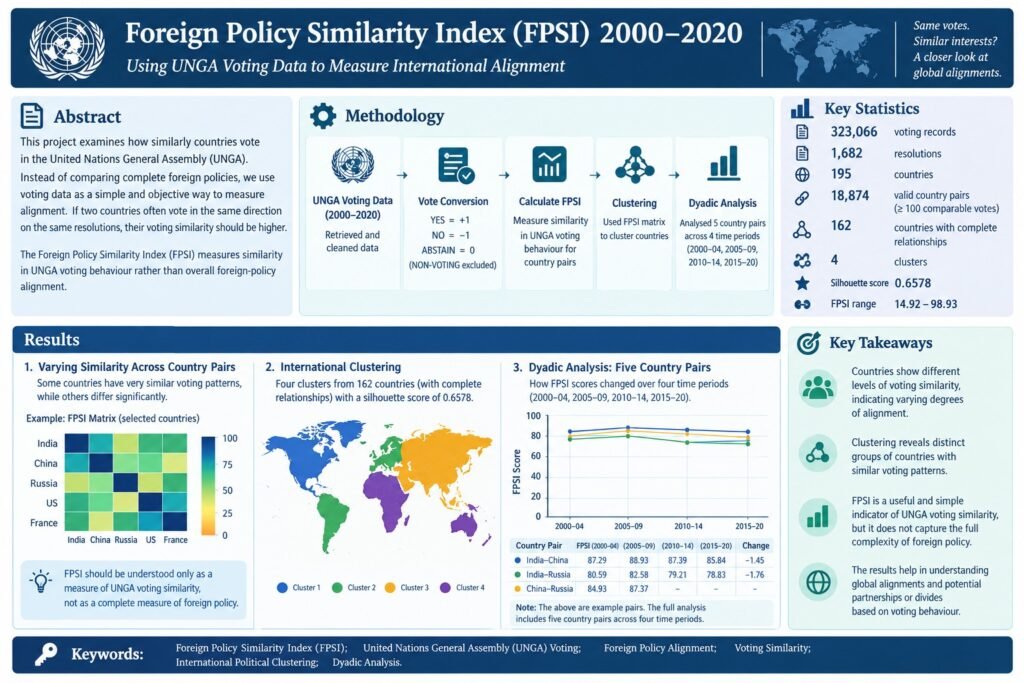
The Foreign Policy Similarity Index (FPSI) matrix was also used to group countries. The distance was calculated as 100-FPSI. Therefore, countries with higher similarity have smaller distances. Agglomerative hierarchical clustering was applied to the 162 countries with complete Foreign Policy Similarity Index (FPSI) relationships. The analysis produced four clusters, with a silhouette score of 0.6578.
Although the original dataset contained 195 countries, clustering was restricted to 162 countries with complete Foreign Policy Similarity Index (FPSI) relationships. The remaining 33 countries had incomplete pairwise relationships because they did not meet the minimum comparable vote requirement with all countries. They were therefore excluded from clustering to maintain a complete distance matrix.
The resulting clusters represent groups of countries with similar voting patterns. The silhouette score evaluated how well these groups were separated based on their Foreign Policy Similarity Index (FPSI)-based distances. A higher silhouette score indicates that countries are more clearly grouped within their clusters and separated from other clusters.
Temporal Analysis
The years 2000 to 2020 were divided into four periods: 2000-2004, 2005-2009, 2010-2014 and 2015-2020. We then used the same Foreign Policy Similarity Index (FPSI) calculation for five selected pairs: India-China, India-Russia, India-USA, China-Russia, and Japan-USA.
To examine how foreign-policy similarity changed over time, the 2000–2020 period was divided into four intervals: 2000–04, 2005–09, 2010–14, and 2015–20. This approach allows comparison of similarity scores over time rather than relying on one overall score for the entire twenty-year period. It therefore helps identify whether alignment patterns remained relatively stable or showed gradual shifts, convergence, or divergence of the period under study.
Methodology Summary
The Foreign Policy Similarity Index (FPSI) converts United Nations General Assembly (UNGA) voting behaviour into comparable numerical scores and produces a country-to-country similarity matrix. The matrix was then used for clustering based on the distance measure 100−FPSI, with higher Foreign Policy Similarity Index (FPSI) values representing smaller distances between countries. Agglomerative hierarchical clustering was applied to the countries with complete Foreign Policy Similarity Index (FPSI) relationships, producing four clusters with a silhouette score of 0.6578.
Interpret the resulting clusters only as data-based groups of countries with relatively similar United Nations General Assembly (UNGA) voting patterns. For example, the presence of China, India and Russia in the same cluster indicates similarity in the voting data used in this study. It does not, by itself, demonstrate a coordinated diplomatic strategy, shared geopolitical interests across all issues, a formal political coalition, or similarity in their complete foreign policies. The clustering therefore identifies statistical patterns of voting similarity rather than political alliances.
Similarly, the silhouette score of 0.6578 indicates reasonable separation of the four groups based on Foreign Policy Similarity Index (FPSI) based distances, but it does not establish that these groups correspond to real-world political blocs. This system mainly converts categorical votes into comparable numerical scores, generating 18,874 valid country pairs. The resulting Foreign Policy Similarity Index (FPSI) matrix supports clustering across 162 countries and temporal comparisons of five country pairs. Together, these findings provide a structured assessment of voting similarity, producing four clusters with a silhouette score of 0.6578.
Data Analysis and Interpretation
The dataset contains country-level voting records for United Nations General Assembly (UNGA) resolutions. In simple terms, each row represents a country’s vote on a particular voting event. The final dataset used for the analysis contains 323,066 voting records, 1,682 resolutions and 195 countries.
|
Column |
Description |
|
undl_id |
Identifier for the voting event or resolution |
|
ms_code |
Country code |
|
ms_name |
Country name |
|
ms_vote |
Voting decision |
|
date |
Date of the voting event |
|
session |
United Nations General Assembly (UNGA) session |
|
resolution |
Resolution reference |
|
subjects |
Subject/category information |
Table 3: Structural schema defining the eight attributes of each United Nations General Assembly (UNGA) vote.
Data Checking
Before the similarity calculation, we checked the dataset for columns, data types, country identifiers, voting values, dates, and missing values. The voting codes were also made consistent. This step was important because even small inconsistencies in voting values could affect the final score.
Results
Foreign Policy Similarity Index (FPSI) Distribution
There were 18,874 valid country pairs. The scores ranged from 14.92 to 98.93. The following graph shows the overall spread of the scores.
The distribution shows substantial variation in voting similarity, indicating that countries differ considerably in how closely their United Nations General Assembly (UNGA) voting patterns correspond.
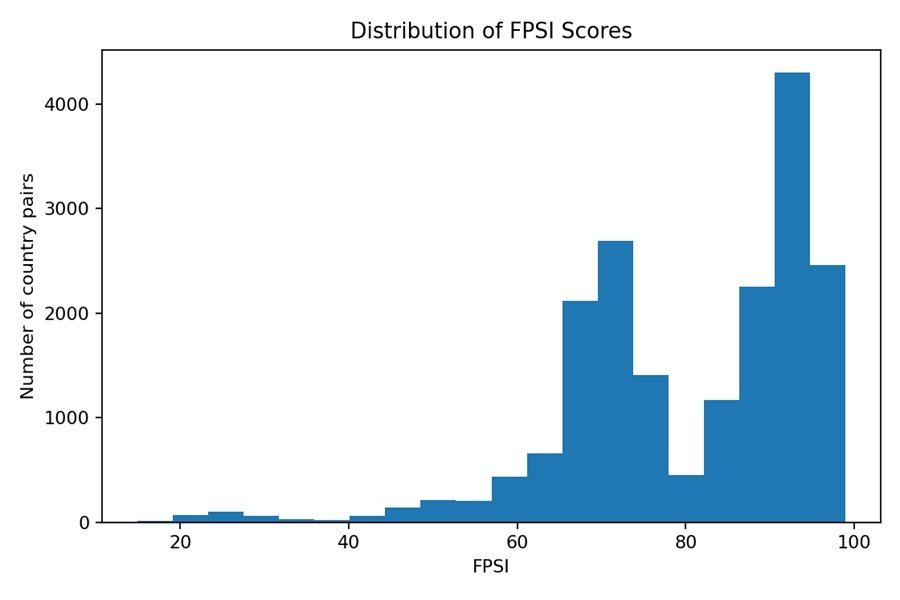
Figure 1. Distribution of Foreign Policy Similarity Index (FPSI) Scores
Highly Similar Pairs
|
Country A |
Country B |
FPSI |
Comparable Votes |
|
SEYCHELLES |
TIMOR-LESTE |
98.93 |
607 |
|
CAPE VERDE |
SEYCHELLES |
98.69 |
724 |
|
BURKINA FASO |
SEYCHELLES |
98.59 |
710 |
|
CAMBODIA |
TURKMENISTAN |
98.44 |
1122 |
|
BARBADOS |
SEYCHELLES |
98.40 |
718 |
|
SAO TOME AND PRINCIPE |
SEYCHELLES |
98.31 |
445 |
|
BELIZE |
SEYCHELLES |
98.25 |
714 |
Table 4: Highly Similar Pairs.
Their near-perfect scores reveal the highest pairwise voting alignments globally.
Source: Author’s Calculation of Foreign Policy Similarity Index Project using United Nations General Assembly (UNGA) Voting Dataset, 2000–2020.
The high scores indicate strong consistency in voting direction across the resolutions shared by these country pairs. These pairs had very similar voting patterns on the resolutions compared. The score is based only on the United Nations General Assembly (UNGA) voting records, so it should not be read as proof that their complete foreign policies are the same.
The highest Foreign Policy Similarity Index (FPSI) scores indicate pairs with very strong similarity in their United Nations General Assembly (UNGA) voting patterns. Seychelles appears in several of the highest-ranking pairs, with Seychelles–Timor-Leste recording the highest score of 98.93 based on 607 comparable votes. Remaining pairs also recorded scores above 98, suggesting high consistency in their voting direction. These results indicate strong voting alignment, although they should not be interpreted as evidence that the countries have identical overall foreign policies.
These countries vote cohesively because they share membership in the Non-Aligned Movement (NAM) and G77 coalitions. As developing, vulnerable, and often small island nations, they pool their votes to maintain strategic neutrality, protect sovereign independence, support United Nations-driven multilateralism, and collectively lobby for critical Global South development and climate funding.
Low Similarity Pairs
|
Country A |
Country B |
FPSI |
Comparable Votes |
|
DEMOCRATIC PEOPLE’S REPUBLIC OF KOREA |
UNITED STATES |
14.92 |
1498 |
|
SYRIAN ARAB REPUBLIC |
UNITED STATES |
15.59 |
1629 |
|
IRAN (ISLAMIC REPUBLIC OF) |
UNITED STATES |
16.57 |
1596 |
|
CUBA |
UNITED STATES |
16.90 |
1648 |
|
ZIMBABWE |
UNITED STATES |
17.50 |
1543 |
|
SOMALIA |
UNITED STATES |
18.01 |
880 |
Table 5: Lowest Similarity Pairs.
Indicating systematic voting divergence from the United States.
Source: Author’s Calculation of Foreign Policy Similarity Index Project using United Nations General Assembly (UNGA) Voting Dataset, 2000–2020.
These lower scores in the above table indicate greater divergence in voting positions across the comparable United Nations General Assembly (UNGA) resolutions. These pairs had more disagreement in their recorded voting patterns. The lowest Foreign Policy Similarity Index (FPSI) scores represent pairs with greater divergence in their United Nations General Assembly (UNGA) voting behaviour. The lowest score was recorded between the Democratic People’s Republic of Korea and the United States (14.92), followed by other pairs involving the United States. These scores indicate that the countries frequently differed in their voting positions across comparable United Nations General Assembly (UNGA) resolutions. Thus, the results reflect voting divergence rather than complete foreign-policy disagreement.
Top and Bottom Pairs
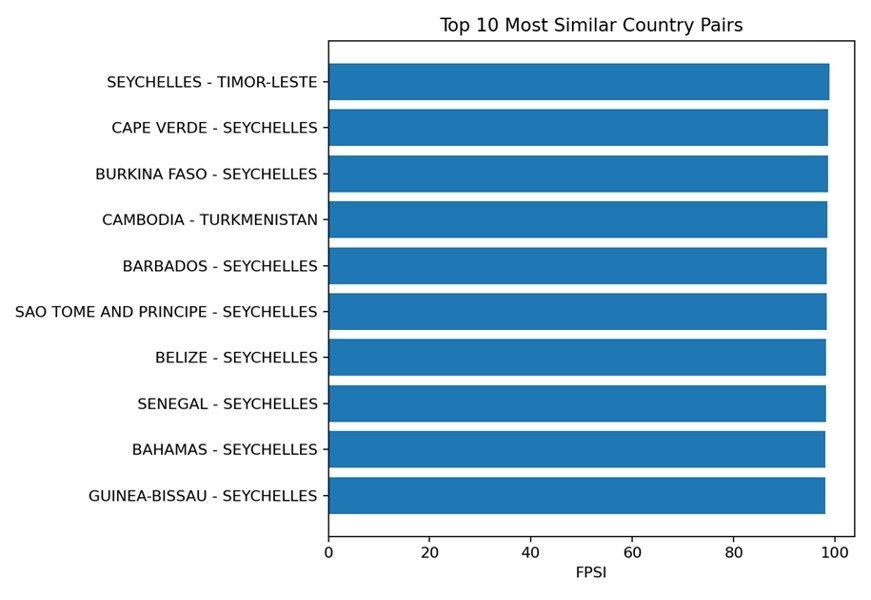
Figure 2. Top 10 Most Similar Country Pairs
Source: Author’s Calculation of Foreign Policy Similarity Index Project using United Nations General Assembly (UNGA) Voting Dataset, 2000–2020.
The top-ranking pairs demonstrate where United Nations General Assembly (UNGA) voting patterns were most closely aligned. The concentration of very high Foreign Policy Similarity Index (FPSI) scores suggests that some countries consistently adopted similar positions across international resolutions. This provides an empirical basis for identifying patterns of foreign-policy similarity without assuming that these countries necessarily share formal alliances or identical political ideologies.
The top similarity pairs recorded the highest Foreign Policy Similarity Index (FPSI) scores, indicating very strong agreement in their United Nations General Assembly (UNGA) voting patterns between 2000 and 2020. Seychelles appears repeatedly, alongside Timor-Leste, Cape Verde, Burkina Faso, Barbados, São Tomé and Príncipe, and Belize. These results reflect voting similarity, not necessarily shared alliances or identical foreign-policy ideologies. The concentration of Seychelles among the highest-ranking pairs indicates a recurring pattern of strong voting similarity with several countries, demonstrating how Foreign Policy Similarity Index (FPSI) can identify closely aligned United Nations General Assembly (UNGA) voting behaviour without equating statistical similarity with formal political alliances.
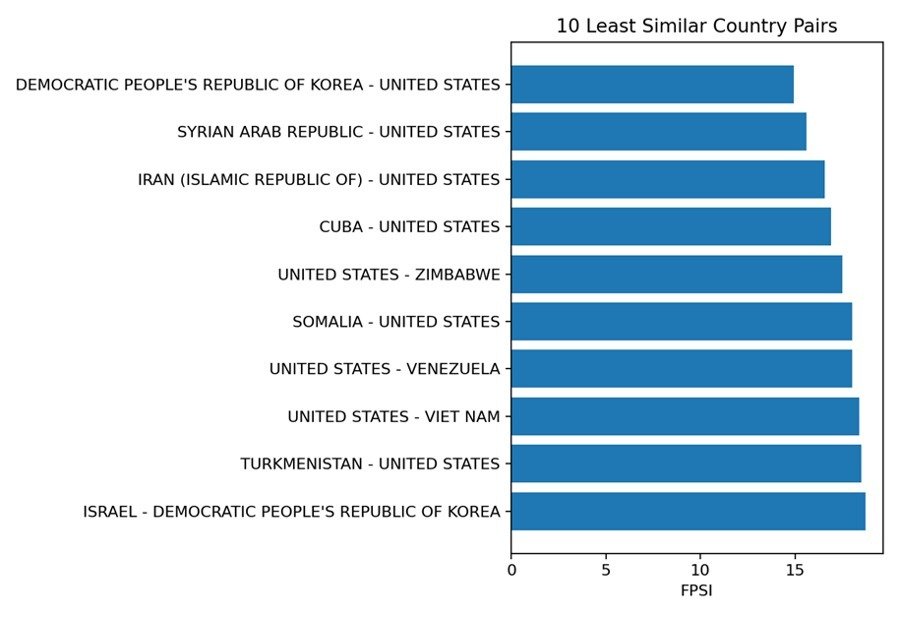
Figure 3. 10 Least Similar Country Pairs
Source: Author’s Calculation of Foreign Policy Similarity Index Project using United Nations General Assembly (UNGA) Voting Dataset, 2000–2020.
The lowest-ranking pairs show the opposite pattern, with substantial differences in their United Nations General Assembly (UNGA) voting behaviour. The repeated presence of the United States among the least-similar pairs suggests clear voting divergence with several countries during the period studied. However, the data alone cannot establish whether this divergence resulted from US influence, alliance relationships, or specific geopolitical factors; it only captures differences in recorded United Nations General Assembly (UNGA) voting.
The concentration of the least similar pairs around the United States reflects broader differences in international political positions. Countries such as the Democratic People’s Republic of Korea, Syria, Iran and Cuba have had sustained geopolitical disagreements with Washington, which can contribute to divergent United Nations General Assembly (UNGA) voting patterns. Research also shows that U.S. sanctions can reduce voting coincidence between the United States and targeted countries, particularly where targets are less dependent on U.S. aid. In contrast, Western allied countries generally show greater voting coincidence with the United States of America, although this alignment varies across issues and periods. Thus, the observed divergence is consistent with broader patterns of geopolitical and policy differences rather than indicating formal opposing alliances.
Clustering Results
|
Cluster |
Number of Countries |
Examples |
|
1 |
3 |
Marshall Islands, Micronesia, Nauru |
|
2 |
46 |
Albania, Australia, Austria, Japan, United Kingdom |
|
3 |
2 |
Israel, United States |
|
4 |
111 |
China, India, Russia and other countries |
Table 6: Four cluster categories of countries based on pairwise voting similarity.
The Foreign Policy Similarity Index (FPSI) matrix grouped countries by overall voting similarity, producing four clusters across 162 countries. Cluster 4 was the largest, containing 111 countries, including China, India and Russia, while the United States and Israel formed a separate two-country cluster. Japan and the United Kingdom were among the countries in Cluster 2. Israel and the United States were in Cluster 3; these groups are based on mathematical similarity in the voting data.
The unequal cluster sizes suggest that countries were not evenly distributed by voting patterns. However, these clusters should be understood as data-based groupings of voting similarity rather than formal political alliances. They show which countries display similar United Nations General Assembly (UNGA) voting behaviour, providing a useful basis for understanding broader patterns of international political positioning.
Silhouette Score
The silhouette score was 0.6578. It indicates reasonable separation between the clusters. This suggests the four groups are reasonably well separated based on the Foreign Policy Similarity Index (FPSI) distance values used for clustering. It does not prove that the groups are real-world political blocs. It indicates how clearly countries fit within their assigned cluster compared with other clusters.
Temporal Analysis
The same FPSI calculation was then applied to five selected pairs: India-China, India-Russia, India-USA, China-Russia, and Japan-USA. These five country pairs were selected to provide contrasting examples of voting similarity, including relatively high, lower, stable and changing relationships. The selection also provides variation in the countries’ geopolitical contexts, allowing the temporal analysis to illustrate how Foreign Policy Similarity Index (FPSI) scores may remain stable, converge or diverge across the 2000–2020 period.
|
Country Pair |
2000-04 |
2005-09 |
2010-14 |
2015-20 |
Change |
|
India – China |
87.29 |
88.93 |
87.39 |
85.84 |
-1.45 |
|
India – Russia |
80.59 |
82.58 |
79.21 |
78.83 |
-1.76 |
|
India – USA |
24.10 |
20.60 |
25.84 |
26.21 |
+2.11 |
|
China – Russia |
84.93 |
87.37 |
83.10 |
83.45 |
-1.48 |
|
Japan – USA |
44.48 |
39.85 |
50.70 |
48.48 |
+4.00 |
Table 7: Tabulated United Nations General Assembly (UNGA) voting similarity (2000–2020) for selected country pairs.
Showing both stable and fluctuating relationships
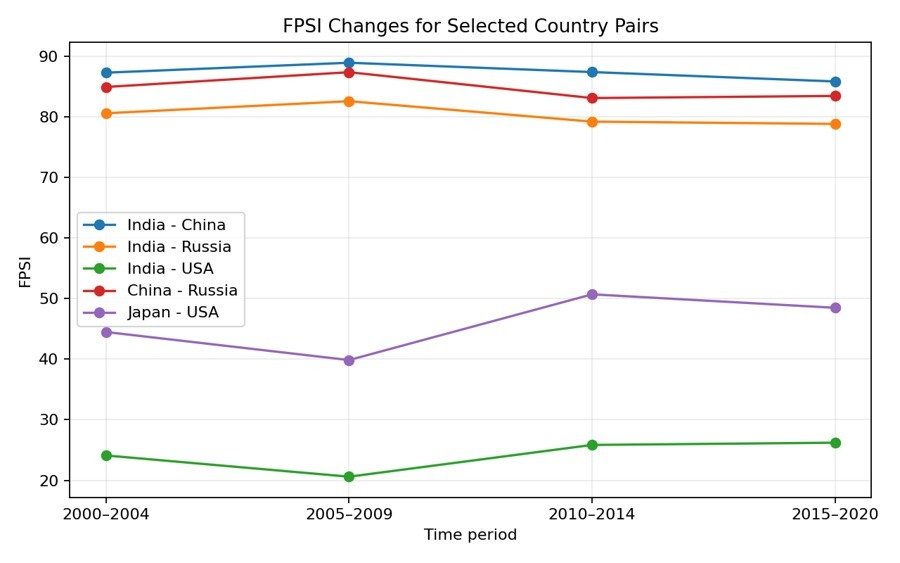
Figure 4. Foreign Policy Similarity Index (FPSI) Changes for Selected Country Pairs
United Nations General Assembly (UNGA) voting similarity shifting across four distinct five-year periods between 2000 and 2020
The project does not claim that a particular political event caused these changes. Altogether, the temporal results show that voting similarity was not uniform across periods, with some relationships remaining relatively stable while others showed greater variation. As shown above, the voting data reflects the following changes:
India-China stayed high in all four periods, although it fell slightly in the last period. India–China similarity rose with closer engagement in 2000-2009, then declined amid growing strategic and normative differences in 2010-2020.
China-Russia similarity stayed relatively high and changed little overall. China–Russia similarity rose through strategic cooperation, fell amid divergences over international crises, and finally slightly recovered through renewed strategic and technological convergence.
India-Russia also remained relatively high but declined slightly overall. India-Russia voting similarity fluctuated due to distinct foreign policy shifts. India’s preference for the West during the early 2000s and other national economic reforms initially moderated alignment. Similarity peaked during 2005–2009 as the BRICS coalition formalised. It declined slightly after 2010 as India’s positions became marginally more pro-West and signalled selective policy pivots.
Japan-USA showed more variation, including a fall in the second period followed by a recovery. Japan–USA similarity declined in 2005–09, which may reflect differences in voting on contentious international issues, while the subsequent rise in 2010–14 suggests greater convergence on selected resolutions. The slight decline after 2015 may partly reflect differences over U.S. foreign-policy positions, particularly on Middle East-related issues. Thus, the fluctuations indicate issue-based variation rather than a consistently stable voting alignment. Across the four periods, India–USA voting similarity increased gradually. Similarity declined from about 24.1 in 2000–04 to 20.6 in 2005–09, indicating greater divergence during the second period. It then increased to around 25.9 in 2010–14 and remained broadly stable at 26.2 in 2015–20. This pattern suggests initial divergence followed by gradual convergence and stabilisation. However, the relatively low similarity throughout the period indicates that India and the USA continued to differ considerably in their United Nations General Assembly (UNGA) voting positions. Reflecting limited but increasing alignment rather than a strong or consistent convergence. Hence, India-USA had a much lower score than the India-China and India-Russia pairs, but its score increased slightly by the last period.
Discussion
The Foreign Policy Similarity Index (FPSI) made it easier to compare countries using a large number of United Nations General Assembly (UNGA) votes. Instead of checking thousands of votes manually, the voting pattern was converted into a single score for each country pair. The index also highlights how methodological choices shape interpretation. By excluding non-voting and requiring at least 100 comparable votes, the Foreign Policy Similarity Index (FPSI) prioritises reliability over coverage, which may omit some strategically important but less frequently voting pairs. The equal weighting of all resolutions means that highly salient security votes and routine procedural votes contribute equally to the final score, potentially masking issue-specific alignment. Moreover, the clustering algorithm identifies statistical groupings but cannot distinguish whether similarity arises from shared interests, alliance pressure, or coordinated diplomatic strategy. These limitations suggest that the Foreign Policy Similarity Index (FPSI) is best used as a structured starting point for deeper case studies rather than as a definitive measure of foreign-policy proximity.
The results show that countries do not all have the same level of similarity. Some pairs have scores close to 100, while some are much lower. The clustering result offers another view of the same pattern by grouping countries with similar voting behaviour. The temporal analysis is also useful because a single score for the full 20-year period can hide changes that happened in between. Looking at separate periods makes those changes easier to see. At the same time, the results should not be overinterpreted. Voting together in the United Nations General Assembly (UNGA) does not necessarily mean that two countries agree on every foreign-policy issue.
Limitations
While the study actively explores Foreign Policy Similarity Index (FPSI), we must keep in mind that United Nations General Assembly (UNGA) voting is only one part of foreign policy. It does not cover every diplomatic, economic or military decision. In the study, we represented abstention as 0. This is a choice made for the calculation, and another approach could produce different values. Also, Non-voting records were excluded, so some country pairs have fewer common observations than others. All comparable votes have equal weight. Important resolutions are not given extra weight in the current Foreign Policy Similarity Index (FPSI). Different subjects are combined into one score, so topic-specific differences may be hidden. The analysis covers 2000-2020 and therefore overlooks the voting behaviour after 2020. Foreign Policy Similarity Index (FPSI) shows similarity but does not explain why two countries voted similarly. The clusters formed in the study are data-based groups and should not automatically be called political alliances.
Future Scope
The project can be extended in several ways. Some possible enhancements are:
- Calculate separate Foreign Policy Similarity Index (FPSI) scores for different subjects such as security, human rights and economic issues.
- Give higher weight to resolutions that are more important.
- Include United Nations General Assembly (UNGA) data after 2020.
- Compare the Foreign Policy Similarity Index (FPSI) with trade, treaties or other international relations data.
- Try other clustering methods and compare the results.
- Create an interactive dashboard for comparing countries.
- Study whether major international events are followed by changes in voting similarity.
Conclusion
|
Item |
Value |
|
Coverage |
2000-2020 |
|
Countries |
195 |
|
Voting records |
323,066 |
|
Resolutions |
1,682 |
|
Valid country pairs |
18,874 |
|
Countries used for clustering |
162 |
|
Clusters |
4 |
|
Silhouette score |
0.6578 |
|
Foreign Policy Similarity Index (FPSI) range |
14.92 – 98.93 |
|
Minimum comparable votes |
100 |
Table 8: Project Summary
Key statistical parameters and model metrics of the United Nations General Assembly (UNGA) study
This project used United Nations General Assembly (UNGA) voting data from 2000 to 2020 to compare countries’ voting behaviour. The final dataset contained 323,066 voting records, 1,682 resolutions and 195 countries. We converted votes into numerical values and used them to calculate the Foreign Policy Similarity Index. We used at least 100 comparable votes for each pair, resulting in 18,874 valid country pairs. We then arranged these into a country-by-country matrix.
The study directly addresses its three research questions. First, it shows that United Nations General Assembly (UNGA) voting behaviour can be measured systematically by encoding YES, NO, and ABSTAIN as +1, −1, and 0, computing pairwise signed agreement, and rescaling it to the 0–100 Foreign Policy Similarity Index (FPSI). This procedure transforms thousands of individual votes into a comparable metric of foreign-policy similarity. Second, the analysis reveals clear patterns of similarity and clustering: some country pairs score near 99, others near 15, and hierarchical clustering identifies four distinct groups with reasonable separation. Third, the temporal breakdown shows that similarity is not static; for example, India–China remained high but declined slightly, India–USA increased modestly, and Japan–USA varied more across periods.
The results confirm that United Nations General Assembly (UNGA) voting provides a structured, observable basis for comparing states, while also highlighting that similarity scores reflect voting alignment rather than comprehensive foreign-policy agreement. This finding aligns with prior clustering-based studies of United Nations General Assembly (UNGA) voting, which similarly show that network- and distance-based methods recover coherent, real-world political groupings from voting-similarity data.
The clustering results identify statistical groups based on similar voting patterns, but these should not be interpreted as formal alliances or evidence of identical foreign policies. Similarly, temporal changes indicate shifts in voting similarity rather than proving changes in overall foreign-policy orientation or their causes.
The findings should also be interpreted in light of several methodological limitations. Coding abstentions as zero does not capture the different political reasons behind abstention. The minimum threshold of 100 comparable votes reduces reliance on small samples, although its robustness against alternative thresholds remains untested. Hierarchical clustering identified four groups among 162 countries with complete Foreign Policy Similarity Index (FPSI) relationships, excluding 33 countries from this analysis.
This study’s core result is the Foreign Policy Similarity Index (FPSI). It provides a partial picture of foreign policy and a simple numerical way to study patterns in United Nations General Assembly (UNGA) voting across countries and years. Foreign Policy Similarity Index (FPSI) is best interpreted as a transparent, reproducible indicator of voting similarity that can guide further qualitative or issue-specific analysis.
Future work could extend the Foreign Policy Similarity Index (FPSI) by incorporating issue-level scores, weighting important resolutions more heavily, including post-2020 data, and linking voting similarity to trade, security, or diplomatic indicators to better explain why alignment changes over time. The study therefore provides a quantitative baseline for identifying patterns of convergence and divergence that can be examined further through qualitative and issue-specific research.
References
- United Nations General Assembly (UNGA) voting dataset used for this project.
- Pandas Documentation — Python Data Analysis Library.
- NumPy Documentation — Numerical computing with Python.
- Matplotlib Documentation — Data visualization with Python.
- Scikit-learn Documentation — Machine learning and clustering tools in Python.
- Amanov, S. (2024). The external convergence of the EAEU on global issues: Evidence from the UN General Assembly vote, 2000–2020. Journal of Globalization Studies, 15(1), 36–58. https://doi.org/10.30884/jogs/2024.01.03
- Bailey, M. A., Strezhnev, A., & Voeten, E. (2016). Estimating dynamic state preferences from United Nations Voting Data. Journal of Conflict Resolution, 61(2), 430–456. https://doi.org/10.1177/0022002715595700
- Benati, S., & Capurri, A. (2026). The alignment index and its application to voting at the United Nations General Assembly. Quality & Quantity. https://doi.org/10.1007/s11135-026-02814-x
- Chakravarty, D. (2026, February 6). Global AI race: Comparative strategies of the US, China, and India. OBSERVER RESEARCH FOUNDATION ( ORF ). Orfonline.Org. https://www.orfonline.org/expert-speak/global-ai-race-comparative-strategies-of-the-us-china-and-india
- Das, A. (2017, July 25). A fine balance: India’s voting record at the UNGA. Orfonline.Org. https://www.orfonline.org/research/fine-balance-india-voting-record-unga
- Destradi, S., & Vüllers, J. (2024). Populism and the liberal international order: An analysis of UN voting patterns. The Review of International Organizations, 20(4), 1053–1080. https://doi.org/10.1007/s11558-024-09569-w
- D’Orazio, V. (2012). Advancing measurement of foreign policy similarity draft v4.
- Dreher, A., & Sturm, J.-E. (2010). Do the IMF and the World Bank influence voting in the UN General Assembly? Public Choice, 151(1–2), 363–397. https://doi.org/10.1007/s11127-010-9750-2
- Gartzke, E. (2007). The capitalist peace . https://pages.ucsd.edu/~egartzke/publications/gartzke_ajps_07.pdf
- Häge, F. M. (2011). Choice or circumstance? Adjusting measures of foreign policy similarity for chance agreement. Political Analysis, 19(3), 287–305. https://doi.org/10.1093/pan/mpr023
- Jo, J. (2009). Preference similarity and interstate commercial cooperation. Journal of International and AREA Studies, 16(1), 17–26.
- Lektzian, D., & Biglaiser, G. (2022). Sanctions, aid, and voting patterns in the United Nations General Assembly. International Interactions, 49(1), 59–85. https://doi.org/10.1080/03050629.2023.2155151
- Li, A. X., & Zha, W. (2024). Leadership turnover, winning coalition size and foreign policy realignment. Asian Review of Political Economy, 3(1). https://doi.org/10.1007/s44216-024-00022-8
- Magu, R., & Mateos, G. (2017). United Nations General Assembly Vote Similarity Networks. Studies in Computational Intelligence, 1174–1183. https://doi.org/10.1007/978-3-319-72150-7_95
- Morse, J. C., & Coggins, B. (2024). Your silence speaks volumes: Weak states and strategic absence in the UN General Assembly. The Review of International Organizations, 19(3), 515–544. https://doi.org/10.1007/s11558-024-09538-3
- Mosler, M., & Potrafke, N. (2020). International political alignment during the trump presidency: Voting at the UN General Assembly. International Interactions, 46(3), 481–497. https://doi.org/10.1080/03050629.2020.1719405
- Russett, B. M. (1966). Discovering voting groups in the United Nations. American Political Science Review, 60(2), 327–339. https://doi.org/10.2307/1953359
- Signorino, C. S., & Ritter, J. M. (1999). Tau-B or not tau-b: Measuring the similarity of foreign policy positions. International Studies Quarterly, 43(1), 115–144. https://doi.org/10.1111/0020-8833.00113
- Sokolova, M. V., & DiCaprio, A. (2018). Agree to Disagree: The Spillover of Trade Policy into United Nations General Assembly Voting (Versions https://unctad.org/system/files/official-document/ser-rp-2018d10_en.pdf).
- Wang, Q., & Xiao, S. (2025, August). The Behavioural Logic of the Modi Government’sParticipation in Global Security Governance: An Analysis Based on the First Committee of UNGA. Cnki.Net. https://oversea.cnki.net/kreader2/flowpdf?invoice=FKvym5pgYd9AIi4iIZZpCXKSsa279DGyJ6yjO7LIYJhlLaAEIl8oUuHfuQ%2FIOklfyicitL0PSUNLXgF56uPzDwOE73g7t%2FfeFZEWZ2w1e%2BEIuPCqttF17HkQASCgjMBpiMBhVykvAgdwLea0jFaDeIAISlyruKxABIK4HU%2BK2d4%3D&platform=OVERSEA&product=CJFQ&filename=TPYX202508003&tablename=cjfdlast2025&type=JOURNAL&scope=trial&cflag=overlay&dflag=pdf&pages=1-2&language=EN&trial=1-2&nonce=A8DAC09CBC824202BE544BFE4BD96C32
- Wolfram, C. (2022). Voting communities in the UN General Assembly. Christopherwolfram.Com. https://christopherwolfram.com/projects/un-voting-modularity/
- Yu, Q. (2021). Dynamic dirichlet process mixture model for identifying voting coalitions in the United Nations General Assembly Human Rights Roll Call Votes. Journal of Applied Statistics, 49(12), 3002–3021. PubMed Central. https://doi.org/10.1080/02664763.2021.1931820
- 刘. (2023, June 9). Upgrade and limit of the QUAD——From the perspective of Australia,India,Japan and the US voting in the UN General Assembly – 中国知网. Cnki.Net. https://oversea.cnki.net/kcms2/article/abstract?v=tBI8TAhqnxR0IYVnCKAuxN9nrtxPAqjCUVRCqHFw_5avh8Q_1HjAMvrgjnfUdBauEWrQDb956kJCjPcPxqiJYzHBinI8zfMTGn4H4SsG49rgdC6QQiVyw0jUjlEdBLV-cVxTavO6BVtc53fXBWMRAlaH62YaC7hiHcwJCXY4M23qFAUlUTgAlOxi6kYpIYkeY-keyxhaLls&uniplatform=OVERSEA&language=EN&captchaId=f9a4451f-c9c5-4162-8a08-9d084d784a44
To download the copy of paper, click below:
Foreign Policy Similarity Index