AUTHORS:
ARUNIMA SINGH, HARNOOR SANDHU, MARIAM BUSARI, RITU DEVI, RIYA GARG
ABSTRACT
This paper examines the visibility of the conflicts, why some conflicts achieve global media visibility while others remain marginalised in the international media and diplomatic attention.
Drawing on UCDP and SIPRI data, the study finds that conflict severity does not automatically translate into international recognition. In 2025, 65 active state- based conflicts produced approximately 2,44,600 deaths as per the data, yet only some handful like Gaza, Ukraine received sustained global coverage.
Comparative media analysis reveals stark differences, with Gaza receiving approximately 60 times the coverage of Ethiopia and Ukraine 20 times, while a civilian death in a high-income country generates roughly 96 times more news coverage than one in a low-income country.
The Survey Analysis done with 100 respondents mainly from India, Bangladesh and Nigeria showcased that people depend heavily on social media (64%) for the conflict information and their interpretations and largely doubt (62%) that coverage is balanced or complete.
The paper argues that a conflict’s “globalisation” depends not on humanitarian scale alone but also on various other factors like media framing, geopolitical interest, political-economic structures, and postcolonial hierarchies of representation that determine whose suffering is recognised as internationally significant.
INTRODUCTION
Armed conflict remains a significant feature of the international system, occurring across regions and taking different forms, from interstate wars to prolonged internal conflicts. Beyond the immediate destruction of lives and infrastructure, armed conflicts generate consequences for civilian populations, displacement, regional stability, and international security. As a result, conflicts can extend beyond their immediate locations and become subjects of international concern, attracting the attention of governments, international organisations, humanitarian actors, and global publics. However, the extent to which a conflict becomes an international concern is not determined solely by the existence or severity of violence. While some conflicts receive sustained international attention, others remain largely within regional or domestic agendas despite prolonged violence and serious humanitarian consequences. This unevenness raises questions about how some conflicts acquire global significance while others remain comparatively marginal.
One important pathway through which distant conflicts become visible to international audiences is the media. For many people, knowledge of conflicts occurring beyond their immediate environment is mediated through news reports, digital platforms, images, and other forms of communication. Media organisations therefore play an important role in determining which events receive attention and how those events are presented. Rather than simply transmitting information, media practices involve processes of selection, framing, terminology, imagery, and emphasis that influence how audiences understand conflicts and the actors involved. Entman’s (2010) work on media framing highlights how political power, journalistic practices, cultural norms, and the selection of particular aspects of reality can shape news representation. More recent research on the coverage of conflicts such as the wars in Ukraine and Gaza similarly examines differences in framing, narrative strategies, terminology, and visual representation, demonstrating the importance of media practices in shaping the visibility and interpretation of armed conflicts.
Yet media visibility does not occur in isolation from the wider political environment in which news is produced and international attention is mobilised. Research on the political economy of media has long examined the influence of political and elite interests on news production, while scholarship on international institutions demonstrates that attention to armed conflicts can also be selective. The relationship between media visibility and political attention therefore becomes particularly important when considering conflicts in the Global South. Post-colonial scholarship, particularly Said’s (1978) analysis of Orientalism, questions the neutrality of dominant systems of representation and draws attention to historically embedded hierarchies in the production of knowledge about non-Western societies.
Contemporary research on the representation of the Global South in Western news media further examines how conflicts may be framed through narratives of instability, terrorism, ethnic or religious violence, or humanitarian crisis, potentially limiting attention to their wider historical and structural contexts.
These perspectives provide important explanations for media framing, selective attention, political influence, and post-colonial representation.
However, they are often examined as related but distinct dimensions of conflict visibility. Less sufficiently understood is how these dimensions interact in the process through which particular armed conflicts come to be recognised as global concerns while others remain comparatively marginal. This is especially relevant to conflicts in the Global South, where the relationship between media representation, geopolitical interests, and historically embedded patterns of representation requires further examination. The issue, therefore, is not simply whether a conflict receives media coverage, but how visibility is produced, what forms of representation accompany it, and how these processes interact with broader structures of political power.
Against this background, this study examines how media visibility and framing, in interaction with geopolitical interests and post-colonial representations, contribute to the construction of armed conflicts as global concerns or as comparatively marginalised crises, with particular attention to conflicts in the Global South. Rather than treating media coverage as an isolated determinant of international attention, the study considers conflict visibility as emerging from the interaction of media, political, and representational processes.
The study is guided by the research question: How do media visibility and framing, shaped by geopolitical interests and post-colonial representations, influence which armed conflicts are constructed as global concerns and which remain marginalised?
Examining this question is significant because international visibility can shape public perceptions, political urgency and the attention available for diplomatic and humanitarian responses. Understanding how such visibility is constructed therefore makes it possible to interrogate whether the global prominence of particular conflicts reflects their severity alone, or whether broader structures of media selection, political interest and representation also determine whose conflicts become visible to the world.
LITERATURE REVIEW
Armed conflicts occur across the world, yet they do not receive equal levels of international visibility or concern. Some wars dominate global news agendas and become subjects of sustained political, diplomatic and humanitarian attention, while others remain comparatively marginalised despite extensive violence and human suffering. SIPRI’s data on armed conflicts in 2024 illustrates this discrepancy: five conflicts recorded more than 10,000 estimated conflict-related fatalities — the Israel-Hamas war, Russia’s war against Ukraine, the civil wars in Myanmar and Sudan, and subnational armed conflicts in Ethiopia. Yet these conflicts did not receive comparable levels of global media attention. Similarly, the Reuters Institute’s recent analysis reports research finding a striking disparity in news coverage per civilian death: more than 1,600 articles per civilian death in high-income countries compared with only 17 in low-income countries. This literature review examines how such inequalities may be constructed through media processes. It first considers the dominant Western/Northern media lens through which conflicts are selected and framed, then examines Global South and postcolonial perspectives that reveal hierarchies in representation and humanitarian recognition, and finally explores the political, economic and institutional structures that may explain why some conflicts become globally visible while others remain peripheral.
1. The Dominant Western/Northern Lens — Media Framing and the Construction of Conflict
This theme examines how dominant media institutions construct particular understandings of conflict. The media do not simply transmit information about wars; they select events, define threats, attribute responsibility and frame actors and victims in particular ways. Understanding these processes is essential because the dominant lens through which international audiences encounter conflicts can influence which wars appear politically relevant and worthy of sustained attention.
Entman’s (2010) work on media framing provides an important foundation for understanding this process. He conceptualises media bias not simply as the intentional ideological preferences of individual journalists but as a dynamic outcome produced through the interaction of framing, cultural norms, journalistic perspectives, real-world developments and elite influence. His analysis therefore demonstrates that slanted coverage can emerge structurally from the processes through which journalism selects and interprets political reality. This is particularly relevant to conflict reporting, where choices concerning terminology, sources and narrative emphasis can shape how audiences understand violence.
Recent comparative research demonstrates these differences empirically. Guo, Duan and Yang’s (2025) cross-national analysis of news coverage of the Russian war in Ukraine demonstrates how the same conflict can be interpreted differently across national media environments. Their findings show that geopolitical and national contexts influence which dimensions of war are emphasised. Similarly, Omairi’s (2025) comparison of BBC and CNN coverage of Gaza and Ukraine identifies substantial differences in terminology and narrative framing. Ukrainian fighters were consistently framed as defenders engaged in a legitimate struggle for sovereignty, whereas Palestinian actors were more frequently associated with negative terminology, violence and humanitarian crisis.
Together, these studies challenge the assumption that international conflict reporting merely reflects objective events. Instead, the dominant media lens actively constructs the political meaning of war through framing and selection. Collectively, the literature suggests that before asking why some conflicts are marginalised, it is necessary to recognise that media representations already shape what audiences understand a conflict to be and why it should matter.
2. Global South and Postcolonial Perspectives — Unequal Representation and the Hierarchy of Suffering
If Theme 1 demonstrates that conflict is mediated through particular frames, this theme examines what becomes visible when these representations are viewed from Global South and postcolonial perspectives. The issue is not simply whether conflicts receive coverage but also whose suffering is humanised, whose voices are recognised and which populations are considered worthy of international empathy. Comparative perspectives therefore reveal how unequal visibility can become a hierarchy of representation.
Edward Said’s concept of Orientalism provides an important framework for examining these inequalities. Said argued that knowledge about the non-Western world has historically been produced through representations that construct the “Orient” as fundamentally different from, and frequently inferior to, the West. Orientalist discourse can represent non-Western societies as irrational, unstable, violent or perpetually prone to conflict while associating the West with modernity, order and political agency. Such representational structures remain relevant to contemporary media because they can influence whether violence is understood as an exceptional crisis or as an expected feature of particular regions.
Recent scholarship provides empirical evidence of these inequalities. Doğutaş’s (2026) study of Western mainstream media coverage of Gaza argues that media discourse constructs a hierarchy of human suffering. Analysing material from major outlets including The New York Times, BBC, CNN and The Guardian, the study identifies the systematic marginalisation of Palestinian civilian suffering through depersonalised language, selective sourcing and frames that obscure structural power asymmetries. Israeli victimhood, by contrast, receives greater emotional amplification. Similarly, Alhirthani’s (2025) analysis of English-language media coverage of human rights in Gaza demonstrates how reporting practices and representations of civilian suffering can influence the extent to which human rights concerns are effectively communicated.
These patterns extend beyond news coverage. Ongenaert and Soler’s (2024) comparative analysis of UNHCR’s Instagram communication on Syrian and Ukrainian displacement identifies crisis-specific differences and hierarchies of deservingness. Their study notes the broader context in which Ukrainian refugees received substantial favourable coverage and policy support compared with many Global Southern crises, demonstrating that unequal humanitarian recognition is embedded within wider systems of representation.
Pachauri and Singh’s (2025) postcolonial analysis further identifies recurring patterns in Western representations of the Global South, including crisis-oriented narratives, economic dependency framing, visual stereotyping and epistemic marginalisation. Together, these studies suggest that unequal conflict attention cannot be reduced to the quantity of coverage alone. The hierarchy of conflicts is also a hierarchy of humanity, agency and deservingness, in which some populations are more easily recognised as victims whose suffering requires international action.
3. Explaining Unequal Visibility — Power, Political Economy and the Structures of Media Attention
The differences identified in the previous themes raise a broader question: why are particular conflicts consistently more visible and politically significant than others? This theme examines the structural factors shaping media attention, including geopolitical interests, economic pressures, institutional power and the political economy of media.
Chomsky and Herman’s concept of the propaganda model in Manufacturing Consent provides a useful theoretical framework. Their argument emphasises that media operate within political and economic structures rather than independently of them. Ownership concentration, advertising dependence, elite sourcing and dominant ideological interests can influence which issues receive attention and how they are represented. Applied cautiously to conflict reporting, this framework suggests that unequal visibility may emerge from structural conditions shaping what news organisations consider commercially viable, politically relevant and acceptable to elite audiences.
Recent research demonstrates the importance of these structural conditions. Allan’s (2025) discussion of visual war journalism argues that visibility necessarily involves processes of inclusion and exclusion. Only a small proportion of the world’s conflicts enters the sightlines of major Western news organisations, while conflicts in places such as Sudan, Yemen, Ethiopia and the Democratic Republic of Congo have often received limited sustained attention. Allan also highlights declining newsroom resources, financial pressures, technological changes and the economic conditions of contemporary journalism as factors influencing war reporting.
The Reuters Institute’s 2026 analysis similarly identifies multiple explanations for unequal attention, including geopolitical relevance, economic influence, cultural proximity, assumptions about audience interest, restricted access to conflict zones and financial constraints within news organisations. These findings complement Lundgren and Klamberg’s (2023) study of selective United Nations Security Council attention. Their research demonstrates that international institutional attention is also selective and influenced not only by conflict severity but by factors such as conflict externalities and the interests of powerful states.
This suggests that media marginalisation should not be explained exclusively through Orientalism or individual journalistic bias. Instead, postcolonial representations interact with geopolitical interests and institutional media structures. Conflicts involving powerful states or regions perceived as strategically important may be more easily constructed as threats to international order, while conflicts in regions historically represented as chronically unstable may struggle to overcome assumptions of distance and normalised violence. Collectively, the literature suggests that unequal conflict visibility is produced through intersecting systems of representational, geopolitical and economic power.
Literature Summary
The literature demonstrates a broad consensus that global attention to conflict is not determined solely by casualties or humanitarian severity. Media framing shapes how conflicts, actors and victims are understood, while comparative research reveals substantial inequalities in the representation and humanisation of populations across geopolitical contexts. Postcolonial perspectives further demonstrate how historical representations of the Global South can reproduce hierarchies of knowledge, visibility and deservingness. At the same time, researchers caution against explaining unequal attention solely through cultural bias. Newsroom resources, institutional practices, geopolitical interests and political-economic structures also influence which conflicts become visible. Existing literature therefore collectively suggests that the global hierarchy of conflicts is produced through the interaction between media representation and broader structures of political and economic power.
RESEARCH GAP
Existing literature provides substantial evidence that international media attention to armed conflicts is uneven and cannot be explained solely by the severity of violence or humanitarian suffering. Research on media framing demonstrates that journalism actively constructs political reality by selecting particular narratives, sources, actors and interpretations. Comparative studies of contemporary conflicts, particularly Ukraine and Gaza, further demonstrate that conflicts and their victims can be represented through significantly different frames, language and degrees of humanisation. Postcolonial scholarship similarly identifies persistent inequalities in the representation of the Global South, including crisis-oriented narratives, stereotyping and the marginalisation of local voices. Research on international institutions also suggests that political attention towards armed conflicts is selective and influenced by factors beyond humanitarian severity.
However, these dimensions are frequently examined in isolation. Studies of media framing tend to focus on how individual conflicts are represented, while comparative studies often examine differences between two particular conflicts without connecting these findings to broader historical structures of representation. Postcolonial research provides important explanations for how unequal knowledge and representations of the Global South are produced, but does not always examine how these structures interact with contemporary media routines and decisions about conflict visibility. Similarly, research on international political attention identifies the influence of strategic interests and powerful states but does not sufficiently integrate the role of media in making conflicts visible, intelligible and politically significant to international audiences.
Furthermore, existing research does not sufficiently bring together the relationship between media visibility, conflict framing, geopolitical interests and postcolonial representations to explain how a broader hierarchy of conflicts is constructed. There remains limited understanding of why certain conflicts become sustained global political and humanitarian concerns while others, despite comparable levels of violence and human suffering, remain peripheral to international media and institutional attention.
This study addresses this gap by examining these interconnected dimensions together. Rather than treating unequal media coverage as an isolated journalistic problem, it investigates how media processes operate within wider structures of geopolitical and postcolonial power. By synthesising media framing, Global South representation and the political economy of media attention, the study aims to contribute to a broader understanding of how some wars are globalised while others are marginalised.
METHODOLOGY
1. Research Design
This study uses a mixed-methods approach, combining a comparative research design to examine how media visibility and framing, geopolitical interests, and postcolonial representations shape the international recognition of armed conflicts.
The mixed-methods approach is appropriate because it merges evidence gathered from a structured survey with qualitative analysis of existing literature, media-related research, and secondary sources that illuminate media visibility.
The qualitative component of this study is best understood as a literature-based conceptual analysis rather than an original, systematic content analysis of media texts. The study does not independently sample and code primary news articles; instead, it synthesises findings from existing systematic media studies including Dragomir (2025), Omairi (2025), Guo, Duan and Yang (2025), and the Reuters Institute (2026) together with secondary conflict-severity data from UCDP, SIPRI, and the Institute for Economics & Peace, to compare patterns of visibility across cases.
Media and research sources for the qualitative review were identified through targeted searches of peer-reviewed journals, institutional reports and recognised conflict databases published largely between 2023 and 2026, prioritising sources that directly measured or discussed media coverage of the conflicts under study (Gaza, Ukraine, Sudan, Ethiopia and Myanmar). This search produced a working sample of approximately 15 core sources (listed in the References), spanning academic content-analysis studies, institutional media-monitoring reports and foundational theoretical works.
This conceptual synthesis is read alongside the study’s own primary survey data, which provides original, exploratory, audience-level evidence of how respondents in India, Bangladesh and Nigeria perceive and engage with conflict coverage. The comparative element of the research design therefore rests on two distinct evidentiary bases: secondary/literature-based evidence for the cross-conflict visibility comparison, and primary survey evidence for audience perception rather than on a single, uniform method applied across both.
The exploratory component helps investigate patterns in how people consume news, their awareness, and their perceptions of how global conflicts are represented in the media. The comparative component enables an examination of differences in the visibility of selected conflicts using indicators such as conflict-related fatalities, humanitarian impact, and geopolitical significance. Additionally, the study compares survey responses across age groups to see how media visibility differs among them.
The research does not assume that media visibility is driven by the severity of a conflict. Instead, it explores how media practices, geopolitical interests, political-economic structures, and postcolonial representations interact to shape the visibility of conflicts and, in turn, influence international recognition.
2. Nature of the Research
The study uses a mixed-methods approach comprising both quantitative and qualitative components.
The quantitative component relies on data gathered through a structured survey. This survey examines how people access their news, how often they consume it, and what they know about ongoing conflicts. It also explores how people perceive the balance and completeness of media coverage, the extent to which they feel sensationalism is used, and their views on institutional influences on conflict reporting.
The qualitative component involves reviewing and analysing research studies, media coverage reports from institutions, and other secondary sources. This helps in exploring themes such as media framing, storytelling and language choices, the representation of victims, geopolitical motives, and postcolonial perspectives on conflicts in the Global South.
The study is empirical, as it combines data collected from people with evidence found in written sources and documented materials.
3. Geographical Scope of the Study
This study examines conflicts occurring around the world, with a particular focus on the Global South. It compares five conflicts — Gaza, Ukraine, Ethiopia, Sudan, and Myanmar — in terms of severity and the level of attention they receive in international media.
The primary survey was conducted with respondents from India, Bangladesh, and Nigeria. Accordingly, the results reflect the views of audiences in these countries and do not represent global public opinion.
4. Population and Sample
The primary data were gathered using a questionnaire administered to 100 respondents across various age groups. Respondents were categorised into the following five age groups:
- Below 18 years
- 18-25 years
- 25-40 years
- 40-60 years
- 60 years and above
Respondents were contacted through family and college networks; therefore, this study uses non-probability convenience sampling. Respondents were selected because they were easy to reach, rather than through randomised selection.
The sample is used to identify patterns in how people perceive conflict coverage and to compare responses across age groups.
5. Sources of Data
The study draws on both primary and secondary data.
i. Primary Data
Primary data were collected through a questionnaire focused on respondents’:
- Sources of information about global conflicts
- Frequency of news consumption
- Awareness of international conflicts
- Perceptions of media balance and completeness
- Perceptions of sensationalism in conflict reporting
- Views on institutional influence on media coverage
- Perceived influence of media coverage on their opinions
- Actions or intentions resulting from information received about conflicts
ii. Secondary Data
Secondary data were obtained from academic journals, research articles, media-coverage studies, institutional reports, news-related research, and publicly available conflict data.
The study draws on sources including UCDP, SIPRI, the Media and Journalism Research Center, the Institute for Economics & Peace, and the Reuters Institute for the Study of Journalism. These sources are used to examine conflict severity, humanitarian consequences, media visibility, and broader patterns of attention.
iii. Media-Coverage and Conflict-Severity Data Used in the Comparative Analysis
The comparative analysis of conflict visibility presented later in this paper (Gaza, Ukraine, Ethiopia, Sudan, Myanmar and the 2025 Israel-Iran war) draws on several secondary sources that differ in their time periods and units of measurement. These are set out below so that the figures reported in the Data Analysis section can be read with their appropriate source, time period and measurement unit in mind.
| Conflict / Crisis | Media-coverage source & period | Measurement unit |
Death / humanitarian-data source & year |
| Gaza | Media and Journalism Research Center (Dragomir, 2025); drawn from a study of 78,667 articles across 10 humanitarian crises | Average articles per day | ~3.3 million people affected, as cited in Dragomir (2025) |
| Ukraine | Media and Journalism Research Center (Dragomir, 2025); same study and period as Gaza | Average articles per day | Major, sustained death toll accumulated over the course of the war (cumulative, not a single-year figure) |
| Ethiopia | Media and Journalism Research Center (Dragomir, 2025); expressed relative to Gaza within the same study and period | Relative multiple (times less coverage than Gaza) | SIPRI (2024): 20,000+ conflict-related fatalities, 2024 reporting year |
| Sudan |
Secondary commentary on Sudan conflict coverage, early 2024 |
Articles per month (early 2024 only) |
Institute for Economics & Peace (2026): 150,000 estimated deaths, a cumulative figure reported as of 2026, not confined to 2024 |
|
Myanmar |
Described qualitatively as “low international visibility”; no single quantified figure available in secondary sources |
Not quantified |
SIPRI (2024): included among conflicts exceeding 10,000 fatalities in 2024 |
|
Israel-Iran |
Event-based news sample covering the 12-day war (2025) |
Articles per day, within the 12-day event window |
~600 reported deaths during the 12-day war (2025) |
Because these indicators are drawn from different studies, time windows and units (daily averages, monthly averages, and relative multiples), they are not strictly commensurable in a statistical sense. For this reason, the direct quantitative comparison drawn in this paper (the 60×/20× Gaza-Ukraine-Ethiopia comparison) is limited to the three cases measured within the same source and time period, namely Dragomir (2025). The Sudan, Myanmar and Israel-Iran figures are presented descriptively, alongside this comparison, to illustrate the broader pattern of disproportionate media attention relative to humanitarian scale, rather than as directly commensurable data points within a single ranking.
6. Data Collection Tool
A structured questionnaire was used as the instrument for collecting survey data, designed to obtain responses from participants across different age groups.
The questions covered news-consumption patterns, awareness of conflicts, perceptions of media representation, perceived sensationalism and balance in reporting, and the perceived influence of political and institutional factors on media coverage.
Secondary material was collected from academic and institutional sources to provide contextual and comparative evidence for interpreting the survey findings.
7. Variables and Key Dimensions
The study considers the following variables and analytical dimensions relevant to the research question.
i. Demographic Variable
Age is examined across groups to identify variations in:
- News-consumption patterns
- Awareness of global conflicts
- Perceptions of media coverage
ii. Media Exposure Variables
- Source of news consumption — the platforms and sources through which respondents
receive information about conflicts - Frequency of news consumption — how often respondents consume news related to
current affairs and conflicts
These variables help examine the relationship between media exposure, awareness, and perceptions of conflicts.
iii. Perception Variables
The study also examines respondents’ perceptions regarding:
- Balance and completeness of media coverage
- Sensationalism in headlines and visual content
- Emphasis on violence and dramatic events
- Political and governmental influence on media reporting
- Influence of media coverage on opinions and actions
8. Conflict Visibility Dimensions
For the secondary-data analysis, conflict visibility is considered in relation to:
- Conflict-related fatalities
- Humanitarian impact
- Media coverage
- Geopolitical relevance
9. Qualitative Dimensions
The qualitative interpretation focuses on recurring themes, including:
- Media framing and narrative selection
- Terminology used to describe conflicts and actors
- Representation and humanisation of victims’ experiences
- Political and economic influences on media attention
- Postcolonial representations of the Global South
- Unequal international visibility of conflicts
10. Data Analysis
The quantitative survey data are analysed using descriptive and comparative methods. Percentages and response distributions are used to identify patterns in respondents’ news consumption, awareness, and perceptions of conflict coverage, with responses compared across age groups where relevant.
Conflict and media-visibility data are analysed comparatively to examine whether the scale of violence and humanitarian suffering corresponds with the level of international media attention. Gaza, Ukraine, Ethiopia, Sudan, and Myanmar are used as case studies.
The qualitative material is interpreted thematically, with attention to media framing, representation, geopolitical interests, political-economic structures, and postcolonial hierarchies of representation.
The quantitative and qualitative findings are then considered together to develop an understanding of why some conflicts receive sustained international attention while others remain comparatively marginalised.
11. Ethical Considerations
The study follows ethical principles relating to the collection and use of research data. Participation in the survey was voluntary, and respondents’ information and responses were treated confidentially.
The identities of respondents are not disclosed in the research paper, and no personally identifying information is included in the presentation of findings. Participants were free to participate without pressure.
Secondary and publicly available data were used responsibly, with original sources acknowledged appropriately. The study does not intentionally misrepresent the findings or arguments of its sources.
12. Limitations of the Study
The study has several limitations:
- Sampling method — The survey uses non-probability convenience sampling through family and college networks, which limits the generalisability of the findings to the wider population.
- Geographical distribution — Most respondents come from India, Bangladesh, and Nigeria; therefore, the survey does not provide a representative picture of global public opinion.
- Subjectivity of perceptions — Respondents’ perceptions of media coverage are subjective and may be influenced by individual experiences, existing beliefs, media preferences, and prior exposure to particular conflicts.
- Comparability of sources — The comparative analysis draws on data and findings from different sources, which may differ in their methods of data collection and measurement. As such, the study primarily identifies patterns and relationships rather than claiming a universal causal relationship between geopolitical power, media visibility, and conflict recognition.
DATA ANALYSIS AND INTERPRETATION
1. Conflict severity does not automatically produce global visibility
The global conflict landscape in 2025 demonstrates that the geographical prevalence and human cost of armed violence do not necessarily correspond with its international visibility. UCDP data indicates that organised violence remains widespread across the international system, encompassing numerous state-based conflicts, extensive fatalities, one-sided violence against civilians and growing forms of external involvement. This suggests that conflict and violence are not exceptional phenomena confined to a handful of strategically important regions; rather, they are geographically dispersed across different parts of the world. In 2025, the data records 65 active state-based conflicts, approximately 244,600 deaths from organised violence, around 76,500 deaths from one-sided violence, and 103 countries involved in external conflict. At the same time, interstate conflicts increased from 2 in 2023 to 8 in 2025.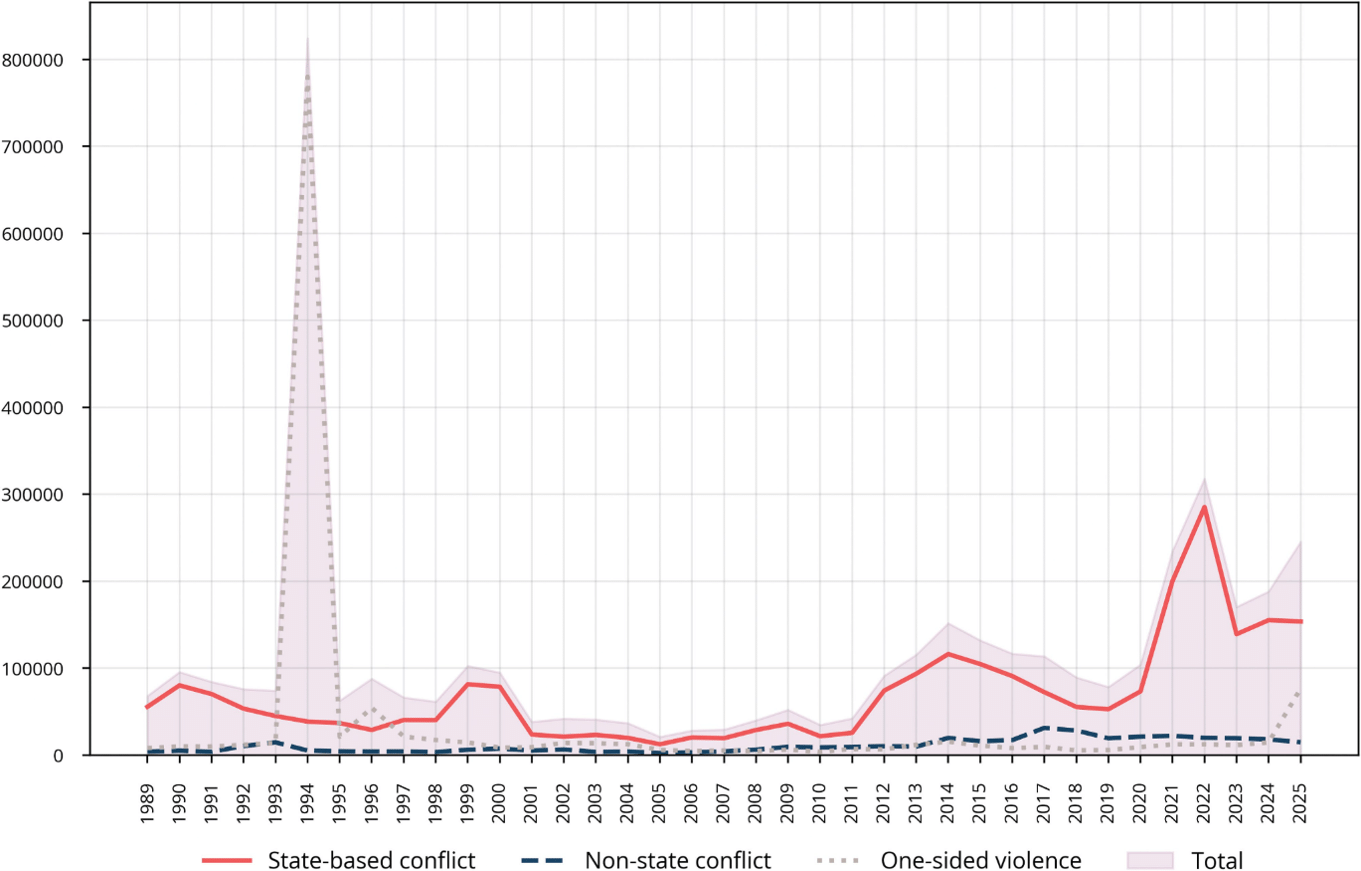
However, the distribution of global attention does not mirror this distribution of violence. SIPRI’s 2024 assessment identified only five major armed conflicts — Ukraine, Sudan, Israel-Palestine, Myanmar and Ethiopia — defined as conflicts producing more than 10,000 conflict-related fatalities in the year but do not necessarily receive comparable international attention.
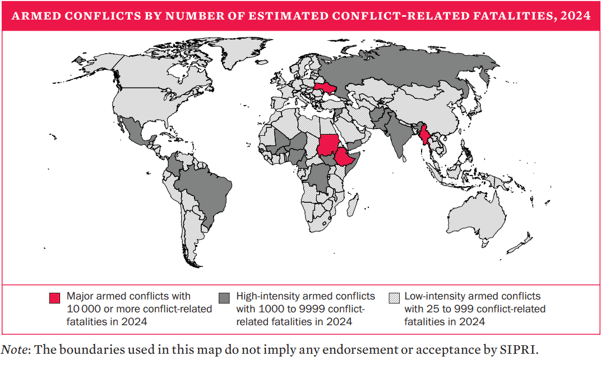
A conflict can be extremely violent but remain relatively peripheral in international news and diplomatic discussion.
This suggests that visibility is not determined by the scale of violence alone.
The comparison Media and Journalism Research Center’s study provides a strong empirical basis for the argument that media visibility does not necessarily correspond proportionally to humanitarian suffering.
| Conflict / Crisis | Media Coverage Indicator | Conflict / Death Indicator | Interpretation |
| Gaza | 58.5 articles/day | ~3.3 million people affected | Extremely high media visibility relative to humanitarian scale |
| Ukraine | 19.4 articles/day | Major, sustained death toll | Very high visibility, linked to European security and Russia-West geopolitics |
| Ethiopia | ~60× less coverage than Gaza | 20,000+ civilian deaths | Substantial suffering but considerably lower visibility |
| Sudan | ~600 new articles/month in early 2024 | 150,000 estimated deaths by 2026 | Extremely low visibility relative to death toll |
| Myanmar | Low international visibility | Major prolonged civilian/humanitarian crisis | Illustrates marginalisation of a long-running Global South conflict |
| Israel-Iran | 75 articles in one major news-event sample/day | ~600 deaths during the 12-day 2025 war | Very high event-driven attention despite much shorter duration |
(The source, exact time period, measurement unit and comparability of each indicator in the table above are set out in the Methodology, Section 5.3.)
The Gaza/Ukraine figures come from the Media and Journalism Research Center’s study of 78,667 articles across 10 humanitarian crises. Gaza averaged 58.5 articles/day and Ukraine 19.4. The same study found that Gaza received about 60 times the coverage of Ethiopia, while Ukraine received about 20 times Ethiopia’s coverage.
For Sudan, The Institute for Economics & Peace reports that Sudan’s war has produced more than 13 million displaced people, yet its media and diplomatic attention remain far below Gaza, Ukraine and Iran. The same analysis cites a median of 1,663 articles per death in high-income countries versus only 17.4 articles per death in low-income countries — almost a 96× difference.
The findings suggest that the construction of a conflict as a global concern cannot be explained exclusively through objective indicators such as fatalities or territorial scale. Rather, global visibility appears to be produced through a combination of conflict severity, geopolitical relevance, media selection and institutional attention.
2. Media Framing Constructs Conflict Visibility and Shapes Public Perception
The media is not simply a channel through which respondents receive information; it plays an important role in shaping how respondents understand global conflicts.
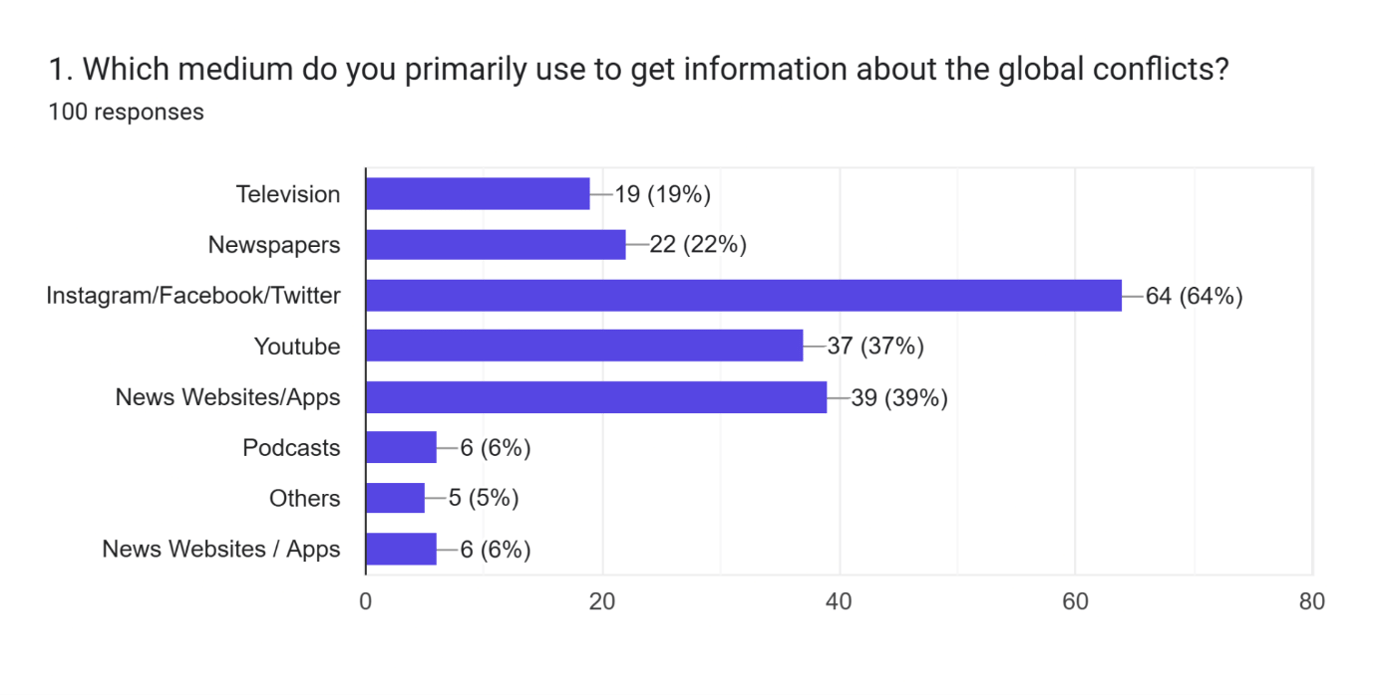
The survey demonstrates that among the 100 respondents, 64% identified Instagram, Facebook or Twitter as their primary medium for obtaining information about global conflicts, followed by news websites/apps (39%), YouTube (37%) and newspapers (22%). Thus, digital and social media constitute the dominant information environment for the surveyed population.
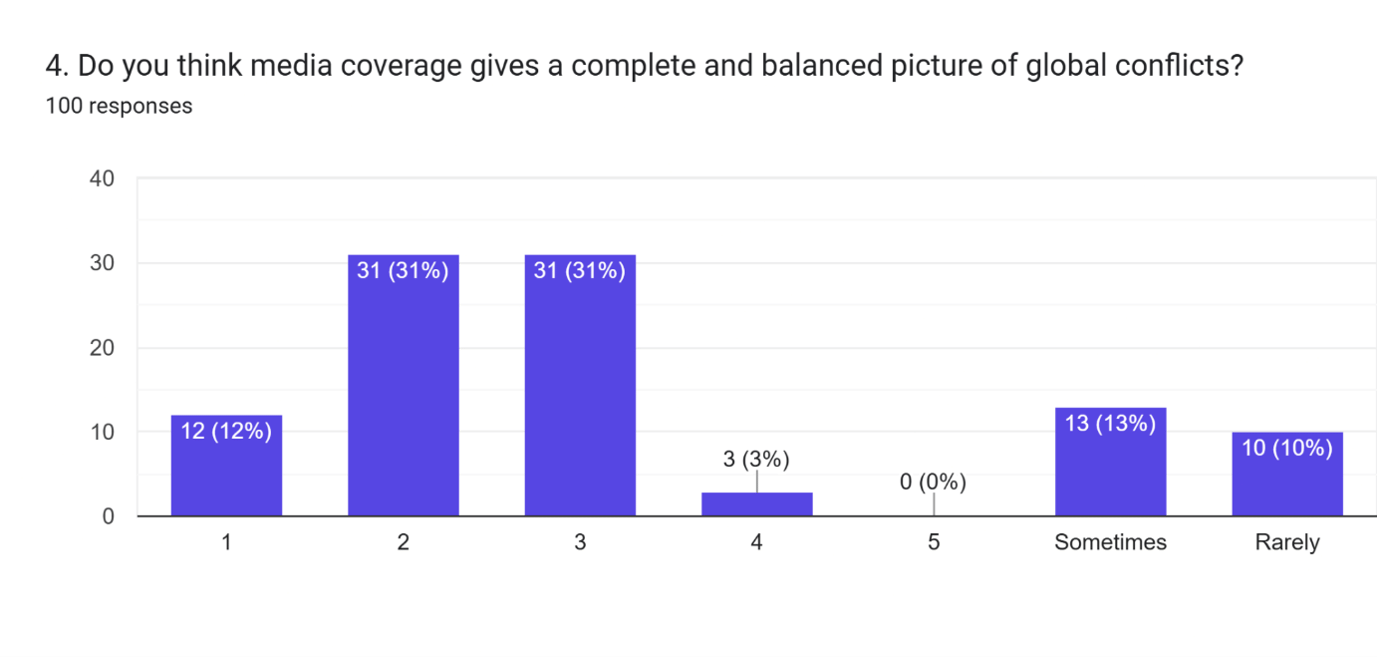
The respondents also perceived sensationalism in conflict reporting. The majority believed that headlines and thumbnails exaggerate the importance or seriousness of conflicts, while respondents strongly felt that media gives greater attention to violence and dramatic events rather than deeper causes and background. 62% of respondents rated the balance and completeness of media coverage between 2 and 3, suggesting that most respondents have a neutral or somewhat negative perception of how comprehensively and fairly global conflicts are presented by the media.
Interpretation
The survey provides audience-level evidence that respondents do not necessarily see media coverage as a neutral reflection of events. Instead, they perceive a process in which certain aspects of conflicts become more visible than others.
The finding that respondents perceive greater attention to dramatic violence is particularly relevant to the research question. When violence, destruction and emotionally powerful images receive greater attention than historical causes, political structures and long-term consequences, audiences may develop an understanding of conflict that is based primarily on immediate spectacle rather than structural context.
This can influence which conflicts appear urgent, understandable and deserving of attention.
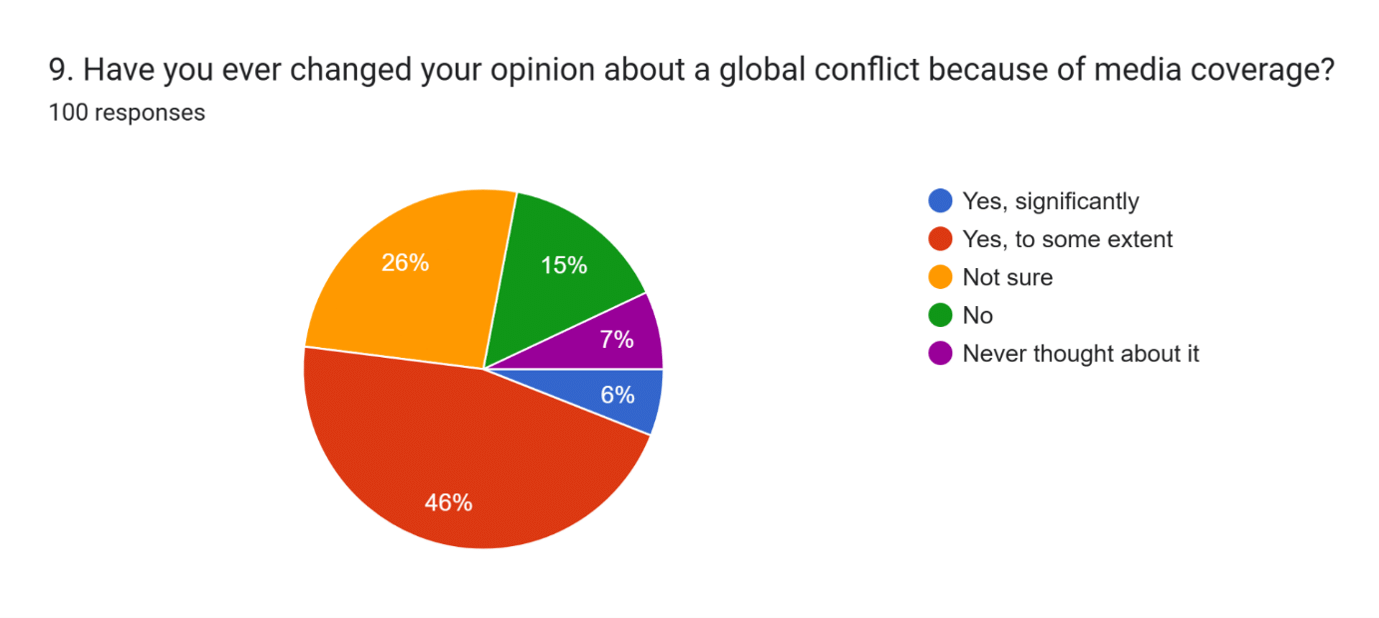
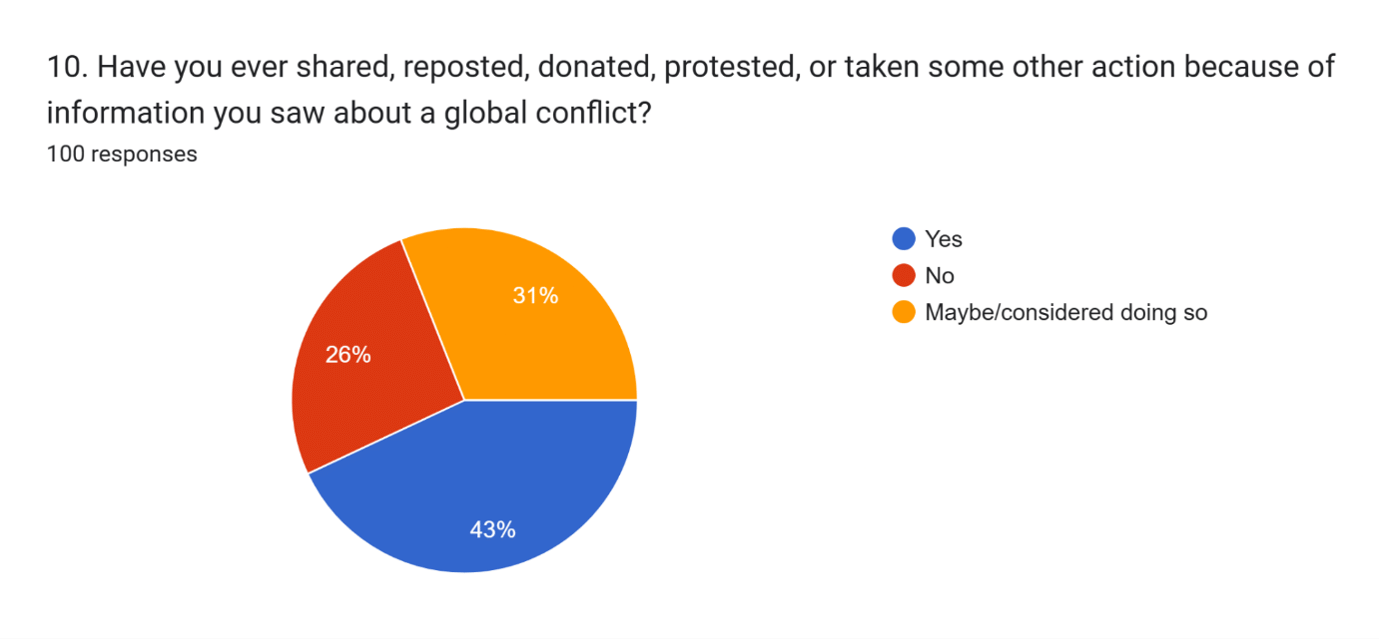
The survey also indicates that this framing has consequences for audiences. 46% of respondents indicated that media coverage had changed their opinion about global conflicts to some extent or significantly, while 74% had either taken action or considered taking action based on information received about a conflict.
3. Geopolitical and Political-Economic Interests Influence the Globalisation of Conflicts
International attention to conflicts cannot be explained exclusively through humanitarian severity. The rise of interstate conflicts from 2 to 8 is particularly relevant because interstate wars involve recognised states, alliances, strategic interests and great-power calculations. Such conflicts can more easily be presented as threats to international stability and the international order.
Media Coverage vs Civilian Deaths
The Institute for Economics & Peace reports:
High-income countries: 1,663 articles / civilian death
Low-income countries: 17.4 articles / civilian death
1,663 ÷ 17.4 ≈ 95.6
A civilian death in a high-income country is associated with roughly 96× more news articles than a civilian death in a low-income country in the cited comparison. This shows that economic interests and threat perceptions can influence which conflicts receive resources, diplomatic attention and sustained media coverage.
The survey provides an audience-level perspective on the political influences perceived to shape media reporting. Respondents identified:
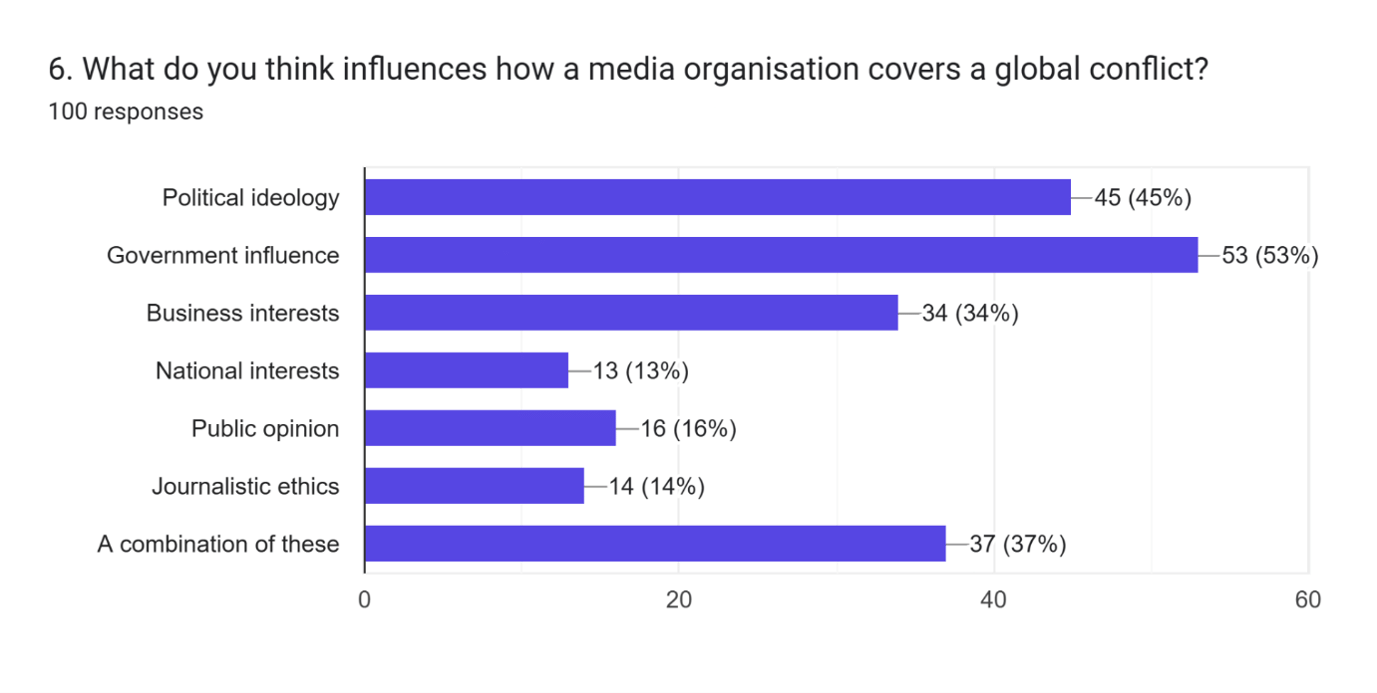
From the above, it can be concluded that respondents consider external political and institutional factors to have great influence on media reporting of global conflict. Government influence and political ideology emerge as the factors receiving the most answers. This shows that media reporting is influenced not only by journalism but also by politics and institutional interests.
Interpretation
This suggests that a conflict becomes “global” not simply because it is violent, but because it becomes connected to strategic interests, powerful states, alliances, economic networks and perceptions of threats to the international order. Consequently, geopolitical importance can reinforce media visibility, while media visibility can simultaneously increase political pressure for international action.
Conflicts lacking comparable geopolitical relevance may struggle to enter this cycle and consequently experience lower levels of international visibility. Thus, the distinction between highly visible and marginalised conflicts cannot be understood solely through differences in violence or humanitarian severity; it must also be understood through the unequal distribution of geopolitical power, economic interests, institutional attention and media visibility.
4. Postcolonial Hierarchies Shape Whose Suffering Becomes Globally Recognised
A large proportion of contemporary political violence occurs in countries of the Global South, yet the dominant international discourse may give greater prominence to conflicts involving powerful States or regions considered strategically important to Western interests.
This suggests a possible hierarchy of global suffering, where some conflicts are constructed as central to the international order while others are treated as peripheral, local or chronic. The distinction is therefore not simply between “more violent” and “less violent” conflicts, but between conflicts that are made globally visible and those that remain comparatively marginalised. A conflict occurring in a Global South country may be framed predominantly through: Ethnic or tribal conflict, religious violence, instability, terrorism, humanitarian catastrophe, corruption, chronic underdevelopment, or internal disorder. Such frames can reduce the visibility of historical, colonial, geopolitical and structural causes.
The marginalisation of some conflicts may reflect not only differences in geopolitical importance but also historically embedded hierarchies of representation that influence whose suffering is humanised, whose agency is recognised and whose violence is treated as internationally significant.
Gaza vs Ukraine vs Ethiopia
Crisis Relative Media Coverage
Gaza 60× Ethiopia
Ukraine 20× Ethiopia
Ethiopia 1× baseline
Gaza ████████████████████████████████████████████████████████ 60×
Ukraine ████████████████████ 20×
Ethiopia █ 1×
Here, Ethiopia functions as the baseline. The graph shows that the two conflicts receiving much greater international attention were not simply more visible because violence existed; they were positioned differently within global news and political narratives.
The 60× difference between Gaza and Ethiopia is especially significant. It indicates that the amount of international media attention surrounding these conflicts can vary enormously.
The 20× difference between Ukraine and Ethiopia similarly demonstrates that conflicts in the Global South can occupy a substantially more peripheral position in international news agendas even when they involve prolonged and serious violence.
The findings suggest that historically embedded representations can operate alongside contemporary media routines, geopolitical interests and political-economic structures.
CONCLUSION
This research addresses a fundamental question in international relations: How do media visibility and framing, shaped by geopolitical interests and postcolonial representations, influence which armed conflicts are constructed as global concerns and which remain marginalised? The question matters because it exposes how international attention to human suffering is distributed not according to humanitarian need but through systems of power that privilege certain conflicts and populations over others. Understanding this mechanism is critical for scholars, policymakers, and advocates confronting global inequality.
Our central argument is that conflict visibility operates not as a neutral reflection of violence severity but as a constructed outcome of intersecting media framing practices, geopolitical power structures, and historically embedded postcolonial hierarchies. This study’s contribution lies in empirically demonstrating these intersections rather than examining them in isolation. While existing literature explores media framing or postcolonial representation separately, this research synthesises these dimensions to reveal how they reinforce one another in producing global hierarchies of conflict attention.
The findings substantiate this argument compellingly. Sudan’s 150,000 deaths received approximately 600 articles per month in early 2024, while Gaza’s humanitarian scale generated 58.5 articles daily. Ethiopia’s 20,000 civilian deaths received 60 times less coverage than Gaza. These disparities are not explained by violence alone. Rather, our analysis reveals that media institutions actively construct significance through terminology, sourcing, and narrative selection. Crucially, 46% of surveyed respondents reported that media coverage changed their opinions significantly, and 62% rated coverage as imbalanced — demonstrating that framing directly shapes public understanding and engagement with distant conflicts.
Beyond media processes, geopolitical-economic structures determine visibility. The 96-fold difference in articles per civilian death between high-income and low-income countries reveals that humanitarian suffering is stratified by economic and strategic importance. Respondents identified government influence (53%) and political ideology (45%) as primary drivers of coverage, indicating that audiences themselves recognise media as embedded within political power rather than autonomous from it. Interstate conflicts involving powerful states receive disproportionate attention because they can be framed as threats to international order, while Global South conflicts are constrained by postcolonial representational frames depicting regions as chronically unstable or naturally violent.
The research’s contribution is demonstrating that marginalisation of Global South conflicts reflects systematic structural forces rather than individual media failure. Media visibility reinforces geopolitical priority, which shapes further attention, creating self-reinforcing cycles. This means that strategic invisibility becomes a structural feature of global inequality.
Implications and Significance
Nationally, policymakers must recognise that media coverage influences resource allocation and diplomatic priority. Globally, populations in marginalised conflicts — Sudan, Ethiopia, Myanmar — face not only violence but international invisibility, constraining humanitarian aid and diplomatic pressure. This exposes how international systems perpetuate inequality through representation itself.
Limitations
The survey sample (90-110 respondents) from primarily India, Bangladesh, and Nigeria limits geographical representation. Sampling was non-random through family and college networks, affecting generalisability. Future research should employ larger, randomised samples across diverse geographical contexts and employ qualitative media analysis examining specific framing patterns across outlets and time periods. Research examining how alternative media platforms challenge these hierarchies would also illuminate pathways for disrupting established cycles of visibility.
REFERENCES
- Guo, Y., Duan, X., & Yang, X. (2025). Valuing or devaluing nuclear weapons in war journalism: A cross-national comparative content analysis of news coverage during the Russian war in Ukraine. Humanities and Social Sciences Communications.
- Omairi, H. T. L. (2025). Content Analysis of Media Coverage on Gaza and Ukraine Conflicts. Wasit Journal for Human Sciences. The study compares BBC and CNN framing, terminology and narrative strategies across the two conflicts.
- Alhirthani, M. (2025). Media coverage of human rights in Palestine, case study: Israel’s war on Gaza 2023-24. Journal of Arab & Muslim Media Research.
- Pachauri, S., & Singh, V. (2025). Representation of the Global South in Western News Media: A Postcolonial Analysis. Journal of Informatics Education and Research.
- Doğutaş, A. (2026). Selective Humanitarianism: Western Media Bias and the Silencing of Gaza. TRT Akademi, 11(26), 236-267.
- Ongenaert, D., & Soler, C. (2024). Beyond victim and hero representations? A comparative analysis of UNHCR’s Instagram communication strategies for the Syrian and Ukrainian crises. Journal of Refugee Studies, 37(2), 286-306.
- Allan, S. (2025). Visual War Journalism. Digital Journalism, 13(1), 1-17. This is particularly useful for the concept of conflict in/visibility and the hierarchy of attention within Western news.
- Lundgren, M., & Klamberg, M. (2023). Selective Attention: The United Nations Security Council and Armed Conflict. British Journal of Political Science, 53(3), 958-979.
- Entman, R. M. (2010). Media framing biases and political power: Explaining slant in news of Campaign 2008. Journalism, 11(4), 389-408. Entman argues that slanted framing results from interactions among real-world developments, cultural norms, journalistic rules and elite attempts to influence the news.
- Said, E. W. (1978). Orientalism. Pantheon Books.
- Herman, E. S., & Chomsky, N. (1988). Manufacturing Consent: The Political Economy of the Mass Media. Pantheon Books.
- SIPRI. The SIPRI data for 2024 records five major armed conflicts involving more than 10,000 estimated conflict-related fatalities: Israel-Hamas, Russia-Ukraine, Myanmar, Sudan and Ethiopia.
- Reuters Institute for the Study of Journalism (2026). Why do some wars don’t make headlines? Its cited analysis found more than 1,600 articles per conflict-related civilian death in high-income countries, compared with 17 in low-income countries. Why do some wars don’t make headlines?
- Dragomir, M. (2025). Humanitarian Crisis Coverage Report. Media and Journalism Research Center. This study examines how media attention is distributed across humanitarian crises and analyses disparities in coverage, framing and relationship between media visibility and humanitarian severity.
- Institute for Economics & Peace. (2026) The report examines global conflict systems, the mechanisms through which conflicts spread across the borders, and increasing interconnection between conflict clusters such as the Horn of Africa and the Greater Middle East.
APPENDIX A: SURVEY INSTRUMENT
The survey responses collected for this study are provided in Appendix A. The responses correspond to the structured questionnaire described in Section 5.1 (Primary Data) and cover respondents’ news-consumption habits, awareness of global conflicts, and perceptions of media coverage across the sampled age groups. The full dataset can be accessed here: Survey Responses.