Authors: Bontu Berhanemeskel, Twinkle Bunkar, Janvi Chopra, Krusha Desai, Sakina Nadeem, Reesha Salian, Adhiti Vishwakarma
Publication Date: 20th September, 2026
Abstract
This study examines how international trade agreements and trade volumes influence the economic growth of countries. International trade agreements are widely regarded as important instruments for promoting economic growth by expanding market access, increasing trade and investment, encouraging technology transfer and strengthening regional economic integration.
A quantitative methodology was utilized, combining a systematic review of existing literature with the descriptive statistical analysis of long run treads in trade-to-GDP ratios and economic growth from 1960 to 2024. The study reviews relevant literature published between 2015 and 2025 to assess the relationship between trade agreements, trade volumes, and economic growth. The findings indicate that the growth effects of trade agreements remain contested. Some studies identify positive or weak effects, while others find weak or statically insignificant results. Others find weak or statistically insignificant results, and still others emphasize that benefits are unevenly distributed across countries, sectors, and income groups.
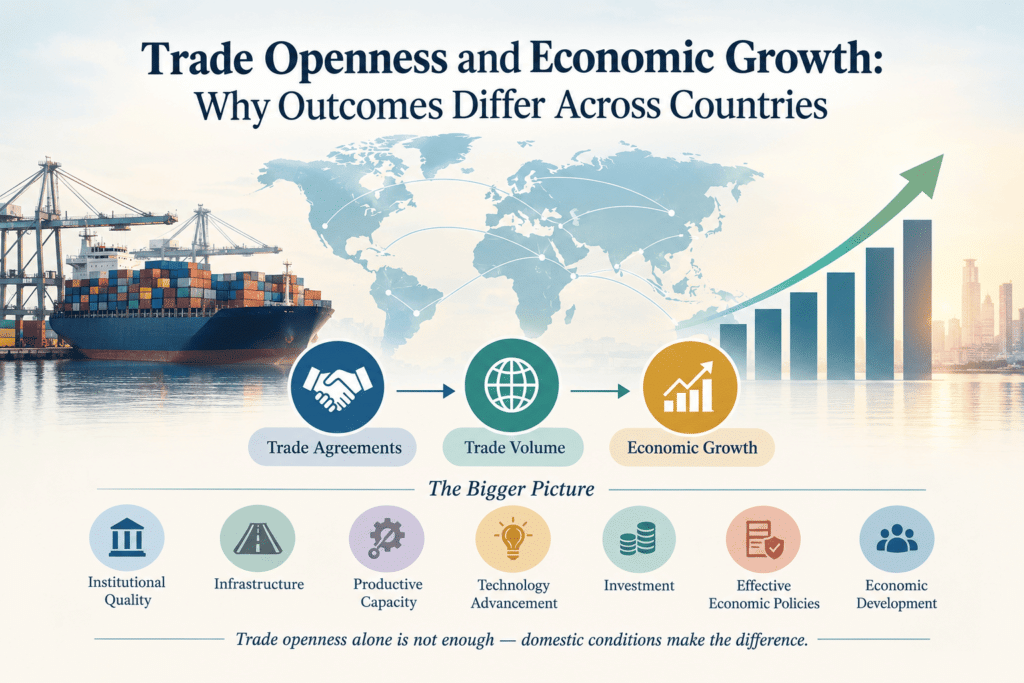
Through a thorough review of studies, this paper highlights how the mere existence of the International Trade Agreement and increased trade volume does not necessarily guarantee economic growth. Rather, the country’s specific institutional quality, infrastructure, productive capacity, technological advancement, investment, effective economic policies and economic development do have a critical impact on its effectiveness.
This study concludes that trade agreements are not automatic ends on themselves. Instead, their ability to generate sustainable and inclusive growth depends upon domestic complementary conditions such as strong institutions, infrastructure, productive capacity and inclusive policies. Without these, trade openness may produce limited and uneven benefits.
1. Introduction
International trade agreements have emerged as one of the key tools of economic policy for various countries as a means of expanding market access, boosting competitiveness, reducing tariffs and other regulatory hurdles, thus ensuring more predictable conditions for conducting international business. The rationale behind international trade agreements is based on well-known economic theories: a reduction in the cost of international transactions, such agreements should lead to market expansion, specialisation through comparative advantage, and the opportunity to take advantage of economies of scale (Jahan & Al-Harbi, 2023). These processes, in turn, should lead to higher productivity, increased investments, and economic growth. Yet the empirical evidence on whether trade agreements actually deliver these growth dividends remains mixed, with some studies identifying positive effects, others finding weak or statistically insignificant results, and still others emphasising that benefits are unevenly distributed across countries, sectors, and income groups.
This ambiguity arises out of a deeper problem. Trade agreements are legal arrangements through which countries develop rules and trade barriers, while trade openness refers to the actual volume of foreign transactions of a country, usually expressed in terms of the share of imports and exports to the gross domestic product (Fujii, 2018). The presence of an institution does not imply any real trade opening, and vice versa. Therefore, any research that analyses a trade policy by counting the number of trade agreements signed can yield completely different results from those which examine the actual trade level, making it impossible to derive any generalizable insights into the topic.
The reason behind why trade agreements can lead to economic growth stems from the difference between static and dynamic benefits from trade. Static benefits result from specialization in producing the goods in which the country enjoys comparative advantages, which leads to efficient allocation of labour, capital, and other factors of production within the economy (Zhang, 2013). Dynamic gains, however, arise through technological spillovers, innovations and learning through international business interactions over longer periods of time. They have potential to promote structural transformation by moving resources towards more productive use, but the actualization of this potential highly depends on the trade policy coherence with the domestic development strategy and assistance to local companies (Tien & Anh, 2019).
A study on ASEAN developing countries also found that higher trade openness might foster growth through promoting trade and investments, but stress the importance of appropriate policies, institutions and additional reforms (Bang, Nam & Ryu, 2024). Similarly, Arisman, Al Arif, and Harahap (2023), in their analysis of differences between D-8 member countries and non-members, found that regional cooperation is positively linked to growth, while political stability, exports and human development have additional positive effects on growth.
However, empirical research by Hur and Park (2012) hasn’t directly linked trade agreements with a universal growth effect. The study found no statistically significant impact of being a Free Trade Agreement (FTA) member on aggregate economic growth of member countries in the first decade after the adoption. This divergent evidence demonstrates that the agreements for trade generate growth opportunities, but their results vary based on the specific features of the countries involved in such agreements, as well as on the agreements themselves and the environment within countries.
Another dimension of trade is related to the nature of traded products. Ekanayake, Madsen, and Bharati (2023), show that high-technology exports and imports have more positive effects on growth compared to trade of primary and low-technology products. Countries, which exchange technologically advanced products, experience higher levels of growth in productivity and income. This evidence suggests that not only the amount of trade, but also the quality of the products might be an important factor in generating growth. Karam and Zaki (2015), similarly differentiate between trade in goods and trade in services in MENA countries and state that while both have positive impacts on growth, goods trade has greater effects on growth.
This study seeks to explore the impacts that industrial capacity, institutional strength, infrastructure and economic development have on the growth effects of free trade agreements. As opposed to the analysis of individual agreements’ impact, the study utilizes a descriptive approach to analyse long-run trends in trade openness and GDP growth for 1960 to 2024 based on World Bank data. Such an approach adds an international empirical dimension to the existing literature on free trade agreements as it allows evaluating the heterogeneous results of agreement-specific and region.
This study also examines the relationship between trade openness and economic growth using World Bank data covering 1960-2024. Instead of estimating the causal impact of each trade agreement, our empirical analysis seeks to identify long term patterns of trade openness and GDP growth per annum across various countries. The descriptive findings that have emerged have been interpreted alongside the examined breadth of literature, which in turn has been observed to suggest that the economic effects of trade integration vary depending on the reliability of institutions, productive capacity, infrastructural prowess, trade composition, and other domestic conditions.
2. Literature Review
The relationship between economic growth and international trade agreements has been a point of extensive academic debate. Generally, trade agreements are expected to encourage economic growth by reducing the barriers to exchange, expanding access to foreign markets, and as a consequence, increasing the movement of goods and services across economies. Larger trade volumes have also shown to improve the allocation of resources (Blyde & Iberti, 2012), encourage specialisation, trigger the globalisation of economies, and as a result grow the domestic economies by exposing local firms to international markets and the competition they bring.
Existing literature does not explicitly state that trade agreements automatically lead to increased economic growth, but their effects appear to be more nuanced. In that, they assess to which extent they generate efficient trade, improve productivity, and deepen economic integration on an international scale.
A very clear distinction must be made between trade agreements and trade openness. Trade agreements are institutional and legal arrangements through which countries reduce trade barriers, establish rules, and encourage international trade relationships (Rodrik, 2018). Trade openness on the other hand, refers to the extent to which an economy participates in international trade and is often measured through portraying the total value of imports and exports as a percentage of the GDP (Fujii, 2018). Trade agreements may increase trade openness, but the existence itself of the agreement does not guarantee that trade volumes will expand or that it will lead to economic growth.
This literature review examines theoretical and empirical research on the relationship between trade integration and economic growth, covering evidence from the 1960s to the 2020s. It considers bilateral free trade agreements, regional trade arrangements, and broader measures of trade openness across both developed and developing economies. Since a large degree of the empirical literature measures trade openness rather than agreement membership directly, the review distinguishes between the effects of formal trade agreements and the effects of the trade flows that may result from them.
The review is organised around the argument that trade agreements create potential channels for growth, but that the realisation and distribution of these benefits depend on domestic institutions, productive capacity, trade composition, and complementary government policies.
2.1 Theoretical Channels Linking Trade Integration and Economic Growth
The theoretical benefits of international trade can be divided into static and dynamic gains. Static gains arise when countries specialise in goods and services they can produce more efficiently, it looks at who holds the comparative advantage in production. By exporting products in which they possess a comparative advantage and importing products that are more expensive to produce domestically, economies stand to improve the distribution of labour, capital, and other resources. Consumers benefit from lower prices as well as an increased range of products to choose from, and access to foreign goods (Zhang, 2013).
Trade agreements support these processes because they lower tariffs, simplify customs procedures, reduce regulatory and administrative uncertainty, and improve market access. Access to larger markets consequently firms to take advantage of economies of scale and results in increased production and reduced average costs (Jahan & Al-Harbi, 2023). Concurrently, greater exposure to international competition can encourage inefficient firms to improve their productivity.
A pattern emerges over a relatively long period of time as we start seeing technological diffusion, innovation, and learning that has been facilitated by international trade. Firms import advanced machinery and intermediate inputs, while exporters acquire market knowledge, international quality standards, and production methods.
While static gains mainly improve the immediate allocation of existing resources, dynamic gains concern the longer term effects of trade on productivity, innovation, and productive capacity.
Tien and Anh’s study of Vietnam is a prime example of dynamic gains where reallocated resources help in the infrastructural development of a nation. The authors argue that international trade policy supports growth as a result of a country exploiting its comparative advantage, and hence, expanding production and restructuring its economy towards more productive activities. However, these benefits depend on trade policy being aligned with domestic development objectives and accompanied by support for local businesses (Tien & Anh, 2019).
In addition to this trade based static and dynamic mechanisms, agreements may influence growth through a third channel, that is foreign direct investments.
Trade agreements have also been observed to influence growth through foreign direct investments. When policy is more predictable, and consequently more stable, it encourages multinational firms to invest in member countries to gain access to local or regional markets. These are the investments that in turn contribute to employment, capital formation, technology transfer, and integration into the international trading system. The larger developmental effects of trade agreements depend mainly on whether or not the foreign investment creates links with domestic suppliers and workers (Jensen, 2010).
However, these effects are stronger when foreign firms establish linkages with domestic suppliers, transfer knowledge to local workers, and reinvest within the host economy. FDIs contribute to dynamic productivity gains, we treat it separately here because it represents a distinct investment based mechanism.
2.2 Empirical Evidence on Trade Integration and Growth
Although these mechanisms explain why trade agreements could promote growth, empirical research must determine whether these predicted benefits consistently appear in practice.
The first empirical theme deals with whether or not trade agreements and greater trade openness produce a measurable increase in aggregate economic growth. The evidence is mixed because a wide array of studies examines different countries, periods of time, definitions of integration, and methods of identification. It has also been observed that some studies report positive relationships between trade integration and economic performance, while others find weak or uneven effects.
Hur and Park provide one of the most relevant studies because they directly examine whether bilateral FTAs increase the growth of participating countries. Using data for 88 countries between 1971 and 2003, they compare FTA country pairs with similar non-FTA pairs. Their matching methodology addresses the fact that countries do not enter agreements randomly and may already differ in income, institutions, education, geography, and openness which eventually leads to a difference in the kind of economic impact FTAs have on each country.
The study does not find any statistically significant effect of FTA membership on the combined growth of member countries during the first one to ten years following implementation. However, some estimated effects are positive, but they are too small or uncertain to unequivocally conclude that FTAs caused the higher growth. The authors also find that growth differences between participating economies only increase over time, indicating that benefits may be unevenly distributed.
Hur and Park suggest two possible explanations. The first being that FTAs support growth only when they facilitate technology transfer and productivity improvements. Secondly, positive effects from trade creation are offset by trade diversion (Hur & Park, 2012).
Trade creation occurs when an agreement replaces inefficient domestic production with more efficient imports from a partner. Trade diversion, contrastingly, occurs when preferential treatment redirects imports from a more efficient non-member towards a less efficient member country. Therefore, increased trade within an agreement does not produce equivalent improvements in welfare or growth, in some cases, even doing the opposite (Krueger, 1999).
Other studies have been observed to identify more positive effects. Bang, Nam, and Ryu, for example, examine trade openness in developing ASEAN economies using panel data and econometric models. Their findings suggest that greater openness can support growth by encouraging trade and investment. However, they emphasise that the benefits significantly depend on effective government policies, strong institutions, and reforms that would enable firms to take advantage of the resulting market access (Bang et al., 2023).
Research on the Developing-8 countries have also found a positive association between regional cooperation and growth. Arisman, Al Arif, and Harahap compare eight D-8 members with eight nonmember countries using fixed-effects panel regression. Their model includes political stability, population, exports, and human development (Arisman et al., 2023). D-8 membership is positively associated with growth, while political stability, exports, and human development also have positive effects. Together these studies have been observed to suggest that trade cooperation may contribute to growth, but it operates alongside domestic stability and human development rather than independently.
These studies differ substantially in the way that they identify and define the relationship between trade and growth. Hur and Park use a matching approach to compare bilateral FTA participants with observationally similar non-participants. This directly addresses the specific selection of countries into agreements.
Bang et al. on the other hand examine how open trade is, through panel econometric models. This means that their analysis captures the broader relationship between trade and growth than examining one particular agreement.
A third comparison, Arisman et al. use a fixed-effects panel regression and a regional membership variable that allows them to account for characteristics of countries that are not observed but remain constant over time.
These contrasting findings, therefore, reflect the differences in the independent variable, unit of analysis, time period, identification strategy, and geographical differences. Studies that measure openness may find stronger associations since they examine real trade activity. Studies that measure formal FTA, on the other hand, end up examining agreements that have not produced any significant changes in trade.
Overall, the empirical evidence does not support a universal growth effect. Trade agreements may create opportunities, but outcomes depend on member characteristics, implementation, and complementary domestic policies.
Institutional and productive capacity explains whether or not a country can respond to new market opportunities, they do not, however, posit an explanation why similar increases in trade levels can be associated with different growth outcomes. Another consideration is that countries which expand on sophisticated technology experience productivity spillovers, while the countries that primarily increase exports of unprocessed commodities do achieve higher trade volumes without the same kind of structural transformation.
2.3 Trade Composition and Productive Capacity
A limitation of focusing only on aggregate trade volume is that it does not account for what countries trade. Economies with similar trade-to-GDP ratios may differ substantially in technological capacity, complexity in export, and their participation in international trade (Krugman et al., 1995).
Ekanayake, Madsen, and Bharati have examined 223 countries between 1962 and 2019 and have classified trade according to product sophistication. Their findings portray that high-technology exports and imports have stronger positive effects on long-term growth than primary or low-technology goods (Ekanayake et al., 2023). Countries trading technologically sophisticated products also experience stronger productivity and income growth.
Although this also points to the effect that countries that trade in such sophisticated products, initially have the means of production, i.e. a well-developed infrastructure, the presented evidence suggests that the quality of trade may matter as much as its quantity. High-technology imports provide access to machinery and productive inputs. While high-technology exports encourage innovation, skilled employment, and facilitate movement into higher-value activities. Contrastingly, countries that are dependent on raw materials may increase trade volumes without achieving similar productivity gains.
Karam and Zaki draw a comparison between the trade of goods and services in 18 MENA economies between 1960 and 2011. They find that both contribute positively to growth, although goods trade seems 10 to have a stronger estimated effect. Services remain important, particularly when supported by liberalisation and structural reform (Karam & Zaki, 2013).
These studies reiterate that trade-to-GDP ratios provide an incomplete picture. High openness reflects advanced manufacturing, digital services, commodity dependence, or re-export activity. The present report also supports this limitation. Economies with the highest ratios include Djibouti, Singapore, Hong Kong, and Luxembourg, that function as ports, financial centres, or re-export hubs. Their openness reflects geography and economic structure as well as strength in policy (Nordås et al., 2006).
2.4 Institutions, Agreement Design, and Distribution of Gains
Siddiqui, however, brings a more critical interpretation. His review concludes that liberalisation does not guarantee development and may increase vulnerability, reduce policy autonomy, and deepen dependence on global markets. He makes the argument that successful economies such as South Korea and Singapore have historically relied not only on openness but also on state intervention, institution building, and industrial policy (Siddiqui, 2019).
Siddiqui’s argument, instead of contradicting the claim that trade increases aggregate output, posits a challenge to the assumption that liberalisation is sufficient to produce comprehensive development. Recent evidence further continues to associate open trade with higher GDP, especially in emerging economies. This, however, does not prove that benefits are evenly distributed or even that all liberalisation produces similar results. (Raghutla, 2020)
Hur and Park also indicate that asymmetries between agreement partners matter. Smaller economies receive weaker benefits when agreements do not generate balanced technology transfer or productivity improvement (Hur & Park, 2012).
Therefore, the impact of an agreement depends not simply on whether a country is developed or developing, but on its productive capacity and bargaining position.
Even when trade agreements increase aggregate income, often their benefits are distributed unevenly. Exporters, investors, and consumers may gain, while firms and workers in import-competing industries experience declining production, wage pressure, or unemployment. Aggregate GDP figures may therefore conceal significant sectoral and regional losses (Krugman et al., 1995).
Empirical evidence from the United States illustrates this problem. Autor, Dorn, and Hanson have observed that the regions that are more exposed to Chinese import competition have experienced steady 11 declines in employment rates and per capita income. These effects were seen to have been visible all throughout 2019 and were significantly more concentrated in geographical areas with higher rates of illiteracy and early industrial specialisation. We use this example to demonstrate the way aggregate consumer and national gains from trade coexist with long lasting localised losses. (Autor et al., 2021)
Rodrik argues that modern agreements extend well beyond the traditional tariff reduction. They increasingly include intellectual-property protections, investor rights, regulatory harmonisation, and rules that govern services and capital. Such provisions benefit multinational firms and industries without having any real contribution to broad social welfare (Rodrik, 2018).
This perspective highlights the importance of agreement design. Trade agreements remove barriers, but they also establish rules that dictate bargaining power and influence domestic regulation. An agreement that expands trade while producing unequal outcomes across countries, firms, workers, and regions is not one that is well designed.
The World Trade Organisation (WTO) further evidence that the expansion of regional agreements does not imply equal growth in preferential trading. Between 2010 and 2022, the proportion of imports that involve RTA partners has considerably increased, while on the other hand, the share of imports receiving these preferences has risen more modestly. This supports the distinction between formal agreement coverage and the utilisation of trade preferences. (Acharya & Parajuli, 2025)
Therefore, adjustment policies matter. Education, social protection, infrastructure, competition policy, and support for domestic firms, all determine whether or not growth from trading activities is inclusive. Without these policies, the costs of liberalisation stand concentrated among groups that are least able to adapt (Flakey et al., 2010).
More recent regional agreements prove to be useful examples of the broader idea being posed by the literature. Comparing agreements at various stages and depths of integration shows us why formal agreement alone proves to be an insufficient measure of economic integration.
These theoretical and empirical concerns are particularly relevant to the AfCFTA, whose potential side effects depend on both the design of the agreement and the ability of diverse member countries to benefit from it.
The African Continental Free Trade Area illustrates both the potential and limitations of regional integration. It seeks to reduce tariffs on approximately 90% of goods, promote intra-African trade, support industrialisation, and strengthen regional value chains (Ajewumi et al., 2024).
Preferential trading here began only recently, and because of this the evidence of its long-term GDP impact is yet to be formally observed. The assessments that do exist today, tend to rely mainly on projections and early implementation experiences rather than long-term causal analysis.
World Bank simulations project that full implementation could increase African income by as much as 9% by 2035, create nearly 18 million additional jobs, and help up to 50 million people leave extreme poverty (World Bank, 2020). These benefits, however, rely on reducing non-tariff barriers, improving infrastructure, and strengthening policy coordination.
UNECA’s 2025 assessment reports early progress through initiatives that have tested customs procedures and tariff preferences. It also emphasises that inadequate infrastructure, slow implementation, and weak coordination continue to limit the agreement’s effects (UNECA, 2025).
We can draw differences between the AfCFTA and other more established regional agreements in both institutional depth and stages of implementation. The European Single Market represents a deeper form of integration that is supported by common institutions, legal enforcement, the movement of goods, services, capital, and labour. This indicates that long standing institutional coordination generates substantial economic growth, while maintaining that sustained regulatory barriers limit integration. (Durá & Pasimeni, 2025) (Bernasconi et al., 2025)
ASEAN is a more relevant comparison to the AfCFTA in terms of economic heterogeneity and gradual implementation. This integration model relies heavily on intergovernmental coordination, tariff standardisation, trade facilitation, and coordination than just the multinational institutional structure that is used in the European Union. This suggests that the AfCFTA progresses but requires continuous customs coordination among its member countries. (ASEAN Economic Integration, 2024)
Finally, USMCA demonstrates that more concentrated localised provisions produce benefits as well as incur costs: its automotive rules have been noted to support domestic production and employment as well as increase vehicle production costs, reiterating the fact that agreement design holds the power to redistribute gains across industries. (United States International Trade Commission, 2023)
2.5 Synthesis and Research Gap
Overall, this literature review leads us to three important insights. The first being, that a formal agreement membership is not a perfect measure of economic integration since agreements differ in their scope and implementation. Secondly, trade influences growth. It does this through the reallocation of resources, but this still very heavily relies on the domestic absorptive capacity of the member countries themselves. Third, and finally, trade composition provides an explanation for similar levels of trade openness producing different outcomes in different economies.
These insights also help us understand the empirical findings better. The findings are a result of genuine differences between different economies but also from variation in agreement design. Studies elaborated on above have measured various concepts like agreement membership, regional cooperation, trade restrictions, trade openness, and trade composition among others. Subsequently, the literature has been observed to support neither, the theory that trade integration is the only cause of growth or that it is generally ineffective. Alternatively, we can confidently conclude that the relationship between free trade agreements and their growth effects is highly conditional.
Existing research provides us with mixed evidence on the relationship between trade integration and economic growth. This inconsistency is further reflected in the differences in how trade integration is measured. As observed, some studies look at formal trade agreement membership, while some others focus more on regional cooperation, trade restrictions, trade openness, or the composition of trade.
Studies also differ in the way that they establish geographical coverage, time periods, and their research methodologies. Subsequently, evidence from individual agreements and regional samples don’t necessarily reveal the relationship between trade volume and growth on a global scale.
This study addresses these limitations using a long-term descriptive analysis of trade openness and GDP growth per annum from 1960 to 2024. Rather than estimating the causal effect of individual trade agreements, we examine whether higher trade openness is associated with higher GDP growth per annum, and how the observed variation in this relationship looks across different levels of trade openness. The analysis, therefore, provides an international empirical baseline that complements the structure of the evidence found in existing literature.
This study does not make an attempt at establishing causality or determining which institutional structural conditions explain developmental differences across countries.
3. Research Methodology
3.1 Research Design
This study uses a mixed method descriptive research layout that combines a structured review of the existing literature and a quantitative analysis of long term international trade and economic growth data. The purpose of the literature review is to examine the theoretical means and domestic conditions that shape the relationship between trade integration and economic growth. The quantitative aspect of this paper has been utilised to complement this evidence by identifying broad patterns in trade openness and the growth of GDP per annum, across countries, and over time. The empirical analysis here is descriptive and is not used to estimate the causal effects of each of the individual trade agreements discussed.
3.2 Literature Review and Study Selection
Five academic databases were selected for the literature search: Google Scholar, JSTOR, ScienceDirect, SSRN, and SpringerLink. These databases were chosen because they provide extensive peer-reviewed publications on international trade, free trade agreements, economic integration, and economic growth.
The search parameters focused on studies examining Free Trade Agreements (FTAs), trade volume, regional trade agreements, international economic integration, and economic growth. The review prioritises the studies published between 2015 and 2025 to ensure that it reflected recent developments in global trade policy, however, other earlier studies have been utilised to establish strong theoretical frameworks or important empirical benchmarks.

The 52 records identified from the selected databases were advanced to the screening stage to identify duplicate records. During this process, 4 duplicate records were removed, leaving 48 records for screening, as illustrated in Figure 1.
During the screening stage, 12 records were excluded because they did not meet the basic selection criteria, reducing the number of studies to 36. All 36 reports were successfully retrieved, with no irretrievable cases.
The retrieved studies were then assessed for eligibility. The inclusion criteria were:
(a) studies examining the relationship between trade agreements and economic growth,
(b) studies analysing trade volumes or international economic integration, and
(c) empirical research on major trade agreements such as AfCFTA, USMCA, CPTPP, and the EU– South Korea FTA.
During this stage, 18 studies were excluded because they were not directly related to the research objectives or lacked sufficient empirical evidence.
At the end of the selection process, 18 articles were included in this review. These studies directly address the research topic and collectively provide the supporting evidence for the analysis and discussion presented in this paper.
3.3 Quantitative Data and Variables
The quantitative section of this paper uses World Bank World Development Indicators data spanning 64 years from 1960-2024. This dataset contains 15,104 country-year observations that move across 267 countries and regional bodies. There are two principal economic variables that have been used here: GDP Growth per annum and Trade as a percentage of GDP. The latter has been interpreted as a measure of trade openness and has been calculated using the relative significance of imports and exports in the economy, rather than using it as a measure of absolute trade volume. It can also be influenced by structural factors such as economic size, geographical remoteness, land area, and access to ports, which may affect trade intensity independently of trade liberalisation or trade agreements.The indicator captures only the value of goods and services traded and does not account for FDI, financial flows, investment provisions, welfare effects, or the distribution of gains and losses arising from trade agreements.
The quantitative analysis is descriptive in the way that it first examines the distributions of GDP Growth per annum and trade openness to get a fair understanding of broad underlying patterns and statistical outliers. Secondly, the simultaneously occurring relationship between trade openness and GDP growth has been examined using both a scatterplot and Pearson correlation coefficient. Finally, annual averages have been used to observe long run changes in trade openness and GDP Growth between 1960 and 2024, and country level averages have been used to distinguish particularly high trade to GDP ratios.
3.4 Scope and Methodological Limitations
However, the empirical analysis is subject to limitations. The first being that the dataset does not contain information on specific trade agreements, agreement membership, or implementation dates, and therefore, cannot estimate the effects of individual agreements. Secondly, variables such as institutional quality, infrastructure, industrial capacity, investment, political stability, and human capital are not 17 included. They are, as a result, examined through the literature lens rather than the quantitative one. We have also come to the conclusion that the use of pooled descriptive data does not address endogeneity or reverse causality between trade and growth. Subsequently, the results must be interpreted as being descriptive associations rather than absolute causal effects.
The trade-to-GDP ratio is also subject to the limitations that it can fluctuate due to commodity price movements and changes in global demand, rather than changes in trade policy or agreement effectiveness. In such a scenario it will be difficult to analyse its effectiveness. Consequently, cross country comparisons of trade to GDP ratio may disadvantage large economies whose economic activity is predominantly domestic.
Four regional trade agreements have been used as illustrative comparative examples to draw differences in implementation, institutional capacity, and design of the trade agreements that correspond with the broader themes that have been evaluated in the literature.
3.5 Case Study and Framework
Case Study 1: African Continental Free Trade Area (AfCFTA)
The African Continental Free Trade Area (AfCFTA), established by the African Union in 2021, is the world’s largest free trade agreement by number of participating countries. It seeks to create a single African market by eliminating tariffs, facilitating the free movement of goods and services, and strengthening regional economic integration. According to the World Bank (2019) and the African Union Commission (2021), AfCFTA has the potential to increase intra-African trade, improve industrial productivity, attract foreign direct investment (FDI), and promote sustainable economic growth across the continent.
AfCFTA aims to remove tariffs on approximately 90% of goods traded within Africa while reducing non-tariff barriers that have historically limited regional commerce. The agreement is expected to stimulate manufacturing, improve regional value chains, and encourage investment by providing businesses with access to a larger integrated market. The World Bank projects that the agreement could substantially increase intra-African exports and improve income levels by expanding market opportunities and enhancing competitiveness.
Despite these expected benefits, implementation remains uneven across member states. Poor transport infrastructure, inefficient customs procedures, inconsistent trade regulations, and limited industrial 18 capacity continue to restrict the full realization of AfCFTA’s objectives. These challenges particularly affect small and medium-sized enterprises (SMEs), which often face higher trade costs despite tariff reductions.

Proposed Solutions:
● Improve transport infrastructure and logistics networks to reduce the cost of cross-border trade.
● Harmonize customs procedures and trade regulations across member states.
● Reduce non-tariff barriers through digital customs systems and trade facilitation measures.
● Increase financial and technical support for SMEs to improve their participation in regional trade.
Discussion and Policy Evaluation
The reviewed studies suggest that AfCFTA has high potential to promote economic growth by increasing trade volumes and strengthening regional economic integration. However, the agreement’s effectiveness depends largely on the quality of implementation rather than the agreement itself. Countries with stronger infrastructure, efficient institutions, and supportive industrial policies are more likely to benefit from expanded trade opportunities.
The literature further indicates that investment in transport infrastructure, digital trade systems, and customs modernization is essential for maximizing the gains from AfCFTA. Strengthening regional cooperation and ensuring consistent policy implementation across member states will enhance trade competitiveness and contribute to long-term economic development. Overall, AfCFTA demonstrates that trade agreements can significantly promote economic growth when accompanied by complementary domestic reforms and effective governance.
Case Study 2: United States–Mexico–Canada Agreement (USMCA)
The United States–Mexico–Canada Agreement (USMCA) came into force on 1 July 2020, replacing the North American Free Trade Agreement (NAFTA). The agreement was designed to modernize trade relations among the three countries by introducing updated provisions on digital trade, labour standards, environmental protection, intellectual property rights, and investment. According to the United States Trade Representative (2020) and the International Trade Administration (2019), the USMCA aims to strengthen regional competitiveness, expand market access, and support long-term economic growth across North America.
The USMCA eliminates or maintains tariff-free access for most goods traded among the United States, Mexico, and Canada while introducing stronger rules of origin, particularly for the automotive industry. The agreement also promotes digital commerce by preventing customs duties on digital products and facilitating cross-border data flows. In addition, updated labour and environmental provisions seek to improve working conditions and encourage sustainable economic development.
The agreement has strengthened regional supply chains, increased business confidence, and attracted investment by providing greater certainty for firms operating across North America. Manufacturing, agriculture, digital services, and automotive production have benefited from improved market access and harmonized trade regulations. However, challenges remain, including compliance costs for businesses, stricter automotive content requirements, and differences in labour policy implementation among member countries.

Proposed Solutions:
● Continue harmonizing trade regulations to reduce compliance costs for businesses.
● Strengthen support for small and medium-sized enterprises (SMEs) to improve participation in regional markets.
● Increase investment in digital infrastructure and innovation to enhance cross-border digital trade.
● Improve labour cooperation and workforce development through skills training and technology adoption.
Discussion and Policy Evaluation
The reviewed literature indicates that the USMCA has significantly strengthened regional economic integration by improving trade certainty, encouraging investment, and enhancing supply chain resilience. Compared with NAFTA, the agreement incorporates modern trade rules that better reflect today’s digital economy and global production networks.
Nevertheless, the effectiveness of the USMCA depends on consistent implementation by all three member countries. While stricter rules of origin have encouraged regional manufacturing, they have also increased production costs for some industries. The literature suggests that continued policy coordination, investment in innovation, and support for SMEs are essential to ensure that the benefits of the agreement are shared more broadly. Overall, the USMCA demonstrates that comprehensive trade agreements can promote economic growth when accompanied by effective regulatory cooperation, institutional commitment, and continuous policy adaptation.
Case Study 3: European Union–South Korea Free Trade Agreement (EU–South Korea FTA)
The European Union–South Korea Free Trade Agreement (EU–South Korea FTA) entered into force in 2011 as the European Union’s first “new-generation” free trade agreement with an Asian country. The agreement was designed to eliminate tariffs, improve market access, and strengthen economic cooperation between the two economies. According to the European Commission (2019), the agreement has significantly expanded bilateral trade, promoted investment, and enhanced industrial competitiveness through reduced trade barriers and regulatory cooperation.
The EU–South Korea FTA removed tariffs on nearly all goods traded between the two parties while simplifying customs procedures and improving access to service markets. Since its implementation, bilateral trade has increased substantially, particularly in automobiles, machinery, electronics, pharmaceuticals, and agricultural products. The agreement has also encouraged foreign direct investment and facilitated technology transfer by creating a more predictable and transparent business environment.
In addition to expanding trade, the agreement has strengthened cooperation in intellectual property rights, sustainable development, and regulatory standards, allowing firms to participate more effectively in international markets. However, some industries have experienced increased competition, requiring businesses to improve productivity and innovation to remain competitive. Small and medium-sized enterprises (SMEs) have also faced challenges in fully utilizing the agreement because of limited awareness and compliance requirements.
Relative Economic Impact

Proposed Solutions:
● Increase awareness programmes to help SMEs fully utilize the benefits of the agreement.
● Strengthen innovation and research partnerships between the European Union and South Korea.
● Simplify regulatory and customs procedures to reduce trade compliance costs.
● Promote investment in advanced technology and digital trade to improve long-term competitiveness.
Discussion and Policy Evaluation
The reviewed studies indicate that the EU–South Korea FTA has significantly enhanced bilateral trade and economic integration by reducing tariffs, improving market access, and encouraging investment. The agreement demonstrates how comprehensive trade liberalization can strengthen industrial productivity, facilitate technology transfer, and improve export performance.
Despite these achievements, the literature suggests that the benefits are not distributed equally across all sectors. Larger firms have generally gained more from expanded market opportunities than SMEs, which often face higher compliance costs and limited access to trade information. The studies therefore recommend continued policy support for SMEs, greater investment in innovation, and closer regulatory cooperation to maximize the long-term economic benefits of the agreement. Overall, the EU–South Korea FTA illustrates that well-designed trade agreements can promote sustainable economic growth when supported by effective implementation, innovation policies, and inclusive trade facilitation measures.
Case Study 4: Comprehensive and Progressive Agreement for Trans-Pacific Partnership (CPTPP)
The Comprehensive and Progressive Agreement for Trans-Pacific Partnership (CPTPP) is a regional free trade agreement involving 11 countries across the Asia-Pacific region. It entered into force in 2018 with the objective of promoting free trade, reducing tariffs, improving market access, and strengthening economic integration among member states. According to the Ministry of Foreign Affairs of Japan (2021) and the National Centre for APEC (2021), the CPTPP enhances regional cooperation through comprehensive rules covering trade, investment, digital commerce, intellectual property, labour, and environmental standards.
The CPTPP eliminates tariffs on the majority of goods traded among member countries while establishing common standards for investment, digital trade, government procurement, and services. The agreement has expanded export opportunities, strengthened regional supply chains, and encouraged greater participation in global value chains. By providing predictable trade rules and investment protection, the CPTPP has increased business confidence and attracted foreign direct investment (FDI), particularly in manufacturing, agriculture, and service industries.
In addition, the agreement promotes digital trade by supporting cross-border data flows and limiting unnecessary restrictions on electronic commerce. These provisions have improved market access for businesses operating in the digital economy while encouraging innovation and technological development. Despite these benefits, some developing member countries continue to face challenges related to regulatory compliance, infrastructure limitations, and the ability of small and medium-sized enterprises (SMEs) to fully utilize the opportunities created by the agreement.
Relative Economic Impact

Proposed Solutions:
● Strengthen technical and financial support for developing member countries to improve compliance with CPTPP standards.
● Expand digital infrastructure and promote digital skills to increase participation in electronic commerce.
● Reduce non-tariff barriers and simplify customs procedures to facilitate cross-border trade.
● Support SMEs through capacity-building programmes, export financing, and greater access to trade information.
Discussion and Policy Evaluation
The reviewed literature suggests that the CPTPP has significantly strengthened regional economic integration by reducing trade barriers, promoting investment, and facilitating participation in global value chains. Its comprehensive provisions on digital trade, investment protection, and regulatory cooperation distinguish it from many traditional free trade agreements and contribute to increased competitiveness among member countries.
However, the studies also indicate that the benefits of the CPTPP depend on each country’s institutional capacity and ability to implement its commitments effectively. Larger and more industrialized economies have generally realized greater gains, while developing members require additional support to overcome infrastructure constraints and regulatory challenges. The literature therefore emphasizes the importance of continued policy coordination, investment in digital infrastructure, and targeted support for SMEs. Overall, the CPTPP demonstrates that modern, comprehensive trade agreements can promote sustainable economic growth by enhancing regional integration, expanding trade opportunities, and fostering innovation across participating economies.
Key Findings
The four case studies demonstrate that trade agreements can expand access to markets, investments, and regional integration without producing uniform economic outcomes. The differences across all these cases arise from specific constraints on implementation and utilisation. This includes trade costs, regulatory requirements, productive capacity and the firms’ ability to gain access to opportunities that are created by these very agreements. The cases below demonstrate what these constraints look like when brought into practice.
Case Study 1: African Continental Free Trade Area (AfCFTA)
The reviewed studies indicate that AfCFTA has considerable potential to increase intra-African trade by reducing tariffs and strengthening regional market integration. Evidence from the World Bank (2019) suggests that the agreement can promote industrialization, increase foreign direct investment (FDI), and improve long-term economic growth. However, inadequate transport infrastructure, nontariff barriers, and inconsistent policy implementation continue to limit its effectiveness. These findings suggest that tariff liberalization alone is insufficient without complementary investments in logistics, customs modernization, and productive capacity.
Case Study 2: United States–Mexico–Canada Agreement (USMCA)
The findings show that the USMCA has strengthened North American trade through improved supply chains, increased investment, and expanded digital trade. Updated provisions on labour standards, intellectual property, and digital commerce have enhanced business confidence and regional competitiveness. However, stricter rules of origin and compliance requirements have increased adjustment costs for some industries, particularly smaller businesses. This demonstrates that modern trade agreements can promote economic growth when supported by effective implementation and continuous regulatory cooperation.
Case Study 3: European Union–South Korea Free Trade Agreement
The reviewed literature demonstrates that the EU–South Korea FTA has significantly increased bilateral trade and strengthened industrial competitiveness through tariff reductions and improved market access. Increased exports, technology transfer, and investment have contributed to higher productivity and 26 economic performance. Nevertheless, the benefits have been more pronounced among larger firms, while many SMEs continue to face challenges related to compliance costs and limited awareness of trade opportunities. These findings highlight the importance of inclusive trade policies that ensure broader participation in international markets.
Case Study 4: Comprehensive and Progressive Agreement for Trans-Pacific Partnership (CPTPP)
The CPTPP illustrates how comprehensive trade agreements promote economic integration through common trade rules, investment protection, and digital trade provisions. Member countries have experienced increased export growth, stronger participation in global value chains, and higher foreign direct investment. However, developing economies continue to face implementation challenges due to infrastructure constraints and regulatory capacity. These findings suggest that institutional readiness and supportive domestic policies are essential for maximizing the benefits of comprehensive trade agreements.
Synthesis Across the Four Case Studies- A Comparative Reflection
The four case studies examined in this paper were selected to represent the diverse landscape of modern trade agreements rather than to serve as directly comparable units of analysis. These agreements cater to the needs of fundamentally different economies, reflecting variations in geographical circumstances, political contexts, and stages of economic development. The AfCFTA represents an ambitious attempt to build regional integration across 55 African economies with varying levels of industrial capacity and infrastructure. The USMCA modernises an established trilateral relationship among three highly integrated North American economies. The EU-South Korea FTA exemplifies a “new-generation” bilateral agreement between two advanced economies seeking deeper regulatory cooperation. The CPTPP represents a comprehensive plurilateral agreement spanning the Asia-Pacific region, encompassing economies at different developmental stages. Treating these agreements as equivalent would obscure the fundamental differences in their starting conditions, institutional contexts, and policy challenges.
AfCFTA represents the challenges of building regional economic integration from a relatively low base by establishing new institutions, harmonising regulations across diverse economies, and developing infrastructure largely from scratch. USMCA, by contrast, represents the challenges of maintaining and upgrading an already-integrated trade bloc. The EU-South Korea FTA represents a different model altogether: a bilateral agreement between two developed economies with established institutional frameworks, where the primary challenge lies in reducing regulatory barriers, facilitating technology transfer, and ensuring that the benefits of liberalisation reach smaller enterprises. The CPTPP illustrates yet another configuration which is a plurilateral agreement among economies with varying institutional capacities, where implementation challenges differ markedly between advanced members like Japan and Singapore and developing members like Vietnam and Malaysia. These fundamental differences in starting conditions and policy challenges mean that direct numerical comparison between the cases should be avoided; the value of the comparison lies in the qualitative patterns each case reveals.
A further distinction lies in the geographic and structural conditions underpinning each agreement. AfCFTA operates across a continent marked by significant variation in infrastructure development, landlocked economies, and uneven access to ports and transport corridors, factors that directly constrain how much member states can benefit from tariff elimination alone. USMCA, by contrast, connects three economies with well-established transport, logistics, and industrial infrastructure, as well as geographic proximity and integrated supply chains built up over decades under NAFTA. The EU-South Korea FTA bridges two economies separated by significant geographic distance but connected by advanced logistics networks and complementary industrial structures; the agreement has facilitated technology transfer and investment flows that reflect both parties’ relatively high levels of technological capacity. The CPTPP spans the Pacific, connecting economies with vastly different resource endowments, infrastructure quality, and industrial capacities, which explains why the agreement’s benefits have been unevenly distributed across members. This suggests that trade openness is not determined by policy design alone, but is shaped by underlying geographic, infrastructural, and resource-based conditions specific to each region.
Despite these contextual differences, all four case studies can be understood through a common analytical lens: the relationship between trade liberalisation and economic growth, mediated by the quality of implementation. Viewed through this shared framework, encompassing trade volume, the four agreements are not isolated examples but applications of the same underlying dynamic in different contexts. The AfCFTA operates at an early, capacity-building stage of integration; the USMCA and EUSouth Korea FTA operate at a mature, optimisation stage; and the CPTPP operates at a comprehensive, multi-tiered stage that encompasses both advanced and developing members. This framing allows the case studies to support a broader argument that the effectiveness of trade agreements depends on complementary domestic reforms and institutional capacity, without implying that the agreements are interchangeable or directly comparable in scale or outcome. The consistent pattern across all four cases is that trade agreements create significant opportunities for economic growth by increasing trade volumes, expanding market access, attracting foreign direct investment, and strengthening international economic integration. However, the magnitude of these benefits depends largely on domestic conditions rather than the agreements themselves.
4. Discussion
4.1 Interpretation of Findings
The findings of this study indicate that increased trade openness is not very strongly associated with higher annual GDP growth in the global sample. Although global trade openness increased significantly between 1960 and 2024, the Pearson correlation coefficient (r = 0.012) reveals an insignificant linear relationship between trade openness and GDP Growth. This suggests that while countries have become more integrated into the global economy, greater participation in international trade does not automatically translate into sustained economic growth.
The descriptive analysis has been observed to reveal a significant amount of heterogeneity among large trade open economies from around the world. Several countries, such as Singapore, Hong Kong SAR, Luxembourg, Djibouti, Bahrain, and Guyana, have consistently recorded high trade to GDP ratios. However, these countries have different economic structures and roles in global trade, which explains why they do not experience similar rates of economic growth.
The literature review has examined various possible explanations for why sometimes similar levels of trade openness is associated with radically different growth outcomes. It observes some causes for this to have been differences in institutional quality, production capacity, and trade composition among others.
Singapore and Hong Kong SAR function as major international trade and re-export hubs, where a significant proportion of goods passing through their ports are re-exported to other countries.
Luxembourg is recognised as an international financial centre with a highly service-oriented economy, while Djibouti’s high trade openness is largely due to its strategically located port that serves neighbouring landlocked countries. Bahrain benefits from well-developed finance and energy sectors, whereas Guyana’s recent economic growth has been driven largely by the expansion of its oil industry.
These differences demonstrate that high trade openness reflects different economic structures and development models rather than guaranteeing uniformly higher economic growth. The descriptive analysis establishes this exact heterogeneity but does not identify its causes. The literature reviewed suggests that among the factors that help explain these differences are institutional quality, infrastructure, productive capacity, and technological capacity.
Furthermore, the trend analysis demonstrated that major global events, including the 2009 Global financial crisis and the COVID-19 pandemic, were associated with simultaneous declines in both openness and GDP growth. This indicates that international trade may act as an important channel through which global economic shocks affect the national economy while also supporting long-term economic integration. However, this relationship should be interpreted with caution, as the descriptive analysis does not establish a causal relationship between trade openness and economic growth.
The findings may also be influenced by reverse causality, where changes in economic growth can themselves affect a country’s level of trade openness. In addition, omitted variables and differences across regions and economic sectors may contribute to the observed outcomes but are not fully captured by the analysis. Therefore, the weak relationship identified in the study should not be interpreted as evidence that trade openness has no effect on economic growth. Rather, it suggests that the relationship is influenced by a wider range of country-specific and structural factors that cannot be fully captured through descriptive analysis alone.
4.2 Comparison with Previous Literature
The findings of this study are consistent with several themes that have been identified in the literature reviewed. Hur and Park (2012) concluded that Free Trade Agreements (FTAs) do not automatically generate higher economic growth because their effectiveness depends on many more factors such as technology transfer, productivity improvements, and domestic economic conditions. The miniscule aggregate relationship that has been established in the study adheres to this idea as well.
Similarly, the very weak relationship identified in this study suggests that trade openness alone is insufficient to drive sustained economic growth.
The results also support the findings of Bang et al. (2023), who argued that the positive effects of trade openness depend on effective government policies, institutional quality, and structural reforms.
Likewise, Arisman et al. (2023) found that regional trade cooperation contributes to economic growth only when supported by political stability, exports, and human development. These findings reinforce the view that trade policies are most effective when combined with favourable domestic conditions rather than implemented in isolation.
In addition, the findings agree with Siddiqui (2019), who argued that trade liberalisation alone cannot guarantee economic development. Successful economies combine openness with strong institutions, industrial policies, and government support. Similarly, Ekanayake et al. (2023) emphasised that the quality of trade is often more important than its quantity, as countries exporting technologically advanced products tend to achieve greater long-term productivity and income growth.
The present study does not have the scope to directly test trade competition, but the variation that has been observed among the more globally integrated economies supports the literature’s argument regarding the structure of trade having significant impact on its overall level.
Overall, these studies suggest mechanisms through which domestic conditions can alter the relationship between trade openness and growth. We see that institutional and political stability increase the predictability of policy, while simultaneously encouraging investment and enabling firms to react to the expanded market access. Production capacity, on the other hand, dictates whether or not increased demand is met with larger domestic production than just increased import penetration. A third strand, technological prowess, affects how much trade can facilitate the transfer of knowledge and improvement in productivity. Trade composition further impacts these effects in the way that economies that import 31 advanced productive inputs or export technologically sophisticated products experience stronger productivity spillovers than economies whose openness is primarily based in trading basic commodities. These mechanisms provide an explanation for the weak aggregate relationship observed in this study. The trade to GDP ratio only measures the extent of international trade but not the domestic processes through which the trade in question may or may not generate sustained growth.
4.3 Policy Implications
A practical implication of these findings is that governments should not treat trade openness as a guaranteed route to economic growth, as the relationship observed here is extremely weak and countries with high openness do not consistently achieve high growth.
Instead, policy should focus more on specific constraints that prevent greater market access from generating domestic productivity gains. Investments made in transport and digital infrastructure lowers the practical costs of reaching international markets. Efficient customs administration and regulatory coordination aids in reducing delays and uncertainty. Policies that support both productive and technological capacity also help domestic firms to respond to an increase in competition and advanced inputs that come with the onset of international trade. The objective, therefore, is to increase trade while strengthening channels through which trade further contributes to investment, and structural transformation.
The evidence also suggests that public policy should focus on the quality of trade, not only the quantity, by encouraging higher value exports, technology transfer, and sectors that raise productivity over time.
At the same time because global crises such as the 2009 financial crisis and the COVID-1 pandemic affected both trade openness and GDP growth, policy makers should strengthen economic resilience through diversification and appropriate adjustment support.
Trade liberalisation should be designed as part of a broader development strategy aimed at inclusive and sustainable growth, rather than a standalone policy that is expected to deliver growth automatically.
5. Limitations and Future Research
5.1 Limitations
This study has three main limitations. The first is the use of aggregate trade openness, measured as trade to-GDP ratios,which does not show what countries trade, how sophisticated those products are, or whether openness reflects manufacturing, services, commodities, or re-export activity. This limits the extent to which the analysis explains why similar levels of trade openness are associated with different growth outcomes.
The dataset does not include the mechanisms to measure variables such as political stability and human development, and as a result cannot test the country specific frameworks that have been identified in the literature.
The study also has limitations in causal interpretation, as it considers long-term global patterns and associations rather than causal effects of particular agreements or policy changes. The relationship between GDP growth and trade openness may also be affected by reverse causality and omitted variables. In addition, aggregate GDP growth can conceal uneven sectoral or regional effects, meaning that economy-wide averages may not capture losses experienced by particular workers, firms, or industries.
5.2 Future Research
Future studies should more directly test country differences by separating developed, developing and highly trade-dependent economies to test whether or not the trade openness-GDP Growth relationship diverges systematically across groups.
Further research should include institutional and structural variables such as infrastructure, human development, political stability and productive capacity and more work should also explore trade composition by differentiating high-technology, low-technology, goods and services trade.
Post-2020 research should assess the impact of crises and newer agreements on growth once longer-run evidence becomes available. Such research could use econometric models such as panel regression or fixed-effects models to examine these relationships more directly.
In conclusion, the results of this study are in line with the broader literature, showing that increased trade openness between 1960 and 2024 did not yield a strong or uniform growth effect across countries (r = 0.012) suggests that trade openness alone is insufficient to explain differences in economic growth across countries.
Trade openness appears to be most advantageous when it is accompanied by strong institutions, productive capacity, effective implementation and policies that enhance the quality, rather than just the quantity, of trade.
Future research using more comprehensive data and causal methods will be important for identifying the conditions through which trade integration affects economic growth across various types of economies.
6. Conclusion
International trade agreements have emerged as important instruments of economic policy, but their impact on growth is a lot more nuanced than the theory suggests. Theory suggests, reducing tariffs and expanding market access should encourage specialization, efficiency, and innovation. However, empirical evidence reveals a more complex reality. More specifically, the empirical analysis shows a weak aggregate relationship ($r = 0.012$) between trade openness and annual GDP growth. However, this result must be interpreted with caution because it does not establish direct causality and may be subject to reverse causality or omitted variable bias.
The findings synthesized in this paper suggest that formal trade agreements function primarily as institutional frameworks rather than direct drivers of prosperity. Their potential success depends on whether they translate into meaningful increases in trade volumes, deeper integration into global value chains (GVCs), and sustained total factor productivity (TFP) growth.
The distinction between formal membership and actual trade openness is essential. Agreements provide a framework, but formal free trade agreement membership alone is not proof of economic prosperity. Moreover, the quality of trade matters as much as its quantity. Economies trading in high-technology goods and services have been observed to experience stronger productivity spillovers than those dependent on primary commodities. This variation occurs because trade openness operates through specific internal mechanisms. This includes institutional stability, domestic production capacity, technological expertise, and export composition. Without these domestic processes, higher trade volumes often result in import penetration rather than sustained domestic growth.
While comprehensive agreements can expand bilateral trade across both intensive and extensive margins, the magnitude and distribution of the resulting growth dividends have been observed to be moderated by domestic structural conditions. Differences in industrial capacity, institutional quality, infrastructure, and product sophistication determine a country’s ability to absorb foreign technology, lower transaction costs, and navigate competitive pressures and consequently improve or impair the likelihood of positive developmental outcomes.
As a result, policy interventions must move beyond general open-market strategies to target binding operational constraints, such as upgrading transport and digital infrastructure, streamlining customs administration, incorporating economically resilient strategies and improving regulatory coordination.
To maximize developmental impact, governments must strengthen institutions, invest in infrastructure, promote innovation-driven industries, and ensure that agreements are balanced and inclusive. Regional 35 cooperation and policy coordination further enhance the effectiveness of integration, as seen in models like ASEAN and the European Single Market.
In conclusion, trade agreements are not ends in themselves but catalysts that require complementary domestic strategies. When supported by strong institutions, infrastructure, and inclusive policies, they can become engines of sustainable and equitable growth. Without such measures, however, liberalization risks deepening inequalities and leaving vulnerable groups behind. The challenge for policymakers is therefore not simply to sign agreements, but to design and implement them in ways that transform opportunities into long-term, inclusive development.
7. References
Acharya, R., & Parajuli, T. (2025, February). The Evolution of Preferential Trade Under Regional Trade Agreements: Has Anything Changed? World Trade Organisation.https://www.wto.org/english/res_e/reser_e/ersd202503_e.pdf
Ajewumi, O., Afolabi, J., & Joe-Akkune, I. (2024). Regional trade agreements and economic integration in Africa: assessing the impact of the African Continental Free Trade Area. World Journal of Advanced Research and Reviews, 23(3).https://www.researchgate.net/publication/384545498_Regional_trade_agreements_and_economic_integration_in_Africa_assessing_the_impact_of_the_African_Continental_Free_Trade_Area_AFCFTA
Arisman, A., Al Arif, M., & Harahap, D. (2023). Trade Agreement and Economic Growth: Evidence in D-8 Countries. Jurnal Ilmu Ekonomi, 10(2).https://www.researchgate.net/publication/353621853_Trade_Agreement_and_Economic_Growth_Evidence_in_D-8_Countries
ASEAN Economic Integration. (2024, December). Driving Synergy and Collaboration Across ASEAN Community Pillars. ASEAN Economic Integration.https://asean.org/wp-content/uploads/2024/12/AEIB-No.16_December-2024.pdf
Autor, D., Dorn, D., & Hanson, G. (2021). On the Persistence of the China Shock. Brookings Papers on Economic Activity, 2021(2).https://www.nber.org/system/files/working_papers/w29401/w29401.pdf
Bernasconi, R., Cordemans, N., Gunnella, V., Pongetti, G., & Quaglietti, L. (n.d.). What is the untapped potential of the EU Single Market? European Central Bank. Retrieved August 5, 2026.https://www.ecb.europa.eu/press/economic-bulletin/articles/2026/html/ecb.ebart202508_01~2e71d52829.en.html
Blyde, J., & Iberti, G. (2012, October). Trade Costs, Resource Reallocation and Productivity in Developing Countries. Review of International Economics, 20(5).https://tarjomefa.com/wp-content/uploads/2015/07/3218-English.pdf
Durá, P., & Pasimeni, P. (2025, May). The Economic Impact of the European Single Market. Single Market Economics Papers.https://single-market-economy.ec.europa.eu/publications/economic-impact-european-single-market_en
Ekanayake, P., Madsen, J., & Bharati, T. (2023). Trade and economic growth: Does the sophistication of traded goods matter? Journal of Economic Growth, 28(4).https://link.springer.com/article/10.1007/s10887-023-09224-w
Flakey, R., Greenaway, D., & Silva, J. (2010). Trade liberalisation and human capital adjustment. Journal of International Economics, 81(2).https://www.etsg.org/ETSG2007/papers/falvey.pdf
Fujii, E. (2018). What Does Trade Openness Measure? Oxford Bulletin of Economics and Statistics, 81(4), 868-888.https://www.researchgate.net/publication/356315459_What_Does_Trade_Openness_Measure
Gries, T., Grundmann, R., Palau, I., & Redlin, M. (n.d.). Productivity Growth, Innovation, and Upgrading along Global Value Chains. International Economics and Economic Policy, 15.https://www.researchgate.net/publication/358229233_Productivity_Growth_Innovation_and_Upgrading_along_Global_Value_Chains
Hur, J., & Park, C. (2012, July). Do Free Trade Agreements Increase Economic Growth of the Member Countries? World Development, 40(7).https://www.researchgate.net/publication/254410163_Do_Free_Trade_Agreements_Increase_Economic_Growth_of_the_Member_Countries
Jahan, A., & Al-Harbi, T. (2023). Global Trade Dynamics: The Effects of Tariffs and Trade Agreements on International Business. International Journal of Economics Commerce and Management, 1(2).https://www.researchgate.net/publication/385900947_Global_Trade_Dynamics_The_Effects_of_Tariffs_and_Trade_Agreements_on_International_Business
Jensen, N. M. (2010). Nation-States and the Multinational Corporation. Princeton University Press.
Karam, F., & Zaki, C. (2013). On the determinants of trade in services: evidence from the MENA region. Applied Economics, 45(33).https://www.researchgate.net/publication/263080072_On_the_determinants_of_trade_in_services_Evidence_from_the_MENA_region
Krueger, A. (1999). Trade Creation and Trade Diversion Under NAFTA. National Bureau of Economic Research.https://www.nber.org/system/files/working_papers/w7429/w7429.pdf
Krugman, P., Cooper, R., & Srinivasan, T. N. (1995). Growing World Trade: Causes and Consequences. Brookings Papers on Economic Activity, 1995(1).https://cpi.stanford.edu/_media/pdf/Classic_Media/Krugman_1995_Globalization.pdf
Nordås, H., Pinali, E., & Grosso, M. (2006). Logistics and Time as a Trade Barrier. OECD, 35.https://www.oecd.org/content/dam/oecd/en/publications/reports/2006/05/logistics-and-time-as-a-trade-barrier_g17a17d5/664220308873.pdf
Raghutla, C. (2020, February). The effect of trade openness on economic growth: Some empirical evidence from emerging market economies. Journal of Public Affairs, 20(3).https://www.researchgate.net/publication/339459595_The_effect_of_trade_openness_on_economic_growth_Some_empirical_evidence_from_emerging_market_economies
Rodrik, D. (2018). What Do Trade Agreements Really Do? JOURNAL OF ECONOMIC PERSPECTIVES, 32(2), 73-90.https://www.hks.harvard.edu/sites/default/files/centers/mrcbg/files/Rodrik%20–%20What%20Do%20Trade%20Agreements%20Really%20Do.pdf
Siddiqui, K. (2019). The Political Economy of Global Inequality: An Economic Historical Perspective. Argumenta Oeconomica Cracoviensia, 2(21).https://www.researchgate.net/publication/339013890_The_Political_Economy_of_Global_Inequality_An_Economic_Historical_Perspective
Tien, N., & Anh, D. (2019, May). The role of international trade policy in boosting economic growth in Vietnam. International Journal of Commerce and Management Research, 5(3).https://www.researchgate.net/publication/338719463_The_role_of_international_trade_policy_in_boosting_economic_growth_in_Vietnam
UNECA. (2025). Economic Report on Africa 2025 [Advancing the Implementation of the Agreement Establishing the African Continental Free Trade Area: Proposing Transformative Strategic Actions].https://repository.uneca.org/entities/publication/ffc1fc2f-c9f5-4631-856b-a6836c0837a5
United States International Trade Commission. (2023, June 30). USITC releases first report on the economic impact and operation of the USMCA automotive rules of origin. https://www.usitc.gov/press_room/news_release/2023/er0630_64076.htm
World Bank. (2020). Making the most of the African Continental Free Trade Area: Leveraging trade and foreign direct investment to boost growth and reduce poverty. World Bank.
Zhang, H. (2013). Static and dynamic gains from importing intermediate inputs: theory and evidence. The Pennsylvania State University, Mimeograph.https://hongsongzhang.weebly.com/uploads/1/3/4/7/13473383/importgain_may2012.pdf