Authors:
Bhagya Sri K, Samira More, Mahin Vaghela, Audrey Salama, Aakarsh Verma, Avni Drolia, Amaya Reetha Shibu, Hiya Bose, Kirti Tiwari
ABSTRACT
States’ voting behavior in the United Nations General Assembly (UNGA) is commonly used to deduce their diplomatic alignments, but most studies based on networks only take into account the Yes/No votes, treating abstentions and non-participation as noise rather than as informative. This paper tests whether including non-voting behavior changes the voting blocs that are detected and whether abstention and absence vary by policy-issue. Drawing on 35 years of UNGA roll-call data covering the Post-Cold War/Unipolar period (1991–2010) and the Multipolar/Contemporary period (2011–2025), we build a full-behavioral network that includes voting similarity, mutual and mixed abstentions, and non-participation, and apply Leiden community detection under the Constant Potts Model to identify coalition structures. We investigate whether the choice of representation between active votes and full behavior influences the voting blocs that are detected, and whether abstention patterns vary systematically according to policy area. By means of the Adjusted Rand Index, we find that the choice of representation is most important in the case of nearly unanimous resolutions, since the active-vote networks reduce to a single major bloc holding 94-97% of states, whereas the full-behavior networks reveal three to four coalitions; when looking only at contentious resolutions (at least five “No” votes), a convergent three-bloc structure is obtained for both types of representation (with ARI 0.92 – 0.97). Avoidance behavior also differs according to the area of the issue, with resolutions relating to administrative/budgetary and regional-conflict showing the highest rates of such behavior. We therefore conclude that the issue of resolutions matters more than how non-voting behavior is coded, and absences are best treated as a secondary, issue-specific signal. Because the fact that absence can reflect capacity limitation as well as deliberate choice, subject to many factors, and abstention would reflect non-alignment while sometimes genuine and other times namesake.
KEYWORDS:
United Nations General Assembly (UNGA); Geopolitical Alliances; Voting Behavior; Emerging Alliances; Voting Blocs; Network Analysis; Leiden; Adjusted Rand Index; Normalized Mutual Information; Avoidance.
INTRODUCTION
On any given day at the United Nations General Assembly, a delegate’s vote is treated by most researchers as one of two things: a yes or a no. But states abstain, or simply do not show up sometimes. Conventional voting analysis has often excluded or treated these behaviors as missing information, a gap in the data rather than a message in it. This paper examines whether abstention and absence provide additional information about patterns of voting behavior at the UN.
Drawing on roll call resolutions from the UN General Assembly from 1991 to 2025, this study builds a full behavioral voting network, one that scores agreement, opposition, and matching non- participation alike, and applies Leiden community detection across two time periods to trace how coalitions have formed, held, and fractured. Alongside this, issue domain classification is used to test whether countries abstain and absent themselves differently depending on what is being voted on, from disarmament to Middle East conflict resolutions (Coggins & Morse, 2022).
Voting at the UN provides one way to examine emerging patterns of alignment among states. Long before two countries formally align, they tend to signal that alignment quietly, and voting at the UN, precisely because it costs nothing to abstain or to be absent, is one of the clearest places this early signaling shows up. This has real stakes for diplomats, foreign policy analysts, and international relations scholars trying to read a world order that appears to be fragmenting rather than holding steady, particularly as traditional blocs splinter into smaller, less predictable groupings. It matters even more for smaller and developing nations, for whom abstention and absence are among the only tools available to express disagreement or caution without risking open confrontation with a more powerful state (Snidal et al., 2024).
A key problem in identifying geopolitical alliances through UN voting is determining whether a group of countries represents a genuinely emerging alliance or an existing political division. Countries may show similar voting patterns because of long-standing regional, economic, or political relationships, making it difficult to establish whether a new alignment is developing. Network analysis can help identify groups of countries, but the result may also vary depending on the clustering method and the choices made during analysis.
The existing literature provides useful methods for measuring political similarity and identifying groups within voting data, but there is still limited research focused specifically on detecting alliances while they are forming. Much of the existing work examines established relationships or uses historical data to identify patterns that are already known. Although research has suggested the use of networks that change over time, these approaches have not been widely applied specifically to UN voting. There is therefore a gap in understanding how changes in relationships between countries can be followed across different periods to identify possible shifts in bloc affiliation. More attention is needed to whether changes in network structures can reveal emerging political groupings before they become clearly established.
LITERATURE REVIEW
International relations are reflected in UN General Assembly (UNGA) voting records (Voeten, 2013), which trace how global alliances evolve (Bailey et al., 2017). Policymakers, institutions, and scholars analyze these patterns to anticipate power shifts, predict support for resolutions, and test international relations theories (Hafner-Burton et al., 2009), a vital task in an increasingly multipolar world.
Most of the research into UN voting behavior can be divided into three types: some of it omits the cases where votes are not cast and concentrates solely on the recorded Yes or No decisions, another approach regards abstentions and absences as missing data or assumes latent preferences, and a smaller number of studies see abstention as a form of strategic action which may indicate position-avoidance, hedging, or low-cost dissent. Thus, existing approaches treat votes as categorical (yes/no), often grouping or excluding abstentions and absences (Voeten, 2013). This misses critical diplomatic nuance: deliberate abstentions or absences often signal strategic position-avoidance, subtle dissent, or balancing competing interests, potentially concealing emerging alignments or coalition instability (Macon et al., 2012).
This study fills this gap by treating yes, no, abstain, and absent as distinct behaviors in a network analysis of UNGA voting patterns from 1991 to 2025. Using voting similarity networks, it examines whether incorporating abstention and absence patterns reveals hidden coalition dynamics that traditional binary analyses overlook.
Theme 1: Geopolitical Alliances and UNGA Voting as Indicators of Political Alignment
A geopolitical alliance is described as a long-standing pattern of strategic coordination among states with regard to international matters, as shown by their diplomatic actions becoming similar. It is different from a political coalition or a voting bloc, since the latter may involve cooperation that is specific to an issue or that is only temporary and does not imply a broader strategic coordination or formal agreements. Geopolitical alliances are central to international politics, with the United Nations General Assembly voting pattern being used as an indicator of states’ preferences and foreign policy positioning (Bailey et al., 2017). However, as emerging powers begin to group together in geopolitical coalitions such as IBSA and BRICS in order to reshape international relations (Binder & Lockwood Payton, 2022), a question arises as to whether UN voting similarity captures states’ geopolitical alliances or is it only an indicator of their general diplomatic stance.
Scholars argue that UNGA voting agreement does not necessarily equal geopolitical alliance. On the one hand, UNGA voting reflects behavioral similarity and ideological preferences among states in international organizations. However, studies have shown that voting agreements and military alliances or defense pacts have only a moderate relationship (Voeten, 2013).
-
By Domain and Contestation: Moving beyond one-dimensional models (e.g., US-centric ideal points), analysis must distinguish between broad systemic/ideological convergence and specific issue voting domains (e.g., arms control, human rights, Middle East) (Bailey & Voeten, 2018).
-
By Conceptualization of Alignment: Research should distinguish between dyadic voting agreements (multilateral behavioral compliance) and formal alliance commitments, including bilateral security pacts and trade network overlap (Magu & Mateos, 2018, 2018).
UNGA voting therefore cannot be used as a proxy for geopolitical alliances by default,but requires specification of whether the analysis in question is concerned with patterns of multilateral voting agreements or formal alliance networks (Bailey & Voeten, 2018).
Theme 2: Network Analysis of UNGA Voting and the Identification of Geopolitical Blocs
Network analysis has provided substantial insights into the study of geopolitics by conceptualizing sovereign states as nodes and voting similarity as weighted edges, thus enabling the application of community detection algorithms such as Louvain to identify voting blocs (Magu & Mateos, 2018; Voeten, 2013). An edge weight shows the degree of voting similarity between two states; the higher the value, the greater the agreement regarding the various resolutions. Network communities thus refer to groups of states exhibiting relatively similar voting behavior, not necessarily meaning that they have formal geopolitical alliances or strategic partnerships. Notably, it has been argued that such blocs typically correspond to either the Western/Developed or Developing/Emerging Powers geopolitical blocs.
Firstly, voting blocs merely represent states’ diplomatic cohesion on specific issues rather than their strategic alliances. The high modularity observed in the United Nations General Assembly (UNGA) voting records mostly reflects the extent to which states share similar preferences regarding normatively sensitive issues. For instance, many developing states tend to vote together on development issues, and their votes rarely affect their strategic alliances (Magu & Mateos, 2018). As such, although states such as Pakistan, Vietnam, and Egypt typically vote together in many UNGA resolutions, their votes do not necessarily reflect strategic alignment because each typically maintains substantial geopolitical ties with one of the great powers. Therefore, the blocs identified in the UNGA voting records say more about each state’s diplomatic culture than their strategic alliances.
Secondly, the voting blocs methodology contains an intrinsic bias towards states that demonstrate decisive voting patterns. This observation stems from the fact that network analysis typically ignores abstentions and non-votes (Panke, 2014). In practice, however, these categories often indicate that a state reserves the option of taking no position on a sensitive issue
Theme 3: Multipolarity and Emerging Coalitions in the Last Decade
The shift from unipolarity to multipolarity in the global system has been demonstrated through the voting patterns in the United Nations General Assembly and their coalitions. (Bajpai & Sharma, 2026) The shift does not manifest itself in abstract indicators but rather in the enhanced role of emerging powers like China, Russia, and India, as well as middle powers, in influencing voting patterns.
Evidence to support this argument is found in the empirical material on the voting practices of the UN General Assembly (UNGA). The analysis of voting patterns of the UN members from 1991 to 2020 revealed that if the U.S. takes a position contrary to China and Russia, the majority of member states follow the stance of the latter two countries, not the United States, with only 14% voting for the U.S. (Nurullayev & Papa, 2023). It is noteworthy that the countries of the so-called Global South are also shifting away from Washington, as evidenced by the statements of the G-77, SCO, and BRICS coalition (Nurullayev & Papa, 2023).
These voting shifts are compounded by institution-building and network effects. The rise of the Asian Infrastructure Investment Bank and other institutions promotes deal-based diplomacy and multi-alignment (Bajpai & Sharma, 2026). Persistent North-South divides are now overlaid by network effects. States that are heavily engaged in defense alliances and IGO (intergovernmental organization) networks vote more cohesively than those that are less engaged (Macon et al., 2012; Liu & Yang, 2026).
Theme 4: Beyond Yes and No – Hidden Political Alignments
In the analysis of voting in the United Nations General Assembly (UNGA), the existing literature typically focuses on votes for and against a particular outcome, with the view that the third category of votes (those not cast) is uninformative (Keohane, 1967; Milner & Voeten, 2024). However, to adequately capture foreign policy preferences, it is necessary to make a distinction between abstentions and absences.
Abstentions differ from absences because they are the result of a conscious decision to participate in the voting process while withholding assent or dissent. States may choose to abstain from voting in order to remain neutral in a dispute (Dreher & Jensen, 2013), avoid diplomatic confrontation, or respond to domestic constraints (Snidal et al., 2024).
In contrast, voting absence means that a state does not participate in the voting process altogether. It is essential to note that science warns against always interpreting this behavior as a political maneuver. For instance, a state might choose to withhold votes as a form of protest against a specific agenda item without expressing disagreement with the entire package (Coggins & Morse, 2022). However, in many cases, such actions are forced by limitations in manpower, resources, or lack of accreditation on the part of delegates.
Consequently, confusing these two concepts leads to either the rejection of useful data about political preferences or the misrepresentation of the position of states that did not vote due to capacity problems. Considering the possibility of both options is crucial to a correct assessment of the alignment of states’ policies in the UNGA voting process (Goldfien et al., 2023).
Synthesizing the analyzed literature, there is a consensus that the UNGA voting patterns can be used to classify states according to political preferences, including the application of ideal-point estimation, network analysis, or clustering methods (Bailey & Voeten, 2018). In particular, the UNGA resolutions related to BRICS and IBSA are viewed as an indicator of shifting geopolitical preferences, driven by the members’ dissatisfaction with the status quo, rather than random convergence (Binder & Lockwood Payton, 2022; Magu & Mateos, 2018).
However, while network analysis is indeed able to capture the evolution of alliances, few authors have systematically incorporated other elements of voting behavior, namely, abstentions and no-shows, into their network conceptualizations of state preferences.
Nature of Research
This study employed a quantitative, non-experimental, and observational approach, based solely on secondary, archival institutional voting records as data sources. Thus, no experimental interventions were implemented, and no primary data were collected from human subjects. The UN member state is the unit of analysis since the study aims to detect patterns of diplomatic alignment at the level of states. The unit of observation, on the other hand, is each individual instance in which a country votes on a resolution, recording the state’s position as Yes, No, Abstain, or Absent with respect to a particular UNGA resolution. The unit of analysis in this study was the member state of the United Nations, whose voting behavior constitutes the observed phenomena. This paper integrates methods of computational social science and international relations research, applying a keyword-taxonomy text-classification step to organize resolutions by issue area and graph theory/community detection to represent voting and avoidance coalitions.
Sample & its Techniques
The study examines UNGA resolutions for which voting data are on record and concentrates on the roll-call voting records to examine the member states’ voting and non-voting behavior. The historical data from 1946-2025 consists of N=5,694 resolutions, of which n=2,876 resolutions were adopted between 1991 and 2025 for the period of investigation.
The process of coding has two stages: in the first stage, the UNGA resolutions are assigned to different issue areas by means of a predefined keyword taxonomy; in the second stage, each entry in the country–resolution voting record is coded as Yes, No, Abstain, or Absent. The resolution is therefore the unit that is assigned to an issue area, while the voting analysis makes use of the country–resolution observation; the country–issue-area observation is the aggregated unit that is obtained for Sub-Question 2.
This research uses a census/full-enumeration approach within the 1991-2025 timeframe rather than a probability or convenience sample: every resolution passed on a qualifying date within the period is included, so there is no sampling error in this study. It should be noted, however, that conclusions cannot be extrapolated beyond the 1991–2025 window without further empirical work.
For Sub-Question 1, the 1991-2025 period is further split into two time periods: Post-Cold-War/Unipolar (1991-2010, n = 1,479) and Multipolar/Contemporary (2011-2025, n = 1,397), to test the representation comparison for temporal stability. A second specification restricts each time period to contested resolutions only (≥5 recorded No votes), yielding n = 490 (Post-Cold-War) and n = 721 (Multipolar) contested resolutions.
For Sub-Question 2, the full 1991-2025 resolution set is classified into various issue areas plus an Other/Unclassified residual; unlike the design’s earlier draft, this classification is applied exhaustively rather than to a purposively selected subset of categories. Countries with fewer than 30 recorded votes in a given issue area are excluded from that area’s statistics, yielding 1,538 countries × issue-area observations that meet this minimum.
Data Collection Tool
Data were collected from databases of the UN Digital Library and UN Bibliographic Information System (UNBIS) in digital form. The following data processing tools were used in the implemented pipeline:
-
Python (pandas): cleaning, date parsing, filtering to the 1991-2025 window, and pivoting raw voting logs (long format, one row per country-per-resolution vote) into country × resolution matrices for the similarity and network stages.
-
Keyword-taxonomy classifier (Python): maps each resolution’s pipe-delimited subjects field to each issue area using a controlled vocabulary built from the dataset’s 364 unique subject tags; unmatched resolutions are retained as “Other/Unclassified” rather than discarded. Taxonomy list in Annexure-I.
-
python-igraph and leidenalg: construction of the VOTE SIMILARITY and FULL BEHAVIOUR country-similarity networks and execution of the Leiden community-detection algorithm under the Constant Potts Model (CPM) objective.
-
scikit-learn: computation of the Adjusted Rand Index and Normalized Mutual Information, both between the two vote-coding representations (Sub-Question 1) and across issue-area avoidance-coalition partitions (Sub-Question 2).
-
Matplotlib: visualization of community-size distributions, network layouts by representation, and avoidance-rate distributions by issue area.
-
Microsoft Excel / openpyxl: consolidated export of similarity matrices, cluster assignments, and comparison statistics into structured workbooks for review and reporting.
Variables Used
-
Independent / Grouping Variables:
-
Vote-Coding Representation (SQ1): VOTE SIMILARITY (active Yes/No votes only) versus FULL BEHAVIOUR (Yes/No votes plus partial credit for mutual/mixed abstention and non-voting). These are constructed as two separate similarity graphs per time period, rather than as two edge-weighting variants of a single combined graph.
-
Time-Period (SQ1): Post-Cold-War/Unipolar (1991-2010) versus Multipolar/Contemporary (2011-2025).
-
Resolution-Selection Specification (SQ1): all resolutions versus contested-only resolutions (≥5 recorded No votes).
-
Issue Area (SQ2): the issue areas (plus Other/Unclassified) derived from the subjects-field keyword taxonomy.
-
-
Dependent / Outcome Variables:
-
Dyadic Similarity Score (Edge Weight) (SQ1): the calculated pairwise agreement rate between member states under each representation.
-
Community Assignment (SQ1): the resulting Leiden/CPM cluster membership of member states, per time-period× representation × resolution-selection specification.
-
Adjusted Rand Index / Normalized Mutual Information (SQ1): the degree of alignment between the VOTE SIMILARITY and FULL BEHAVIOUR partitions, within each time period × specification. This is the primary quantitative answer to Sub-Question 1.
-
Abstention Rate, Absence Rate, Avoidance Rate (SQ2): produces per-issue-area share of recorded votes coded as Abstain, coded as non-voting, and their sum, respectively.
-
Cross-Area Adjusted Rand Index (SQ2): the agreement between the avoidance-coalition community structure recovered within one issue area and that recovered within another. This is the primary quantitative answer to Sub-Question 2.
-
Ethical Considerations
All the data used for this study are publicly available information from the United Nations Digital Library System (UNDLS). However, the researchers adhered to research ethics.
Limitations
The sample includes only resolutions adopted by roll-call vote. Resolutions passed by consensus without a recorded vote are excluded, meaning the dataset may skew toward more contested agenda items and underrepresent less controversial diplomatic domains. Furthermore, the absences category cannot independently distinguish deliberate strategic boycotts from routine logistical non-attendance (e.g., delegations from small nations lack the capacity to attend the chamber). This represents a known interpretive challenge in multilateral voting literature. Limiting the sample to 1991-2025 supports internal longitudinal analysis but would limit the ability to establish a long-run historical baseline relative to prior decades without separate empirical execution.
DATA ANALYSIS & INTERPRETATION
Overview
This chapter presents findings of empirical analysis addressing the two questions of the sub-issues of the study’s main research question related to UN General Assembly (UNGA) voting coalitions. The database contains historical roll-call votes on the resolutions passed by the UN General Assembly from 1946 to 2025. The same dataset of UNGA roll-call votes between 1991 and 2025 (2,876 items in total) was used as a basis for analysis. Within the analytical sample, the data is organized as a resolution × country matrix; each resolution is presented as a row, and each UN member state is presented as a column with voting outcomes.
Within this window, the dataset is further divided into two time periods:
-
Post Cold-War/Unipolar (1991-2010) – beginning with the dissolution of the USSR and the end of the two-bloc structure in geopolitics.
-
Multipolar/Contemporary (2011-2025) – corresponding to the period in which emerging powers such as China, Russia, India, and coalitions such as BRICS are gaining greater weight in geopolitics.
This split allows the study to examine whether coalition patterns detected through network analysis are stable in the global power structure or change as the international system moves from a unipolar to a more distributed order, which speaks directly to the study’s aim of detecting and identifying emerging alliances.
All analyses were carried out in Python using primarily pandas, python-igraph, leidenalg, and scikit-learn libraries (the latter was used for cluster-agreement evaluation). The first sub-question (SQ1) is discussed in section 2; the second sub-question (SQ2) is discussed in section 3.
Sub-question 1 asks whether different input representations of the Yes-No-Abstain-Non-vote voting data lead to different patterns of voting coalitions. Sub-question 2 asks whether the proportion of abstentions and non-votes differs over issues and, consequently, determines different alliance patterns for each issue.
SUB-QUESTION 1: Do Different Data Representations Generate Different Coalition Patterns?
Analytical Approach
In the analytical approach to sub-question 1, the section aims to test whether the identified coalition structure is an artifact of how individual vote choices were encoded in the similarity measure. To that end, we re-ran the analysis using the complete set of UNGA roll-call resolutions (2876 items), adopted by the UNGA in the period 1991-2025, split into two time periods: the Post-Cold-War/Unipolar Period(1991-2010, n = 1,479), and the Multipolar/Contemporary Period(2011-2025, n = 1,397). The motivation for this choice was to assess the robustness of the identified patterns, rather than to focus on a single point in time.
Two country-pair similarity formulas were applied to the same set of resolutions in each time period. Symbols are defined in Table 1. The first measure, VOTE SIMILARITY (the active-vote representation), considers only Yes and No votes, with Abstain and Non-voting votes excluded from both the numerator and the denominator:
Equation 1. Vote-Similarity(i,j)
Vote-Similarity(i,j) = [(YY + NN) − (YN + NY)] / (YY + NN + YN + NY)
The second measure, FULL BEHAVIOUR (the behavioral representation), retains the full Yes/No signal but additionally credits mutual or mixed abstention/non-voting as partial diplomatic alignment (weight 0.5), while asymmetric pairings contribute to the resolution count without affecting the numerator:
Equation 2. Behaviour-Similarity(i,j)
Behaviour-Similarity(i,j) = [(YY + NN) × 1.0 + (XX + XA + AX + AA) × 0.5− (YN +NY) × 1.0] / Total Valid Non-Blank Resolutions
For every pair of states, a similarity score(Vote-Similarity/Behaviour-Similarity) ranges between -1.0 and 1.0.
Table 1. Symbols used in the similarity formulae
Symbol |
(i, j) |
Score |
|
YY |
Both states vote Yes |
1.0 |
|
NN |
Both states vote No |
1.0 |
|
YN, NY |
One state votes Yes and the other votes No (explicit disagreement) |
-1.0 |
|
AA |
Both states abstain |
0.5 |
|
XX |
Both states absent (non-voting) |
0.5 |
|
XA, AX |
One state abstains, and the other is absent |
0.5 |
|
Asymmetric Pairing |
One state votes (Y/N) and the other avoids (A/X) |
0.0 |
|
Total Valid Non-Blank Resolutions |
Resolution on which both states have a recorded entry (Y/N/A/X) |
1.0 |
A state uses Yes and No votes to show explicit agreement and disagreement resp. towards a resolution. However, sometimes when a state desires to avoid explicit voting, it may choose to A = abstain, or X = absent (non-voting). While abstaining is considered a deliberate act of withholding assent or dissent, in contrast, being absent for the roll-call voting may arise from a mix of reasons such as capacity-related constraints, deliberate strategic choice, or a targeted form of protest (Morse & Coggins, 2024).
Noticing the ambiguity in the avoidance behavior of states is difficult to interpret and highly situational. However, the study treated the avoidance behavior of the states as equally meaningful and important in understanding voting blocs. Nevertheless, due to the ambiguity in the stance of the states. pairwise mutual avoidance behavior is scored 0.5, while explicit mutual agreement/disagreement (YY/NN) is scored 1 and clash in explicit voting(YN/NY) is scored -1.
For each time-period × representation, a weighted similarity network was constructed (edges retained at a similarity threshold >= 0.40) and partitioned with the Leiden algorithm (Leidenalg/python-igraph implementation) using the Constant Potts Model (CPM) objective function (resolution parameter: 0.3). The CPM objective function was selected over the default modularitiy optimisation in Leiden due to the typically very high edge density of the similarity networks (52-93% across different specifications; Refer Traag, Waltman & van Eck, 2019 for a review of the limitations of modularity for dense networks). Partitions with fewer than three states were merged with either the most similar group according to edge weights or marked as “Unassigned” if no such group could be identified. The concordance between the partitions recovered for each representation was then assessed using both the Adjusted Rand Index (Hubert & Arabie, 1985) and Normalized Mutual Information (Danon et al., 2005) defined in Table 2.
The analysis was performed twice — once on the full resolution set and once restricted to the resolutions with at least five recorded No votes (contested resolutions) in order to address the concern that near-unanimous resolutions (which comprised 44% of all resolutions with two or fewer No votes) may bias the results disproportionately due to their low variance. Both specifications are reported here for the sake of comparison: reporting two variations of the analysis permits an evaluation of the effect size of one methodological choice, the vote-coding scheme, within one statistical procedure and a comparison of the results against the alternative specification, which embodies a different methodological choice, the contested resolution set.
Findings
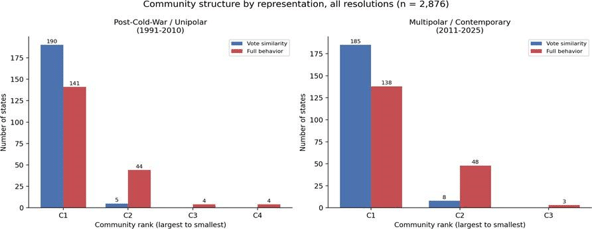
Figure 1. Community sizes by representation, all resolutions (n = 2,876).
Source: Author’s calculation, from UN Voting Coalition Analysis
Under the unrestricted resolution set, the two layouts differ (refer to Figure 1): Vote Similarity collapses the network down to one dominating community of 185-190 states (94-97% of UN members) in both time periods, with the few other states (5-8) forming small satellite groups; while Full Behavior Similarity applied to the same set of resolutions extracts 3-4 communities, with the second one containing 44-48 states.
Table 2. Partition/Clustering Evaluation Metrics
Adjusted Rand Index (ARI) |
– A chance-adjusted Rand index – Used to compare partitions/clusterings of the same dataset. – Should be used when the reference clustering has large, equal-sized clusters; |
−0.5 to 1 (in practice mostly 0 to 1) |
1 – identical partitions; 0 – agreement no better than chance; negative: worse than chance. Corrected for chance. Applied to the VOTE SIMILARITY and FULL BEHAVIOUR partitions (SQ1) and to the avoidance-coalition partitions of two policy areas (cross-area ARI, SQ2). |
Normalized Mutual Information (NMI) |
– A measure of Mutual Information. – It is not adjusted for chance; if the number of clustered data points is not large enough, the expected values of MI or NMI for random labelings can be significantly non-zero; |
0 to 1 |
0 – the partitions share no information; 1 – identical partitions. Not corrected for chance, so it is read alongside ARI. |
Table 3 reports corresponding cluster-agreement statistics: ARI=0.217 (Multipolar period) and 0.153 (Post–Cold War period); NMI=0.255 and 0.283, respectively, pointing to weak-to-moderate levels of agreement, close to chance, between the two codings at the level of near-unanimous resolutions.
Table 3. Cluster agreement between representations, by resolution specification.Source: Author’s calculations based on data from the ARI NMI Comparison
|
Time Period |
Specification |
ARI |
NMI |
|
Multipolar (2011-2025) |
All resolutions (n = 1,397) |
0.217 |
0.255 |
|
Post-Cold War (1991- 2010) |
All resolutions (n = 1,479) |
0.153 |
0.283 |
|
Multipolar (2011-2025) |
Contested only (n = 721) |
0.970 |
0.955 |
|
Post-Cold War (1991- 2010) |
Contested only (n = 490) |
0.924 |
0.883 |
Source: Author’s calculation, from UN Voting Coalition Analysis
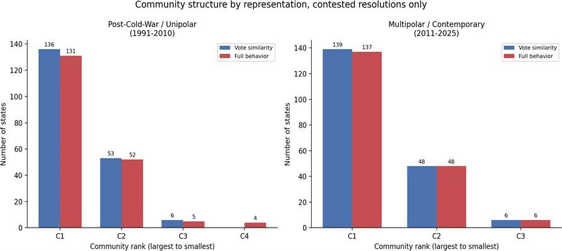
When the resolution set is restricted to contested votes, both representations collapse to similar three-bloc configurations in both time periods Figure 2. The largest bloc (131-139 states) is made up of a majority of developing countries from the G77 and Non-Aligned Group. The other two blocs are made up of Western and European countries (44-53 states). A smaller bloc (5-6 states) always remains of a consistent composition.
Figure 2. Community sizes by representation, contested resolutions only (total no. ≥ 5). Source: Author’s calculation, from UN Voting Coalition Analysis
Source: Author’s calculation, from UN Voting Coalition Analysis
Table 4. Community structure by time period and representation (contested resolutions only)
|
Time Period |
Representation |
Communities (≥ 3 states) |
Bloc sizes |
Unassigned |
|
Post-Cold War (1991- 2010) |
Vote similarity |
3 |
136, 53, 6 |
1 |
|
Post-Cold War (1991- 2010) |
Full behaviour |
4 |
131, 52, 5, 4 |
4 |
|
Multipolar (2011-2025) |
Vote similarity |
3 |
139, 48, 6 |
3 |
|
Multipolar (2011-2025) |
Full behaviour |
3 |
137, 48, 6 |
5 |
Source: Author’s calculation, from Network Stats and Cluster
Cross-referencing of the underlying cluster-assignment output identifies that this smallest bloc consists of the United States, Israel, Canada, and the small Pacific Island states (Marshall Islands, Micronesia, Palau; Nauru in the previous period instead of Canada) – this composition being common to both representations and both periods (Table 3). Under this specification, ARI reaches 0.924-0.970 and NMI 0.883-0.955(Table 2), testifying to an extremely close agreement between the two vote representations.
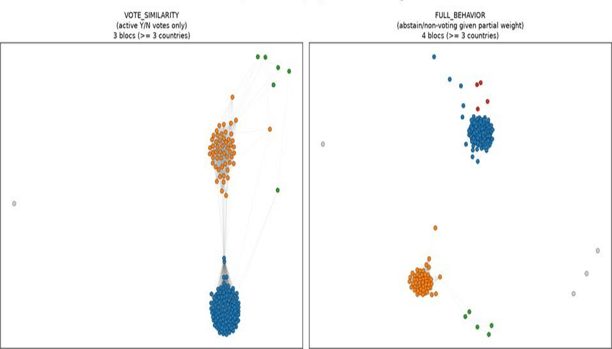
The two specifications demonstrate that vote-representation is not an intrinsic characteristic of the dataset, but rather a conditional one, dependent upon an often-unremarked methodological choice: whether or not to retain near-behavioral resolutions as indicators of agreement. By inflating the degree of similarity between all pairs of states, such resolutions add a layer of noise to the voting pattern matrix, one that overwhelms resolution-based community detection algorithms and obscures the signal to be extracted by them. Put differently, the very choice to retain such resolutions as positive votes necessarily biases the outcome toward a specific geopolitical configuration, which may not reflect reality any more than a choice to discard them does. When these proximally unanimous resolutions are excluded from consideration, both representations collapse onto a similar tripartite coalition pattern, as shown in Figure 3.
Figure 3.UN Voting Coalition Structure – Multipolar/Contemporary Period (2011-2025)
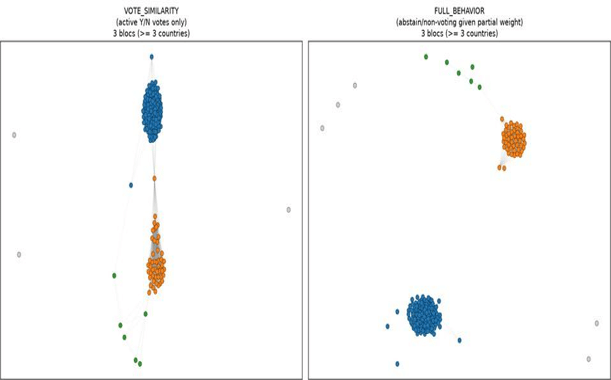
Figures 3 and 4 below effectively recover the known UNGA voting-behavioral configuration: a U.S.-backed bloc and an anti-American Global South majority.
Figure 4. UN Voting Coalition Structure – Post Coldwar/Unipolar(1991-2010)
Source: Author’s analysis, from UN Voting dataset
SUB QUESTION 2: Are Patterns of Abstention and Absence Different Across Issues?
Analytical Approach
This section explores whether countries that exhibit avoidance behavior tend to do so consistently across different issue areas. In other words, do patterns of joint abstention and absence vary by issue area? Secondly, are the coalitions formed by such patterns different across different issue areas?
To examine whether avoidance behavior varies across issue areas, each UNGA resolution from 1991-2025 was classified into an issue area based on the subject tags associated with the resolution.
The 364 unique subject tags present in the selected time period were classified using a keyword taxonomy developed from the dataset. As shown in Table 5, resolution classifications are assigned to substantive issue areas: Administrative & Budgetary, Regional Conflict & Peacekeeping, Human Rights, Middle East / Palestine, Decolonization / Self-determination, Nuclear & Disarmament, Economic & Development, Humanitarian & Refugees, and Terrorism & Security. The resolutions that did not match any predefined term were placed in “Other / Unclassified”.
Table 5. Resolutions per Issue Area
|
Administrative & Budgetary |
83 |
|
Regional Conflict & Peacekeeping |
140 |
|
Human Rights |
542 |
|
Environment & Sustainability |
112 |
|
Middle East / Palestine |
593 |
|
Decolonization / Self-determination |
283 |
|
Nuclear & Disarmament |
901 |
|
Economic & Development |
173 |
|
Humanitarian & Refugees |
29 |
|
Terrorism & Security |
14 |
|
Other/Unclassified |
6 |
In each policy issue, three state-level measures were calculated:
-
Abstention Rate – The share of the state’s recorded abstentions in the roll-call voting.
-
Absence Rate – The share of the state’s absences in the roll-call voting
-
Avoidance Rate – The sum of the two (Rate of Abstention + Rate of Absence)
The states with fewer than 30 recorded votes in each area were excluded from each issue area’s mean-measures calculations to avoid unstable rates, and area-level figures are unweighted means. As a result, the number of countries per issue area ranged from 193 to 196 (193 current UN member states + 3 former states that were dissolved/partitioned/merged during the Unipolar period). Three issue areas (Humanitarian & Refugees, Terrorism & Security, and Other/Unclassified) were also omitted from further analysis as they contain fewer than 30 resolutions each.
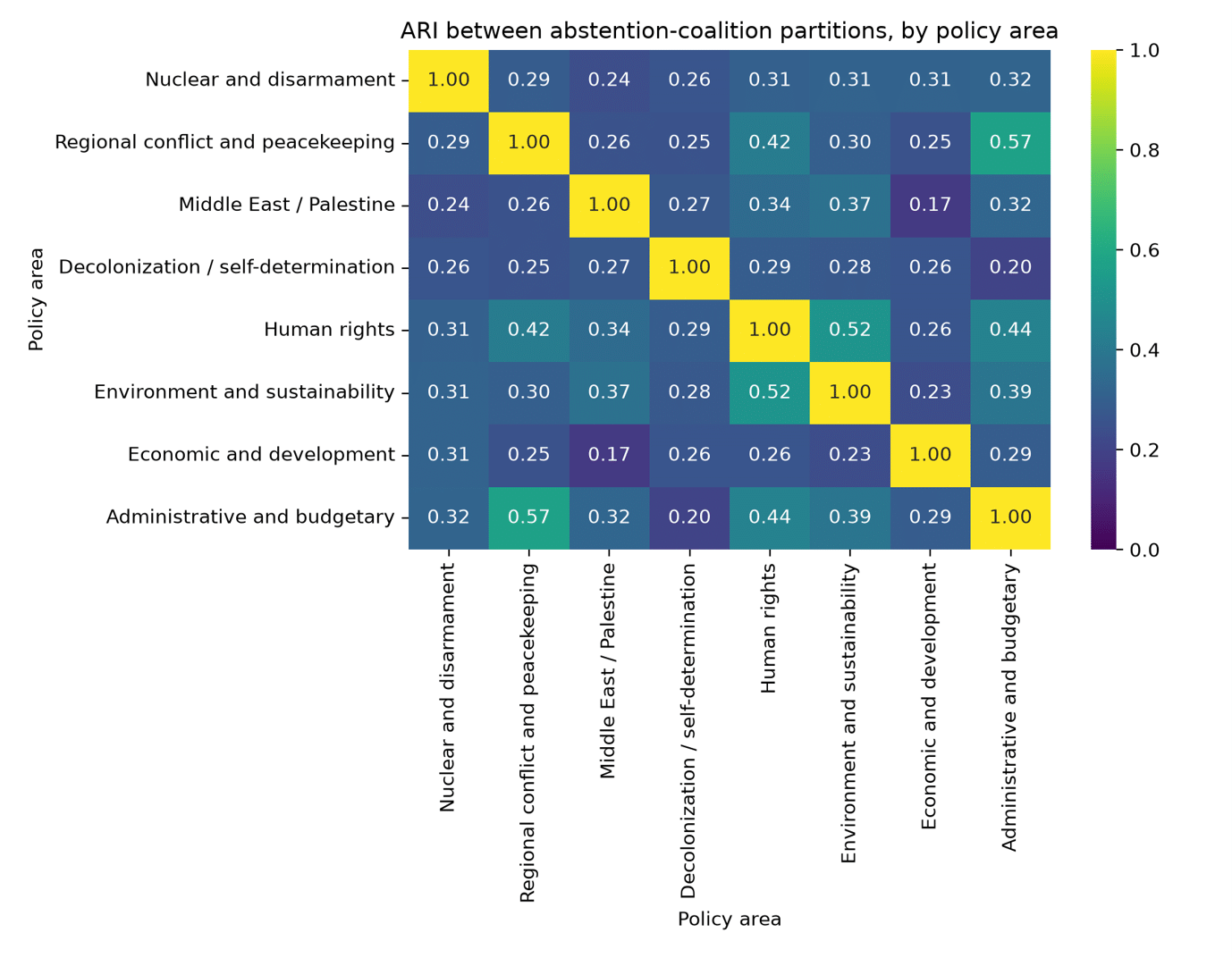
Additionally, to address the second question, whether the coalitions formed through avoidance differ across policy-issue areas, a fourth measure, joint avoidance similarity for each policy-issue, is calculated. Within each policy area, pairs of states scoring above 0.40 were linked in a network, which was partitioned with the same Leiden/CPM procedure as in SQ1 (resolution parameter 0.3; communities of fewer than three states labeled “Unassigned”). The resulting partitions were then compared across policy areas using ARI (cross-area ARI).
Findings
Across policies, avoidance rates are different —see Table 5. Mean avoidance rate by issue area, ranked highest to lowest, shows the distribution of countries according to their avoidance-rate bucket, sorted by mean avoidance. Administrative & Budgetary resolutions have the highest mean avoidance of 29.1%, followed by Regional Conflict & Peacekeeping (27.3%) and Human Rights (25.3%); the lowest are Economic & Development (17.2%) and Nuclear & Disarmament (17.7%).
Countries also differ in how issue-selective their avoidance behavior is. Figure 6. No. of Countries × Rate of Avoidance by Issue Area lists the country behavior, the most variable above-average behavior across issue areas (“selective avoiders”, who abstain/absent heavily on some issues but rarely on others) alongside those with the most consistent rate regardless of issue (“flat avoiders”)
Table 6. Mean avoidance rate by issue area, ranked highest to lowest
|
Issue Area |
No. of Countries |
Mean Abstention % |
Mean Absence % |
Mean Avoidance % |
No. of Resolutions |
|
Administrative & Budgetary |
193 |
8.6 |
20.5 |
29.1 |
83 |
|
Regional Conflict & Peacekeeping |
194 |
10.4 |
16.9 |
27.3 |
140 |
|
Human Rights |
195 |
16.6 |
8.8 |
25.3 |
542 |
|
Middle East / Palestine |
196 |
11.3 |
12.2 |
23.5 |
593 |
|
Decolonization / Self-determination |
194 |
9.2 |
10.3 |
19.5 |
283 |
|
Environment & Sustainability |
193 |
4.4 |
14.5 |
18.9 |
112 |
|
Nuclear & Disarmament |
196 |
9.3 |
8.4 |
17.7 |
901 |
|
Economic & Development |
194 |
8.0 |
9.2 |
17.2 |
173 |
Figure 5. No. of Countries × Rate of Avoidance by Issue Area
Source: Author’s calculation, mean rate of avoidance among countries across policy areas with countries meeting the 30-vote minimum in each area.
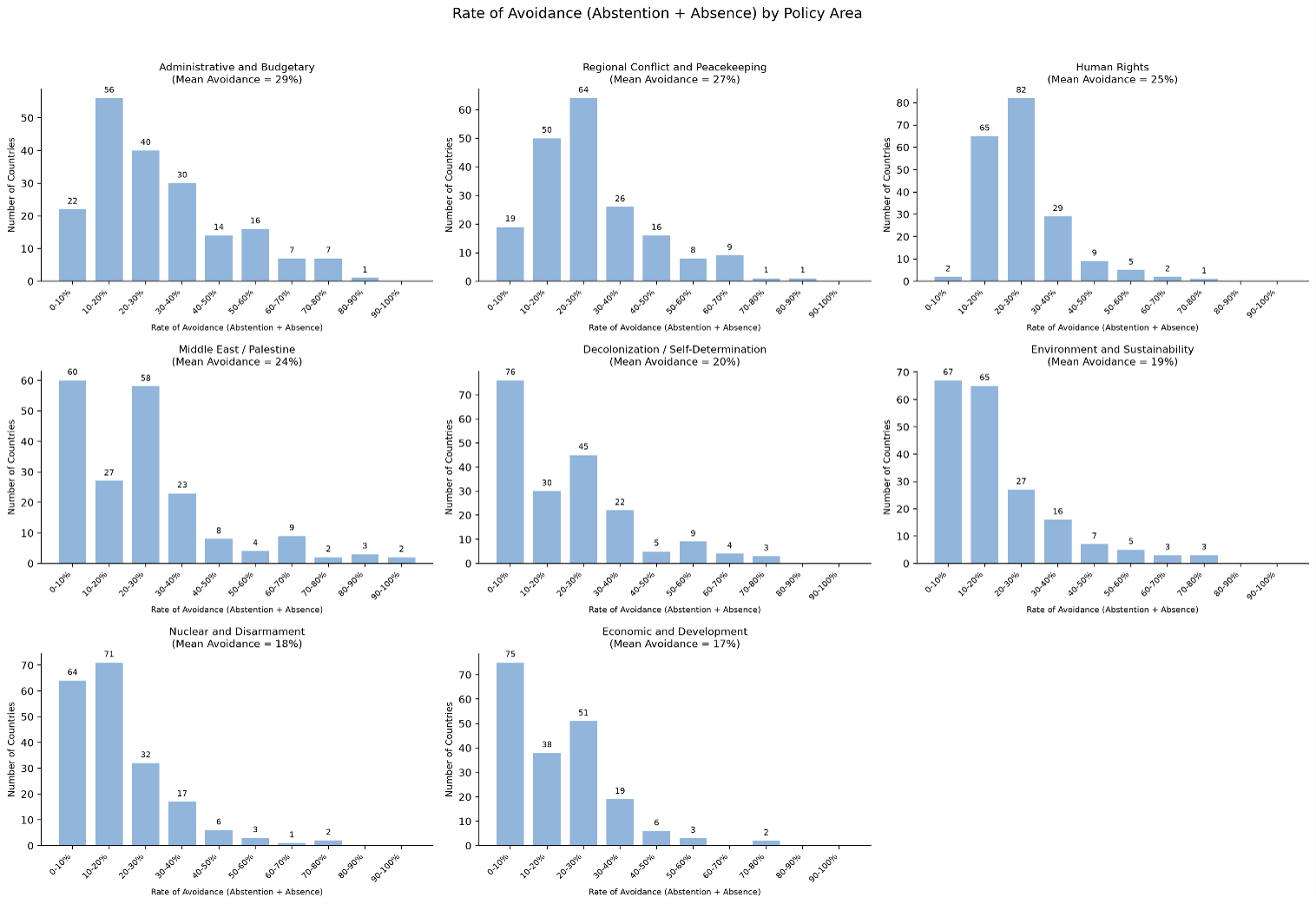
Source: Author’s analysis of the mean rate of avoidance among countries across policy areas, with countries meeting the 30-vote minimum in each area.
DISCUSSION
The findings of this study indicate that UN General Assembly voting alignment is more complex than a simple distinction between states voting for or against a resolution. The analysis demonstrates that the structure of coalitions identified from UNGA voting depends not only on how voting behavior is represented, but also on which resolutions are included in the analysis. At the same time, abstention and non-voting behavior vary substantially across issue areas and produce coalition structures that are considerably more issue-specific than those obtained from active voting.
The present findings extend this understanding by showing that the observed structure of alignment changes according to the behavioral dimension being examined.
-
Coalition patterns and the importance of data representation:
The results for SQ1 show that different representations of voting behavior can produce substantially different coalition structures, but this sensitivity is conditional on the type of resolutions included in the analysis. When all 2,876 resolutions were considered, the active-vote representation produced a highly concentrated network, with one dominant community containing approximately 94-97% of UN member states. In contrast, the full-behavior representation generated three to four communities, with a behavioral secondary bloc of approximately 44-48 states.
This result suggests that the choice of behavioral representation cannot be treated as a purely technical decision in UNGA network analysis. Rather, it can influence the substantive interpretation of the resulting coalition structure. The primary concern in analyzing the UNGA voting data is that network-based identification of voting blocs may depend upon how voting behavior is operationalized and that detected communities do not necessarily correspond directly to underlying geopolitical alliances (Magu & Mateos, 2018). However, setting a restriction on unanimously voted resolutions in the analysis provided an important qualification to this finding. Once the analysis was restricted to contested resolutions, defined as resolutions receiving at least five recorded No votes, the two representations converged strongly. ARI increased to 0.924 in the Post-Cold-War period and 0.970 in the Multipolar/Contemporary period, while NMI increased to 0.883 and 0.955, respectively.
The implication is not simply that “different representations produce different answers.” Instead, the behavior suggests that representation sensitivity is largely driven by the inclusion of near-unanimous resolutions. This distinction is important because 44% of the resolutions in the analyzed dataset contained two or fewer No votes.
In this sense, consensus voting can create what may be described as background similarity. Two states voting yes on a resolution supported by almost the entire membership appear similar in the network, but that particular vote provides little evidence that they are politically aligned with each other. Once these low-discrimination observations are removed, the underlying coalition structure becomes substantially clearer. The convergence of the two representations on contested resolutions therefore suggests that the principal source of instability is not necessarily the treatment of abstention and non-voting itself, but the informational quality of the resolutions used to construct the network.
This finding has an important methodological implication for studies of UNGA voting. Consensus resolutions should not necessarily be interpreted as useless, but their ability to discriminate between states’ preferences is limited when the overwhelming majority of states adopt the same position.
-
The three-bloc structure and the interpretation of geopolitical alignment:
The contested-resolution analysis identifies a relatively stable three blocs in both behavioral representations of the Multipolar (2011-2025) period. The largest community consists predominantly of Global South and Non-Aligned Movement states, the second contains Western and European-
aligned states, and the smallest community is consistently composed of the United States, Israel, Canada, and several small Pacific Island states, with minor changes across periods.
The persistence of this structure is important because it suggests that, once consensus-driven similarity is controlled for, UNGA voting contains a relatively stable underlying pattern of diplomatic alignment. This is broadly consistent with previous research identifying recurring divisions between Western/developed and developing/emerging states in UNGA voting networks (Magu & Mateos, 2018). At the same time, this structure should not be interpreted as direct evidence of three formal geopolitical alliances.
This distinction is particularly relevant to the objective of identifying emerging geopolitical alliances. A voting network can reveal behavioral proximity between states, but the existence of a community does not by itself demonstrate that those states have entered into a formal alliance. Rather, persistent network proximity can be interpreted as evidence of a political relationship that may warrant further investigation using other indicators of geopolitical alignment.
-
Abstention and non-voting as distinct dimensions of diplomatic behavior:
The findings of SQ2 demonstrate that abstention and non-voting are not distributed uniformly across UNGA policy issue areas. Administrative & Budgetary resolutions have the highest mean avoidance of 29.1%, followed by Regional Conflict & Peacekeeping (27.3%) and Human Rights (25.3%). By comparison, Economic & Development and Nuclear & Disarmament showed substantially lower mean avoidance rates of 17.2 and 17.7%, respectively.
This variation supports the central premise of the study that non-voting behavior contains structured information rather than constituting simple statistical noise. Previous research has argued that abstentions may represent deliberate neutrality, avoidance of diplomatic confrontation, or attempts to manage competing interests, while also emphasizing that absence can arise from practical or institutional constraints (Panke, 2014; Coggins & Morse, 2022; Snidal et al., 2024).
This finding provides empirical support for the argument that non-participation may provide information that is overlooked by binary voting approaches. Instead of asking only whether two states agree or disagree, avoidance behavior allows researchers to examine circumstances in which states choose not to express an explicit position. This adds a further dimension to the measurement of diplomatic behavior.
-
Issue-specific avoidance and the possibility of diplomatic hedging:
The most important substantive finding from SQ2 is that avoidance does not produce one stable coalition structure across issue areas. The cross-area agreement between avoidance-based partitions is relatively low, with an average ARI of approximately 0.35.
The contrast between these results is significant. Active voting reveals a comparatively stable broad structure, whereas avoidance behavior produces different groupings depending on the policy issue. This suggests that states may maintain a relatively persistent general diplomatic orientation while adopting more flexible positions on specific issues. One possible interpretation is that avoidance provides an indication of issue-specific diplomatic hedging. A state may generally vote alongside a particular group while avoiding explicit alignment on an issue where its interests do not fully correspond with those of that group.
However, this interpretation must be treated cautiously. The data cannot establish that every instance of abstention or absence is strategically motivated. In particular, non-voting may reflect limitations in diplomatic capacity, delegation availability, or other institutional constraints. The distinction between abstention and absence is therefore important. The fact that these patterns consistently differ across policy domains nevertheless suggests that non-voting behavior contains information that warrants further investigation.
Figure 6. ARI between abstention and absence by Coalition partition, by Policy Issue Area
Source: Author’s calculation, mean rate of avoidance among countries across policy areas with countries meeting the 30-vote minimum in each area.
-
A more dynamic understanding of geopolitical alignment:
Taken together, the findings suggest that geopolitical alignment in the UNGA should not be understood as a single fixed structure. The contested active-vote networks reveal a relatively persistent three-bloc pattern across the two historical periods, while avoidance networks produce substantially different structures across issue areas. These results indicate that states can simultaneously exhibit a stable broad diplomatic orientation and more flexible, issue-specific behavior.
The distinction between stable and issue-specific alignment is particularly relevant in an increasingly multipolar international environment. Previous literature has described the contemporary international system as becoming more fragmented and decentralized, with emerging powers and middle powers acquiring greater influence over multilateral voting patterns (Ghulam Mehdi et al., 2025; Bajpai & Sharma, 2026).
Therefore, emerging geopolitical alignment may be better conceptualized as a combination of persistent voting proximity and issue-specific behavioral flexibility. Network analysis can identify these patterns, but the interpretation of those patterns requires distinguishing between general diplomatic similarity, issue-specific convergence, and formal geopolitical alliance.
-
Methodological implications:
The findings have methodological implications for future research using UNGA voting data. First, coalition detection is sensitive to the informational composition of the resolution set. The strong convergence between the two representations after contested-resolution filtering indicates that the selection of resolutions can be as consequential as the coding of individual voting behaviors.
Second, the results support treating abstention and non-voting as potentially informative behavioral categories rather than automatically removing them as missing observations. The substantial differences in avoidance across issue areas and the low cross-area similarity between avoidance coalitions demonstrate that these behaviors contain patterns that cannot be recovered from active voting alone.
Third, the findings suggest that active voting and avoidance may be better treated as complementary analytical layers. Combining them into a single indicator can provide an overall measure of similarity, but separating the two behaviors makes it possible to distinguish explicit agreement from shared non-commitment. This distinction is particularly important because the same countries may occupy similar positions in active voting while displaying very different avoidance patterns across specific issue areas.
-
Implications for identifying emerging geopolitical alliances:
The findings ultimately suggest that network analysis can contribute to the identification of potential emerging geopolitical alignments, but that it should not be used to label UNGA communities as formal alliances on the basis of voting behavior alone. The most reliable evidence from this study is the existence of persistent behavioral communities in contested voting and the presence of issue-specific avoidance structures.
This leads to a useful distinction between identifying alignment and establishing alliance formation. Network analysis is capable of identifying states that repeatedly exhibit similar behavior. Persistent similarity across contested resolutions can therefore serve as an indicator of diplomatic proximity. However, determining whether that proximity represents an emerging geopolitical alliance would require additional evidence beyond UNGA voting, such as changes in diplomatic cooperation, institutional memberships, economic relationships, security arrangements, or other forms of interstate interaction.
Overall, the findings support a view of UNGA alignment as a multidimensional and issue-dependent phenomenon. Explicit voting provides evidence of relatively stable broad coalitional structures, while abstention and non-voting reveal additional variation in how states respond to particular issues.
CONCLUSION
In conclusion, the findings demonstrate that the impact of vote-representation schemes of states depends heavily on resolution contestation. On near-unanimous resolutions, full-behavior models prevent the artificial collapse of member states into a single dominant cluster. However, when restricted to contested resolutions receiving at least five negative votes, both active-voting and full-behavior representations converge onto a highly stable, tripartite coalition structure across both the post-Cold War and contemporary multipolar eras.
In contrast to broad voting alignments, non-voting behavior is strongly issue-dependent. Avoidance rates peak in administrative, budgetary, and peacekeeping resolutions, while dropping significantly in economic and disarmament issues. The low cross-area similarity among avoidance coalitions indicates that non-participation functions primarily as an issue-specific signal of diplomatic hedging rather than a structural shift in core geopolitical alliances.
To build upon these findings, future research should focus on two concise priorities:
-
Model Capacity Controls: Incorporate state capacity indicators (e.g., delegation size, GDP per capita) to formally distinguish capacity-constrained absence from intentional diplomatic signaling.
-
Cross-Validate External Alignments: Test whether identified voting network clusters correlate with external bilateral indicators, such as trade flows, treaty co-sponsorships, and defense pacts.
REFERENCES
Bailey, M. A., Strezhnev, A., & Voeten, E. (2017). Estimating dynamic state preferences from United Nations voting data. Journal of Conflict Resolution, 61(2), 430–456.
https://journals.sagepub.com/doi/10.1177/0022002715595700
Morse, J. C., & Coggins, B. (2024). Your silence speaks volumes: Weak states and strategic absence in the UN General Assembly. The Review of International Organizations, 19(3), 515–544.
https://link.springer.com/article/10.1007/s11558-024-09538-3
Panke, D. (2014). Is bigger better? Activity and success in negotiations in the United Nations General Assembly. Negotiation Journal, 30(4), 367–392.
https://direct.mit.edu/ngtn/article/30/4/367/121723
Schrodt, P. A., & Gerner, D. J. (2000). Cluster-based early warning indicators for political change in the contemporary Levant. American Political Science Review, 94(4), 803–818.
Keohane, R. O. (1967). The study of political influence in the General Assembly. International Organization, 21(2), 221–237.
https://doi.org/10.1017/S0020818300013217
Traag, V. A., Waltman, L., & van Eck, N. J. (2019). From Louvain to Leiden: Guaranteeing well-connected communities. Scientific Reports, 9, 5233.
https://www.nature.com/articles/s41598-019-41695-z
Hubert, L., & Arabie, P. (1985). Comparing partitions. Journal of Classification, 2(1), 193–218.
https://link.springer.com/article/10.1007/BF01908075
Danon, L., Díaz-Guilera, A., Duch, J., & Arenas, A. (2005). Comparing community structure identification. Journal of Statistical Mechanics: Theory and Experiment, 2005, P09008.
https://iopscience.iop.org/article/10.1088/1742-5468/2005/09/P09008
Macon, K. T., Mucha, P. J., & Porter, M. A. (2012). Community structure in the United Nations General Assembly. Physica A: Statistical Mechanics and its Applications, 391(1–2), 343–361.
https://www.sciencedirect.com/science/article/abs/pii/S0378437111004778
Bailey, M. A., & Voeten, E. (2018). A two-dimensional analysis of seventy years of United Nations voting.Public Choice, 176(1), 33–55.
https://link.springer.com/article/10.1007/s11127-018-0550-4
Magu, R., & Mateos, G. (2018). United Nations General Assembly vote similarity networks. In Complex Networks & Their Applications VI (Studies in Computational Intelligence, vol. 689). Springer.
https://doi.org/10.1007/978-3-319-72150-7_95
Panke, D. (2014). Absenteeism in the General Assembly of the United Nations: Why some member states rarely vote. International Politics, 51(6), 729–749. https://www.researchgate.net/publication/269285902_Absenteeism_in_the_General_Assembly_of_the_United_Nations_Why_some_member_states_rarely_vote
Ball, M. M. (1951). Bloc voting in the General Assembly. International Organization, 5(1), 3–31. https://doi.org/10.1017/S0020818300029805
Dreher, A., & Jensen, N. M. (2013). Country or leader? Political change and UN General Assembly voting. European Journal of Political Economy, 29, 183–196. https://www.sciencedirect.com/science/article/abs/pii/S0176268012000958
CGTN (2025, July 4). How is greater BRICS cooperation reshaping the Global South’s future? https://news.cgtn.com/news/2025-07-04/How-is-greater-BRICS-cooperation-reshaping-the-Global-South-s-future–1EJuhl8xejm/p.html
Center for International Governance Innovation (2024). With BRICS expansion, the Global South takes center stage. https://www.cigionline.org/articles/with-brics-expansion-the-global-south-takes-centre-stage/
Voeten, E. (2000). Clashes in the Assembly. International Organization, 54(2), 185–215. https://www.cambridge.org/core/journals/international-organization/article/abs/clashes-in-the-assembly/4F638AC73870394253E43626CC4A359C
Voeten, E. (2013). Data and Analyses of Voting in the UN General Assembly. In B. Reinalda (Ed.), Routledge Handbook of International Organization (pp. 54–66). Routledge. https://papers.ssrn.com/sol3/papers.cfm?abstract_id=2111149
Hafner-Burton, E. M., & Montgomery, A. H. (2006). Power positions: International organizations, social networks, and conflict. Journal of Conflict Resolution, 50(1), 3–27. https://journals.sagepub.com/doi/10.1177/0022002705281669
Nurullayev, D., & Papa, M. (2023). Bloc politics at the UN: How other states behave when the United States and China–Russia disagree. Global Studies Quarterly, 3(3), ksad034.https://doi.org/10.1093/isagsq/ksad034
Bruegel (Amighini, A., & García-Herrero, A.) (2023). What really influences the United Nations’ voting on Ukraine? https://www.bruegel.org/analysis/what-really-influences-united-nations-voting-ukraine
The Hill (2025, February 24). These 17 countries voted with the US against the Russia-Ukraine UN resolution.https://thehill.com/homenews/5161380-ukraine-un-resolution/
ANNEXURE – I
POLICY-ISSUE-AREA TAXONOMY ( built from the tags that actually exist in the data)
POLICY_ISSUE_KEYWORDS = { # ORDER = PRIORITY (first match wins for primary area)
“Nuclear & Disarmament”: [ ”NUCLEAR”, “DISARMAMENT”, “WEAPONS OF MASS DESTRUCTION”, “MISSILE”, “ARMS CONTROL”, “ARMS RACE”, “ARMS TRANSFERS”, “ARMS TRADE”, “CONVENTIONAL ARMS”, “CONVENTIONAL WEAPONS”, “CHEMICAL WEAPONS”, “CHEMICAL AND BIOLOGICAL”, “BIOLOGICAL WEAPONS”, “LANDMINES”, “ANTI-PERSONNEL”, “CLUSTER MUNITIONS”, “DEPLETED URANIUM”, “FISSIONABLE”, “FISSILE”, “IAEA”, “ATOMIC ENERGY”, “OUTER SPACE”, “WEAPONS–”, “SMALL ARMS”, “STOCKPILE”, “AUTONOMOUS WEAPONS”, “DUAL-USE”, “VERIFICATION”, “CONFIDENCE-BUILDING”, “TRANSPARENCY IN ARMAMENTS”, “GENEVA PROTOCOL”, “ARMAMENTS”, INFORMATION–INTERNATIONAL SECURITY”, “SCIENCE AND TECHNOLOGY–INTERNATIONAL SECURITY” ],
“Regional Conflict & Peacekeeping”: [“PEACEKEEPING”, “INTERIM FORCE”, “ARMED CONFLICT”, “CIVIL WAR”, “UKRAINE–POLITICAL”, “CRIMEA”, “AFGHANISTAN”, “ZONES OF PEACE”, “REGIONAL SECURITY”, “INTERNATIONAL SECURITY”, “PEACEBUILDING”, “SECURITY COUNCIL”, “MERCENARIES”, “USE OF FORCE”, “BOSNIA”, “CYPRUS”, “CONFLICT”, “SPECIAL POLITICAL MISSIONS”, “MINE CLEARANCE”, “RESPONSIBILITY TO PROTECT”],
“Middle East / Palestine”: [“PALESTINE”, “ISRAEL”, “GAZA”, “WEST BANK”, “GOLAN”, “JERUSALEM”, “MIDDLE EAST”, “UNRWA”, “LEBANON”, “NEAR EAST”],
“Decolonization / Self-determination”: [“DECOLONIZATION”, “SELF-DETERMINATION”, “TRUST TERRITORY”, “NON-SELF-GOVERNING”, “COLONIAL”, “WESTERN SAHARA”, “FALKLAND”, “MALVINAS”, “GIBRALTAR”, “CHAGOS”, “MAYOTTE”, “APARTHEID”, “NATIONAL LIBERATION”, QUESTION”, “NAMIBIA”, “SAINT HELENA”, “NEW CALEDONIA”, “FRENCH POLYNESIA”],
“Human Rights”: [“HUMAN RIGHTS”, “CIVIL AND POLITICAL RIGHTS”, “TORTURE”, “MINORITIES”, “INDIGENOUS”, “RACIAL DISCRIMINATION”, “RIGHTS OF THE CHILD”, “CHILD RIGHTS”, “WOMEN’S ADVANCEMENT”, “WOMEN–RIGHTS”, “RURAL WOMEN”, “FREEDOM OF”, “DEMOCRACY”, “RULE OF LAW”, “SUMMARY EXECUTIONS”, “CAPITAL PUNISHMENT”, “RIGHT TO”, “ELECTIONS”, “YOUTH”, CULTURAL PROPERTY”, “CLONING”, “KOSOVO”, “INTERNATIONAL CRIMINAL COURT”, “CULTURE OF PEACE”, “PEACE”],
“Terrorism & Security”: [“TERRORISM”, “TRANSNATIONAL CRIME”, “PIRACY”, “CYBERSECURITY”, “ORGANIZED CRIME”, “CRIME PREVENTION”, “ILLICIT TRAFFIC”, “TRAFFICKING”],
“Humanitarian & Refugees”: [“REFUGEE”, “HUMANITARIAN”, “MIGRA”, “INTERNALLY DISPLACED”, “FAMILY REUNIFICATION”, “EMERGENCY ASSISTANCE”, “DISASTER RELIEF”, “STORMS”, “HIV/AIDS”, “HEALTH”, “NARCOTIC”],
“Environment & Sustainability”: [ENVIRONMENT”, “CLIMATE”, “SUSTAINABLE DEVELOPMENT”, “SUSTAINABLE ENERGY”, “AGENDA 21”, 2030 AGENDA”, “BIODIVERSITY”, “BIOLOGICAL DIVERSITY”, “DESERTIFICATION”, “LAW OF THE SEA”, “MARINE”, “COASTAL”, “ANTARCTICA”, “DISASTER”, “WATER”, “NATURE”],
“Economic & Development”: [“ECONOMIC”, “TRADE”, “DEBT”, “POVERTY”, “FOOD SECURITY”, “DEVELOPMENT FINANCE”, “SOCIAL DEVELOPMENT”, “SOCIAL CONDITIONS”, “FINANCING”, “FINANCIAL”, “GLOBALIZATION”, “AGRICULTURE”, “INDUSTRIALIZATION”, “LEAST DEVELOPED”, “LANDLOCKED”, “DEVELOPING COUNTRIES”, “COMMODITIES”, “TAXATION”, “INVESTMENT”, “MILLENNIUM SUMMIT”, “CUBA–UNITED STATES”, “SCIENCE AND TECHNOLOGY”, “INFORMATION”, “SANCTIONS”, “DEVELOPMENT COOPERATION”, “INDUSTRIAL DEVELOPMENT”, “SMALL ISLAND DEVELOPING”, “NARCOTIC DRUGS”, “SPORT”],
“Administrative & Budgetary”: [“UN–BUDGET”, “UN–HUMAN RESOURCES”, “PENSIONS”, “UN–ADMINISTRAT”, “SCALE OF ASSESSMENT”, “UN–REFORM”, “PROGRAMME BUDGET”, “SECRETARIAT”, “STAFF”, “UN SYSTEM”, “UN CONFERENCES”, “UN CHARTER”, “UN RESOLUTIONS”, “OPERATIONAL ACTIVITIES”, “GUAM”, “ORGANIZATION”, “OBSERVER STATUS”, “PROGRAMME PLANNING”, “INTER-PARLIAMENTARY”],