Authors: Nimat Banday, Parul Verma, Saloni Chauhan
Abstract
The global political system is becoming increasingly multipolar, making it important to identify emerging geopolitical alliances beyond formal organisations such as NATO, BRICS, and the Shanghai Cooperation Organisation (SCO). This study analyses voting patterns in the United Nations General Assembly (UNGA) from 1990 to 2024 using network analysis. Countries are represented as nodes, while voting similarity forms the connections between them. The Louvain algorithm is used to identify voting communities, and centrality measures are used to determine influential and bridge countries. A temporal analysis using five-year rolling windows examines how these communities evolve over time. The study aims to identify hidden geopolitical alliances, compare them with existing international organizations, and evaluate whether changes in voting behavior can indicate future geopolitical realignments.
Keywords: UNGA, Network Analysis, Geopolitical Alliances, Community Detection, Louvain Algorithm, Centrality Analysis.
Introduction
The international system is becoming increasingly multipolar, making it important to understand geopolitical alignments beyond formal alliances such as NATO, BRICS, and the Shanghai Cooperation Organisation (SCO). Although these organisations reflect institutional cooperation, they do not always capture the evolving patterns of diplomatic alignment among states. Voting behaviour in the United Nations General Assembly (UNGA) provides an important indicator of countries’ foreign policy preferences and can reveal informal political relationships that are not evident through formal alliances alone. (Voeten, 2012; Bailey, Strezhnev & Voeten, 2017).
Network analysis offers an effective approach for identifying such relationships by examining patterns of voting similarity among states (Magu & Mateos, 2018; Gallop & Minhas, 2021). While previous studies have analysed UNGA voting behaviour, limited research has explored how these voting communities evolve over time and whether they can signal emerging geopolitical alliances before they become formalised (Magu & Mateos, 2018).
Against this background, the present study investigates whether patterns of voting similarity in the United Nations General Assembly can reveal emerging geopolitical alliances that are not immediately visible through conventional diplomatic or institutional frameworks. The study seeks to answer four interrelated questions: can UNGA voting similarity be used to identify emerging geopolitical alliances, how do these voting communities evolve in response to major geopolitical events over time, which countries function as influential actors or bridges connecting different voting communities, and to what extent can changes in UNGA voting behaviour serve as early indicators of future geopolitical realignments.
To address these questions, the study pursues two primary objectives. First, it identifies geopolitical alliances by analysing UNGA voting similarity through network analysis, community detection using the Louvain algorithm (Blondel, Guillaume, Lambiotte, & Lefebvre, 2018), and centrality measures to identify influential and bridge countries. Second, it examines the evolution of these alliances over time and compares the detected voting communities with existing international organisations and alliances, including NATO, BRICS, the Shanghai Cooperation Organisation (SCO), the African Union (AU), and ASEAN. By integrating network science with the study of international relations, the research contributes to a deeper understanding of how informal diplomatic alignments emerge, evolve, and potentially shape the future international political order (Pauls & Cranmer, 2017).
Review of Literature:
Bloc Formation and Alignment Shifts in UNGA Voting
Existing scholarship has long used United Nations General Assembly (UNGA) voting patterns to examine geopolitical alignments and alliance structures. The most consistent thing the literature shows is that the US has become increasingly isolated at the UN when it disagrees with China and Russia; other countries side with the US only about 14% of the time, and this gap has been growing steadily since the 1990s (Nurullayev & Papa, 2023). Groups like the G77, BRICS, and the Shanghai Cooperation Organization have drifted further from the US position over time, while NATO members lean toward the US but without any clear upward or downward trend. At the broadest level, the literature points to two broad patterns of alignment centred around the US and China-Russia, although neither grouping is stable or internally uniform.
The instability inside the Western bloc is actually one of the more interesting things the literature picks up on. Alignment with the US among its closest allies, the G7, NATO, OECD, and WEOG countries, dropped by about seven percentage points during Trump’s presidency, most sharply on Middle East resolutions (Mosler & Potrafke, 2020). What’s notable is that this wasn’t just Western left-wing governments reacting to a right-wing US president; the ideological explanation doesn’t hold up in the data. It looks more like a response to specific foreign policy shifts under one leader, which raises a bigger question: if Western bloc cohesion can move that much in response to a single presidency, how durable are these blocs really? The network analysis literature assumes a certain stability in voting communities over time (Maoz et al., 2007; Lerner, 2016), but the voting-behaviour literature suggests that stability might be more fragile than it looks.
The Ukraine war brought this same instability question to the Global South. Countries that were expected to follow a “Global South” position didn’t all vote the same way, and the reasons why seem to stack on top of each other rather than pointing to one clear driver. Being economically or militarily dependent on Russia, being a non-democracy, and being a G77 member all independently made a country less likely to support the resolutions, not because they’re the same thing, but because they happened to overlap for a lot of countries at once (De Oliveira et al., 2025).
This is where the literature becomes more contested. When you look only at G77 countries, regime type, whether a country is a democracy or not, predicts voting positions better than G77 membership itself does (Tawat, 2025). In other words, the Global South did not behave as a single, cohesive voting bloc. It was splitting along a democratic/authoritarian line that cuts straight through the group. But even that isn’t a clear explanation; India, the world’s largest democracy, stayed neutral throughout, not because it sympathised with Russia but because its more immediate concerns were about China and Pakistan (Rabel, 2025). So regime type matters, but it can be overridden by regional security calculations that have nothing to do with the war itself.
What this adds up to is a literature that has several reasonable partial explanations for how voting blocs form and shift, but none of them have been tested against each other in the same framework. The network analysis side of this field is good at showing the shape of voting communities but doesn’t explain why those communities exist or why they change (Fritz et al., 2022; Cartwright & Harary, 1956). The political-explanation side explains the “why” but always within one bloc or one crisis at a time, without mapping those explanations onto an actual network. Existing studies have rarely taken a set of resolutions, built the voting network, and then checked whether the clusters that show up actually match the political and economic patterns the literature would predict. That’s the gap this study addresses.
These explanations do not simply build on each other; they actively pull in different directions. Nurullayev and Papa (2023) treat group membership (G77, BRICS, SCO) as the primary driver of alignment, which implies that blocs are relatively stable and institutionally grounded. But Mosler and Potrafke (2020) undercut that assumption by showing that even the most institutionalised Western bloc shifts significantly with a single change in US leadership, suggesting alignment is far more contingent than structural accounts imply. Tawat (2025) goes further, arguing that even within the G77, the group label explains less than regime type does, which effectively challenges the premise that institutional membership is a meaningful predictor at all. Rabel (2025) then complicates Tawat’s regime-type argument by showing that India, a democracy, behaved more like a non-aligned state because of regional security concerns that had nothing to do with regime type. Taken together, these studies do not converge on a single explanation; they produce competing accounts that are each partially correct and none of which has been tested against the others in one framework.
Network Analysis and Alliance Detection
Network analysis has become one of the most common methods used to study international relations, precisely because it shifts focus from individual countries to the relationships between them. These connections can be based on cooperation, conflict, trade, or voting behaviour in international organizations like the United Nations (UN), and because countries with similar political interests or foreign policy goals usually vote in similar ways, analysing UN voting records has become an effective way to identify alliances and understand changes in global politics.
One of the theoretical foundations for this approach is Structural Balance Theory. Relationships are more likely to remain stable when friends support each other and share common opponents (Heider, 1946), and this idea was later applied to networks to suggest that countries naturally move towards balanced relationships over time (Cartwright & Harary, 1956). These ideas help explain why some countries repeatedly vote together and maintain long-term diplomatic partnerships; voting alignment is not random but reflects underlying patterns of affinity and opposition.
Empirically, countries with similar foreign policy interests often show similar voting behaviour in the UNGA, and voting records can reveal political relationships that may not always be visible through formal alliance agreements alone (Maoz et al., 2007). More recent methodological work has pushed this further. Since international relations include both cooperation and conflict, analysing only positive relationships does not provide the complete picture; including both positive and negative ties offers a better way to understand how alliances are formed and how they change over time (Fritz et al., 2022). Countries sharing common allies or common rivals are also more likely to cooperate with one another, reinforcing the idea that the structure of the broader network shapes individual countries’ behaviour (Lerner, 2016).
Although these studies have improved our understanding of alliance detection, they mainly focus on the structure of international networks and pay less attention to factors such as economic interests, leadership changes, regional politics, and current geopolitical events that may influence UN voting behaviour. This is the limitation that connects the network analysis literature to the bloc-formation literature reviewed above: the tools exist to map who votes together, but explaining why those clusters form or shift requires bringing in the political and economic factors the structural approaches leave out.
Methodology
Research Design
This study adopts a mixed-methods research design, combining quantitative and qualitative approaches to examine geopolitical alignments reflected in the voting behaviour of United Nations General Assembly (UNGA) member states. The quantitative component employs Social Network Analysis (SNA) to identify voting communities, influential countries, and changes in voting alignments over time. The qualitative component complements these findings through a thematic analysis of existing literature, enabling the study to explain the economic, political, and regional factors that shape UNGA voting behaviour. The integration of these approaches provides both empirical evidence of voting patterns and a broader understanding of the drivers of geopolitical alliances
Data Source
The quantitative analysis uses roll-call voting data from the United Nations General Assembly (UNGA) covering the period from 1990 to 2024. The primary source of the data is the Voeten UNGA Voting Dataset, which provides comprehensive records of member states’ votes on General Assembly resolutions. The dataset was cleaned by removing incomplete observations, standardising country names, and ensuring consistency across all UNGA sessions before analysis. The qualitative component draws upon peer-reviewed journal articles, books, and official United Nations reports examining the determinants of UNGA voting behaviour, including economic interdependence, leadership change, regional organisations, and major geopolitical events such as the Russia-Ukraine conflict.
Quantitative Analysis
Following data preparation, an agreement index was calculated for every pair of countries based on the proportion of resolutions on which they cast identical votes. These agreement scores were used to construct a weighted voting network, where countries represent nodes and voting similarity forms the weighted edges connecting them.
The Louvain community detection algorithm was employed to identify groups of countries exhibiting similar voting behaviour. These communities were interpreted as informal geopolitical voting blocs and compared with formal international organisations, including NATO, BRICS, the Shanghai Cooperation Organisation (SCO), the African Union (AU), and ASEAN.
The Louvain algorithm was selected over alternative community detection methods for several reasons. Compared to the Girvan-Newman algorithm, which removes edges iteratively and becomes computationally prohibitive for large networks, the Louvain method is significantly more scalable and better suited to the 191-node network used here (Blondel et al., 2008). Unlike the k-means or spectral clustering approaches that require the number of communities to be specified in advance, the Louvain algorithm determines the optimal number of communities automatically by maximising modularity, making it more appropriate for exploratory analysis where the number of voting blocs is not known beforehand. It has also been widely validated in political science network studies (Macon et al., 2012; Pauls & Cranmer, 2017), which supports its use for this type of analysis.
To identify strategically important countries within the network, the study employed eigenvector centrality and betweenness centrality. Eigenvector centrality identifies influential countries connected to other influential states, whereas betweenness centrality highlights countries that serve as bridges between different voting communities. Temporal analysis using five-year rolling windows was incorporated to examine changes in voting communities and the evolution of geopolitical alignments over time.
Qualitative Analysis
To complement the quantitative findings, a qualitative thematic analysis was conducted using relevant academic literature and official UN documents. The literature was systematically reviewed to identify recurring themes influencing UNGA voting behaviour. Four major themes emerged: economic interests, political leadership and regime change, regional cooperation, and major geopolitical events. These themes were used to interpret the patterns identified through Social Network Analysis and to explain the broader political and strategic factors underlying changes in UNGA voting blocs.
The integration of quantitative network analysis with qualitative thematic analysis provides a comprehensive understanding of both the structure of UNGA voting communities and the factors driving their evolution in the contemporary international political system.
Data Analysis
The findings of the network analysis on vote records from the United Nations General Assembly (UNGA) are presented in this section. The study employs roll-call voting information derived from the Voeten UNGA Voting Dataset (Voeten, 2013), covering the period from 1990 to 2019.
Community Detection Results
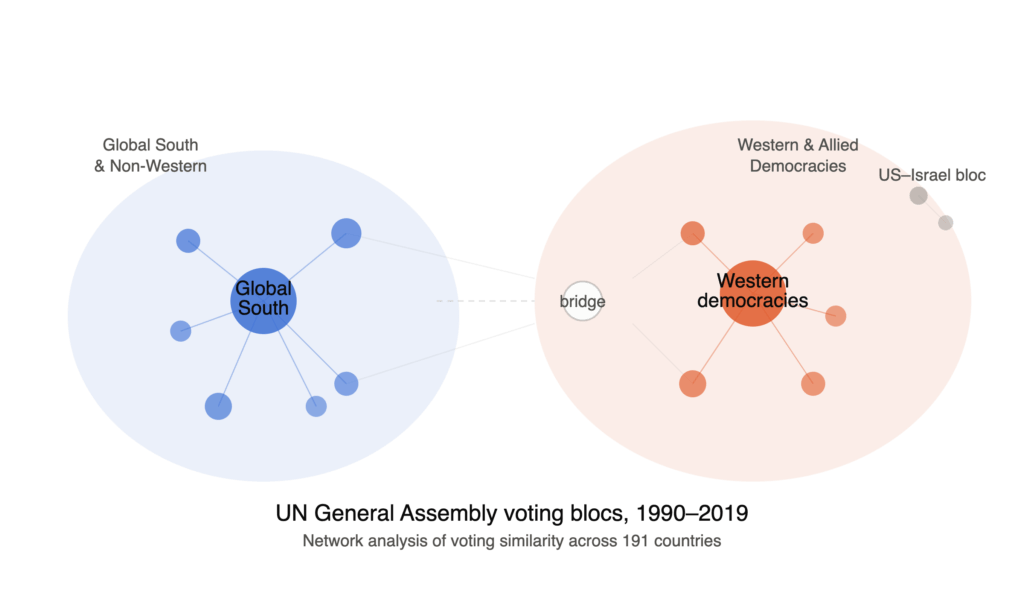
In examining community detection with the UNGA network during this period, the Louvain algorithm (Blondel et al., 2008) revealed four distinct voting communities, a summary of which is presented in figure 5.1.
Figure 5.1 — Detected Voting Communities

This four-community structure points to two notable patterns. Russian and Chinese voting positions align more closely with the developing world than with the Western world, suggesting that the China-Russia bloc functions as part of a broader non-Western coalition rather than as a separate grouping. At the same time, the US, Israel, and Micronesia find themselves in a position of relative isolation, consistently voting against the majority of UN member states.
Validation Against Formal Alliances
The paper’s main hypothesis, that voting behaviour conveys alignment patterns broader than formal alliance structures, is supported by a partial but incomplete overlap between the identified communities and official institutional affiliations (NATO, BRICS, SCO, AU, and ASEAN):
- The Western & Allied Democracies group, which includes NATO members, also comprises non-NATO nations such as Japan and South Korea. These countries exhibit analogous voting patterns on resolutions without having formal alliances.
- The community comprising the Global South and the Non-Western Bloc encompasses a significantly larger number of entities. This suggests that the congruence in voting behavior among developing nations and states outside the Western sphere surpasses the boundaries set by current institutional affiliations..
- The US-Israel Bloc exists only as a voting-behaviour phenomenon.
Network Visualisation
Figure 5.2 presents the voting similarity network.

Visual representation indicates two prominent and interlinked clusters: the Global South and Non-Western Bloc depicted in blue, and the Western and Allied Democracies in red. This data suggests that voting alignment in the UNGA is extensive, with most nations within these communities consistently casting similar votes on the majority of resolutions.
Centrality Analysis: Geopolitical Brokers and Influencers
Betweenness centrality (Freeman, 1977) identifies countries that act as “bridges” between otherwise distinct voting communities — states whose removal would most disrupt the flow of voting alignment across the network.

Eigenvector centrality (Bonacich, 1972) identifies countries whose voting positions are most closely connected to other influential countries.

Temporal Dynamics

Fluctuations in the legislative activity of UNGA are illustrated in the related figure for resolutions per year, marked by significant events such as the dissolution of the Soviet Union in 1991 (green line) and the 2008 global financial crisis (orange line).
These events elucidate the persistent structural presence of the Russia-China aligned voting bloc within the larger Global South coalition rather than as an independent entity.
Analysis of the Economic, Political, and Regional Drivers of UN General Assembly Voting Blocs
Studies of UN General Assembly (UNGA) voting show that countries form voting blocs that usually reflect political alliances, but these patterns can also signal future geopolitical changes. Using network analysis and modularity-based community detection on UNGA roll-call votes from 1946–2008, Macon et al. (2012) identified stable voting communities that closely mirrored Cold War rivalries and later fragmented after the collapse of bipolarity. Because UNGA votes are frequent and low-cost diplomatic signals, changes in voting behaviour often emerge before formal alliances shift.
Alliance Formation: Economic Interests
During alliance formation, countries often begin voting together before signing formal agreements. States with strong trade, investment, and aid relationships tend to vote more similarly in the UNGA, although the effect varies according to the issue and national strategic priorities (Dreher & Sturm, 2012). The most concrete recent example of this is China’s Belt and Road Initiative. China’s expanding investments and infrastructure financing across Africa and Asia have coincided with greater diplomatic support from many recipient countries in UNGA votes concerning human rights and sovereignty; countries such as Ethiopia, Kenya, and Zimbabwe have frequently aligned with China’s voting position (Dreher et al., 2018).
However, the economic explanation has limits that are worth flagging. Steinert and Weyrauch (2024) found that BRI participation did not consistently shift Asian, African, or Latin American countries toward China’s voting position, and some European BRI signatories actually became less supportive over time. This suggests that economic incentives create conditions for alignment but do not guarantee it; states weigh economic ties against other strategic interests, and the relationship is neither automatic nor permanent.
Alliance Consolidation: Leadership and Regional Dynamics
During alliance consolidation, voting generally reinforces existing alliances, but domestic politics can reshape these patterns significantly. Leadership turnover often produces voting realignment because new governments redefine foreign policy priorities (Voeten, 2013). This effect is strongest in small-coalition authoritarian regimes, where leaders can rapidly redirect foreign policy without domestic constraint (Smith, 2016). A clear historical example is the shift in African bloc voting after several leadership changes in the early 2000s, where newly elected governments with different foreign policy orientations produced measurable shifts in UNGA alignment within a single session (Dreher & Jensen, 2013).
Regional organisations also play a consolidating role. The African Union and the European Union encourage bloc voting through shared security interests, historical ties, and institutional cooperation (Kim & Russett, 1996). The EU in particular demonstrates one of the highest levels of internal voting cohesion in the UNGA, with member states coordinating positions before sessions through the Common Foreign and Security Policy mechanism. But this cohesion is not unconditional; Hungary’s divergence from the EU bloc on Ukraine-related resolutions after 2022 illustrates how domestic political shifts within a single member can fracture even highly institutionalised blocs.
Alliance Decline: Geopolitical Shocks
Voting divergence frequently appears before formal political realignment, making UNGA data a useful early warning indicator. The end of the Cold War, the War on Terror, and the Russia-Ukraine war have each reshaped global voting coalitions by altering states’ strategic calculations (Bailey et al., 2017). The Ukraine case is particularly instructive. Support for UNGA resolutions condemning Russia’s invasion declined from over 140 votes in 2022–2024 to just 93 votes in February 2025, with 18 votes against and 65 abstentions (United Nations, 2025). Critically, the United States, which had supported similar resolutions consistently, voted against the Ukraine-sponsored resolution, while India, South Africa, and several African and Asian countries abstained. This was not a random shift but a reflection of changing strategic priorities: the US under its new administration was recalibrating its position on the war, while Global South states were balancing economic dependency on Russia against diplomatic pressure from the West.
This three-stage framework shows that voting blocs are not static structures. They form under economic incentives, consolidate through institutional momentum and leadership continuity, and fragment under the pressure of major geopolitical events. The implication for this study is that any snapshot of voting clusters like the 1990–2019 network analysed here captures one moment in an ongoing process of alignment and realignment rather than a fixed geopolitical map.
While the analysis provides important insights into voting-based geopolitical alignment, several limitations should be acknowledged. The most fundamental is that UNGA voting captures diplomatic signalling rather than the full depth of interstate relations. Countries may vote together for strategic or symbolic reasons, to avoid antagonising a major power, to maintain regional consensus, or simply out of diplomatic inertia, without this reflecting genuine geopolitical alignment. Conversely, close allies may occasionally diverge on specific resolutions without any meaningful rupture in their broader relationship. This means that voting similarity is a useful but incomplete proxy for alliance.
The analysis is also constrained by the dataset, which runs to 2019 and therefore does not capture voting dynamics following the 2022 Russia-Ukraine conflict or developments in the Middle East, two of the most significant recent drivers of geopolitical realignment. The community detection was also performed on the full 1990–2019 period as a single aggregated network rather than through the five-year rolling windows specified in the original methodology, which limits the ability to track how communities shift over time.
Additionally, UNGA resolutions are non-binding and vary widely in political salience. Treating all resolutions equally in the agreement index may weight low-stakes procedural votes the same as high-stakes political ones, potentially distorting the community structure that emerges. Future research could weight resolutions by political significance, for example, by using the US State Department’s “important votes” classification, to produce a more nuanced picture of meaningful alignment.
Conclusion
This study examined emerging geopolitical alliances through UNGA voting patterns using a mixed-methods approach, combining Social Network Analysis with qualitative thematic analysis. The network identified four distinct voting communities: the Global South and Non-Western Bloc, Western and Allied Democracies, the US–Israel Bloc, and Pacific Micro-states, and showed that voting alignment extends well beyond formal institutional memberships like NATO or BRICS.
Several findings carry direct practical relevance. First, the fact that non-NATO states like Japan and South Korea cluster consistently with the Western bloc indicates that formal alliance membership understates the actual scope of Western alignment, a finding relevant for foreign policy analysts tracking the real boundaries of US diplomatic influence. Second, the US-Israel Bloc, existing only as a voting-behaviour phenomenon without any formal institutional basis, demonstrates that UNGA data can surface informal alignments that do not appear in conventional alliance datasets. For policymakers and intelligence analysts, this points to UNGA voting as a useful early-warning signal for alliance shifts that have not yet been formalised.
Third, and most significantly for contemporary foreign policy, the persistence of the Russia-China aligned voting bloc within the broader Global South coalition, rather than as a separate, discrete grouping, suggests that efforts to isolate Russia diplomatically face a structural challenge. Russia’s alignment is embedded in a much larger non-Western voting community, which means diplomatic pressure needs to be directed at the conditions driving Global South alignment (economic dependency, regime type, regional security concerns) rather than at Russia itself.
The study also demonstrates the value of combining network analysis with political and economic explanation. Network tools can show that clusters exist and where the bridges between them are; the qualitative literature explains why those clusters form and how durable they are likely to be. Neither alone gives the full picture. Future research should extend this framework to post-2022 voting data, incorporate economic and military dependency variables directly into the network model, and apply the five-year rolling window analysis to track how these communities have shifted in response to the Ukraine war and other recent geopolitical developments.
Acknowledgements: Lavanya and Shoaib
References
- Bastian, M., Heymann, S., & Jacomy, M. (2009). Gephi: An open source software for exploring and manipulating networks. Proceedings of the International AAAI Conference on Web and Social Media, 3(1), 361–362. https://aaai.org/papers/00361-13937-gephi-an-open-source-software-for-exploring-and-manipulating-networks/
- Blondel, V. D., Guillaume, J.-L., Lambiotte, R., & Lefebvre, E. (2008). Fast unfolding of communities in large networks. Journal of Statistical Mechanics: Theory and Experiment, 2008(10), P10008. https://doi.org/10.1088/1742-5468/2008/10/P10008
- Bonacich, P. (1972). Factoring and weighting approaches to status scores and clique identification. Journal of Mathematical Sociology, 2(1), 113–120. https://doi.org/10.1080/0022250X.1972.9989806
- Freeman, L. C. (1977). A set of measures of centrality based on betweenness. Sociometry, 40(1), 35–41. https://doi.org/10.2307/3033543
- Jacomy, M., Venturini, T., Heymann, S., & Bastian, M. (2014). ForceAtlas2, a continuous graph layout algorithm for handy network visualization designed for the Gephi software. PLoS ONE, 9(6), e98679. https://doi.org/10.1371/journal.pone.0098679
- Robinson, D. (2017). unvotes: United Nations General Assembly voting data [R package]. https://github.com/dgrtwo/unvotes
- Signorino, C. S., & Ritter, J. M. (1999). Tau-b or not tau-b: Measuring the similarity of foreign policy positions. International Studies Quarterly, 43(1), 115–144. https://doi.org/10.1111/0020-8833.00113
- Voeten, E. (2013). Data and analyses of voting in the UN General Assembly. In B. Reinalda (Ed.), Routledge handbook of international organization (pp. 80–92). Routledge. https://dataverse.harvard.edu/dataset.xhtml?persistentId=doi:10.7910/DVN/LEJUQZ
- Measuring geopolitics: the promise and limits of UNGA voting data for IB research | Journal of International Business Policy | Springer Nature Link https://share.google/WPrVNjan0bpN4SncB
- De Oliveira, A. N. C., Geiger, L. M., & Ugar, E. T. (2025). The United Nations General Assembly in a multipolar world order: An analysis of roll call votes on UNGA resolutions addressing Russia’s military actions in Ukraine. Chinese Political Science Review. https://doi.org/10.1007/s41111-025-00292-4
- Mosler, M., & Potrafke, N. (2020). International political alignment during the Trump presidency: Voting at the UN General Assembly. International Interactions, 46(3), 481–497. https://doi.org/10.1080/03050629.2020.1719405
- Nurullayev, D., & Papa, M. (2023). Bloc politics at the UN: How other states behave when the United States and China–Russia disagree. Global Studies Quarterly, 3(3), ksad034. https://doi.org/10.1093/isagsq/ksad034
- Rabel, R. (2025). Global South and western divergence on Russia’s war in Ukraine: Implications for world order. International Affairs, 101(3), 1005–1021. https://doi.org/10.1093/ia/iiaf008
- Tawat, M. (2025). The Russia–Ukraine war: Understanding the Global South’s vote at the UN and its implications for the current world order. Third World Quarterly, 46(16), 2019–2036. https://doi.org/10.1080/01436597.2025.2549357
- Bailey, M. A., Strezhnev, A., & Voeten, E. (2017). Estimating dynamic state preferences from United Nations voting data. Journal of Conflict Resolution, 61(2), 430–456. https://doi.org/10.1177/0022002715595700
- Dreher, A., & Jensen, N. M. (2013). Country or leader? Political change and UN General Assembly voting. European Journal of Political Economy, 29, 183–196. https://doi.org/10.1016/j.ejpoleco.2012.09.004
- Dreher, A., & Sturm, J.-E. (2012). Do the IMF and the World Bank influence voting in the UN General Assembly? Public Choice, 151(1–2), 363–397. https://doi.org/10.1007/s11127-010-9750-2
- Kim, S. Y., & Russett, B. (1996). The new politics of voting alignments in the United Nations General Assembly. International Organization, 50(4), 629–652. https://doi.org/10.1017/S0020818300033550
- Macon, K. T., Mucha, P. J., & Porter, M. A. (2012). Community structure in the United Nations General Assembly. Physica A: Statistical Mechanics and Its Applications, 391(1–2), 343–361. https://doi.org/10.1016/j.physa.2011.07.029
- Smith, A. (2016). Leader turnover, institutions, and voting at the UN General Assembly. Journal of Conflict Resolution, 60(1), 143–163. http://www.jstor.org/stable/24755883
- Dreher, A., Fuchs, A., Parks, B., Strange, A., & Tierney, M. J. (2018). Apples and dragon fruits: The determinants of aid and other forms of state financing from China to Africa. International Studies Quarterly, 62(1), 182–194. https://doi.org/10.1093/isq/sqx052
- United Nations. (2025, February 24). General Assembly adopts resolution reaffirming Ukraine’s sovereignty and territorial integrity. https://news.un.org/
- Bailey, M. A., Strezhnev, A., & Voeten, E. (2017). Estimating dynamic state preferences from United Nations voting data. Journal of Conflict Resolution. https://doi.org/10.1177/0022002715595700
- Blondel, V. D., Guillaume, J.-L., Lambiotte, R., & Lefebvre, E. (2008). Fast unfolding of communities in large networks. Journal of Statistical Mechanics: Theory and Experiment, 2008(10), P10008. https://doi.org/10.1088/1742-5468/2008/10/P10008
- Magu, R., & Mateos, G. (2018). United Nations General Assembly vote similarity networks. Conference paper hajim.rochester.edu/ece/sites/gmateos/pubs/un/UN_CN17.pdf
- Gallop, M., & Minhas, S. (2021). [Network-based analysis of UNGA voting similarity patterns] https://www.cambridge.org/core/journals/network-science/article/abs/network-approach-to-measuring-state-preferences/BDAF9FFF5FBBE948C11A607AD36C3D25
- “Affinity communities in United Nations voting: Implications for democracy, cooperation, and conflict” Scott D. Pauls,Skyler J. Cranmer https://www.sciencedirect.com/science/article/abs/pii/S0378437117304879?via%3Dihub
- Cartwright, D., & Harary, F. (1956). Structural balance: A generalization of Heider’s theory. Psychological Review, 63(5), 277–293. https://doi.org/10.1037/h0046049
- Fritz, C., Mehrl, M., Thurner, P. W., & Kauermann, G. (2025). Exponential random graph models for dynamic signed networks: An application to international relations. Political Analysis, 33(3), 211–230. https://doi.org/10.1017/pan.2024.21
- Heider, F. (1946). Attitudes and cognitive organization. Journal of Psychology, 21(1), 107–112. https://doi.org/10.1080/00223980.1946.9917275
- Lerner, J. (2016). Structural balance in signed networks: Separating the probability to interact from the tendency to fight. Social Networks, 45, 66–77. https://doi.org/10.1016/j.socnet.2015.12.002
- Maoz, Z., Kuperman, R. D., Terris, L., & Talmud, I. (2007). Structural equivalence and international conflict: A social networks analysis. Journal of Conflict Resolution, 51(4), 574–604. https://doi.org/10.1177/0022002707302689