Authors: Ananya D, Kaushal Pallai, Neha Mahesh, Rafia Perween, Shriya Sawant, Shaunak Palsule, Vishakha Sharma
Abstract
This research paper intends to study the growing diplomatic power of the Global South through changes in the patterns of UN voting, particularly in the UNGA. The paper has also made an attempt to study the changing nature of diplomatic alliances in a multipolar world. The developments caused changes in classifying different countries as constituents of a single and particular ideological bloc have also been traced by the transition from a bipolar world dominated by two world powers to later being dominated by a single power, and lastly being characterised by various centres of power, a multipolar world order. Today, the alliances in the world are issue-based rather than being on the lines of ideology that is being pursued by the countries. The paper tries to examine the changes in the UN voting patterns and assess whether the Global South countries exhibit increasing diplomatic cohesion in UN voting behaviour. It has also undertaken to understand Global South diplomacy and its implications for contemporary Global Governance. However, it is also seen that despite the growing prominence of the Global South in international governance, existing UN network patterns provide a limited study of the phenomenon.
The study also sheds light on different methods used by the researchers to study diplomatic international alliances through the means of UN Voting behaviour. The research method used in the paper is qualitative in nature and uses three perspectives, namely Social Network Theory, Neorealism, and Constructivism, to examine the changes in the UNGA voting patterns, which show the growing power of the Global South Diplomatic Alliance in an era of multipolarity.
The research is guided by a constructive research philosophy which perceives global alliances as products of social construction, common identities and evolving political interests among states. The study also traces the changes in diplomatic global alliances from being categorised as ideology-based to being influenced by issues faced in common by different nations. It is also seen that the increased membership of the UN by states attaining independence and the aftereffects of the decolonisation process also affect diplomatic alliances. The role played by organisations like NAM, G-77 also shows the difference in stance taken by the Global South, which helped to transition from an ideology-based alliance to issue-based alliances. This study also shows that modern geopolitical alliances are shaped by pragmatic, cohesive alliances rather than a fixed military bloc based on ideological beliefs. This has also shown that permanent alliances have become non-existent due to different common issues faced by countries. Thus, the study makes an effort to understand these changes and evaluate the role of the Global South.
Keywords: Multipolarity, International Order Transformation, Global South Diplomacy, Social Network Theory, Network Modularity, Voting Affinity
The contemporary international system is undergoing a significant transformation as the post-Cold War order gives way to a more multipolar arrangement, marked by the rise of emerging powers and the growing prominence of the Global South within multilateral institutions (Heywood, 2011; Bull & Banik, 2025). The United Nations remains the central forum for this diplomacy, where voting behaviour reflects states’ foreign policy preferences (Bailey, Strezhnev, & Voeten, 2017). Yet conventional analyses of voting outcomes, which treat states as isolated actors, struggle to capture the relational structures like alliances, blocs, and clusters that shape diplomatic alignment. Network analysis offers a more systematic approach, enabling identification of emerging alliances and structural shifts over time (Macon, Mucha, & Porter, 2012).
Despite the growing prominence of the Global South in global governance, existing studies of UN voting provide limited insight into how such diplomatic alliances emerge and evolve as networked structures over time. This study addresses this by applying network analysis to UN voting patterns to identify emerging geopolitical alliances, with emphasis on the Global. South’s evolving diplomatic role. While previous studies have examined UN voting behaviour (Bailey, Strezhnev, & Voeten, 2017) and network analysis (Macon, Mucha, & Porter, 2012) independently, limited attention has been paid to understanding how changes in UN voting pattern networks reflect the emergence of the Global South as a diplomatic alliance in the era of multipolarity. This study addresses this gap by integrating these two perspectives- voting behaviour analysis and network analysis- to examine evolving geopolitical alignments.
Research Question:
How do changes in UN voting network analysis reveal the Emergence of a Global South diplomatic alliance in an era of Multipolarity?
Objectives
1. To examine changes in UN voting patterns in the context of the evolving multipolar international order.
2. To identify emerging geopolitical alliances through the application of network analysis of UN voting behaviour.
3. To assess whether Global South countries exhibit increasing diplomatic cohesion in UN voting behaviour.
4. To analyse how network analysis techniques, such as community detection and centrality measures, reveal patterns of cooperation and alignment among states.
5. To contribute to the understanding of Global South diplomacy and its implications for contemporary Global Governance.
This study contributes to the growing literature on international relations by integrating network analysis with the study of UN voting patterns to examine emerging geopolitical alignments. It advances understanding of the Global South’s evolving diplomatic role in an era of multipolarity, while demonstrating the utility of computational approaches for the analysis of international political behaviour. The findings are relevant for scholars, policymakers, and researchers engaged with global
governance and multilateral diplomacy.
LITERATURE REVIEW
The United Nations General Assembly has been an important arena for understanding patterns of foreign policy behaviour and diplomatic alignment. Before, studies suggested similarities in the voting patterns as indicating a shared political preference, although recent studies about international politics indicate a more focused perspective towards the broader structural change within the global order. As power is becoming increasingly dispersed towards the emerging economies and countries, research scholars have started questioning if these transformations are showing new forms of cooperation that are diplomatic in nature, particularly amongst the Global South countries. On the other hand, the advancements in network analysis have encouraged researchers to move beyond the conventional bilateral comparisons and analyse voting behaviours as a focused portion of an interconnected system of relationships. Altogether, the emergence of these countries provides an essential base and a framework for examining how the changes in UN Voting networks show emerging geopolitical alignments.
Earlier scholars measured the alignment using voting coincidence indices, affinity scores, S-scores and correlation coefficients with the purpose of comparing the behaviours of pairs of different states. The assumption in these methods was that the countries voting on similar lines shared a common foreign policy interest and preferences in ideologies. Even though it was useful for assessing bilateral relationships, they largely overlooked the wider patterns of interactions in the UNGA. Spatial models have been introduced, like ideal point estimation, which estimates countries’ latent ideological positions with the help of roll call voting data (Bailey, Strezhnev, & Voeten, 2009). Bailey and Voeten (2018) later demonstrate that UN Voting cannot at all times be understood through one
ideological dimension. This highlights the complexity of the preferences of states on different policy issues. In spite of these methodological developments, the models struggle to understand the fluid coalition-building and multidimensional alignments, which are in turn associated with the increasingly multipolar international system.
The most significant advancement in methodology has been the application of network analysis in the UN Voting behavior. Instead of analysing states differently, network approaches help treat countries as nodes connected using similarities in voting patterns, making it even more possible to identify the hidden communities, evolving diplomatic structures and the influential actors. Macon, Mucha, and Porter (2012) state that representing the UNGA Voting as a network reflects the patterns of political cooperation that conventional numerical and statistical methods overlook. By using the weighted and signed network, their study has shown that changes in the community structures closely correlate with the major geopolitical developments, which include the end of the Cold War. A dynamic network analysis helps in strengthening the approach by allowing the researchers to analyse alliance formation, fragmentation, and drastic shifts in influence over time. This makes it very useful for analysing and identifying diplomacy in an ever-changing international environment.
From Unipolarity to Multipolarity: Structural Transformation of the International System
The distribution of global power is changing and provides an important context for the methodological developments. The post-Cold War period is often characterised by the predominance of the United States; contemporary international politics has been reflecting the growing popularity of countries such as China, India, Brazil, Indonesia and South Africa. These developments have led to intense debates with respect to the emergence of multipolarity and how international institutions are starting to show more diverse centres of influence. Voeten (2026) states that geopolitical alignments should be understood by differentiating ideological agreement from the formal relational alliances. As per his analysis, the UNGA Voting primarily influences and captures agreement on the international order instead of the traditional military or security alliances. This difference is relevant in a multipolar era, where many states suggest and vote similarly on global governance while simultaneously maintaining their distinguishing strategic and security alliances.The cited literature also shows the growing diplomatic significance of the Global South among the Multilateral institutions. Beauguitte (2017) demonstrated that in spite of the end of the Cold War, the voting behaviour in the UNGA reflects a persistent North-South divide. The network analysis identifies organisations such as the Group of 77 (G77) and the Non-Aligned Movement (NAM) as very vital platforms through which the countries, particularly developing, coordinate their own diplomatic positions. He further stated that political regionalisations function as a “weapon of the weak” and enable only smaller and developing states to have greater collective influence than they would be possible to have individually. This increased coordination in the voting behaviour and the official speeches clearly suggest that the collective diplomacy has now been enhanced to an important strategy for advancing the interests of the Global South within the international institutions.
However, the researchers remain curious about the equation of economic cooperation with political alignment. Steinert and Wegrauch (2024) study the participation in China’s Belt and Road Initiative (BRI) and whether it produced greater voting convergence with China in the UNGA. Their findings show that for most of the Asian, African and Latin American countries, joining the BRI did not show any significant short-term changes in the voting pattern. Rather, the study concluded that economic partnerships as the only source cannot automatically show and generate diplomatic alliances, and the political alignment develops over time through complex and gradual processes. The use of community detection algorithms, moreover, illustrates how the network pattern analysis can show evolving voting communities and still reveal the limitations of the interpretation of economic initiatives as the direct indicators of geopolitical alignment patterns.
The literature shows considerable progress in the measurement of diplomatic alignment and understanding the consequences of multipolarity. The developments that are methodological in nature have progressed from bilateral voting comparisons to the sophisticated network approaches that are capable of identifying structural transformations inside the international system. On the other hand, existing cases and research work recognised the growing agency of diplomacy of the Global South while questioning if the contemporary voting convergence shows a cohesive alliance or just an issue-based cooperation.
The Global South: Identity, Agency and Coalition Formation
In The Darker Nations, Vijay Prashad (2007) stated that “The Third World was not a place. It was a project.” This observation encapsulates the evolution of the Global South from a mere geographical distinction into a political and diplomatic project rooted in shared historical experiences, aspirations for equitable development and the demand for a more representative international order. While the term originally emerged in the context of decolonisation and Cold War politics, it has increasingly evolved to represent a collective voice advocating reforms in global governance and greater agency within multilateral institutions. Understanding whether this political project has translated into a cohesive diplomatic alliance requires a critical examination of its historical evolution, competing conceptualisations, and the pattern of cooperation in the international forums, particularly the United Nations.
Amitabh Acharya, “Who are the norm makers?” (2014) stated that the intellectual foundations of the Global South can be traced back to the Bandung Spirit, where the newly independent Asian and African countries articulated a vision of solidarity, sovereign equality and peaceful coexistence. Rather than aligning with bloc politics, they challenged the Eurocentric views of global governance and advocated political autonomy and collective self-determination rooted in the idea that “Colonialism in all its manifestations is an evil which should speedily be brought to an end.” (Final Communique, Bandung Conference, 1955).
Subsequently, the vision was institutionalised through the Non-Aligned Movement (NAM), established in 1961, which sought to preserve strategic independence amidst the superpower rivalry. Later, the creation of the Group of 77 (G77) in 1964 further expanded this agenda by shifting the focus towards economic cooperation, emphasising reforms in international trade, development finance and the establishment of the New International Economic Order (NIEO). These institutions transformed the Global South from a mere geographical entity into an organised platform for collective action.
Further, Andrew Heywood (2011) explains that during the 1990s, the collapse of bipolarity and the simultaneous emergence of globalisation shaped the global order by the rise of emerging powers (India, Brazil, China and so on) and simultaneously strengthened the roots of southern solidarity with new institutional arrangements such as IBSA (India-Brazil-South Africa) and the New Development Bank (NDB). Moreover, India`s Voice of Global South has further reinforced the political salience of Global South as a platform advocating for debt restructuring, climate justice, equitable representation within institutions such as the United Nations Security Council, the International Monetary Fund, and the World Bank and seeking greater agency within the emerging multipolar international order.
While these institutional developments strengthened South-South cooperation, this historical trajectory has been continuously debated by scholars, and the important question remains whether the Global South constitutes a coherent diplomatic alliance or merely a flexible political identity. Based on the pragmatic interpretation, Oliver Stuenkel (2024) stated that countries coordinate selectively on issues as context dependent and states align on development issues while simultaneously diverging on the question of regional security, military alliances, or geopolitical competition. India is a case in point as New Delhi and Beijing maintain converging interests on climate justice despite being active strategic rivals.
S Jaishankar, The India Way: Strategies for an Uncertain World (2020) also outlines this pragmatic settlement to engage with nations while pursuing their own self-interest and national security. Consequently, from this perspective, the Global South is viewed as a network of overlapping strategic partnerships to exploit the global contradictions in order to advance national interests rather than acting as a rigid diplomatic bloc.
On the other hand, Nilsen (2025) stated that we are not witnessing an emerging World order with a stronger role for the Global South, but rather entering into an era of deep instability and uncertainty and conceptualising this period as “southern interregnum”, drawing from Gramsci’s ideas of a transitional period where the old structures are dying but the new ones are yet to be born. He cited the contradictory trajectory of the Global South, with the growing accumulation of capital in some countries, such as China and Brazil, while the persistence of poverty, inequalities and structural exclusion across much of the global periphery. Hence, the Global South engagement has become a key rhetorical claim in shaping the global order. This debate raises an important empirical question: Is the historical solidarity of the Global South reflected in the observable patterns of diplomatic behaviour? One of the most significant observable areas for examining this question is voting behaviour in the United Nations General Assembly.
Addressing this question, Nicholas M Anspach (2025) used a mixed-method approach and conducted a statistical study of roll call votes in the United Nations General Assembly (UNGA) from 1965 to 2022 to measure group cohesion and individual voting patterns, particularly among the G77. The study finds that Southern solidarity remains the defining feature of UNGA, maintained by the shared Southern worldview rooted in the historical experiences with imperialism and the belief that the international economic order has remained unfair. Countries support each other’s priorities to maintain their collective “power in numbers”. For instance, the resolutions of sovereignty and human rights, sustainable development, climate change, nuclear disarmament and the conflicts in Ukraine, Gaza and Sudan tend to exhibit similar voting patterns. Hence, the Global South is not merely reacting to the changing global landscape, but increasingly functions as a “norm shaper” in the emerging new world. and exhibits a measurable pattern of diplomatic coordination within multilateral institutions.
Network Metrics as Indicators of Power, Leadership and Coalition Formation
The growing application of Complex Network analysis in International relations has shifted the analytical focus from individual state behaviour to the relational structures that connect states within the international system, and provides a valuable bridge between abstract theories of international relations and the observable behaviour of states.
Bull and Banik (2025) stated that the network analysis of the United Nations General Assembly (UNGA) voting pattern provides an operational tool by treating individual states as nodes and their voting coincidences as edge weights. Rather than revealing a single voting bloc, network modularityand centrality (Freeman, 1978) reveal the internal fractures and coalitions theorised by scholars. When UNGA voting networks are filtered by issue areas, such as separating security resolutions from those concerning sustainable development, the data reveal a highly nuanced landscape of alignment.
On economic and development fronts, the network typically generates a dense, highly cohesive network, reflecting the historical anti-colonial and emancipatory project of the G77 and BRICS networks. Here, the edge weights between the Global South states are at their strongest, demonstrating a unified front against Western institutional dominance.
However, when analysing security or human rights resolutions, this macro cluster undergoes significant fragmentation. In these sub-networks, centrality metrics– specifically betweenness and eigenvector centrality highlight key “ swing states” or middle powers, such as India, Brazil, and South Africa, acting as bridges between Western-centric clusters and the Global South. This shifting provides empirical proof of Bull and Bakin’s concept of strategic balancing. Instead of entering into permanent and rigid alliances, emerging powers utilise their network position to practice active nonalignment, dynamically shifting their proximity to different power centres to maximise national interest. Thus, a network approach moves beyond simplistic binaries, mapping the emergence of the Global South as a complex web of overlapping, issue-based diplomatic alliances.
Although existing literature provides substantial deep insights into the conceptual evolution of the idea of the Global South, the development of South-South Cooperation and how it transformed into Global South-led diplomatic alliances, as represented in UN voting patterns. However, the important research gap remains, as much of the existing literature represents the Global South either as static historical identity or a mere geographical distinction, rather than concrete diplomatic alliances with strong empirical evidence to shape the network structures over time. Moreover, owing to the Eurocentric roots of the discourse, the relationship between the redistribution of Global power, the rise of emerging powers, and the restructuring of the UN voting networks remains insufficiently explored. Overall, these studies suggest that network metrics provide a robust analytical framework for identifying shifts in diplomatic alignments, thereby offering a suitable methodology to examine whether the evolving structure of UNGA voting networks reflects the emergence of the Global South diplomatic alliance in an increasingly multipolar international system.
THEORETICAL FRAMEWORK
No single theory fully accounts for the shifting pattern of UNGA voting identified above. Structural approaches capture the geometry of alignment but not its motivation, while identity-based accounts explain the motivation but not the graph itself. This study draws on three perspectives: social network theory to detect the structural pattern, neorealism to explain why states align under multipolarity, and constructivism to explain why Global South cohesion persists across issue areas. It builds on the work of Macon, Mucha, and Porter (2012) and Bull and Banik (2025), who introduced network analysis to UN voting research.
Social Network Theory
Social Network Theory treats UN member states as nodes and voting agreements as weighted edges. (Magu & Mateos, 2018). Applied to UNGA data, community detection methods produce clusters that track known political groupings fairly closely, and shifts in those boundaries align with major turning points, such as the end of the Cold War (Macon et al., 2012). Centrality measures like betweenness and eigenvector centrality pick out swing states like India, Brazil, and South Africa that bridge Western-aligned and Global South clusters (Bull & Banik, 2025). The value of this approach is that it lets us observe coalition formation directly, rather than inferring it from bilateral vote comparisons.
Neorealism
Neorealism explains why the clusters form. As power diffuses away from a single hegemon toward several competing centres, states hedge by aligning with others facing the same shift. Coordinated voting becomes a cheap way to signal position (Waltz, 1979). Voeten’s (2026) distinction between ideological agreement and formal alliance commitments is useful here, as the UNGA cohesion reflects shared preferences about the international order but not binding security pacts. It is the kind of loose, issue-based alignment that multipolarity tends to produce
Constructivism
Constructivism explains why the cohesion outlasts any single power shift. Prashad (2007) frames the Third World as “a project” rather than a place, an identity forged well before the current multipolar moment, rooted in the Bandung Spirit and later institutionalised through the NAM and G77 (Acharya, 2014). Anspach (2025) argues it’s this shared worldview, not material calculation alone, that has held G77 voting together from 1965 to 2022, especially on development, sovereignty, and climate resolutions.
The three perspectives are not competing explanations. Because while social network theory maps the alignment, neorealism explains its timing, and constructivism explains why it holds once it forms. Read together, they support treating the UNGA voting shifts as possible evidence of an emerging global South diplomatic alliance, rather than a coincidence of overlapping interests. Thus, in the theoretical framework section, we have a view of how these perspectives of different kinds complement each other while addressing different dimensions of diplomatic alignment. Social Network Theory identifies patterns of connectivity and clusters but cannot fully explain the political motivations behind them, while Neorealism explains alignment through changing power structures and strategic interests. However, it may understate the role of shared identities as well as historical experiences, whereas Constructivism addresses these identity-based factors, although it may not fully capture strategic calculations. By combining these three perspectives, we can ultimately study and examine how alignments emerge, why they occur, and why they may persist or change over time. Together, these perspectives provide us with a conceptual basis that is important for examining the changing UN voting patterns. While Social Network Theory ultimately identifies patterns of alignment, Neorealism and Constructivism help explain their strategic and identity-based dimensions. To examine these patterns empirically and assess whether they indicate emerging diplomatic alignments, the study adopts the following methodological approach.
RESEARCH METHODOLOGY
This study adopts a qualitative research methodology, supported by social network analysis (SNA), to examine how changes in UNGA voting patterns reveal the emergence of a Global South diplomatic alliance in an era of multipolarity. The study follows a research design that is explanatory and longitudinal in nature, analysing voting behaviour from 1946 to 2025 to identify shifts in diplomatic alignment and coalition formation. Rationale for this approach: This combination of methods was chosen because it allows the study to examine both the pattern of UN voting and its political meaning. Network analysis reveals how countries are connected through similar voting behaviour, while the qualitative approach explains the reasons behind these connections. Since the central aim of the study is to understand an emerging alliance, this combined approach offers a more comprehensive analysis and allows the changes in diplomatic relationships to be interpreted over time, drawing on official UN voting data and existing scholarly literature. This study is further guided by a constructivist research philosophy, which views international alignments as products of social construction, shaped through repeated interactions, shared identities, and evolving political interests among states. This theoretical framework provides a basis for interpreting voting relationships beyond purely material or strategic considerations.
To maintain the authenticity of the study, it relies exclusively on secondary data collected from authoritative sources, including UNGA roll-call voting records, the UN Digital Library, verified UN datasets, and peer-reviewed research papers. Sovereign states form the unit of analysis, along with their voting behaviour on selected resolutions covering areas such as international security, human rights, development, climate change, decolonisation, and major geopolitical conflicts. The study uses a purposive sampling technique to select resolutions that reflect contemporary diplomatic dynamics.
The findings generated through this study are interpreted qualitatively, relating structural changes in voting networks to broader developments in the geopolitical arena. This mixed analytical approach enables the study to explain not only the emergence of Global South alliances but also the broader significance of these changing voting patterns.
To ensure methodological rigour, the findings were carefully triangulated against established scholarly literature on UN voting behaviour and international diplomacy. As this research is based entirely on publicly available secondary data and involves no human participants, it presents minimal ethical concerns.
Thus, the methodology provides us with a basis for examining both the structure and political meaning of UNGA voting behaviour. This particular section will present the voting data and identify patterns of convergence and divergence among states, with a particular emphasis on the Global South, to assess the extent of emerging diplomatic alignment.
DATA ANALYSIS
Analysis of 738,764 votes on United Nations General Assembly (UNGA) resolutions (5,270 total resolutions, 200 member states and territories, 1946-2025) shows a largely consensus-driven voting trend. In particular, a majority of the votes, namely 79.7%, were affirmative (‘Yes’), while 12.9% of the votes were abstentions, and 7.4% were negative (‘No’). Besides, the proportion of affirmative votes grew from around 50-60% in the early decades of the UN to about 80-85% in recent years due to greater participation after decolonisation and enlargement of the UN. Variations in country voting trends suggest differences in the diplomatic approach, since some developing countries had consistently more affirmative votes compared to certain Western major powers.
KEY FINDINGS
The patterns seen in the voting behaviour, taken together with the existing body of knowledge, point towards the development of flexible issue-based alignments rather than ideological camps. The rise in the number of affirmatives points to an increase in multilateral collaboration following the rise in the number of independent states in the UN. On the other hand, the difference in voting behaviour points out that the strategic interests of states continue to play a key role in decision-making. The patterns seen in the study seem to fit in well with the existing body of knowledge, which considers the
BRICS, G77 and NAM as the platforms through which many countries in the Global South align their stance on issues of sovereignty, non-interference, sustainable development, climate justice, and reform of international institutions. India’s voting behaviour also fits in with its policy of strategic autonomy, where it maintains engagement with both the West and the Global South.
The observations made in this research can further be supported by the preceding studies on the voting patterns of the Global South members. The analysis of G77 voting in the UN General Assembly revealed that “G77 countries voted together on over 75 percent of roll-call votes in the United Nations General Assembly (UNGA) during 1999–2010” (Lees, 2023, p. 3), illustrated in the figure below. Similar to the results of my own research, this article also demonstrates that there is an observable trend of voting cohesion among the members of the Global South that do not necessarily vote as a united bloc but rather have a shared voting pattern on specific issues of common interest.
While results demonstrate the tendency towards voting cohesion, they also highlight the degree to which this cohesion is relative and issue-based. Indeed, the voting patterns of the countries analysed were consistent across issues within certain parameters but did not demonstrate absolute voting cohesion, which would further suggest their relative alignment on specific geopolitical priorities while pursuing other policies independently. Overall, the results of this research support the findings of Lees (2023) regarding the existence of voting patterns that highlight emerging geopolitical alignments beyond the binary of the West vs. the Global South.
Furthermore, it is also important to note the limitations of relying on the voting patterns of states in the United Nations General Assembly as the sole data point for this research. Indeed, not all of the resolutions that were sponsored by the states actually had to be voted on, as some of them were passed unanimously. Therefore, while the voting patterns of the states in the UNGA can demonstrate their relative alignment on specific issues, they might not necessarily reflect the countries’ actual positions on all matters. Consequently, while the results of this research can highlight trends in the degree to which states vote together, they cannot fully reflect the actual geopolitical realities of individual countries or regions due to the lack of other considerations taken into account by states when voting.
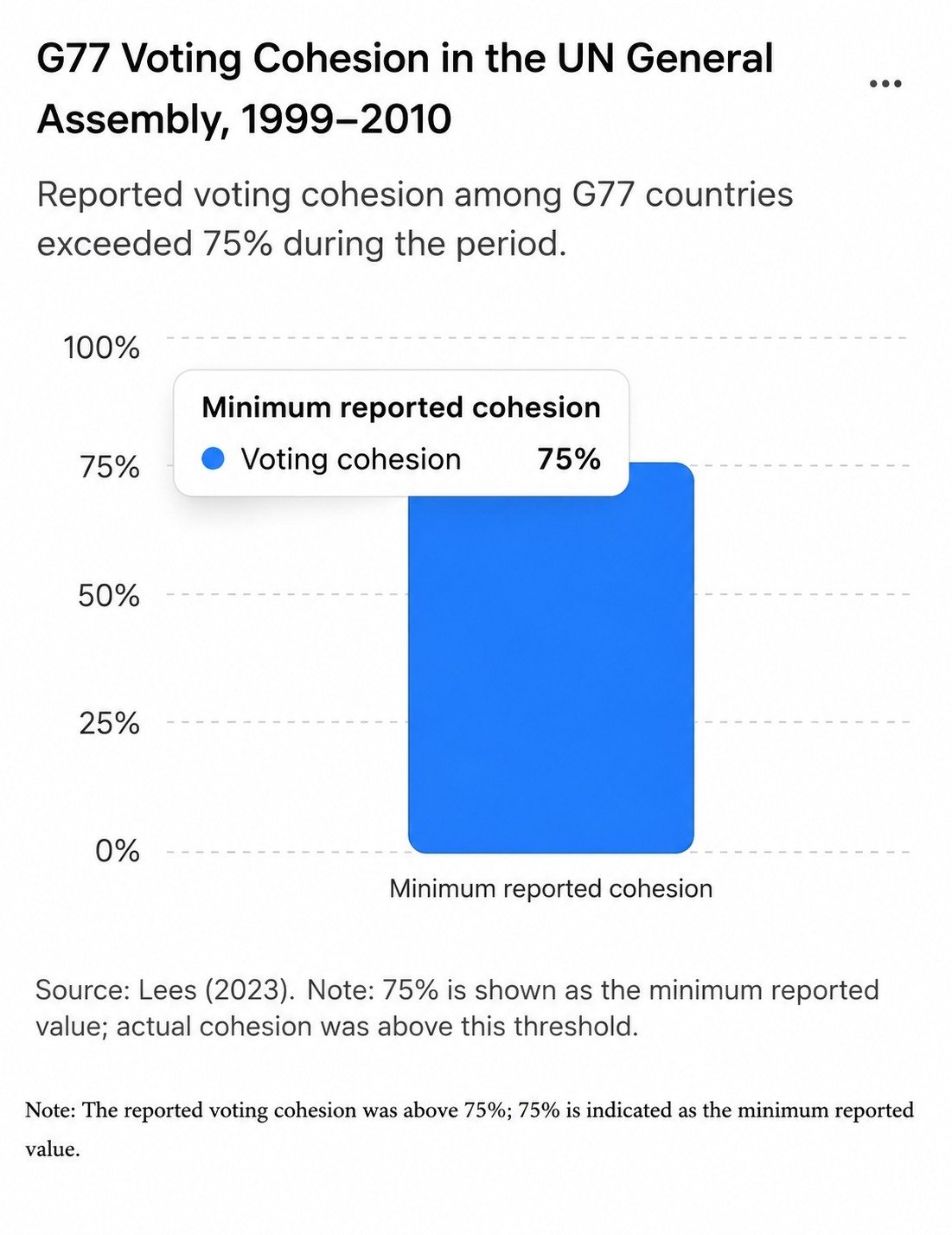
Figure X. G77 Voting Cohesion in the United Nations General Assembly, 1999-2010
DISCUSSION
The results generally confirm the assumption that modern geopolitical alliances are becoming characterised by pragmatic collaboration rather than a fixed military bloc. In terms of the UN voting pattern, voting reveals diplomatic alignment on particular issues rather than the presence of a permanent alliance, especially in cases of developing nations advocating for an international order that is more balanced. The results are consistent with the existing literature showing that the contemporary international system is more multipolar and that cooperation takes place through institutions like BRICS, G77 and NAM rather than through Cold War-type alliances.
Nevertheless, the existence of discrepancies in the voting pattern of the major powers shows that the process of geopolitical competition persists despite multilateral cooperation. It is important to mention that the study has a number of significant methodological shortcomings. The UN voting data provides a good understanding of how diplomats collaborate, but does not prove the existence of any geopolitical alliances. The voting pattern is just one aspect of the state-to-state relationship, and hence it should be combined with other political, economic, and strategic factors.
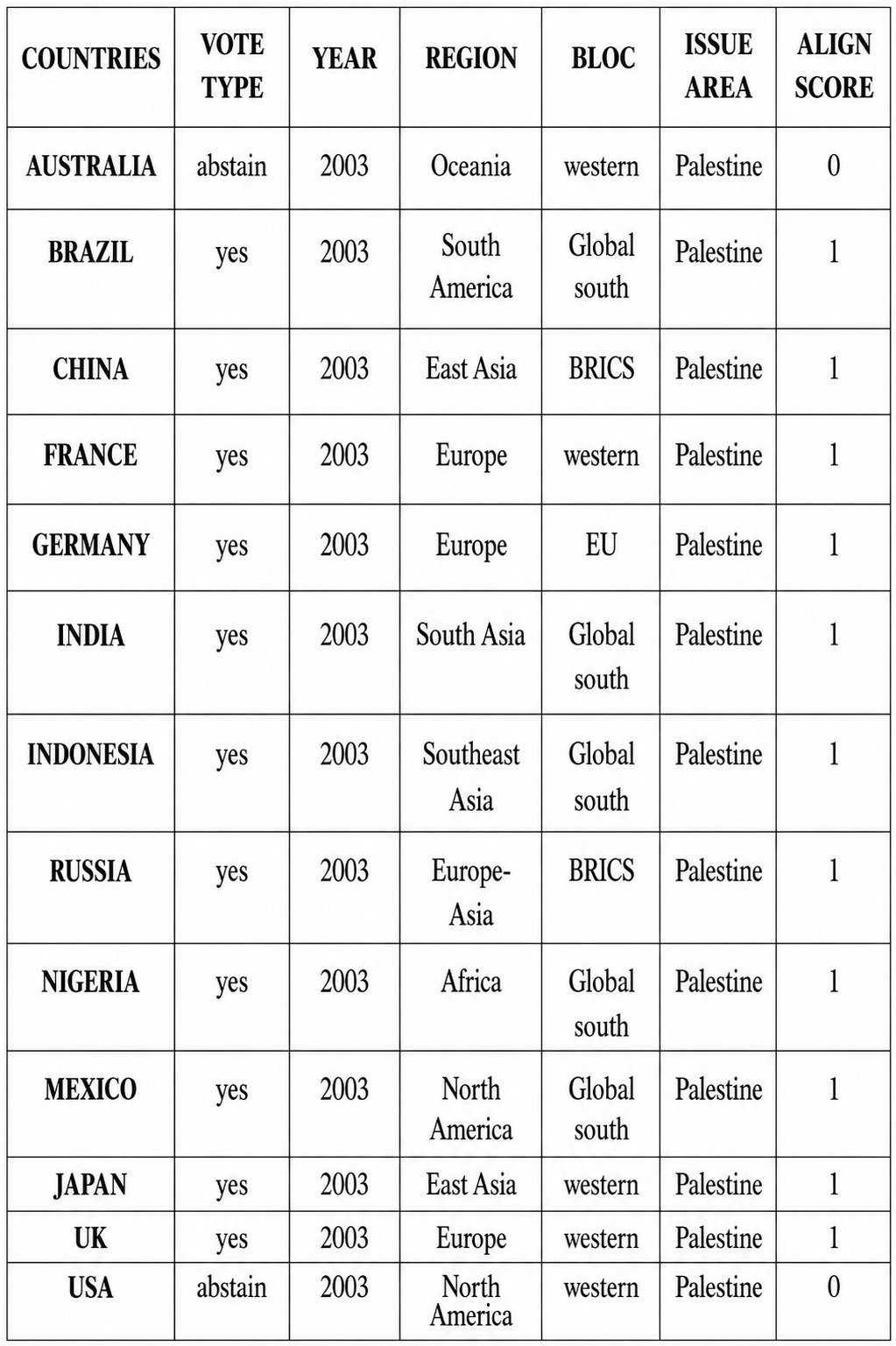
Table 1 presents an illustrative case study of the voting behaviour of selected United Nations member states on UN General Assembly Resolution A/RES/58/20 (2003) concerning the Question of Palestine. The selected countries represent diverse geographical regions and major geopolitical groupings, including the Western bloc, BRICS, the European Union, and the Global South. The variables included in the table provide a multidimensional understanding of voting behaviour. The Country column identifies the selected member states, while the Vote column records each state’s official voting position on the resolution. The Year identifies the period under examination, whereas the Region and Bloc columns enable comparison of voting behaviour across geographical and political groupings. The Issue Area specifies the subject matter of the resolution, and the Alignment Score provides a simplified indicator of support for the resolution, where countries voting in favour are assigned a value of one and abstentions are assigned zero. The analysis indicates a broad level of diplomatic convergence among the selected countries. Most Global South countries, including India, Brazil, Indonesia, Nigeria, and Mexico, voted in favour of the resolution, reflecting common positions on issues related to sovereignty, self-determination, and international justice.
Similarly, China and Russia also supported the resolution, indicating convergence among major emerging powers. Within the Western bloc, however, voting behaviour was not entirely uniform. While France, Germany, Japan, and the United Kingdom voted in favour, Australia and the United States abstained, highlighting differences in national diplomatic priorities on politically sensitive issues. Overall, the case study demonstrates that voting behaviour within the United Nations General Assembly is increasingly characterised by issue-based diplomatic coordination rather than rigid geopolitical divisions. Although based on a single illustrative resolution, the observed voting pattern supports the broader argument that contemporary international cooperation frequently extends across traditional political blocs and reflects the growing importance of flexible multilateral engagement in an evolving multipolar international system.
This study has four main limitations. First, the analysis relies on UNGA voting data that only represents one dimension of the diplomatic behaviour of the Global South. It limits the capture of the other dimensions like informal negotiations, bilateral engagements, economic interdependence and security partnerships that contribute to forming alliances. Second, the study is constrained by the conceptual approach that presents the Global South as a static historical identity and geographical category. It undermines the other identities and factors that are fluid and constantly changing as per their national interests. Third, earlier research on G77 voting supports our finding and shows substantial voting convergence among Global South countries despite their political and economic differences (Lees, 2023). However, such convergence should not be interpreted as evidence of permanent geopolitical alliances among South Asian countries, as UNGA voting captures only recorded positions and overlooks prior negotiations and consensus-building. Fourth, the analysis uses limited data to claim the rise of diplomatic alliances of the Global South. While the majority of data shows that the diplomatic alliances of the Global South aren’t strongly organised, the states do vote against the Global South diplomatic alliances. Thus, the emerging alignments identified in this study are better understood as flexible, issue-based patterns of cooperation rather than durable strategic alliances.
As the 21st century witnesses a profound transformation in the structure of international politics, it will not be remembered merely for the decline of unipolarity or the rise of new powers. Its defining feature lies in how power is diffusing from a concentrated Western-centric to a more dispersed, networked, and multipolar system. In this structural shift, the emergence of the Global South diplomatic alliance is no longer an idea but a reality. Based primarily on Social Network Theory, the study examines the changes in the UNGA voting patterns and the growing power of the Global South Diplomatic Alliance in an era of multipolarity. The study suggests that the structure of international politics has moved beyond the rigid military and ideological blocs to a more flexible network of overlapping diplomatic and issue-based alliances, especially in the Global South. It has been concluded from the study that the Global South states have formed their own diplomatic alliances due to the shared historical experiences with colonialism, imperialism, and the belief that Western hegemony isn’t fair in the world order. The diplomatic alliances of the Global South are not only based on the historical experiences but also on contemporary issues faced by the states, such as climate change, sustainable development, human rights, the refugee crisis, the imperial war in Ukraine, Palestine, and other Middle East countries. Ultimately, this study argues that the transformation in the structure of international order is best understood not as a sequence of hegemonic transitions but as a shift in the structure of diplomatic relationships. By revealing how patterns of cooperation evolve within the United Nations General Assembly, it demonstrates that the rise of the Global South is not an abstract narrative but a reality the world is witnessing as diplomatic alliances are rising in the Global South.
References
Bailey, M. A., Strezhnev, A., & Voeten, E. (2017). Estimating dynamic state preferences from United Nations voting data. Journal of Conflict Resolution, 61(2), 430–456. https://doi.org/10.1177/0022002715595700
Bailey, M. A., & Voeten, E. (2018). A two-dimensional analysis of seventy years of United Nations voting.
Beauguitte, L. (2017). Studying networks geographically: World political regionalisation in the United Nations General Assembly (1985–2010). In Complex Networks & Their Applications VI. Springer. https://doi.org/10.1007/978-3-319-45023-0_514
Bull, B., & Banik, D. (2025). The rebirth of the Global South: Geopolitics, imageries and developmental realities. Third World Quarterly.
Draguljić, G., & Anspach, N. M. (2025). Southern solidarity? A mixed-methods analysis of the G77 in the United Nations General Assembly. Global Studies Quarterly, 5(1), Article ksaf027.
Heywood, A. (2011). Global politics. Palgrave Macmillan.
Hooijmaaijers, B., & Keukeleire, S. (2016). Voting cohesion of the BRICS countries in the UN General Assembly, 2006–2014: A BRICS too far? Global Governance, 22(3), 389–407.
Lees, N. (2020). The endurance of the G77 in international relations: South–South ideology and voting at the United Nations, 1970–2015. Third World Quarterly, 41(9), 1548–1567. https://doi.org/10.1080/01436597.2020.1738060
Lees, N. (2023). The endurance of the G77 in international relations: South–South ideology and voting at the United Nations, 1970–2015. Japanese Journal of Political Science, 24(3), 310–330.
Macon, K. T., Mucha, P. J., & Porter, M. A. (2012). Community structure in the United Nations General Assembly. Physica A: Statistical Mechanics and Its Applications, 391(1–2), 343–361. https://doi.org/10.1016/j.physa.2011.06.030
Magu, R., & Mateos, G. (2018). In Complex Networks & Their Applications VI. Springer International Publishing. https://doi.org/10.1007/978-3-319-72150-7_95
Steinert, J., & Weyrauch, S. (2024). Belt and Road Initiative membership and voting patterns in the United Nations General Assembly. Research & Politics. https://doi.org/10.1177/20531680241233784
Voeten, E. (2013). Data and analyses of voting in the United Nations General Assembly. In B. Reinalda (Ed.), Routledge handbook of international organisation (pp. 54–66). Routledge.
Voeten, E. (2026). Conceptualising and measuring geopolitical alignments. Annual Review of Political Science. https://doi.org/10.1146/annurev-polisci-041924-012436
Waltz, K. N. (1979). Theory of international politics. McGraw-Hill.