Authors: Samridhi Gupta, Aarti Maheshwari, Sreelakshmi Sudhendu
Abstract
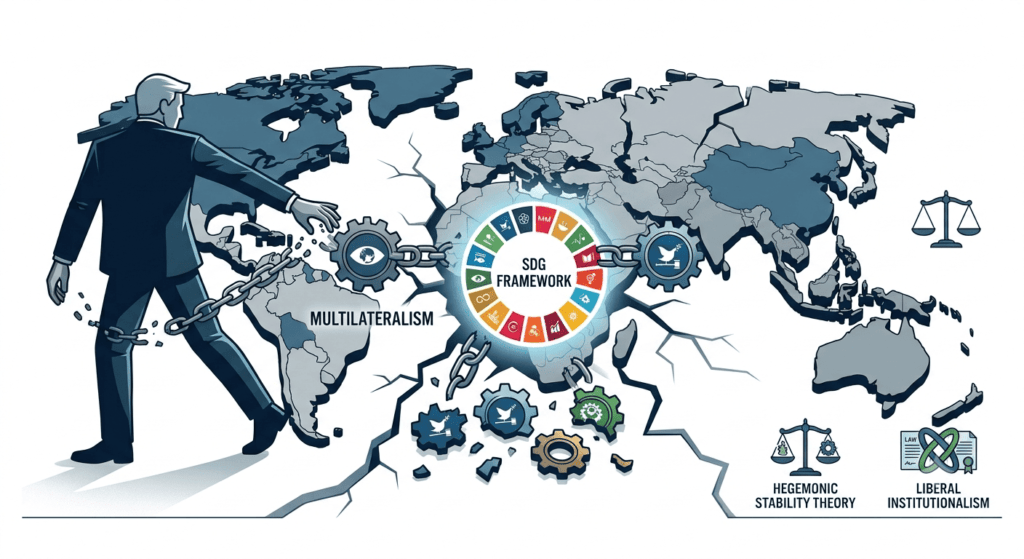
This paper examines how the United States stepping back from multilateral institutions — particularly between 2017 and 2021 — affected the implementation of the United Nations Sustainable Development Goals (SDGs). We use two main theoretical lenses: Hegemonic Stability Theory and Liberal Institutionalism. The paper analyses four major areas — climate governance, global health, development finance, and peace and security — and evaluates SDG outcomes across three comparable periods: pre-retrenchment (2010–2016), retrenchment (2017–2021), and re-engagement (2021–2025). We find that U.S. disengagement created real and measurable problems, particularly in areas dependent on American funding and institutional leadership. At the same time, other actors — the EU, China, and countries in the Global South — began filling some of those gaps, suggesting a gradual shift toward more multipolar global governance. A section on 2025–2026 developments is included because the second Trump administration has repeated and deepened many of the same patterns, confirming the paper’s core argument. We also acknowledge the limitations of this study, including the difficulty of isolating U.S. retrenchment from other concurrent global disruptions, and we discuss alternative explanations for observed SDG outcomes.
1. Introduction
After World War II, the world tried to build a system that would prevent another catastrophic conflict and manage global problems together. At the heart of this system were multilateral institutions — the United Nations, the World Bank, the IMF, and later the WTO — and the United States played a defining role in establishing all of them. For decades, U.S. leadership was seen as essentially indispensable to keeping these institutions functioning, not just because America contributed substantially to their budgets, but because it helped shape their agendas and conferred a kind of legitimacy that other countries respected.
That changed quite significantly between 2017 and 2021. Under Donald Trump’s first term, the United States pulled back from several key multilateral commitments — it initiated the process of leaving the Paris Agreement, cut funding to the WHO during a global pandemic, left the UN Human Rights Council, and blocked the WTO’s appellate body from functioning properly. Officially, these moves were framed as protecting American sovereignty and correcting what the administration saw as unfair burden-sharing. But internationally, most observers read them as a retreat from multilateral leadership.
This period overlapped with something consequential — the early years of the 2030 Agenda for Sustainable Development, which the UN adopted in 2015. The 17 Sustainable Development Goals are ambitious in scope: ending poverty, reducing inequality, addressing climate change, improving health outcomes. Unlike older development frameworks, the SDGs are deeply tied to multilateral structures. They depend on sustained international cooperation, cross-border finance flows, and shared norms — all conditions that U.S. engagement historically helped sustain.
There is a substantial body of scholarship on U.S. retrenchment, and separately on SDG implementation, but relatively little that connects the two in a systematic, multi-issue way. Most existing research focuses on one domain — climate change is the most frequently examined — without asking what retrenchment means for the SDG framework as a whole across multiple issue areas. This gap is what the present paper seeks to address.
Our central argument is that U.S. retrenchment between 2017 and 2021 exposed structural weaknesses in how the SDG framework was designed — particularly its dependence on consistent multilateral funding and hegemonic leadership. Some institutions adapted, found alternative donors, and maintained operational continuity. But the period also demonstrated that progress on several SDGs remained substantially reliant on the United States playing its traditional role. The effects extended beyond financial disruption — there was normative uncertainty, institutional friction, and a shift in the practical functioning of global governance.
2. Research Methodology
This is a qualitative study. Rather than statistical analysis, we rely on a combination of primary sources — UN reports, institutional budget data, official government statements, and treaty documentation — and secondary sources including peer-reviewed academic literature and think-tank research. Source selection followed two criteria: institutional authority (prioritising UN system reports, World Bank data, and established IR scholarship) and temporal relevance (emphasising sources from 2015–2026 to capture both the SDG implementation period and the retrenchment episodes under examination). Where conflicting accounts existed, we cross-referenced multiple sources and noted disagreements.
To give the analysis structure, we compare three time periods: pre-retrenchment (2010–2016), the retrenchment period (2017–2021), and the re-engagement phase under the Biden administration (2021–2025). Looking across these three phases allows us to identify patterns — where conditions deteriorated, where they held steady, and where new actors stepped in. Evidence is evaluated not only for its content but for what it reveals about the mechanisms through which U.S. engagement (or its absence) shapes SDG outcomes: financial flows, normative signalling, institutional capacity, and coalition behaviour.
We bring in two theoretical frameworks — Hegemonic Stability Theory and Liberal Institutionalism — to interpret the evidence. Rather than deploying them only as background, we apply both frameworks consistently in each issue area to assess which aspects of SDG vulnerability they best explain. Where the evidence aligns more with one theory than the other, we note this explicitly.
We acknowledge several limitations. First, isolating U.S. retrenchment as a causal variable is inherently difficult: the 2017–2021 period also saw COVID-19, rising geopolitical tensions, and broader democratic backsliding globally, all of which affected SDG progress. Second, SDG data collection is uneven across countries, making comparative assessment imprecise. Third, this study does not claim to measure the counterfactual — what SDG outcomes would have looked like had the U.S. remained fully engaged. These limitations are discussed further in the conclusion.
3. Research Question
To what extent did U.S. retrenchment from multilateral institutions affect the implementation of the Sustainable Development Goals?
We break this into three subsidiary questions:
- Which SDGs were most vulnerable to U.S. disengagement?
- Did other international actors manage to compensate for the U.S. stepping back?
- What does this reveal about the structural resilience of multilateral governance?Theoretical Framework
To make sense of the relationship between U.S. engagement and SDG outcomes, we draw on two well-established frameworks in International Relations: Liberal Institutionalism and Hegemonic Stability Theory (HST). They approach the question from different angles but together explain both the institutional and structural dimensions of what happens when a major power steps back.
4.1 Liberal Institutionalism
Liberal Institutionalism argues that international cooperation is possible even in an anarchic international system — one without overarching enforcement authority. The key insight, developed by Robert Keohane and Joseph Nye, is that international institutions reduce uncertainty, lower transaction costs, and establish monitoring mechanisms that make states’ commitments more credible (Keohane, 1984; Keohane & Nye, 1977). When states interact repeatedly through shared institutions, they develop habits of cooperation and become more oriented toward absolute rather than relative gains.
The SDGs exemplify this kind of institutionalised cooperation. Adopted through the UN in 2015, they coordinate action across issue areas — poverty, health, climate, gender equality — that no single state can resolve unilaterally. From a Liberal Institutionalist perspective, U.S. participation matters because it contributes resources, confers legitimacy, and incentivises other states to take the SDG framework seriously. When the U.S. withdraws, institutions lose not only funding but normative authority — other states may reasonably question the value of commitments that the world’s largest economy is willing to abandon.
4.2 Hegemonic Stability Theory
Hegemonic Stability Theory makes a stronger structural claim. Drawing on the work of Charles Kindleberger and later Robert Gilpin, HST holds that the international system functions most effectively — and global public goods are most reliably provided — when a single dominant power underwrites the costs of order (Gilpin, 1981; Kindleberger, 1973). The United States has fulfilled this role since 1945, providing an open trading system, financial stability, and institutional infrastructure that other states benefit from without necessarily paying for proportionally.
Applied to the SDGs, HST suggests that goals requiring massive financial resources, technology transfer, and coordinated political action across dozens of countries are especially vulnerable when the hegemon disengages. Climate finance, development assistance, global health coordination — these all depend, to varying degrees, on sustained U.S. commitment. When that commitment is withdrawn, the gaps are difficult to fill quickly, and hard-won institutional momentum can stall or reverse.
4.3 Applying the Frameworks Together
Used in combination, Liberal Institutionalism and HST provide a more complete analytical picture than either offers alone. Liberal Institutionalism explains how institutions translate political will into concrete SDG cooperation — through monitoring, norm-diffusion, and reduced coordination costs. HST explains why the quality and durability of that cooperation depends heavily on whether the most powerful state is genuinely committed. Together, the frameworks suggest that U.S. retrenchment damages SDG progress at two levels simultaneously: it removes material resources (the HST dimension) and erodes the normative environment in which those resources are deployed (the Liberal Institutionalist dimension). In each issue area below, we assess which dynamic is more visible and what the combined effect has been.
5. History and Background
Before examining the 2017–2021 period, it is important to establish what U.S. engagement with multilateral institutions actually looked like in the preceding decades. Since 1945, the U.S. was central to constructing the multilateral order — it helped found the UN, the Bretton Woods institutions, and a wide range of specialised agencies. Materially, this translated into the largest assessed contributions to the UN regular budget (22%), the peacekeeping budget (26%), and numerous voluntary funds across humanitarian and development agencies. This level of financial dominance meant that any U.S. decision to disengage would have outsized consequences for the institutions involved.
The shift began becoming visible in 2017. Under the first Trump administration, the U.S. initiated withdrawal from the Paris Agreement, suspended WHO funding during COVID-19, left the UN Human Rights Council, and accumulated significant arrears on UN peacekeeping contributions. The administration’s stated rationale emphasised unfair burden-sharing and the prioritisation of domestic interests. Whatever the domestic justification, the international effect was clear — institutions that depended on U.S. financial and political leadership faced a sudden and significant disruption.
The situation partially reversed when the Biden administration took office in January 2021. The U.S. rejoined the Paris Agreement on the first day, restored WHO funding, and signalled a general return to multilateral engagement. This re-engagement phase is analytically valuable because it allows us to observe what institutional recovery looks like — and to note that it is neither immediate nor complete. Some damage was structural and took considerable time to repair, which is itself informative about the depth of the dependency that had developed.
6. Mapping U.S. Withdrawals and Their Impact on SDGs
6.1 Climate Governance
The United States has historically been a significant actor in climate governance, funding institutions including the UN Framework Convention on Climate Change (UNFCCC), the UN Environment Programme (UNEP), and the International Solar Alliance (ISA). As of 2023, China accounted for approximately 34% of global fossil fuel emissions and the United States for roughly 12%, down from 5,928 million tonnes in 2000 to 4,682 million tonnes in 2023. The Paris Agreement, adopted at COP21 in 2015, established a headline goal of limiting global temperature increase to well below 2°C above pre-industrial levels. The Obama administration was a strong advocate for the Agreement and coordinated closely with China on implementation.
In 2017, the Trump administration announced withdrawal from the Paris Agreement, citing economic concerns about emissions targets. Biden rejoined on 19 February 2021, but four years of U.S. absence had already disrupted climate finance flows and undermined international trust in U.S. climate commitments.
From a Liberal Institutionalist perspective, the withdrawal damaged the monitoring and norm-diffusion functions that the Paris Agreement depended on. From an HST lens, the absence of the hegemon weakened the coalition dynamics needed to mobilise developing country participation in emissions reductions. Comparing the three periods: pre-retrenchment saw rising U.S. climate finance and growing UNFCCC participation; retrenchment saw a $0 UNFCCC contribution from 2017–2019 and a collapse in Green Climate Fund pledges; re-engagement partially restored commitments but without the four-year continuity needed for long-term climate finance planning.
Impact on the SDGs
-
SDG 13 (Climate Action):
S. withdrawal from the Paris Agreement, UNFCCC, and UNEP reduced climate finance flows and made coordinating global emissions targets significantly harder. Progress was delayed and in some areas reversed.
-
SDG 7 (Affordable and Clean Energy):
Withdrawing from the ISA and IRENA hurt international cooperation on renewable energy transitions, directly affecting SDG 7.
-
SDG 6 (Clean Water and Sanitation):
Cuts to UN Water programmes had indirect consequences for SDG 2 (Zero Hunger) as well.
-
SDG 17 (Partnerships for the Goals):
The broader shift toward an isolationist foreign policy — including cutting the Green Climate Fund — undermined SDG 17’s core premise.
6.2 Global Health Governance
The World Health Organisation, established on 7 April 1948, has been responsible for managing public health crises globally — including major successes like eradicating smallpox and nearly eliminating polio, and ongoing efforts against HIV/AIDS, malaria, tuberculosis, and Ebola. The U.S. was one of its founding members and has long been its largest funder, covering approximately 50% of the global health budget when assessed and voluntary contributions are combined. The UN Population Fund (UNFPA), which focuses on reproductive health and gender-based violence, similarly relied heavily on U.S. support — the U.S. contributed $286.4 million in combined UNFPA contributions, compared to $168.5 million from the next largest contributor.
In 2020, the Trump administration sharply criticised the WHO for its handling of COVID-19 and formally notified the UN of its intent to withdraw on 7 July 2020. It also blocked a UN Security Council resolution calling for international cooperation during the pandemic. Biden reversed the withdrawal immediately on taking office in January 2021, but the episode damaged both WHO’s operational capacity and its institutional standing as a politically neutral body.
Applying our frameworks: from a Liberal Institutionalist perspective, the withdrawal degraded WHO’s monitoring and coordination functions precisely when they were most needed. From an HST perspective, it removed the financial anchor that sustained global disease surveillance infrastructure. Pre-retrenchment, U.S. voluntary contributions to WHO averaged approximately $570 million annually; during retrenchment, contributions were suspended entirely; re-engagement restored funding but not the continuity that multi-year health programmes require.
Impact on the SDGs
-
SDG 3 (Good Health and Well-Being):
S. assessed contributions to WHO averaged around $111 million per year, with voluntary contributions averaging roughly $570 million annually. Losing this funding threatened disease surveillance, vaccine programmes, and emergency health response globally.
-
SDG 17 (Partnerships for the Goals):
Withdrawing during a global pandemic sent a particularly damaging signal about the reliability of U.S. multilateral commitment, weakening the cooperative spirit that SDG 17 depends on.
6.3 Global Development Finance
The United States is the single largest contributor to the UN system overall — 22% of the regular budget, 25% of peacekeeping, over 40% of the humanitarian budget. Beyond direct UN contributions, the most significant U.S. development instrument globally was USAID — the United States Agency for International Development. Established in 1961, USAID became the world’s largest foreign aid agency, operating in over 100 countries across education, poverty reduction, health, environment, and democratic governance. Between 2001 and 2024, USAID maintained an average annual budget of approximately $23 billion. Researchers estimate that between 2001 and 2021, USAID interventions saved between 4.1 and 4.7 million lives per year — reducing all-age, all-cause mortality by 15% in the countries where it operated, and cutting HIV/AIDS-related mortality by 65%.
Table 1: USAID Funding Trends by Sector
Period |
Top Funded Sector |
Key Notes |
|
1990s–2010s |
Health |
HIV/AIDS, maternal and child health, infectious disease — health consistently the biggest area of spending. |
|
2022 |
Humanitarian Assistance |
57.2% nutrition; 50% food distribution; 54.4% agriculture; 41.9% WASH. Big surge from global crises. |
|
2023 |
Governance |
Democratic institutions, anti-corruption, civil society. Shift toward institutional stability. |
|
2024 |
Humanitarian Assistance |
Back to top. Health and Governance close behind. |
Impact on the SDGs
-
SDG 1 (No Poverty):
The U.S. provides around 26% of all foreign aid to Sub-Saharan Africa. Any significant reduction risks reversing years of poverty reduction progress, particularly in the continent’s most fragile economies.
-
SDG 3 (Good Health and Well-Being):
Reductions in maternal and child health programmes, malaria prevention, and tuberculosis control have had direct human consequences — documented in Nigeria, Somalia, northeast Kenya, and Myanmar.
-
SDG 4 (Quality Education):
USAID was the biggest bilateral donor for education globally. Cuts have left millions of children — especially in Sub-Saharan Africa — without access to schooling.
6.4 Global Security and Peace
UN peacekeeping forces maintain stability in conflict zones, support post-conflict transitions, and assist fragile states. The U.S. has been the largest financial contributor to peacekeeping, providing 26% of the total budget. During 2017–2021, the U.S. built up arrears exceeding $1.8 billion and reduced personnel contributions by 25%, affecting 9 of 11 active missions including UNIFIL, UNMISS, and MONUSCO.
Table 2: U.S. Peacekeeping Retrenchment Indicators (2017–2021)
Indicator |
Data |
|
Personnel reduction |
25% globally (~13,000–14,000 troops/police) |
|
U.S. financial arrears |
$1.8B (peacekeeping) + $820M (regular budget) |
|
Missions affected |
9 out of 11 active missions |
|
SDG 16 — violence risk |
Security vacuums exploited by local militias (e.g. M23 in DRC) |
|
SDG 16 — civilian protection |
Fewer Protection of Civilians (POC) patrols |
|
SDG 17 — influence shift |
China became 2nd-largest payer; moved toward 1st in active funding |
Impact on the SDGs
-
SDG 16 (Peace, Justice and Strong Institutions):
When peacekeeping capacity shrinks, armed groups fill the vacuum. This makes every other SDG harder to achieve in conflict-affected countries — poverty reduction and improved health outcomes are not achievable in active war zones.
-
All other SDGs:
Peace is a precondition for development. Without it, the other 16 goals are largely unachievable in the places that need them most.
7. Comparative Leadership Analysis
U.S. retrenchment during 2017–2021 did not simply create a vacuum that stayed empty. Other actors moved in — some more effectively than others — to try to sustain the SDG framework. This section applies our theoretical frameworks to assess who responded, how, and with what effect.
7.1 Burden-Sharing: Moving Beyond a Single Dominant Donor
The retrenchment period exposed the structural vulnerability of depending on one country to provide global public goods — a direct implication of HST that its proponents had long acknowledged. The Trump years forced international organisations to think harder about diversifying their funding base. A pattern of “club multilateralism” emerged — smaller coalitions of like-minded states stepping up to fund specific SDGs rather than waiting for the hegemon. The G20, the Bridgetown Initiative, and various bilateral coalitions became more active. From a Liberal Institutionalist perspective, this represented the adaptive capacity of institutions: rather than collapsing, they reorganised around new funding coalitions and increased pressure on member states to rationalise operations.
7.2 The EU, China, and the Global South
Three sets of actors stand out:
-
The European Union:
tried to maintain the normative leadership the U.S. was vacating. Through the European Green Deal and its “Fit for 55” targets, the EU set climate standards that effectively required trading partners to align with SDG 13 norms if they wanted EU market access. This is a Liberal Institutionalist strategy in practice — using institutional rules and economic interdependence to maintain multilateral standards even when U.S. political leadership was absent.
-
China:
expanded its role as a development finance provider, particularly in infrastructure. Its dominance in renewable energy manufacturing has made it the leading partner for energy transitions in much of the Global South — directly relevant to SDG 7. From an HST perspective, China’s growing contributions represent a partial hegemonic substitution, though China’s approach to multilateralism is more transactional and less committed to universal norms than the post-1945 order was designed around.
-
Global South countries:
increased South-South cooperation. India in particular promoted its digital public infrastructure models — including the UPI payment system and Aadhaar identity platform — as scalable solutions for developing nations, advancing SDG 9 without relying on Western frameworks.
7.3 Did Anyone Actually Replace the U.S.?
The honest answer is: not fully, and not quickly. The Biden re-engagement in 2021 showed that a change in U.S. administration could rapidly reverse the most visible aspects of retrenchment — rejoining the Paris Agreement and WHO within days. But the deeper damage proved harder to repair. Development partners who had adapted their planning around U.S. absence could not simply reset to a pre-2017 baseline. Long-term commitments had been disrupted, and the credibility of U.S. multilateral engagement had taken a reputational hit that diplomatic signals alone could not fully repair. The multipolar response was real but partial and uneven. From an HST perspective, no single actor came close to matching the scale or breadth of U.S. contributions. From a Liberal Institutionalist perspective, the institutions survived but with reduced effectiveness and momentum.
8. Impact Assessment
This section pulls together the direct and indirect impacts of U.S. retrenchment on multilateral governance and the SDGs. The U.S. contributed 22% of the UN regular budget — the highest assessed share of any member state — meaning any reduction in U.S. payments immediately created cascading problems across the entire UN system. For WHO specifically, U.S. contributions ranged between $163 million and $816 million annually over the decade before retrenchment.
8.1 Direct Impacts
Financial
The immediate effect of U.S. retrenchment was financial disruption across multiple UN bodies. Accumulated arrears on both regular and peacekeeping budgets created planning uncertainty for institutions operating on annual budget cycles. The table below illustrates the scale of U.S. assessed contributions across the UN system — cuts or delays in these amounts touched everything from trade and development to climate and gender programmes.
Table 3: Selected UN Entity Funding and U.S. Contribution (FY2024)
UN Entity |
FY24 Regular Budget |
U.S. Share (22%) |
|
Dept. of Economic and Social Affairs |
$89.6M |
$19.7M |
|
Economic and Social Commission for Africa |
$89.1M |
$19.6M |
|
Econ. and Social Commission for Latin America |
$61.3M |
$13.4M |
|
Economic and Social Commission for Asia-Pacific |
$55.5M |
$12.2M |
|
International Residual Mechanism for Tribunals |
$55.1M |
$13.4M |
|
UN Conference on Trade and Development |
$83.2M |
$18.3M |
|
UN Framework Convention on Climate Change |
N/A |
$14.2M (voluntary) |
|
UN Women |
$10.8M |
$2.3M |
|
UN Population Fund |
N/A |
$155.8M (voluntary) |
Programmatic Disruptions
Beyond raw financial figures, the suspension of U.S. funding disrupted specific programmes already in operation. In global health, this produced gaps in disease surveillance and reduced vaccine procurement. In climate, it created uncertainty around whether finance commitments would be honoured — making developing countries less willing to commit to long-term adaptation planning. The broader effect was a weakening of collective action dynamics: when the largest player signals potential non-participation, other players rationally recalculate whether to commit their own resources.
Trade and Development
The shift toward a more isolationist U.S. trade policy had downstream effects on development outcomes. Trade disputes and reduced export opportunities for developing countries suppressed industrial output, employment, and GDP growth — slowing progress on SDG 1 (No Poverty), SDG 2 (Zero Hunger), and SDG 8 (Decent Work and Economic Growth).
Institutional Weakening
The less visible but equally important effect was on institutional authority and capacity. The U.S. helped found many of these bodies, and its participation gave them agenda-setting power that depends partly on the engagement of influential members. When the U.S. stepped back, monitoring mechanisms — data collection, peer review processes, voluntary reporting cycles — became less effective. Institutions continued functioning but with reduced credibility and momentum.
8.2 Indirect Impacts
Normative Erosion
One of the harder effects to quantify, but important to acknowledge, is the normative damage U.S. retrenchment caused. When one of the five permanent UN Security Council members visibly disengages, it signals to other states that the system is optional — that powerful states can select their multilateral commitments based on short-term domestic calculations. Over time, such signals erode the shared expectations that make international institutions function. It also emboldened states already sceptical of the multilateral order: if the United States could opt out of the Paris Agreement and the WHO, the argument that these commitments were genuinely binding became harder to sustain.
Leadership Vacuum and Fragmentation
U.S. withdrawal created a competition for influence in the space it left behind. China expanded its financial presence and extended its footprint in institutions where the U.S. was reducing its engagement. But this did not produce coherent alternative multilateral leadership. China’s approach is more transactional and less oriented toward universal norms than the system’s architecture was designed around. Russia and China increasingly bypassed multilateral frameworks in favour of bilateral arrangements, while India focused on regional and strategic autonomy. The result was institutional fragmentation — a more contested and less coherent system of global governance, which is a poor environment for achieving something as complex and interdependent as the SDG framework.
9. Comparing the Pre- and Post-Retrenchment Periods
Before 2017, the U.S. was the central multilateral donor. It contributed 22% of the UN regular budget, 26% of peacekeeping, and approximately $13 billion annually in voluntary contributions to UN agencies. In climate specifically, the U.S. covered 25% of the UNFCCC core budget. USAID and the State Department together disbursed roughly $32.5 billion in FY2025 aid, with around 40% aligned with SDG targets. The 2025 UN SDG Report estimated that approximately 17% of global SDG targets were on track — a modest figure reflecting real but uneven progress in areas where U.S. support was consistent.
Table 4: U.S. Multilateral Engagement — Before and During Retrenchment
Metric |
Pre-Retrenchment (2010–2016) |
Retrenchment (2017–2021) |
|
UN Regular Budget Share |
22% (~$820M) |
Disputed; arrears accumulated |
|
Peacekeeping Contribution |
26% (~$1.23B) |
Reduced; 25% personnel cut |
|
Voluntary UN Contributions |
~$13B/year |
Down 16–22% (~$10B) |
|
SDG Targets On Track |
~17% globally |
Declining trajectory |
|
UNFCCC Contribution |
25% of core budget |
Withdrawn; $0 (2017–2019) |
|
WHO Annual Contribution |
$163M–$816M/year |
Suspended 2020; withdrawal started |
The qualitative picture is equally important. Before retrenchment, U.S. leadership helped build the soft power environment that made SDG cooperation possible — 45 countries, for example, improved electricity access through U.S. aid programmes. After 2017, the risks became more visible: growing U.S. isolation, expanded Chinese influence in multilateral bodies, operational stress on UN institutions, and delays in SDG progress especially around climate and gender. Biden’s re-engagement in 2021 partially corrected the trajectory, but the window was short and many disruptions had not fully healed by the time the administration changed again.
Comparing across the three periods reveals a consistent pattern: the pre-retrenchment period showed the SDG framework functioning near its design capacity, with U.S. hegemonic support enabling broad multilateral participation (consistent with HST). The retrenchment period demonstrated the fragility of this arrangement when hegemonic commitment was withdrawn — progress stalled, coalitions fragmented, and normative authority diminished (consistent with both HST and Liberal Institutionalist expectations). The re-engagement period showed that institutional recovery is possible but incomplete — suggesting that while institutions have some adaptive capacity, they cannot fully insulate SDG progress from hegemonic volatility.
10. Contemporary Developments (2025–2026): The Second Wave
Everything we found about the 2017–2021 period is, if anything, more visible in what has happened since January 2025. The return of the Trump administration brought a second and significantly larger wave of U.S. disengagement — one that makes the first term look comparatively moderate. We include this section not to expand the scope of our primary analysis, but because these events directly confirm the vulnerabilities we identified in the earlier period. The structural dependence of the SDG framework on U.S. hegemonic commitment has not gone away — if anything, the second wave has made it more visible.
10.1 What Happened: A Quick Chronology
- February 2025: Executive Order 14199 directed the Secretary of State to review all international organisations the U.S. is a member of. This came alongside formal withdrawal from the WHO and confirmation of withdrawal from the UN Human Rights Council and UNRWA. A review of UNESCO was triggered, resulting in formal U.S. withdrawal on 22 July 2025.
- April 2025: The Treasury Secretary confirmed the U.S. would remain in the World Bank and IMF, but only under conditions: the IMF should drop its focus on climate, gender, and social issues; the World Bank should return to fossil fuel investment. In the same period, USAID was effectively dissolved, with its functions transferred to the State Department.
- August 2025: The government announced cuts of $3.2 billion to development aid programmes, $322 million to the democracy fund, and $838 million to peacekeeping. A further $521 million was cut from State Department contributions to international organisations.
- January 2026: A presidential decree formally withdrew the U.S. from 31 UN organisations and 35 non-UN international organisations on grounds that participation was contrary to U.S. interests.
10.2 How Bad Is It for the SDGs?
The numbers are striking. Projections suggest U.S. aid withdrawal could push between 5.7 and 10 million more people into extreme poverty by the end of 2026. In Sub-Saharan Africa alone, the U.S. provided roughly 26% of all foreign aid — approximately $54 billion annually — and losing that funding is expected to reverse approximately a decade of progress on SDG 1. The Centre for Global Development estimated that the combined loss of maternal health programmes, malaria prevention, and tuberculosis control could result in 14.2 million preventable deaths by 2030.
Financially, the Contributions to International Organisations (CIO) account fell to $339 million in FY2026 — a 75% drop from $1.37 billion in FY2025. Total multilateral contributions fell by approximately 22%, representing about $1.2 billion in lost institutional funding. Early 2026 projections suggest fewer than 10% of SDG targets will be on track by year-end, compared to 17% in the 2025 UN SDG Report.
10.3 The Multipolar Response Continues
As with 2017–2021, other actors have responded. The EU is deepening its regulatory approach to climate governance — the Carbon Border Adjustment Mechanism (CBAM) now functions as a real enforcement tool that requires trading partners to align with SDG 13 standards to maintain EU market access. China has consolidated its position as the dominant provider of renewable energy technology for the Global South through its “1+N” policy framework. And there are now active discussions in multilateral forums about “retrenchment-proofing” — designing institutions and funding mechanisms that can absorb a major power exit without collapsing. This represents a significant structural shift, suggesting that even if a future U.S. administration re-engages, the architecture of global governance will likely look more genuinely multipolar than it did before 2017.
11. Research Limitations and Alternative Explanations
This study has several limitations that bear acknowledgment. First and most significantly, isolating U.S. retrenchment as a causal factor in SDG outcomes is methodologically difficult. The 2017–2021 period coincided with the COVID-19 pandemic, which was itself the single largest global disruption to health, poverty, and education outcomes in decades. Rising geopolitical competition between the U.S. and China, growing democratic backsliding across multiple regions, and the lingering effects of the 2008 financial crisis all interacted with the retrenchment episode in ways that are not easy to disentangle.
Second, alternative explanations for observed SDG underperformance deserve consideration. It is possible that the SDG framework was always structurally overambitious — setting 169 specific targets across 17 goals for 193 countries with highly uneven institutional capacity was an extraordinary undertaking regardless of U.S. engagement. Some scholars have argued that SDG progress has been hampered more by weak domestic governance and implementation capacity in recipient countries than by the withdrawal of external donor support. This paper does not dismiss this view; it argues, rather, that U.S. retrenchment compounded pre-existing structural difficulties rather than being the sole cause of underperformance.
Third, SDG data quality is uneven across countries and time periods, making precise cross-period comparison difficult. Many of the statistics cited in this paper are projections or estimates rather than verified outcomes, particularly for the 2025–2026 period. We have tried to flag this where relevant, but readers should treat quantitative comparisons as indicative rather than definitive.
Finally, this study does not measure the counterfactual. We cannot know with certainty what SDG outcomes would have looked like had the U.S. remained fully engaged throughout 2017–2021. These limitations do not undermine the paper’s core findings, but they do suggest that future research should pursue more rigorous causal identification strategies — for instance, through comparative case studies of SDG performance in countries with different levels of U.S. aid dependency, or through interrupted time-series analysis of SDG indicator data.
12. Conclusion
This study has examined the extent to which U.S. retrenchment from multilateral institutions between 2017 and 2021 affected the implementation of the SDGs. Returning to our three research questions:
On the first question — which SDGs were most vulnerable — the evidence points clearly to SDG 13 (Climate Action), SDG 3 (Good Health and Well-Being), SDG 1 (No Poverty), and SDG 16 (Peace, Justice and Strong Institutions) as the goals most directly and severely affected by U.S. disengagement. These are precisely the goals that depend most heavily on consistent multilateral financing, hegemonic coordination, and institutional infrastructure — making them especially susceptible when the largest contributor steps back.
On the second question — whether other actors compensated — the answer is partial and asymmetric. The EU provided normative leadership on climate through regulatory mechanisms; China filled some development finance gaps; and Global South countries built new South-South cooperation frameworks. But none of these substitutes matched the scale, breadth, or institutional legitimacy of U.S. engagement, and the transition was slow and costly. From an HST perspective, this confirms that hegemonic substitution is not a readily available option in the short or medium term. From a Liberal Institutionalist perspective, it suggests that institutions have meaningful but limited adaptive capacity.
On the third question — what this reveals about the structural resilience of multilateral governance — the evidence suggests a mixed picture. Multilateral institutions did not collapse. They adapted, survived, and in some cases restructured their funding bases. But this resilience was not costless: it was measured in delayed SDG progress, normative erosion, and the disproportionate burden placed on the countries least able to absorb disruption. The 2025–2026 developments confirm the paper’s core argument rather than undercutting it — a second and larger wave of retrenchment has produced projected setbacks across nearly every SDG domain while simultaneously pushing institutions toward more explicit retrenchment-proofing strategies.
The honest conclusion is that the SDGs cannot be achieved through hegemonic commitment alone — but they also cannot afford prolonged hegemonic absence. The transition toward a more genuinely multipolar governance system is underway, but the gap between hegemonic withdrawal and effective collective substitution remains real and costly. That cost falls disproportionately on the countries and populations that can least afford it — which is, of course, the very group the SDGs were designed to serve.
Future research should focus on three areas: more rigorous causal identification of retrenchment’s effects on specific SDG indicators; comparative analysis of institutional resilience across different multilateral bodies; and normative inquiry into what governance architecture would make SDG progress more structurally robust to the volatility of any single member state’s domestic politics.
References
Brookings Institution. (2025). Ending extreme global poverty. Brookings.
https://www.brookings.edu/articles/ending-extreme-global-poverty/
Centre for Global Development. (2026, January). Update: Lives lost from USAID cuts. CGD Blog.
https://www.cgdev.org/blog/update-lives-lost-usaid-cuts
Centre for Strategic and International Studies. (2025). What is the U.S. posture toward the United Nations? CSIS.
https://www.csis.org/analysis/what-us-posture-toward-united-nations
Down to Earth. (2025, August). Trump pulls U.S. out of UN climate treaty, IPCC and 64 other global bodies.
https://www.downtoearth.org.in/climate-change/trump-pulls-us-out-of-un-climate-treaty-ipcc-and-64-other-global-bodies
Focus2030. (2026, January). United States withdrawal from 66 international organisations: A new step in a disengagement initiated in 2025.
https://focus2030.org/en/united-states-withdrawal-from-66-international-organisations-a-new-step-in-a-disengagement-initiated-in-2025/
Gilpin, R. (1981). War and change in world politics. Cambridge University Press.
http://cambridge.org/core/books/war-and-change-in-world-politics/3A41732AFF3F08687A9FEDA2AF1E6A5D
Keohane, R. O. (1984). After hegemony: Cooperation and discord in the world political economy. Princeton University Press.
http://slantchev.ucsd.edu/courses/ps240/05%20Cooperation%20with%20States%20as%20Unitary%20Actors/Keohane%20-%20After%20Hegemony%20%5BCh%204-6%5D.pdf
Keohane, R. O., & Nye, J. S. (1977). Power and interdependence: World politics in transition. Little, Brown.
http://slantchev.ucsd.edu/courses/ps240/05%20Cooperation%20with%20States%20as%20Unitary%20Actors/Keohane%20&%20Nye%20-%20Power%20and%20interdependence%20%5BCh%201-3%5D.pdf
Kindleberger, C. P. (1973). The world in depression, 1929–1939. University of California Press.
https://www.ucpress.edu/books/the-world-in-depression-1929-1939/paper
The Hindu. (2025, March). United Nations to cut 25% of its global peacekeeping force in response to U.S. funding strains.
https://www.thehindu.com/news/international/united-nations-to-cut-25-of-its-global-peacekeeping-force-in-response-to-us-funding-strains/article70145224.ece
United Nations. (2025). The sustainable development goals report 2025. United Nations.
https://sdgs.un.org/goals
United Nations Population Fund. (2026). Donor profile: United States of America. UNFPA.
https://www.unfpa.org/donor/united-states-america
U.S. Department of Health and Human Services. (2025). Fact sheet: U.S. withdrawal from the World Health Organisation. HHS.
https://www.hhs.gov/press-room/fact-sheet-us-withdrawal-from-the-world-health-organization.html
Wikipedia. (2026). United States and the Paris Agreement. In Wikipedia.
https://en.wikipedia.org/wiki/United_States_and_the_Paris_Agreement
Wikipedia. (2026). World Health Organization — Contributions. In Wikipedia.
https://en.wikipedia.org/wiki/World_Health_Organization
World Bank. (2025). Poverty overview.
https://www.worldbank.org/en/topic/poverty/overview