Authors: MS. Somya Shuchi, Mr. Atharva Telwane, Mr. Dev Chandekar, Ms. TSK Thanujaa
Abstract:
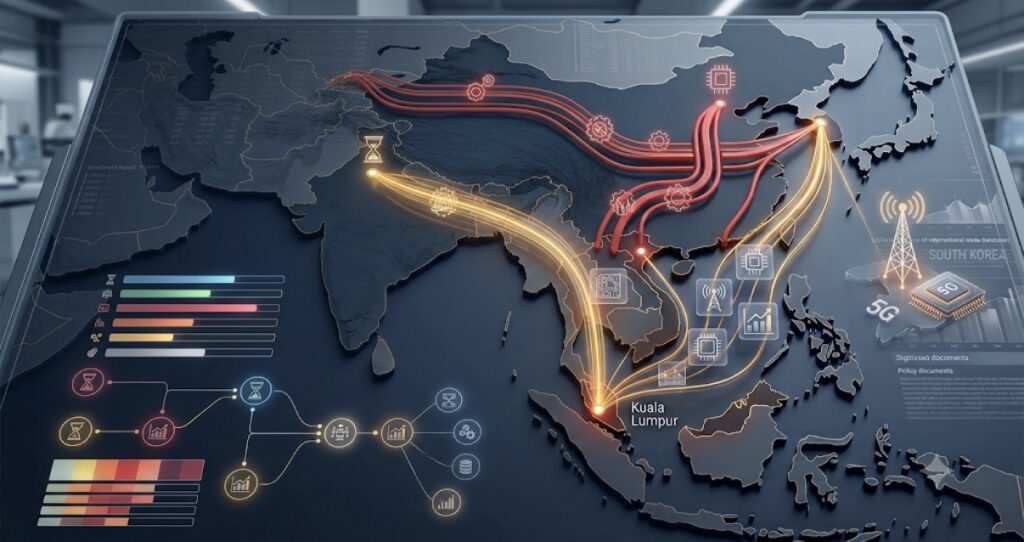
Global supply chains have increasingly become instruments of geopolitical competition in the aftermath of the United States-China trade war, the COVID-19 pandemic, and the Russia-Ukraine War. Within this evolving geoeconomic landscape, ASEAN has emerged as a major hub for supply chain diversification, particularly in the electronics and telecom sectors, even as China continues to retain structural dominance through integrated manufacturing networks and intermediate goods control. This study aims to examine the extent to which India can reduce ASEAN’s dependence on Chinese electronics and telecom supply chains and assess the role of South Korea in facilitating this transition through technology, investment and industrial cooperation. The study adopts a mixed-methods research design combining quantitative analysis of trade and investment trends with qualitative analysis of strategic and policy frameworks. The study covers the period from 2018 to 2024 to evaluate the impact of post-trade war supply chain reconfiguration in Asia. Data has been drawn from trade databases, investment reports, policy documents and secondary scholarly literature. The findings indicate that the trade war did not significantly weaken China-centered supply chains; rather, it regionalized them through ASEAN economies such as Vietnam and Malaysia. However, the study also finds that India possesses selective competitive advantages in electronics assembly and telecom manufacturing, particularly when supported by South Korean technological capabilities and industrial partnerships. The paper concludes that while comprehensive substitution of China remains unlikely in the near term, India-South Korea cooperation can contribute to the gradual development of alternative and resilient supply chain networks within ASEAN.
Keywords: global supply chains, regional cooperation, geoeconomics, trade war, strategic realism, bilateral cooperation.
Introduction:
Supply chains have acquired a prominent place in current geopolitics-especially geoeconomics particularly in the aftermath of three key events, viz the COVID pandemic, the Sino-American trade war and the recent Russia-Ukraine crisis. Starting with the pandemic as it was then that the factors started aggregating due to economic shutdown and quarantine conditions, organizations like the World Bank Group and United Nations Conference on Trade and Development (UNCTAD) constantly monitored the fluctuation in the global trade economy based on each sector. Moving towards the Sino-American Trade war, the crux of the conflict can be captured by the telecom sector advancement and the chip technology developed by China and the consequent tariffs on Chinese goods by Washington to curb its trade deficit. Simultaneously, the dependent economies on ASEAN economies principally Indonesia, Thailand and Vietnam- used by China as a proxy against USA, making the countries and the organization dependent on Chinese supplies and capital. Thus, what was once mainly about efficiency and cost took on a strategic dimension coupling with complex interdependence being used as a geopolitical leverage. Scholarship postulates that when core economies occupy a central position in global networks, they exert pressure on the dependent economies- especially in high-tech sectors vital for both national security and economic stability. This led to the emergence and usage of the term weaponized interdependence by Henry Farrell and Abraham Newman to describe a condition where states exploit their central position in global, asymmetrical networks to exert coercive power over others.
The Russian invasion of Ukraine in 2022 created a major shock to global supply chains primarily through sanctions, the physical destruction of infrastructure and blockages of key shipping routes causing a critical shortage in energy; demonstrating how economic networks and strategic dependencies could be transformed into instruments of coercion, reiterating weaponized interdependence. The sectoral shocks of the conflict on critical goods and services such as electronics as well as Information and Communication technology (ICT) have been severe for developing and economically performing regions such as Southeast Asia and Europe. International Data Corporation (IDC) examined how the global financial crisis effect ICT spending and technology marketplaces.
The data indicates that there was an increase in spending by countries on different ICT areas during 2021-22. The lion’s share was taken by software and public cloud accounting for 12 and 14% respectively followed by infrastructure. Hence, the trade war coupled with the Russian crises, triggered tariffs alongside export controls and tech restrictions which led multinational firms to diversify production using the China+N strategy.
ASEAN nations prominently Vietnam, Indonesia, Malaysia, Thailand and Malaysia emerged as ideal alternatives due to pull factors like electronic manufacturing hub, assembling of semiconductors and their testing, cheap labor, and ever evolving infrastructure; thus luring China to the region by controlling the upstream components like chips, displays and rare earth minerals (REM), expanding Chinese firms into the region viz Huawei and ZTE among others. Factors exploited by China in ASEAN are cost efficiency and competitiveness due to the availability of labor and raw materials respectively, rapid deployment capabilities, outsourced production and partial manufacturing and plethora of bilateral agreements under Regional Comprehensive Economic Partnership.
Given the significance of ASEAN nations and their cultural ties with India, it has been an observer nation of ASEAN and has extended explicit foreign aid to the nations through its Act East Policy and the ASEAN-India Trade in Goods Agreement (AITIGA). Middle powers such as India and South Korea have been stepping up their engagement with the regional bloc through Act East and New Southern Policy, respectively. the primary objectives of these policies revolve around three core pillars viz: supporting a rule-based international order, improving regional connectivity and economic friendship, however, the existing literature posits that the bilateral cooperation between the two nations is limited. While existing scholars extensively debate on the theoretical necessity of supply chain diversification, it frequently suffers from a lack of granular, sector-specific empirical grounding. Specifically, there remains a notable absence of quantitative investigations determining whether burgeoning industrial partners, such as India and South Korea possess the requisite capacity to structurally replace Chinese dominance in high-value telecommunications (HS Code 8517). Current literature often depends on macroeconomic indicators rather than disaggregated trade flow analysis, leaving a critical knowledge void regarding the feasibility of such substitution in the post 2022 geopolitical landscape. This research addresses this gap by triangulating longitudinal trade datasets with institutional policy reviews, thereby moving beyond the prevailing, largely speculative assessments to provide a rigorous, data-driven determination of the viability of Indo-Korean supply chain synergy as an alternative to existing Chinese trade concentrations. To address these limitations, this study restricts its analytical scope to the telecommunications sector (HS Code 85173), to investigate the substitution potential of India and South Korea within ASEAN markets. By isolating a critical node, the research provides a granular evaluation of whether structured bilateral cooperation can realistically mitigate regional dependency on Chinese intermediate goods. Consequently, this study interrogates the validity of assuming that broad geopolitical realignment will automatically trigger supply chain diversification, instead examining the empirical feasibility of India and South Korea emerging as viable alternative anchors within the established, high barrier technological ecosystem. The paper argues that although recent disruption has pushed ASEAN toward diversification, structured factors such as- production capacity, technological expertise and China’s entrenched position in Global networks make it difficult to replace China in the short term. Still growing cooperation between Indian and South Korea offers a partial but meaningful path towards rebalancing supply chains in the region over the longer run.
Literature Review:
1. Farrell, Henry, and Abraham L. Newman (2019). Weaponized Interdependence: How Global Economic Networks Shape State Coercion
Publication: International Security, vol. 44, no. 1, pp. 42–79.
DOI/URL: https://doi.org/10.1162/isec_a_00351
Summary: Farrell and Newman show that states controlling central nodes in global financial and information networks can coerce others through surveillance (panopticon effect) or access denial (chokepoint effect). This dismantles the liberal assumption that interdependence breeds cooperation where asymmetric networks create durable power imbalances. The framework explains how China uses its centrality in regional trade and supply chains to pressure Southeast Asian states, and why supply chain diversification through India and South Korea is a strategic act and not merely an economic one.
2. Chattaraj, Saheli (2023). Korea’s Indo-Pacific Strategy and Its Implications for Bilateral Cooperation between India and South Korea
Publication: KIEP World Economy Brief, vol. 13, no. 24, Korea Institute for International Economic Policy.
DOI/URL: https://ssrn.com/abstract=4539865
Summary: Chattaraj maps South Korea’s December 2022 Indo-Pacific Strategy against the existing bilateral relationship. India is explicitly listed as a Special Strategic Partner, with convergence on maritime security, supply chain resilience, and rules-based order. Most useful as a close reading of what Seoul committed to on paper versus what bilateral action has followed.
3. Panda, Jagannath P., et al. (2024). India-Korea Relations in the Emerging Dynamics of the Indo-Pacific
Publication: Observer Research Foundation (ORF) Report.
Summary: Multi-author ORF report assessing where India stands in South Korea’s Indo-Pacific Strategy. It covers trade, maritime security, S&T, defense, and diplomacy, finding economic ties the strongest pillar and security cooperation still catching up. The report is frank where both sides need to move from signed agreements to structured action. The China factor runs through every chapter, even though neither country has fully named it as the explicit driver.
4. John, Jojin V. (2020). India-South Korea Relations Under ‘Special Strategic Partnership’: ‘Act East Policy’ Meets ‘New Southern Policy’
Publication: India Quarterly: A Journal of International Affairs, vol. 76, no. 2, pp. 207–225.
DOI/URL: https://doi.org/10.1177/0974928420917798
Summary: John traces the relationship from 1992 through the 2010 CEPA to the 2015 Special Strategic Partnership, identifying a recurring pattern: diplomatic upgrades not matched by operational depth. Both governments remain cautious about being drawn into each other’s great-power entanglements. South Korea’s China economic dependence and BRI support, set against India’s explicit rejection of BRI, is treated not as a diplomatic irritant but as a structural constraint on security cooperation.
5. Dhawan, Ranjit Kumar (2020). Korea’s ‘New Southern Policy’ Towards India: An Analysis
Publication: Journal of Asian Security and International Affairs, vol. 7, no. 1, pp. 55–80.
DOI/URL: https://doi.org/10.1177/0973598420906248
Summary: Dhawan is blunt: the New Southern Policy toward India is primarily an economic instrument, and Seoul has deliberately avoided framing it as a counter to China. That choice limits its usefulness for counterbalancing. Unlike Japan, Australia, or the US, South Korea never committed to Free and Open Indo-Pacific framing, which prevents full alignment with India’s security-oriented regional architecture. Economic deliverables are real; security depth is not.
6. Bajpaee, Chietigj (2022). Reinvigorating India’s ‘Act East’ Policy in an Age of Great Power Competition
Publication: The Pacific Review, vol. 36, no. 5, pp. 1052–1083.
DOI/URL: https://doi.org/10.1080/09512748.2022.2110609
Summary: Bajpaee reviews three decades of Look East/Act East and identifies three recurring problems: India’s domestic reform agenda underdelivers relative to its foreign policy ambitions; ASEAN’s insistence on centrality limits how far India can push a competitive China posture in multilateral forums and sharpening US-China rivalry forces Southeast Asian states into alignment choices India cannot control. Real maturation of India’s maritime diplomacy is documented, but the gap with China’s regional footprint remains.
7. Ngaibiakching and Amba Pande (2020). India’s Act East Policy and ASEAN: Building a Regional Order Through Partnership in the Indo-Pacific
Publication: Journal of Asian Security and International Affairs, vol. 7, no. 1, pp. 81–107.
DOI/URL: https://doi.org/10.1177/0020881719885526
Summary: The authors situate India’s 2014 shift from Look East to Act East within Indo-Pacific framing and argue the policy now functions as India’s main vehicle for countering Chinese regional primacy. Institutional deepening with ASEAN is documented, with growing maritime security emphasis. But ASEAN’s neutrality preference creates a real tension: if India pushes too hard, member states hedge rather than align.
8. John, Jojin V., and Jagannath P. Panda (2023). 50 Years of the South Korea-India Relationship: Retrospect and Prospect
Publication: The Journal of Indian and Asian Studies, vol. 4, no. 3, article 2330018.
DOI/URL: https://doi.org/10.1142/S2717541323030018
Summary: Written on the fiftieth anniversary of diplomatic relations, the paper proposes four priorities: a Korea-Australia-Indonesia-India (KAII) monoliteral format, city and para-diplomacy, defense industrial cooperation, and substitution of key Indian imports from China. The Japan-India 2009 Action Plan is used as a comparison point, showing how far behind South Korea is in building structured bilateral depth. The anniversary is used as a reason to get specific about what needs to change, not to celebrate.
9. Panda, Jagannath P. (2023). Major Determinants and Way Forward for Korea-India Relations: A Korean Perspective
Publication: The Journal of Indian and Asian Studies, vol. 4, no. 3, article 2340005.
DOI/URL: https://doi.org/10.1142/S2717541323400053
Summary: Panda writes from a Korean vantage point and names the central contradiction in which Seoul and New Delhi share concerns about Beijing’s assertiveness, but South Korea’s China exposure prevents the posture India’s own China policy implies. The paper recommends monoliteral formats to build strategic depth without triggering direct bilateral commitments that would provoke Beijing. It also calls for an explicit India-Korea Indo-Pacific action plan that is absent despite the 2015 Special Strategic Partnership.
10. Saha, Premesha (2023). South Korea’s New Indo-Pacific Strategy: Where Does India Fit In?
Publication: The Journal of Indian and Asian Studies, vol. 4, no. 3, article 2340008.
DOI/URL: https://doi.org/10.1142/S2717541323400077
Summary: Saha works through South Korea’s 2022 Indo-Pacific Strategy and asks whether India is more than rhetorical filler. The answer is cautiously affirmative: India is a Special Strategic Partner with CEPA upgrading, high-level exchanges, and maritime cooperation as named workstreams. But Saha is clear-eyed about the gap between text and action where South Korea’s North Korea calculus, China dependence, and historical aversion to great-power entanglement all produce friction. The ambition is on paper however, the mechanism is not.
11. Basrur, Rajesh, and Collin Koh Swee Lean (2023). South Korea’s New Southern Policy and the Middle Power Quest: Implications for India-Korea Relations
Publication: Asian Affairs: An American Review, vol. 54, no. 2, pp. 187–208.
DOI/URL: https://doi.org/10.1080/03068374.2023.2213115
Summary: Basrur and Koh read the New Southern Policy through middle power theory: it is primarily about Seoul asserting strategic autonomy, not countering China. The policy’s deliberate avoidance of Free and Open Indo-Pacific language is a feature from Seoul’s perspective, but a problem for India, which wants partners who take clear positions on South China Sea freedom of navigation. The paper names this mismatch directly: the two countries want different things from the partnership and closing that gap is a precondition for deeper cooperation.
12. Kim, Mirye, and Jaeho Hwang (2023). Collective Resilience: Deterring China’s Weaponization of Economic Interdependence
Publication: International Security, vol. 48, no. 1, pp. 91–135.
DOI/URL: https://direct.mit.edu/isec/article/48/1/91/117127
Summary: Kim and Hwang document China’s use of market size as a coercive instrument through concrete cases: South Korea’s 2021 urea shortage from Chinese export restrictions, $15.6 billion in tourism losses after THAAD deployment, and Lithuania’s 91% export drop to China after opening a Taiwan representative office. They then assess what collective responses worked such as early warning systems, trade diversification, supply chain arrangements like the Quad and Minerals Security Partnership. The paper establishes empirically that South Korea is already a target of Chinese economic coercion, giving Seoul and New Delhi a shared, concrete interest in supply chain coordination.
13. Kuik, Cheng-Chwee (2021). Irresistible Inducement? Assessing China’s Belt and Road Initiative in Southeast Asia
Publication: Council on Foreign Relations Discussion Paper.
Summary: Kuik pushes back against the assumption that BRI investment converts straightforwardly into political control. ASEAN states defer to China on core interests more than a decade ago but push back when sovereignty is at stake and none has accepted Finlandization. The paper is useful as a calibration where it shows how much room exists for alternative partnerships. If ASEAN states are already hedging against Chinese dependence, an India-South Korea offer has real traction, more than a crude dependency narrative would suggest.
14. Russel, Daniel R., and Blake H. Berger (2020). Weaponizing the Belt and Road Initiative
Publication: Asia Society Policy Institute Report.
Summary: Russel and Berger show how BRI infrastructure deals, digital agreements, and debt structures create strategic dependencies Beijing exploits politically, even when original transactions were commercial. Direct PLA projection through BRI facilities remains constrained by local resistance, but economic dependencies are real and durable. India’s alarm about the China-Pakistan Economic Corridor is documented as one of the few cases where a government has named the military risk explicitly. The report sharpens the case for why India and South Korea need credible alternative infrastructure frameworks with actual financing and institutional follow-through.
15. Dinesh, Aditya, and Prajakta Bhosale (2025). Where India and China Meet: Competing Regional Statecraft in Southeast Asia
Publication: Political Science Quarterly, advance article, Oxford Academic.
DOI/URL: https://doi.org/10.1093/psquar/qqaf059
Summary: Dinesh and Bhosale compare China’s and India’s approaches across five dimensions diplomacy, defense, institutional initiatives, trade, and investment finding a stark asymmetry: China is proactive and pushing for primacy, India is reactive and focused on preventing Chinese dominance rather than building its own. China leads across most metrics. The paper traces India’s Look East Policy back to 1991 as a counter to Chinese influence and finds three decades later the gap has not closed. It provides the clearest empirical baseline for what an India-South Korea partnership is working against and makes the case that India needs external force multipliers.
16. Panda, Jagannath P., and Chanwahn Kim (2023). A Shared Vision Begets the Future: Korea-India Defense Cooperation
Publication: The Journal of Indian and Asian Studies, vol. 4, no. 3, article 2340006, World Scientific.
DOI/URL: https://doi.org/10.1142/S2717541323400065
Summary: Panda and Kim focus on defense cooperation, the part of the India-South Korea relationship that has moved fastest since 2019 but received least attention in the literature. They trace the arc from basic education exchanges and coast guard drills to joint naval exercises in the Bay of Bengal and East China Sea, with the K-9 Vajra howitzer deal as the clearest co-production example. Their argument is based on the convergence on maritime security is driven by pressure, not institutional design. India’s China border friction, South Korea’s need for defense export markets, and both governments’ Indo-Pacific ambitions. Interoperability is being built from a low base and political declarations cannot substitute for procurement commitments.
17. Hwang, Wonjae, and Hayoun Jessie Ryou-Ellison (2021). Taking a Side between the United States and the People’s Republic of China: Strategic Hedging of South Korea and India
Publication: International Area Studies Review, vol. 24, no. 2, pp. 60–78, SAGE Publications.
DOI/URL: https://doi.org/10.1177/22338659211013650
Summary: One of the few papers treating India and South Korea comparatively rather than in isolation. Hwang and Ryou-Ellison use UN General Assembly voting records from 1991 to 2018 to show both states have consistently hedged between Washington and Beijing, refusing full alignment with what they call dual engagement with strategic ambiguity. Both extracted real benefits: foreign policy autonomy and bargaining leverage. The implication for this review is uncomfortable: framing an India-South Korea partnership as an anti-China coalition runs directly against a decades-old strategic instinct that has served both governments reasonably well.
18. Yeo, Andrew (2022). South Korean Foreign Policy in the Indo-Pacific Era
Publication: Brookings Institution Policy Brief, Center for East Asia Policy Studies, November 2022.
DOI/URL: https://www.brookings.edu/articles/south-korean-foreign-policy-in-the-indo-pacific-era/
Summary: Yeo documents something the bilateral literature skips, ‘how the rest of Asia rates South Korea as a strategic partner’. In a 2021 survey, South Korea ranked last out of ten countries for regional leadership confidence. Japan, Australia, and ASEAN partners all placed Seoul below Washington, Tokyo, and Canberra. Yeo traces this to Seoul’s silence on South China Sea claims, Xinjiang, Hong Kong, and its refusal of Free and Open Indo-Pacific framing when other US allies had adopted it. The brief examines the Yoon administration’s course correction and is honest about the political risks. For this review, it provides the external credibility assessment the partnership literature avoids.
19. Rim, Hyun Ji (2023). South Korea’s Indo-Pacific Strategy: Challenges for the Yoon Administration
Publication: Journal of Indo-Pacific Affairs, vol. 6, no. 1, pp. 109–116, Air University Press.
DOI/URL: https://media.defense.gov/2023/Feb/02/2003154190/-1/1/1/17%20RIM_COMMENTARY.PDF
Summary: Rim reads South Korea’s December 2022 Indo-Pacific Strategy closely, noting its ambition, nine lines of effort, a goal of becoming a global pivotal state alongside its deliberate insistence that Seoul is not hostile toward China. She explains the context: North Korea launched 67 missile tests in 2022, including seven ICBMs, consuming defense budget and attention; economic exposure to Beijing also constrained the posture. Most useful for understanding the gap between the strategy’s paper commitments and what it can sustain, a gap that directly affects how much India can rely on South Korean Indo-Pacific commitments.
20. Zha, Wen (2023). Southeast Asia amid Sino-US Competition: Power Shift and Regional Order Transition
Publication: The Chinese Journal of International Politics, vol. 16, no. 2, pp. 241–261, Oxford Academic.
DOI/URL: https://doi.org/10.1093/cjip/poad006
Summary: Zha offers what the English-language IR literature rarely provides: a Chinese academic’s reading of how Beijing perceives ASEAN and the regional order transition. His central argument is that China no longer sees ASEAN centrality as a constraint on its influence, but it sees it as compatible with Chinese interests. That is why Beijing shifted from ASEAN-centric regionalism in the 1990s to a China-centric order anchored in the BRI and the Asian Infrastructure Investment Bank. For this review, the paper clarifies the competitive environment India and South Korea are operating in and how Beijing is actively reshaping the regional order, not passively watching alternative partnerships form.
21. Rim, Hyun Ji (2025). Against Strategic Threats at Sea: South Korea’s Naval Strategy and Unmanned Maritime Systems
Publication: The Pacific Review, vol. 38, no. 5, pp. 781–807, Tandfonline.
DOI/URL: https://doi.org/10.1080/09512748.2024.2436928
Summary: Rim asks what the bilateral literature mostly avoids: what does South Korea’s actual military capacity look like, and what can Seoul bring to maritime operations beyond the Korean Peninsula? She documents Defense Innovation 4.0, investment in Unmanned Maritime Systems, and the 3K system (Kill Chain, Korea Air and Missile Defense, Korea Massive Punishment and Retaliation). This modernization is situated against growing Chinese naval capability in an Indo-Pacific where 60% of US naval forces are now stationed. The paper fills a real gap: it tells you whether South Korea has the maritime hardware to be a meaningful partner in Indo-Pacific waters where China’s naval presence is expanding.
22. Kim, Min-hyung (2023). Soft Power in India-South Korea Relations and Role of Cultural and Popular Connections
Publication: The Journal of Indian and Asian Studies, vol. 4, no. 3, article 2340009, World Scientific.
DOI/URL: https://doi.org/10.1142/S2717541323400089
Summary: Kim examines the people-to-people and cultural dimension the security and trade literature skips. Soft power connections are real, Hallyu has a genuine following in India, education exchanges are growing, and grassroots goodwill is measurable. But these ties are not institutionalized enough to function as a strategic asset. Kim’s argument is that durable partnerships need societal depth that formal agreements cannot manufacture on their own. The partnership’s durability across administration changes will depend partly on whether ordinary Indians and Koreans see each other as meaningful partners.
23. Asia Society Policy Institute (2026). Seeking Agency in Uncertainty: Asian Middle Powers and the Fragmenting Global Order
Publication: Asia Society Policy Institute Report, March 2026.
Summary: Places India and South Korea within a comparative analysis alongside Australia, Japan, and Indonesia. The South Korea data is striking. Defense exports grew from roughly $2–3 billion in 2020 to over $17 billion in 2022, with customer countries expanding from 4 to 12. But that defense export surge has not converted into strategic influence because Seoul’s political caution toward Beijing has historically blocked it from translating reach into regional weight. India scores growing international convening power but low on trade, investment, and regional defense engagement relative to its overall power ranking. The report names the structural problem: both countries are asserting strategic autonomy, but from incompatible traditions as India’s non-alignment versus Korea’s alliance dependence.
24. Bajpaee, Chietigj (2014). India-South Korea Relations and the Emerging Regional Architecture
Publication: Strategic Analysis, vol. 38, no. 4, pp. 437–443, Tandfonline.
DOI/URL: https://doi.org/10.1080/09700161.2014.918408
Summary: Written a decade before Bajpaee’s 2022 Pacific Review piece, this article examines India-South Korea relations when both the Look East Policy and Seoul’s ASEAN engagement were beginning to deepen. Bajpaee’s argument says that the two countries have structural reasons to work together as democracies uncomfortable with Chinese hegemony with shared stakes in open sea lanes is essentially the same argument made in 2022, with greater urgency. Reading both pieces together reveals a pointed problem the literature has not confronted squarely: why does a sound structural logic keep failing to produce structural outcomes?
25. Nguyen, Tuan Binh, et al. (2022). Competitive Strategy of India and China in Southeast Asia and Its Impact on the Region
Publication: Asia-Pacific Social Science Review, vol. 22, no. 1, pp. 80–92.
DOI/URL: https://www.researchgate.net/publication/360858826
Summary: Nguyen and co-authors approach the India-China competition from the Southeast Asian side. What ASEAN member states want from the two-power contest is not alignment, it is optionality. China’s strategy is multi-layered: BRI infrastructure, institutional forums, military signaling. India’s is thinner and more dependent on bilateral deals lacking China’s institutional scaffolding. Southeast Asian states are extracting benefits from both sides simultaneously and have no structural incentive to stop. The critical finding for this review: India and South Korea are not approaching a region waiting to be rescued from Chinese dependence. They are approaching states that have learned to play both sides and will treat any counterbalancing offer as one more card to play.
The existing scholarship reveals a persistent disjuncture between the theoretical desirability of India-South Korea supply chain cooperation and the empirical realities of regional trade dynamics. While foundational works, such as those by Farrell and Newman, establish a framework of weaponized interdependence that necessitates diversification, the literature remains divided on the feasibility of this transition. A recurring tension emerges: while analysts like Bajpaee argue that shared security anxieties provide a clear structural logic for bilateral alignment, this perspective often underestimates the agency of ASEAN states, as highlighted by Nguyen et al., who demonstrate that these nations prioritize optionality over binary alliance structures. Furthermore, a critical divergence persists between the aspiration for partnership and the operational reality; whereas Dhawan and Basrur and Koh identify a strategic mismatch rooted in South Korea’s cautious, China-dependent economic stance, others like Dinesh and Bhosale provide empirical evidence of China’s entrenched structural dominance that complicates any straightforward counterbalancing strategy. My study addresses this analytical lacuna by shifting the focus from general geopolitical postulations to the granular realities of the telecommunications sector (HS Code 8517). By triangulating longitudinal trade datasets with current institutional policy reviews, this research moves beyond speculative assessments of strategic autonomy. It provides a data-driven determination of whether, amidst this established structural inertia, bilateral synergy can realistically function as a structural counterweight or if it remains constrained by the persistent preference for hedging that currently defines the Indo-Pacific geopolitical landscape.
Methodology:
The study aims to empirically examine the substitution potential of South Korea and India to counter China in ASEAN’s telecommunications sector in the post-2022 period. Specifically investigating whether the shift in the global supply chain caused by the Russia-Ukraine Conflict created measurable opportunities for diversification away from China in the telecommunications sector. This research question emerged from a broader research gap identified in existing literature, in which existing studies mostly emphasize the theoretical significance of supply chain diversification while providing limited quantitative assessment of the extent to which India and South Korea can realistically contribute to countering ASEAN’s dependence on Chinese imports within a specific strategic sector. Consequently, research remains conceptual rather than grounded in sector-specific trade analysis.
Research Design:
This study employs a mixed-methods research design, combining quantitative trade data analysis and qualitative policy interpretation to examine the substitution potential of India and South Korea within ASEAN’s telecommunications import structure in the post-2022 period. To ensure analytical precision, a three-tier methodological framework is employed. First, trend analysis was conducted by calculating the Compound Annual Growth Rate (CAGR) for HS 8517 imports across the 2018-2024 timeframe, specifically isolating volatility spikes during the 2022 supply chain crisis to distinguish between secular trade shifts and exogenous shock-driven fluctuations. Second, comparative analysis was performed by normalizing trade values across China, India and South Korea, enabling a standardized evaluation of market-share that accounts for varying baseline trade volumes and prevents the skewing of results by disproportionately large trade partners. Third, gap analysis was utilized to quantify the specific divergence between projected policy-driven export targets, such as those articulated in the Production Linked Incentive (PLI) scheme and realized import shares within the ASEAN market. By isolating these key indicators, the study provides a robust empirical basis for evaluating the feasibility of industrial substitution,effeciency separating deliberate policy-driven diversification efforts from standard regional trade pattern.
Context/Site:
The study is situated in the Southeast Asian region, specifically within ASEAN’s telecommunications import structure, with particular focus on regional trade dependence and diversification patterns within the sector. ASEAN was selected as the primary site due to its crucial role within the regional trade network and global trade flows, particularly within the telecommunication sector. The supply chain dominance of China in the region has increasingly positioned diversification and supply chain resilience as important strategic and economic priorities post-2022 regional policy discussions. In this context, India and South Korea have emerged as potential alternative partners for strengthening trade diversification within ASEAN and reducing concentrated import dependence within strategic sectors such as telecommunication.
Sample:
The analytical sample consists of trade data from ASEAN member states, with special emphasis on import patterns involving China, India, and South Korea within the telecommunications sector classified under HS Code 8517. The study examines trade data across the 2018-2024 period to assess changing patterns of regional import dependence and diversification within ASEAN’s telecommunication import structure.
ASEAN was selected as the regional sample due to its significant integration within the regional trade network and its continued dependence on the China-centric supply chain in the technology-intensive sector. China, India, and South Korea were selected as primary comparative actors due to their relevance in the regional diversification discussion and telecommunication trade dynamics in the post-2022 period.
Data Collection:
This study utilizes a mixed-methods explanatory sequential design to evaluate the substitution potential of South Korea and India against China’s dominance in the telecommunication sector of ASEAN, focusing specifically on the post-2022 period, identifying the Russia-Ukraine conflict as a structural catalyst that shifted trade logic from “just-in-time” efficiency to “just-in-case” resilience (Lücker 371). And it primarily relies on official government reports, institutional publications, and trade datasets associated with the ASEAN Secretariat to ensure data credibility, authenticity, and analytical reliability.
4.1 Quantitative Data; ASEAN Stats Trade Flow Analysis:
The quantitative phase measures the real-time redirection of trade volumes, followed by the 2022 supply chain crisis.
- Primary Source (ASEANstats IIMTS): This research utilizes aggregate trade data from the ASEANstats International Merchandise Trade Statistics (2018-2024).
- Product Focus (HS Code-8517): Analysis is restricted to HS Code 8517(Telephone sets and apparatus for voice/data transmission) to isolate telecommunications hardware as the primary variable of interest.
- Trade Metrics: The research tracks import Values (USD) and Partner Share (%) to determine if the decline in China’s Export dominance in ASEAN, which went down from $52 billion in 2021 to $34 billion in 2024, resulted in a measurable “substitution gain” for India and South Korea.
- Substitution Window: The data is segmented into pre-conflict (2018-2021) and post-conflict (2022-2024) phases to assess the velocity of trade redirection.
4.2 Qualitative Data: Strategic trade driver and Policy Architecture:
The qualitative phase explains the institutional and geopolitical causes behind the trade shifts observed in the ASEANstats data.
- India’s Trade Enablement Policies: Primary documentation is used to analyze the India Semiconductor Mission 2.0 and the production-linked incentive Scheme. With an incentive outlay of Rs 1.91 lakh crore, the PLI scheme is examined as a mechanism for “Deep Localization” intended to scale India’s export capacity in the telecom sector (“PLI Scheme: Strengthening India’s Manufacturing”)
- South Korea’s strategic Diplomacy and tech Controls: The study incorporates the K-semiconductor Strategy and the AMRO Annual Consultation report (2025). These sources emphasize Korea’s pivot towards logic chips and high-value telecom components as a response to rising US tech controls and “techno-Nationalism”. The reports were utilized to examine South Korea’s expanding role in advanced semiconductor manufacturing and its strategic potential in diversifying high-tech production. The data further supports analysis of how South Korea’s technological positioning may contribute to reducing overdependence on a China-centric supply chain structure in high-tech sectors.
- Geopolitical Catalyst: Research draws from ADBI and World Bank reports to contextualize the Russia-Ukraine conflict as the event that de-risked the “China Plus One” strategy, making it a trade necessity for ASEAN importers
- Regional Integration Mechanisms: The study reviews the ASEAN Digital Economy Framework Agreement (DEFA). This provides the qualitative basis for ASEAN’s move toward a “seamless, interoperable digital ecosystem” designed to reduce regulatory divergence and facilitate diversified sourcing from partners like India and South Korea.
Data Analysis:
5.1 Quantitative Analysis:
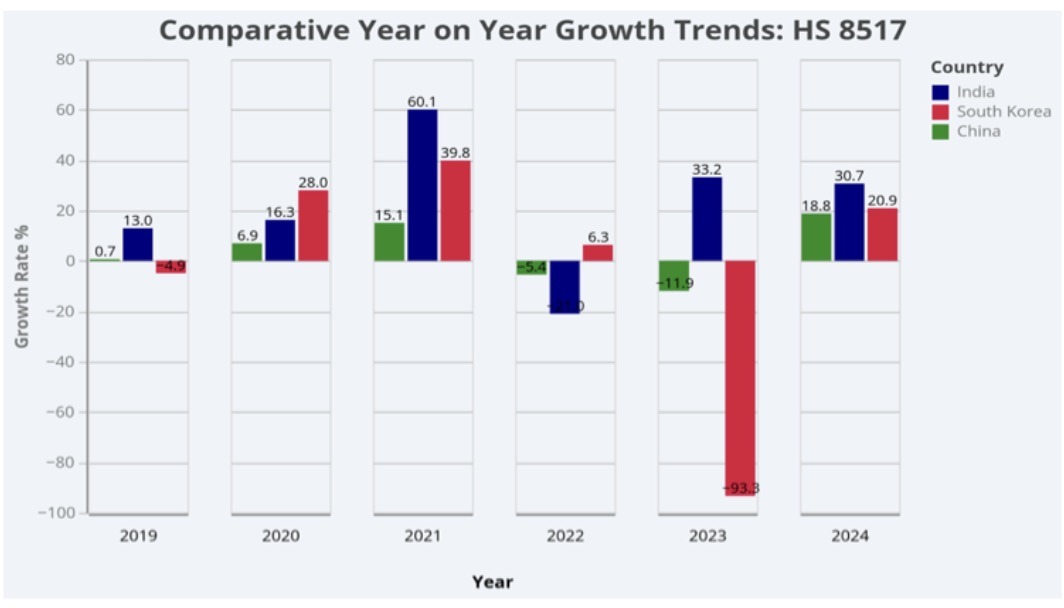
This section examines ASEAN-linked HS 8517 trade patterns between 2018 and 2024 to evaluate changing regional supply-chain dynamics within the telecommunication sector. Using aggregated trade flow datasets, the analysis specifically focuses on export growth trends, regional trade shifts, and import volume trends among China, India, and South Korea to assess evolving trade concentration, diversification patterns, and the potential of substitution within the ASEAN market.
- India’s Emerging Expansion Potential: The above-mentioned graph indicates India’s export trends are increasing participation within ASEAN-linked HS8517 trade networks despite temporary post-pandemic fluctuations. The recovery observed after 2022 reflects growing regional integration and suggests long -term potential for India to expand its role as an alternative supplier within the telecommunications supply chain.
-
- South Korea’s strategic but Volatile Role: South Korea demonstrated a comparatively unstable export performance despite retaining strategic relevance within a high-technology-linked production network. The fluctuation suggests a possible transition toward higher value technological specialization rather than volume-based export expansion.
- China’s Mature but slowing dominance: China maintained a relatively stable export performance throughout the observed period, reflecting its already established position within the ASEAN telecommunication trade network. However, the comparatively moderate growth trajectory may indicate a transition from rapid expansion toward market saturation, creating potential space for emerging suppliers such as India to gradually expand their regional presence.
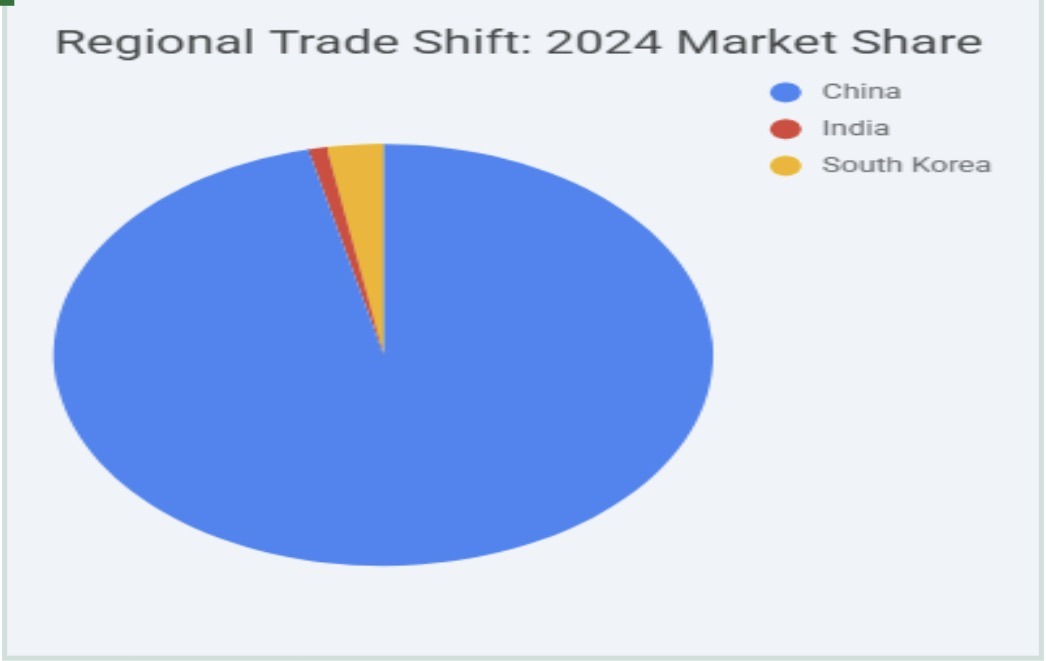
- China’s Persistent Market Dominance: China accounted for approximately 96.3% of the combined HS8517 import share among the selected partners in 2024, indicating continued concentration rather than diversification of ASEAN’s telecommunications import structure.
- Limited Regional Substitution by India and South Korea: Despite the gradual growth trends, India and South Korea maintained relatively small market shares at 0.9% and 2.8%, respectively, suggesting that neither country has yet emerged as a substantial alternative to Chinese dominance in this sector.
- Implications for Supply-Chain Diversification: The 2024 market-share distribution indicates that ASEAN’s telecommunication-related import dependence remains heavily concentrated, limiting the extent of regional supply-chain diversification despite broader geopolitical and strategic realignment efforts.
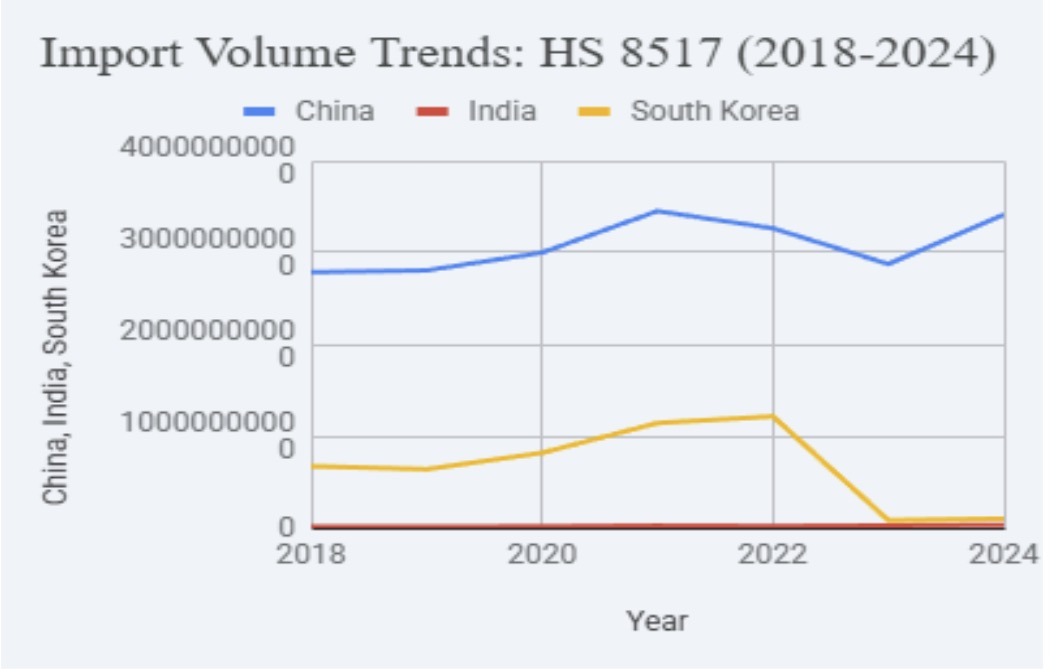
- China’s Large-scale Trade Capacity: China consistently maintained the highest import volume across the observed period, reflecting the scale and depth of its telecommunication manufacturing ecosystem within the ASEAN trade network.
- South Korea’s High Value but Narrower Trade Structure: Despite a period of strong performance, South Korea’s comparatively fluctuating trade volumes suggest a more specialized and less volume-intensive trade structure within the region.
- India’s Expanding but Limited Market Presence: India demonstrated a gradual increase in import volume over time; however, its overall trade scale remains substantially smaller in comparison to China and South Korea, indicating that its regional trade presence is still in an emerging phase.
5.2 Qualitative Analysis:
This analysis aims to explain the why and how behind the quantitative analysis. To do so, a tripartite framework of domestic industrial policy, regional integration, and global geopolitical de-risking was incorporated.
- Domestic Catalyst and Internal Policy Structure: The shift in ASEAN’s regional trade is driven by two distinct domestic strategies: Deep Localization in India and a shift towards quality-dominant production in South Korea.While Production Linked Incentive (PLI) schemein India is architecturally designed to catalyze trade growth through a 1.91 lakh crore fiscal outlay aimed at ‘deep localization,’ its tangible effectiveness remain contingent on bridging the structural disparity between incentive dispersion and realized manufacturing output. Although the Indian Semiconductor Mission (ISM)has successfully sanctioned 12 projects valued at 1.64 lakh crore to bolster domestic assembly and specialized GaN-based technology capacity(PIB Delhi), the empirical impact on ASEAN-bound telecommunications exports is currently lagging. This discrepancy suggests that while the scheme has successfully incentivized capital formation,it has not yet overcome persistent supply chain bottlenecks or the heavy reliance on imported intermediate components. Consequently, a critical assessment indicates that unless the PLI framework evolves from a purely incentive-based model to one that integrates more deeply into regional value chains, rather than focusing primarily on domestic assembly it will remain a limited instrumental for genuine industrial substitution and regional trade rebalancing. South Korea’s strategy is a response to a sharp quantitative inflection, specifically a 93% drop in growth rate in 2023, caused by its historical dependence on high-volume, commoditized memory chips (Korea 2025 1). To stabilize its trade position, Korea is utilizing a KRW 150 trillion National Growth Fund to pivot toward “capital and technology intensive” logic and foundry segments, moving from a volume-heavy model to a high-margin export structure (Korea 2025 14).
- Geopolitical Inflection: The reallocation of trade flows, particularly within the electronics and HS 8517 categories, is an “inflection” driven by global de-risking and a push for supply chain resilience (Freund et al. 1). Quantitative data indicates these shifts are part of a “Great Reallocation” where regional hubs act as essential intermediaries that remain “intricately linked” to broader production networks (Alfaro and Chor 1). For India, this geopolitical climate explains the “why” behind accelerating the ISM to ensure “technological sovereignty” and reduce external dependencies (PIB Delhi). For South Korea, the shift is defensive; the state must diversify its product mix to mitigate “exposure to export controls” and unilateral trade restrictions that disproportionately affect its memory-heavy export model (Korea 2025 14). Both nations are leveraging their revealed comparative advantage to capture trade diverted from traditional manufacturing hubs (Freund et al. 1).
Institutional Architecture: The long-term sustainability of these domestic transitions depends on an institutional architecture that reduces regulatory friction and bridges the high-skill talent gap. The ASEAN Economic Community Strategic Plan 2026-2030 and the Digital Economy Framework Agreement (DEFA) provide the regional framework for this, aiming to create “interoperable digital ecosystems” and lower transaction costs (ASEAN Economic Community 1). This architecture enables the region to function as a stable “trade corridor” managing nearly USD 2 trillion in annual exports (Trade Crossroads 1). Locally, South Korea’s “Top-Tier Visa,” introduced in 2025, serves as a specific institutional tool to attract global experts in semiconductors and AI, ensuring the transition to quality-dominant manufacturing is supported by necessary human capital (Korea 2025 5). Furthermore, the implementation of the WTO Agreement on Trade Facilitation ensures that customs functions act as “critical infrastructure” for these evolving value chains (Mikuriya 5).
Ethical Consideration:
This research uses publicly available Secondary sources, including institutional reports, policy documents, and aggregated trade datasets. Ethical research practices were maintained through accurate citation, responsible interpretation of data, and avoidance of analytical bias or data distortion.
Limitation:
6.1 Lag in International Trade Databases:
One limitation of the study was the delayed availability of the latest international trade data, due to reporting lag in regional databases. As a result, complete datasets from 2025 onward were not accessible during research. To address this, the study incorporated recent qualitative sources, including policy documents, strategic reports, and semiconductor initiatives published after 2024, to supplement quantitative findings and provide insight into ongoing strategic and trade developments.
6.2 Market Distortion During the COVID-19 Period:
The trade pattern observed during the COVID-19 pandemic reflected unnatural disruption in global supply chains, manufacturing, and trade flows. This created limitations in interpreting quantitative trade trends exclusively within the pandemic period, as fluctuations may not accurately represent long-term regional trade behavior. To counter this distortion, the study expanded the analytical timeline to include pre-pandemic trade data from 2018 onward, enabling broader comparative analysis beyond the COVID-affected period.
Discussion:
The empirical findings underscore that the reconfiguration of the Indo-Pacific trade landscape, particularly within the telecommunications sector (HS8517), represents an evolutionary transition rather than an abrupt decoupling. This trajectory is best interpreted through the lens of New Trade Theory, wherein the persistent concentration of trade is driven not merely by factor endowments as suggested by the Heckscher-Ohlin model but by the network externalities and entrenched economies of agglomeration inherent to China’s manufacturing ecosystem (Alfaro and Chor 1; Freund et al. 1). Consequently, while diversification initiatives are observable, they operate within a ‘Great Reallocation’ framework where new manufacturing hubs remain functionally tethered to existing Global Value Chains to maintain operational efficiency. This structural inertia explains why the shift away from traditional centers remains a protracted, long-term process rather than an immediate revolutionary break. In this context, the complementary strengths of India and South Korea emerge as a strategic recalibration of Global Value Chain participation. South Korea’s ‘quality dominant’ pivot, supported by its National Growth Fund, positions it to leverage high-tech IP advantages (Korea 2025 14), while India’s industrial scaling, catalyzed by the Production Linked Incentive scheme, provides the requisite manufacturing volume (Press Information Bureau 28). This synergy is not merely additive; it functions as a critical counterweight that effectively alters the terms of GVC participation. When bolstered by the institutional architecture of the ASEAN Economic Community, these combined capabilities create a more robust trade corridor, mitigating the systemic risk of overdependence while establishing the necessary critical mass to challenge established regional trade monopolies. (ASEAN Secretariat 2) In this gradual transition, India and South Korea emerge as primary regional partners with deeply complementary strengths that address the dual needs of the global market. South Korea is successfully pivoting toward a “quality-dominant” model, utilizing its National Growth Fund to lead in high-tech logic and foundry segments (Korea 2025 14). Simultaneously, India provides the necessary counterweight through its high growth rate and the massive potential to scale production volume via the PLI scheme (“PLI Scheme”). This synergy South Korea providing the high-tech IP and India providing the manufacturing depth and volume creates a resilient regional supply chain model. When supported by the institutional architecture of the ASEAN Economic Community, these complementary strengths allow for a more balanced “trade corridor” that can sustain global demand while mitigating the risks of overdependence on a single source (ASEAN Economic Community 1).
Conclusion:
This study evaluated the substitution potential of India and South Korea within ASEAN’s telecommunications import structure in the post-2022 period, providing a grounded empirical assessment where previous scholarly discussions remained largely theoretical. The quantitative data underscores the magnitude of this challenge, confirming China’s persistent 96.3% market dominance in 2024, which is showing signs of a slowing growth trajectory, in stark contrast to India’s low but incrementally expanding share (0.9%), propelled by a significantly high growth rate. South Korea maintained a larger 2.8% share but demonstrated volatile performance, marked by a sharp 93% drop in its 2023 growth rate. Qualitative analysis reveals that diversification operates within a “Great Reallocation” framework, where China’s structural dominance persists through its control of intermediate supply chains, meaning new regional hubs remain intricately linked to pre-existing networks. While India pursues volume through “Deep Localization” via the PLI scheme and South Korea pivots towards high-tech specialization using its National Growth Fund, these strategies are deeply complementary. Ultimately, substitution potential exists but remains uneven and sectorally concentrated, manifesting primarily through the complementary synergy of India’s manufacturing scale and South Korea’s technological IP. This synergy, with South Korea providing the high-tech IP and India providing the manufacturing depth and volume, creates a resilient regional supply chain model. Future growth depends on sustained competitiveness and manufacturing capabilities supported by institutional architecture like the DEFA. Consequently, the regional trade reality reflects a gradual,long-term evolutionary transition rather than an abrupt decoupling from the established network (Alfaro and Chor 1). However, to translate this emerging trade potential into enduring economic competitiveness, India must translate the reliance on broad-based incentives to targeted structural reforms. Sustained growth necessitates a rigorous focus on reducing the logistics cost burden that currently hampers global value chain integration, alongside aggressive initiatives to enhance labor productivity and upskill the manufacturing workforce. Furthermore, the integration of MSMEs into the global value chain remains a critical imperative; policy must pivot to facilitate their absorption into the high-value electronics and telecommunication ecosystem supported by initiatives such as the PLI scheme and ISM scheme (Press information bureau 28,29). This requires overcoming significant implementation challenges, most notably the execution gap between signed diplomatic memoranda and tangible operational outcomes, by establishing a performance-tracked accountability framework.
Ultimately, true export diversification will only be realized when these domestic structural improvements are harmonized with regional institutional mechanisms, such as DEFA, to ensure that India’s manufacturing scale effectively complements South Korea’s technological IP, thereby creating a resilient and strategically autonomous regional trade architecture(ASEAN Secretariate1;Freund et al. 1).
Works Cited:
- Alfaro, L., & Chor, D. (2023, August). Global supply chains: The looming ‘great reallocation’ (Working Paper No. 24-012). Harvard Business School.
- ASEAN Secretariat. (2025). ASEAN Economic Community strategic plan 2026–2030. Adopted by the 46th ASEAN Summit.
- ASEAN+3 Macroeconomic Research Office (AMRO). (2025). Korea 2025: Annual consultation report (AMRO Country Report ACR-2026-03).
- Asia Society Policy Institute. (2026, March). Seeking agency in uncertainty: Asian middle powers and the fragmenting global order. Asia Society Policy Institute. https://asiasociety.org/policy-institute/seeking-agency-uncertainty-asian-middle-powers-and-fragmenting-global-order
- Azhgaliyeva, D., et al. (Eds.). (2023). Fostering resilient global supply chains amid risk and uncertainty. Asian Development Bank Institute.
- Bajpaee, C. (2014). India-South Korea relations and the emerging regional architecture. Strategic Analysis, 38(4), 437–443. https://doi.org/10.1080/09700161.2014.918408
- Bajpaee, C. (2022). Reinvigorating India’s ‘Act East’ Policy in an age of great power competition. The Pacific Review, 36(5), 1052–1083. https://doi.org/10.1080/09512748.2022.2110609
- Basrur, R., & Koh Swee Lean, C. (2023). South Korea’s New Southern Policy and the middle power quest: Implications for India-Korea relations. Asian Affairs: An American Review, 54(2), 187–208. https://doi.org/10.1080/03068374.2023.2213115
- Cha, V. D. (2023). Collective resilience: Deterring China’s weaponization of economic interdependence. International Security, 48(1), 91–124. https://doi.org/10.1162/isec_a_00465
- Chattaraj, S. (2023, July 12). Korea’s Indo-Pacific strategy and its implications for bilateral cooperation between India and South Korea (KIEP World Economy Brief, WEB 23-24). Korea Institute for International Economic Policy. https://ssrn.com/abstract=4539865
- Dhawan, R. K. (2020). Korea’s ‘New Southern Policy’ towards India: An analysis. Journal of Asian Security and International Affairs, 7(1), 55–80. https://doi.org/10.1177/0973598420906248
- Dinesh, A., & Bhosale, P. (2025). Where India and China meet: Competing regional statecraft in Southeast Asia. Political Science Quarterly. Advance online publication. https://doi.org/10.1093/psquar/qqaf059
- Farrell, H., & Newman, A. L. (2019). Weaponized interdependence: How global economic networks shape state coercion. International Security, 44(1), 42–79. https://doi.org/10.1162/isec_a_00351
- Feingold, S., & Pfister, A.-K. (2026, January 5). ASEAN takes major step toward landmark digital economy pact. World Economic Forum. https://www.weforum.org/stories/2025/10/asean-defa-digital-economy-pact-negotiations/
- Freund, C., Mattoo, A., Mulabdic, A., & Ruta, M. (2023). Is US trade policy reshaping global supply chains? (Policy Research Working Paper No. 10593). World Bank.
- Hwang, W., & Ryou-Ellison, H. J. (2021). Taking a side between the United States and the People’s Republic of China: Strategic hedging of South Korea and India. International Area Studies Review, 24(2), 60–78. https://doi.org/10.1177/22338659211013650
- John, J. V. (2020). India-South Korea relations under ‘Special Strategic Partnership’: ‘Act East Policy’ meets ‘New Southern Policy’. India Quarterly: A Journal of International Affairs, 76(2), 207–225. https://doi.org/10.1177/0974928420917798
- John, J. V., & Panda, J. P. (2023). 50 years of the South Korea-India relationship: Retrospect and prospect. The Journal of Indian and Asian Studies, 4(3). https://doi.org/10.1142/S2717541323030018
- Kim, M.-H. (2023). Soft power in India-South Korea relations and role of cultural and popular connections. The Journal of Indian and Asian Studies, 4(3). https://doi.org/10.1142/S2717541323400089
- Kuik, C.-C. (2021, June). Irresistible inducement? Assessing China’s Belt and Road Initiative in Southeast Asia. Council on Foreign Relations. https://www.cfr.org/sites/default/files/pdf/kuik_irresistible-inducement-assessing-bri-in-southeast-asia_june-2021.pdf
- Lücker, F. (2023). Risk management in global supply chains. In D. Azhgaliyeva et al. (Eds.), Fostering resilient global supply chains amid risk and uncertainty (pp. 363–382). Asian Development Bank Institute.
- Mikuriya, K. (2022, November 28–30). Challenges for resilient global supply chains [Talking points]. 2022 ADBI Annual Conference: Fostering Resilient Global Supply Chains Amid Risk and Uncertainty, Asian Development Bank Institute.
- Ngaibiakching, & Pande, A. (2020). India’s Act East Policy and ASEAN: Building a regional order through partnership in the Indo-Pacific. International Studies, 57(1), 81–107. https://doi.org/10.1177/0020881719885526
- Nguyen, T. B., et al. (2022). Competitive strategy of India and China in Southeast Asia and its impact on the region. Asia-Pacific Social Science Review, 22(1), 80–92. https://www.researchgate.net/publication/360858826_Competitive_Strategy_of_India_and_China_in_Southeast_Asia_and_Its_Impact_on_the_Region
- Panda, J. P. (2023). Major determinants and way forward for Korea-India relations: A Korean perspective. The Journal of Indian and Asian Studies, 4(3). https://doi.org/10.1142/S2717541323400053
- Panda, J. P., & Kim, C. (2023). A shared vision begets the future: Korea-India defense cooperation. The Journal of Indian and Asian Studies, 4(3). https://doi.org/10.1142/S2717541323400065
- Panda, J. P., et al. (2024). India-Korea relations in the emerging dynamics of the Indo-Pacific. Observer Research Foundation. https://www.orfonline.org/research/india-korea-relations-in-the-emerging-dynamics-of-the-indo-pacific
- Press Information Bureau. (2026, February 20). PLI scheme: Strengthening India’s manufacturing ecosystem and deepening localization. https://www.pib.gov.in/PressReleasePage.aspx?PRID=2230621
- Press Information Bureau. (2026, February 7). India Semiconductor Mission 2.0: A ₹1,000 crore budget push towards semiconductor self-reliance. https://www.pib.gov.in/PressReleasePage.aspx?PRID=2224839
- Press Information Bureau. (2026). Cabinet approves two new semiconductor units worth Rs 3,936 crore. Press Information Bureau.
- Rim, H. J. (2023). South Korea’s Indo-Pacific strategy: Challenges for the Yoon administration. Journal of Indo-Pacific Affairs, 6(1), 109–116. https://media.defense.gov/2023/Feb/02/2003154190/-1/-1/1/17%20RIM_COMMENTARY.PDF
- Rim, H. J. (2025). Against strategic threats at sea: South Korea’s naval strategy and unmanned maritime systems. The Pacific Review, 38(5), 781–807. https://doi.org/10.1080/09512748.2024.2436928
- Russel, D. R., & Berger, B. H. (2020, September). Weaponizing the Belt and Road Initiative. Asia Society Policy Institute. https://asiasociety.org/sites/default/files/2020-09/Weaponizing%20the%20Belt%20and%20Road%20Initiative_0.pdf
- Saha, P. (2023). South Korea’s new Indo-Pacific strategy: Where does India fit in? The Journal of Indian and Asian Studies, 4(3). https://doi.org/10.1142/S2717541323400077
- Yeo, A. (2022, November). South Korean foreign policy in the Indo-Pacific era [Policy brief]. Brookings Institution, Center for East Asia Policy Studies. https://www.brookings.edu/articles/south-korean-foreign-policy-in-the-indo-pacific-era/
- Zha, W. (2023). Southeast Asia amid Sino-US competition: Power shift and regional order transition. The Chinese Journal of International Politics, 16(2), 241–261. https://doi.org/10.1093/cjip/poad006