
Climate-Induced Migration from Tuvalu and Kiribati: The Future of Sinking Island Nations – Aarushi Mahajan, Bharadwaj, Anil Tamsoy, Sarabel Odero
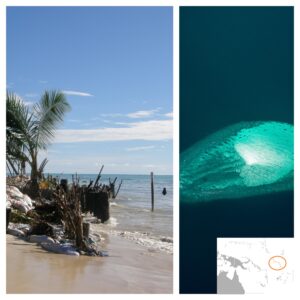
Introduction Tuvalu and Kiribati, two low-lying island nations in the Pacific Ocean, are at the forefront of climate-induced migration discussions. With average elevations barely above sea level, these countries face existential threats from climate change, including rising sea levels, increased frequency of extreme weather events, and environmental degradation. These challenges not only jeopardize the habitability of their homelands but also compel communities to consider migration as a viable adaptation strategy. Understanding the environmental and geographic vulnerabilities of Tuvalu and Kiribati is crucial to comprehending the drivers behind this migration and formulating effective policy responses. Environmental and Geographic Vulnerability Tuvalu and Kiribati are two low-flying islands and are majorly composed of coral atolls. Their maximum heights barely graze the 4.5 meters above the sea level mark. This geography renders them vulnerable to the effects of climate change, more so that of the rising sea level. In the coming 30 years, these countries may face at least a 15-centimetre rise in sea levels, regardless of future carbon emission scenarios (NASA,2024). This is highly alarming, bringing along with it natural dangers such as coastal erosion, seawater in freshwater bodies, and massive flooding. These problems pose a deadly threat to the very existence of these two islands. Adding on to these worrying problems, the two islands are also geographically isolated, cementing the intensity of the risks at their horizons. Far-flung and scattered in the Pacific Ocean, these countries have little access to the outside world. Without access to external resources and technology, their options become very limited. They become dependent on local, climate-vulnerable resources for their livelihood. Which includes agriculture and fishing, both exposed to the evils of climate change. Weather events such as tropical cyclones are increasing in their commonness and severity thanks to global warming. The Cyclone Pam in 2015 hugely crippled Tuvalu. It lost more than 25% of its national GDP (World Bank, n.d.). Such incidents not only pulverize their housing and infrastructure but also create socio-economic consequences in the long term, such as displacement of the population and loss of livelihoods. These environmental issues lead to migration trends. In Kiribati, the migration is usually internal. People migrate from the outer islands to the capital, South Tarawa, to seek better livelihood opportunities and living conditions (UNU-EHS, 2015). While in Tuvalu, the migration is both internal as well as external. Most people seek to migrate overseas to truly escape the environmental challenges that they face (UNU-EHS, 2015). But that is very restricted due to strict immigration laws of potential host countries leaving very few options alive for them. Looking at the social and cultural aspects of their lives, one can see that it is also riddled with threats. The land is an important cultural hub. The reason for a culture to flourish. Migrating from it risks traditional livelihoods and social structures. It is an intense emotional and controversial turmoil for the people. It is not just a relocation of the physical form but the loss of a cultural identity. Throwing it away and reconstructing another identity is a slow and emotionally painful task. Both the Tuvaluan and Kiribati governments have taken different approaches to fight back these issues. The government of Kiribati has been pushing forward the policy of “migration with dignity” where its citizens procure skills that will equip them in the global labor markets, opening new avenues to migrate more voluntarily and with more dignity (Migration Policy Institute, 2017). The Tuvaluan government has been directing its focus on advocating for stronger global climate action to fight the very need for relocation, wishing for its people to remain on their ancestral islands (IOM, 2012). In short, the environmental and geographical vulnerabilities of Tuvalu and Kiribati are key drivers of climate-induced migration. Meeting these challenges is a. multifaceted task involving international cooperation to open migration channels, investment in local policies and strategies, and international efforts to reduce climate change. Identifying and responding to these vulnerabilities is the key to facilitating the resilience and sustainability of these island states. Migration Trends and Societal Impacts Migration trends in Tuvalu and Kiribati are heavily influenced by environmental degradation and resource constraints, making migration a critical adaptive strategy. Both nations, characterized by small land areas and increasing vulnerability to climate change, face growing populations that outstrip the capacity of their ecosystems and economies to support them. Kiribati, in particular, relies on weak natural resources, contributing to food insecurity while Tuvalu, although slightly better off, is also struggling with limited agricultural land and economic opportunities (“A Climate Justice Perspective on International Labour Migration and Climate Change Adaptation Among Tuvaluan Workers,” 2022). In Kiribati, overpopulation, especially in South Tarawa, has prompted migration, which between 2005 and 2015 comprised one-third of international migration. Despite such statistics, the migration rate of this island remains relatively low compared to Tuvalu. This is largely due to the limited migration pathways available, especially for unskilled workers. Tuvalu has recorded a high international migration rate of 64%, with migration to countries like New Zealand and Australia being facilitated through programs like the Pacific Access Category (PAC) Visa (Curtain et al., 2019). Looking ahead to 2050, migration from both countries is projected to increase due to the expected rise in pressure on resources and limited employment opportunities within the countries. While internal migration had certainly provided relief in the initial stages of battling climate change, it has today proven to be inadequate. The ability to migrate internationally is essential for both these island nations as it provides a much-needed income from remittances which in turn support families and communities within these islands, However, while migration offers substantial benefits to the migrants themselves, it has had significant societal implications (Curtain & Dornan, 2019). The continued migration of the working-age population leaves a gap in the domestic labor market, exacerbating internal challenges for both nations, Economically, both islands also face fiscal challenges. Kiribati’s economy is projected to be heavily reliant on foreign aid and fishing revenues. With