
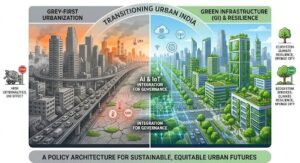

GREEN INFRASTRUCTURE AS A NECESSITY: Mapping the Environmental Costs of Grey Builds and Pathways to Technology-Integrated Policy Solutions for Indian Cities
India’s cities are undergoing rapid demographic and spatial transformation, with over 600 million people projected to reside in urban areas by 2031. This growth has concentrated successive policy cycles on “grey” infrastructure- concrete, asphalt, and steel-dominated construction that offers political legibility at the cost of long-run ecological dysfunction. This paper maps the quantifiable environmental externalities generated by conventional grey construction against the restorative capacities of nature-based Green Infrastructure (GI) solutions. Drawing on environmental economics, urban political ecology, and Amartya Sen’s Capability Approach, the paper argues that GI constitutes a structural requirement for climate-resilient urban futures. It additionally examines the role of AI and IoT technologies in scaling GI governance across Indian municipalities, identifying persistent governance failures- such as fragmented institutional mandates and maintenance deficits- as the primary barriers to adoption, and concludes with a technology-informed policy architecture designed to address them.
