Authors:
Swetanjali Sahoo, Amritendu Mandal, Aishwarya Baheti, Amatullah Musfira Jabeen
1. Abstract
Education is an important part of India’s social and economic development, and a significant amount of public funds is allocated to the education sector every year. However, there is often a difference between the amount of budget allocated and the amount actually spent. This study aims to examine the gap between budget allocation and actual expenditure in the Indian education system and understand how this gap changes across different years and between the Centre and States. The study is based on secondary data collected from government reports, budget documents, official websites, CAG reports, and other reliable sources, covering the period from 2019 to 2025. The findings show that although a large proportion of the allocated education budget is generally utilized, the gap between allocation and expenditure varies across years and across different levels of government. The study also indicates that administrative delays, implementation challenges, and differences in the financial capacity of states can affect the utilization of education funds. Therefore, better financial planning, timely release of funds, effective monitoring, and stronger implementation mechanisms are needed to reduce the gap and ensure that allocated resources are effectively used for improving education in India.
2. Introduction
Education is a powerful tool in lifting people out of poverty, reducing socioeconomic inequalities persistent in our nation and in enabling values of peace, justice and resilience. It is foundational to democracy, creating more inclusive societies. Educated people are more likely to participate in the workforce and make informed decisions. A strong education system pushes communities to be more resilient and self-reliant. And education for girls and women especially plays a big part in reducing infant mortality rate and child marriage. Public funding through the government creates equal opportunities for children from low income, rural areas removing the financial barriers to receiving education and basic literacy. It is an investment into the future. Recognizing education as a critical investment, the combined expenditure of the Centre and States currently stands at approximately 4.1% of the GDP, on education through various schemes like NIPUN Bharat to increase reading proficiency of children by grade 3, Samagra Shiksha Abhiyan to ensure equity and inclusion at all levels of schools and teacher training programs, PM POSHAN which was established to update the mid-day meal program in schools ensuring that school going students meet the nutritional requirements, etc. The RTE Act 2009, guarantees free and compulsory education for kids aged 6-14 years. NEP 2020 was introduced to keep education on par with the challenges and skills required for the 21st century.
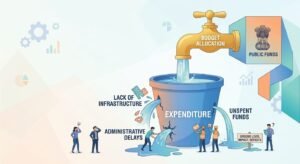
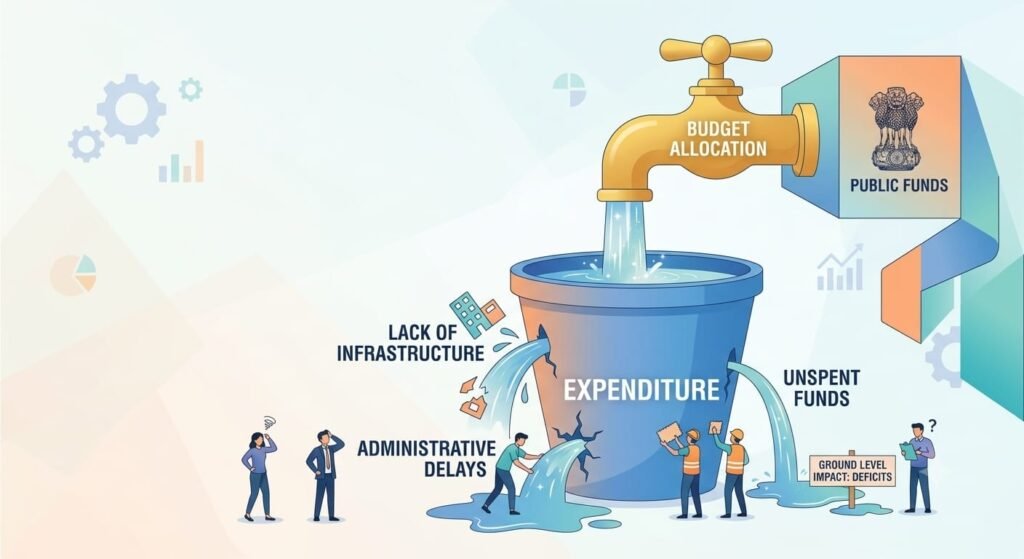
Despite all this spending the gap between budget and utilization of that budget remains due to corruption, underutilization of sanctioned funds, delayed disbursement, inadequate allocation, teacher networks and lack of proper supervision. This gap directly contributes to severe infrastructure deficits, declining outcomes in foundational learning and widening socioeconomic inequalities. It creates teacher shortages and teacher training programs get affected leading to compromised knowledge delivery. It also contributes to lack of resources necessary for day to day smooth running of schools like mid-day meals, free textbooks, safe drinking water, electricity and clean functional toilets. Not only is this but in this age of Internet, digital education and equipment to deliver this education a must in schools. Yet according to UDISE+ reports less than 40% of schools are digitally equipped. The problem necessarily is not the amount of spending but also how efficient it is at delivering the required outcomes it is aiming for. One cannot solve the problem by pouring more water into an already leaking bucket.
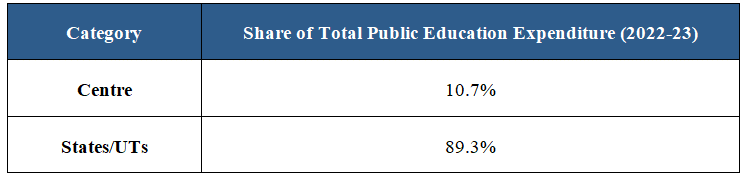
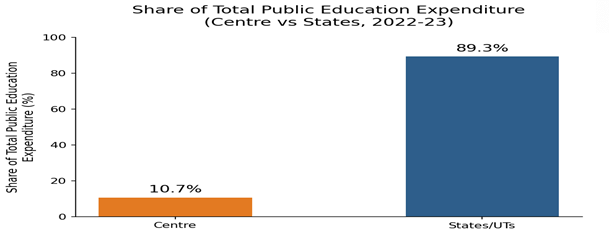
Between the state and the center, the center only contributes 10-11% of the whole educational spending budget while the bulk of it is carried by states which are around 80-89 %. This means poorer states with less capital struggle to fund public education which in turn leaves them behind in terms of human and economic development.
This study presents a comprehensive view of the data on government spending and utilization and how it affects the schools, students and teachers at grassroots level. Including ways the government can possibly adopt to bridge this gap. Partnering with NGOs to better deliver community centered education and forming government-corporate partnerships for better infrastructure and planning along with real time data monitoring of attendance, infrastructure needs and accountability structures can go a long way in improving the utilization statistics of the capital allocated to education.
3. Literature review
3.1. Overview
Education is an important pillar for nation building. It’s a part of concurrent list in Indian Constitution, where state and center both are responsible for providing quality education. The combined spending on education by the center and states stands around 4.1% of GDP whereas the recommended is 6% of GDP (Demand for Grants 2026-27 Analysis: Education, PRS Legislative Research). In order to achieve high-quality education, vocational training and industry level skills for all; this topic of ‘gap between the budget allocated for education and expenditure’ becomes empirical to study. It is of crucial importance to understand the different themes of this vast subject. A body of research analyses different aspects related to this broader topic. They are reviewed in order to gain a deeper knowledge of the subject and to understand the existing issues and constraints. Reviewing existing literature also helps in structuring current research study; by identifying under researched dimensions of the central topic and guiding the study in the right direction. This review analyses various research paper, reports, and newspaper article and audit reports from 2010 to 2026 to evaluate the persistent budget-expenditure gap in Indian education. This time frame effectively brackets historical analyses of center-state funding disparities alongside recent evaluations of inclusive education, digital infrastructure deficits, and localized NGO intervention. It highlights how vertical fiscal imbalances between the Centre and States directly impact educational infrastructure and teacher availability. It shifts the academic focus from budget adequacy to the efficiency of utilization, administrative hurdles, and ground-level absorptive capacity. It synthesizes diverse themes to show how financial shortages disproportionately affect marginalized groups, such as children with disabilities and Scheduled Tribe students. It reveals that educational outcomes are hampered not just by a lack of funds, but by weak governance, corruption, and financial auditing malpractices.
3.2. The Reasons behind the Existing Budget-Education Expenditure Gap and The Challenges it poses on The Sector
This theme is further sub-divided into 2 parts. One is budgetary allocation and underutilization of fund and another is about reasons and challenges.
3.2.1. Scheme-Wise Allocation and Underutilization
PM POSHAN which is updated version of Mid-day meal scheme aims to improve nutritional status among school going children and improve the enrolment ratio in school education. For that in 2026-27, ₹ 12,750 crore has been allocated to the scheme, but there is a trend of approximately 82% of money has been used during FY 2018-19 to 2019-20. There has been increase in utilization of money after COVID but there’s still ₹22.39 crore of unspent money as of FY 2022-23 (CAG, 2025).
Samagra Siksha Abhiyan was launched in 2018, subsumed various schemes such as Samgra Siksha Abhiyan, Rashtriya Madhyamika Siksha Abhiyan and several teachers training initiatives. Key objectives of the program include (1) supporting States to implement the NEP, 2020 and RTE Act, 2009. (2) Ensuring equity and inclusion at all levels of school education, (3) strengthening teacher training, (4) promoting vocational education. But on an average 86% of the money has been utilized, also money allotted for vocational training not fully utilized.
PM SHRI aims to upgrade around 14,500 government schools as per the goals of the National Education Policy, 2020. But there’s also around 80% of money utilized. We can see this trend for various other schemes like- money allotted for PM RUSHA (Pradhan Mantri Rashtriya Uchhatar Shiksha Abhiyaan), only 16% has been utilized so far. (PRS, 2026)
NIPUN Bharat launched in 2021 aims at achieving proficiency in basic arithmetic and reading by grade 3. Also target teacher training program and improve learning outcome. As per (PRS, 2026) there is a decreasing trend in expenditure for teacher’s training program.
3.2.2. Infrastructure and Digital Deficits
But due to financial shortage it faces various issues, such as- lack of internet in schools, lack of proper infrastructure for ICT (Information Communication Technology). As per UDISE+ report only 36.5% of schools in India have functional desktop/PCs, under which only there is a gap between government and private school. Also, only 10.5% of schools have functional integrated teaching learning devices and only 33.9% schools used digital board. For effective use of ICT in education we need to bridge the gap between budget and actual expenditure in Indian education (UDISE+, 2025-26).
3.2.3. Inclusivity Constraints and Human Resource Inefficiencies
Union and state governments do not allocate sufficient funds for CWD- specific interventions and Inconsistencies in identifying and counting CWDs across different surveys (Census, MHRD, DISE) severely impede accurate planning and budgeting (Kundu, 2020).The study done by Muralidharan (2017), examines the effectiveness of public spending on education in India by comparing increased educational inputs with the efficient use of existing resources. Using nationally representative panel data from schools across 1,297 villages, the study found that increased public investment improved input-based measures of school quality. However, the reduction in inefficiency was limited, particularly due to teacher absenteeism. The study reported that 23.6% of teachers were absent during unannounced school visits, resulting in an estimated salary loss of $1.5 billion annually. It highlights that increased government spending alone does not necessarily ensure better educational outcomes. Efficient utilization and monitoring of allocated resources are equally important.
3.2.4. Administrative Friction and Governance Failures
Various factors still impact the utilization of resources and hence outcomes. Delay in the release of funds, administrative hurdles, teacher vacancies, uncoordinated school networks and gaps in proper supervision; all contribute towards inefficient us of funds (Sai Archana, 2026).
The Allocations under schemes such as Samagra Shiksha have been rising, but the delayed utilization of funds leads to a gap between budgetary allocations and actual outcomes on-grass root levels. Limited capital expenditure absorption capacity, administrative issues, and execution hurdles on state-level were noted as key factors behind slow deployment of resources (Sai Archana, 2026). It was also stated that sometimes “state co-funding requirements, procurement and tendering delays, land and contractor clearances, vacancies in implementing offices, and late submission of utilization certificates needed for subsequent releases” act as hindrances to seamless execution (Sai Archana, 2026, para 5).
Ravde (2026) specified in her study that the amount of money spent on education cannot automatically guarantee better results. The impact of the spending is hampered by issues like inefficient use of allocated funds, teacher vacancies and weak governance. The spending levels also vary across different states and over time. However, differences in outcomes often depend more on how effectively policies are carried out and the quality of local institutions than the amount of money spent.
A major concern is that there is a budget estimate then a revised estimate and still gap occurs in final spending. Actual spending often drops another 10% to 15%. The reasons are delayed fund releases, implementation problems and unspent funds in schemes like Samagra Shiksha. Data in 2023-24 shows that actual expenditure was around ₹1,14,054 crore whereas the budgeted estimate was of ₹1,20,000 crore; emphasizing again on important issues like a lack of administrative capacity in states and weak monitoring system (Education for All in India, 2026).
3.2.5. Systemic Corruption and Malpractices
Another angle to this existing budget-expenditure gap is about misuse of funds. ‘India Tomorrow’ (an online news and media portal) has published an article titled “Corruption in the Education Sector – An Analysis”, in May 2026. Study states that corruption in financial auditing is one of the different ways through which corruption takes place. Auditors or organizations sometimes alter the audit process to hide illegal money actions like fraud, bribery.
Kaur & Vasundhra (2022) observed educational malpractices such as fake Certificates and degrees, Capitation fees and scholarship and admission scam in their study. Such activities may not contribute towards creating a gap between allocated budget and actual expenditure; but they certainly impact the positive change that education budget is supposed to bring about and hence becomes a challenge.
3.2.6. Socio-Economic Disparities and NGO Interventions
The study conducted by Lateef et.al (2025) examines how financial constraints affect access to quality education in Punjab, Pakistan. It highlights the role of both public and private funding in providing equal educational opportunities. Using household surveys, government expenditure reports, and institutional funding data, the study found that inadequate government funding creates differences in the quality of education, especially in rural and low-income areas. Private institutions and public-private partnerships help provide additional resources, but they also increase inequality because low-income students may not be able to afford private education. The study also found that the socio-economic condition and financial awareness of families influence their decisions regarding education. Therefore, the study recommends increased government investment, need-based scholarships, and better financial management in the education sector.
Sharma & Goyal (2025), the core theme in this research paper focuses on NGO interventions in rural and marginalized areas where the government has failed to deliver on their educational goals. Despite government spending to deliver education to every child in India, schools still face lack of infrastructure, understaffed schools and high dropout rates. The study done by Varanasi, et.al (2024), aims to shed light on the lack of support and resources for teachers to rely on in low-income schools. Teachers are the backbone of education yet they are severely neglected by the system.
3.2.7. The Impact of Natural Calamities on Fiscal Planning
One more important challenged that is sometimes posed on our country is of disaster management which in turn impacts education sector as well.
Bihar is extremely at risk and frequently suffers flood-related disasters. Bihar was always an underperformance state in terms of education marked by poor structure, weak governance and social inequities. The research discovers the spatial-temporal pattern of school dropout among the districts North Bihar from 2016 to 2022. Statistical investigation reveals a significant positive correlation between school dropout rates and key flood-impact variables in North Bihar mainly in housing devastation. Direct impacts include the loss of life and the damage of school buildings, learning materials, and transportation networks. Indirectly, floods deplete household livelihoods, significantly increasing the chance cost of education. Floods cause low admission of children in school, increased drop-out rates, and lesser educational completion. (Kapoor, et.al 2025).
The floods of 2022 and 2024 emphasize the helplessness of Bihar’s teaching system to repetitive climate-related disorders. In 2024, floods affected 29 districts, impacting nearby 4.5 million persons, including 2.1 million children, and making the shutting of over 600 government institutes. (Ministry of Education, Government of India, 2024)
These conclusions exhibit how a major natural disaster can build surplus and sudden budgets demands for the administration, potentially placing burden on assets allotted for scheduled progressive activities in education.
3.3. The Impact of Gap between Allocation and Expenditure on Different Section of the Society
According to Kundu, 2020 only 67% of CWDs aged 6-17 attend educational institutions, millions remain out of school, and those enrolled rarely progress beyond primary levels. This suggests that existing policies are not achieving their intended outcomes, possibly due to gaps in their design, planning, budgeting, or implementation, with human, infrastructural, and financial resources identified as critical barriers. This problem is important because ensuring equal access to quality education for all children is a national priority and an international commitment under the 2030 Agenda for Sustainable Development Goal (SDG-4).
Kumar (2023) extends the discussion to higher education among schedules tribes, highlighting financial hardship and delays in scholarship disbursement as factors contributing to student attrition, another author (Ghosh 2025) provides that states differ in their absorptive capacity and timely utilization of funds under Samagra Shiksha, while administrative bottlenecks and delayed fund flows reduce the predictability required for sustained programs. This indicates that institutional capacity plays an important role in determining whether allocated resources translate into actual educational provision.
Swargiary and Roy (2024), provides a systematic review of the Samagra Shiksha Abhiyan which gives a broader perspective on the implementation of educational programs. Although the scheme has contributed to increased enrollment, reduced drop rates and improved infrastructure, significant challenges remain. Inadequate funding, bureaucratic hurdles and lack of accountability constrain implementation, while shortages of trained teachers and resources for children with disabilities continue to affect educational access and quality. Their findings suggest that the availability of financial provisions does not automatically ensure effective implementation.
(Kumar 2023) also identifies differences in the distribution of financial support, with substantial assistance concentrated in selected professional institutions which further states that over a five-year period (up to Dec 2023), 3,121 ST students dropped out of premier central Institutions—2,622 from Central Universities, 408 from IITs, and 91 from IIMs. A study of Lateef, 2025 highlights that the study found that inadequate government funding creates differences in the quality of education, especially in rural and low-income areas. Murlidharan, 2017 highlights that increased government spending alone does not necessarily ensure better educational outcomes. Efficient utilization and monitoring of allocated resources are equally important. Tilak (2003, 2007) also argues constant funding in education is required for accountability, fairness and growth in the education sector. If there are disparities then it will led to rising gaps in the quality of education which indirectly hampers our future. Government funds are very much necessary for both quality and accessible education in India. Most of the central universities, national universities are supported by center government while state governments are responsible for allocating government schools, colleges and state universities. But this split in budget funding has led to substantial differences in educational infrastructure, accessibility of teachers, and learning outcomes in different states (Motkuri & Revathi, 2023). This studies show that these gap is not only affecting the marginalized section of society, inclusivity in Indian education system but also the access to quality education.
3.4. Bridging the Gap between Education Budget Allocation and Expenditure in India
Hota & Acharya (2023), the study shows the link between economic development and spending on education for infrastructure development and quality of education. The economic growth of Odisha as a whole is significantly influenced by the state’s educational system. It is recommended that the infrastructure in schools should be well-equipped in order to meet the needs of the current generation. The government should collaborate with the private corporate sector, industrial units in constructing infrastructural facilities such as smart classrooms, computer and internet facility, laboratory etc. in schools. Hamini, et.al (2025) the study highlights the importance of efficient and transparent management of education funds, particularly when educational institutions face budget constraints. It proposes a smart budgeting model for Islamic educational institutions based on five stages: setting goals, identifying needs, preparing the budget, monitoring and evaluation, and involving stakeholders. The study found that proper budgeting can improve the effective use of funds, increase transparency, and encourage community participation. (Agrawal & Singh, 2023) the public investment consolidated by University Grants Commission (UGC) and development and maintenance grants, has definitely helped in growth of student enrolments. Scholars highlight local imbalances, high rates of absenteeism. To overcome these serious challenges, experts suggest budgetary reforms and need to have more focused curricula. The 15th Finance Commission of India Draft report (2019) looks at India’s vertical fiscal imbalance. The center government ensured the collected taxes and state governments had to manage their social and development costs. To resolve the imbalance, Article 280 of the constitution requires the finance commission to recommend how to distribute tax revenues and distribute funds among states. This is a system based on principles of fiscal federalism.
4. Research Gap
Existing studies primarily focus on descriptive tracking of budgetary allocations versus actual expenditures across Central and State governments. However, they offer limited prescriptive solutions regarding the effective utilization of unspent funds. The studies also indicate that the gap is involving inadequate allocation, underutilization of sanctioned funds, delayed disbursement, administrative constraints and unequal distribution. However, important gaps remain. Existing studies provide limited comparative analysis of why states consistently underutilized funds and how budgeted allocations translate into actual expenditure across different educational levels and marginalized groups and further the challenges during situation like pandemic or any natural calamities and the focus on resilient infrastructure and institutional preparedness remain unaddressed. And crucially, current research lacks frameworks explaining how improved fund utilization and absorptive capacity can directly enhance human capital outcomes.
5. Research Questions
- What is the gap between budget allocation and actual expenditure in the Indian education system during the study period?
- How has the budget–expenditure gap changed over different years?
- What differences exist between the utilization of education funds at the Central and State levels?
- Which states show higher and lower budget utilization, and what factors may contribute to these variations?
- How does the gap between budget allocation and expenditure affect educational infrastructure, quality, and different social groups?
6. Research Methodology
6.1. Introduction to Methodology
This study uses a quantitative data, focuses on gap between budget and expenditure in the Indian education system. Data includes various government and non-government organization’s reports, policy documents, budget documents, key education scheme reports, and trustworthy newspaper articles and other published sources for the last six years (2019-2025). The study examines government education schemes by comparing budget allocations with actual expenditure. It identifies the size and trends of the budget-expenditure gap during the selected period. The study also assesses the effective utilization of allocated educational resources. This study also examines both the overall financial gap and its impact on beneficiaries.
6.2. Scope and unit of analysis
The study examines the gap between budget allocation and actual expenditure in the Indian education system using secondary data for the period 2018–19 to 2024–25. The unit of study comprises budgetary and expenditure records at the national and state levels, rather than individual participants. The study compares different geographical zones of India to analyze year-wise changes in budget gaps and spending rates. It focuses on the past six years to identify variations in budget utilization, with 2023–24 recording the highest spending rate during the study period.
6.3. Procedures
This study adopts a descriptive approach based primarily on secondary data to examine the persistent underutilization in education budget in India. It uses verified sources such as CAG reports, PRS Legislative Research, Ministry of Education records, and scheme-wise expenditure data, ASER data and UDISE+ data provide information on educational infrastructure and qualities. Academic studies published between 2010 and 2026 are used to understand issues such as teacher absenteeism, administrative delays, and Centre–State financial disparities. Newspaper and NGO reports provide additional insights into corruption and disruptions. By comparing allocated, revised, and actual expenditure across schemes and states, the study identifies patterns and factors influencing fund utilization.
6.4. Variables
6.4.1. Financial variables
Include Budget Estimates (BE), Revised Estimates (RE), and Actual Expenditure for school and higher education at the central and state levels. The key variable is the utilization rate, measuring the gap between budgeted and actual expenditure.
6.4.2. Impact variables
The study examines grassroots-level consequences of underutilization by tracking indicators such as reading and mathematics proficiency and dropout rates using ASER, UDISE+, and other reports. It assesses the link between fund underutilization and educational quality, particularly its impact on marginalized groups such as SC, ST, and Children with Disabilities (CWD).
6.5. Limitation
Because Actual Expenditure and ASER data are currently capped at FY 2024-25, verified analysis of the budgetary gap concludes here, limiting real-time correlation with learning outcomes.
7. Data Analysis
The Indian Economy/ Budget is often characterized by its financial deficit, but research shows that there are a few sectors with surplus budgetary allocations instead of a deficit. The government’s failure to effectively utilize allocated funds compromises the educational development that serves as the foundation of the nation.
7.1. National Allocation Vs Utilization
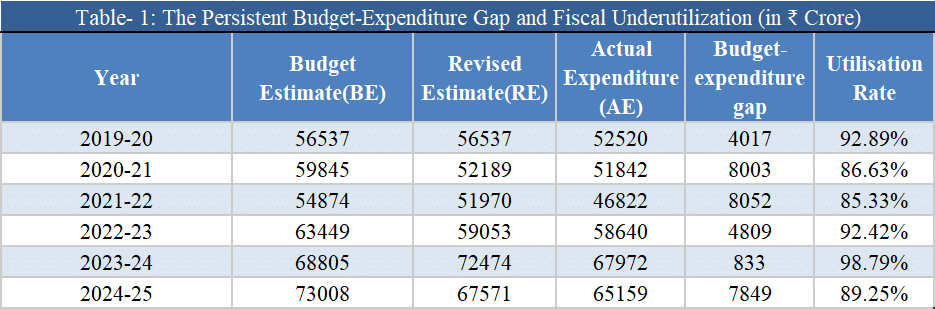
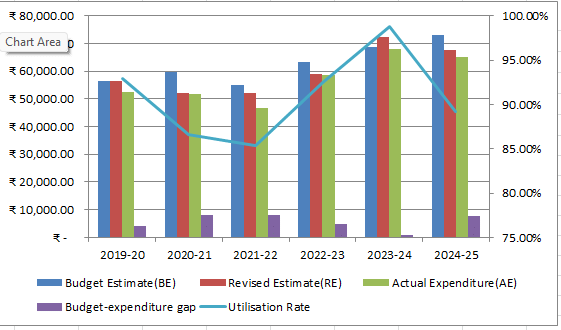
The data shows that from 2019-20 to 2024-25; education expenditure generally remained relatively close to the budget allocation. The utilization rate stayed above 85% in all years, indicating that a large proportion of the allocated budget was utilized. However, the gap between allocation and actual expenditure varied across the years.
Table- 1: The Persistent Budget-Expenditure Gap and Fiscal Underutilization (in ₹ Crore)
7.2. Education Financing in India (2019–2024): An Analysis of Centre-State Expenditure
7.2.1. Spending Against the NEP 2020 Target
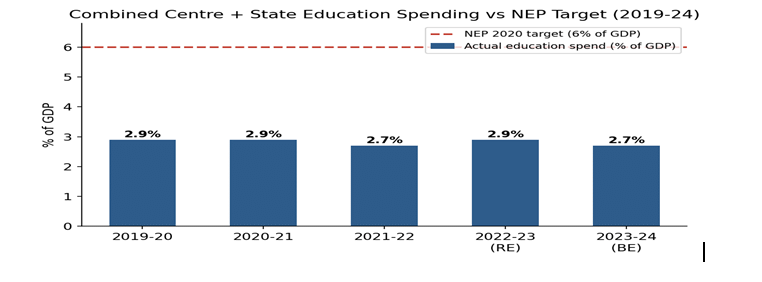
It has been seen by the joint efforts by the Central and State Government in the Education system had allocated around 6% of the GDP (Gross Domestic Product) but also Government have to see that the actual spending is much below the allocated budget.
7.2.2. Budget Allocated vs. Actual Expenditure (Centre)
The data shows that the Ministry of Education consistently spent less than its original budget allocation. The gap was particularly high during 2020–21 and 2021–22, when under spending was around 14–15%. The gap later reduced to around 5% from 2022–23 onwards, indicating an improvement in the utilization of the allocated budget.
Table- 2: Centre Expenditure
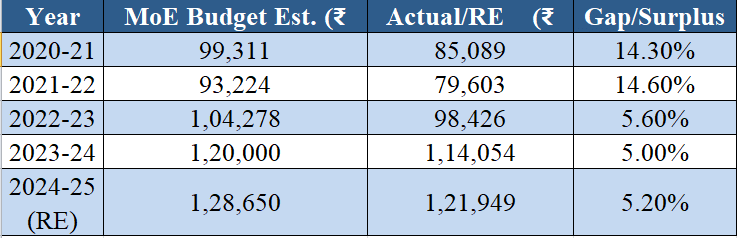
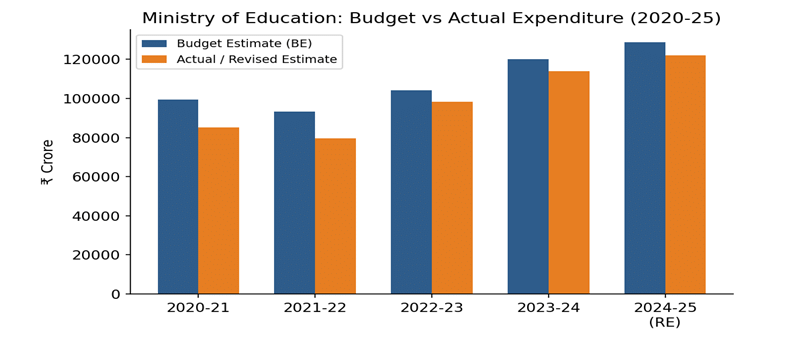
This shows that at the central level, the budget–expenditure gap was larger during the COVID-affected years and subsequently became smaller. Therefore, the data helps us to examine how the relationship between allocation and expenditure changed over time.
7.2.3. Budget Allocated vs. Actual Expenditure (States): The big states get big budgets and big gaps
The data shows considerable differences among states in terms of allocation and expenditure. Uttar Pradesh had the largest gap of ₹7,796.01 crore, followed by Bihar with ₹4,114 crore. However, these large gaps should also be understood in relation to their high overall budget allocations.
Table- 3: State Expenditure
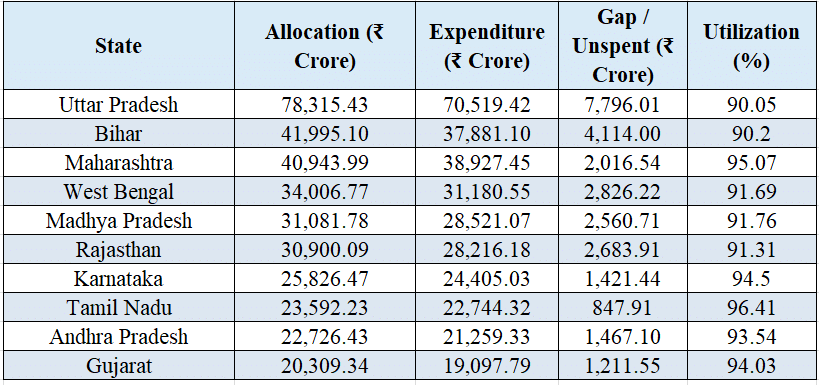
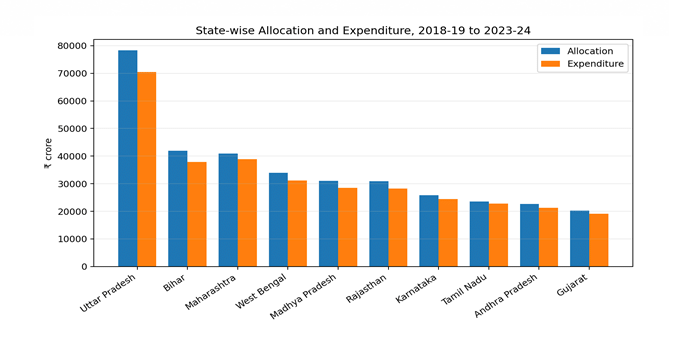
This comparison shows an important finding for our research: a higher budget allocation does not automatically mean better or worse utilization. Some states with comparatively large allocations were able to utilize a higher proportion of funds, while others showed relatively lower utilization.
7.2.4. Centre vs. State Share of Total Spending
States/UTs account for 89.3% of total public education expenditure, whereas the Centre accounts for 10.7% in 2022–23. Therefore, state-level allocation and utilization patterns are particularly important for understanding the overall gap between budget allocation and actual expenditure in the Indian education system.
Table- 4: Centre vs. State Share of Total Public Education Expenditure (2022-23)
7.3. Fiscal Bottlenecks and Educational Deficits: A Causal Analysis
7.3.1. The Macro-Financial Cause: Structural Imbalance
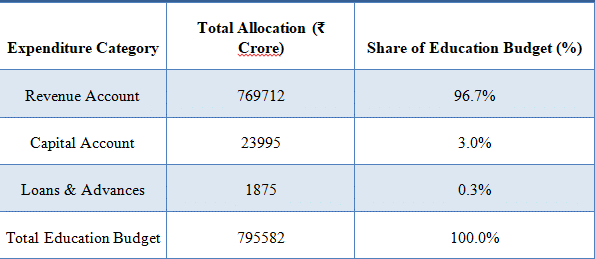
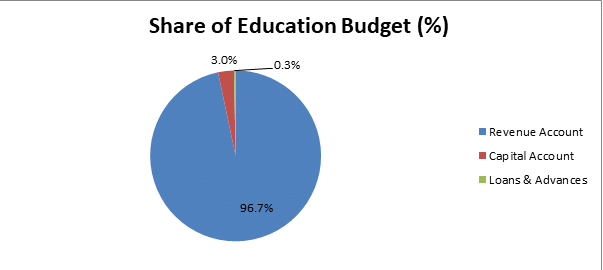
This data shows the Capital vs. Revenue Disparity: 96.7% (₹769,712 crore) of the budget goes toward recurring revenue expenses (salaries, pensions, and administration). and Capital Starvation: Only 3.0% (₹23,995 crore) is reserved for capital expenditure, leaving critical infrastructure upgrades (e.g., CWSN-compliant toilets, labs) unfunded.
Table- 5: Structural Imbalance in Public Education Financing (FY 2022–23)
7.3.2. Scheme-Level Bottlenecks: Utilization Failures
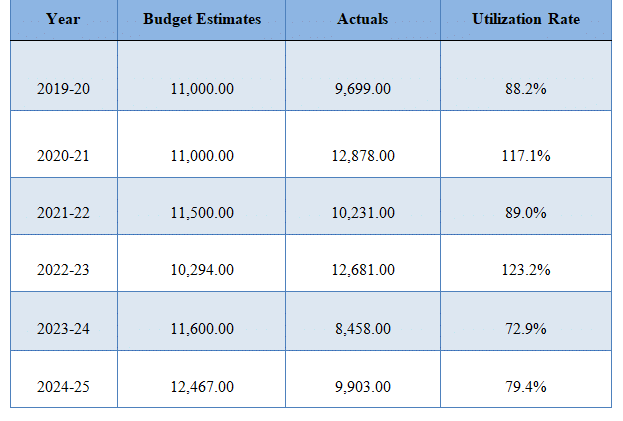
PM POSHAN Volatility
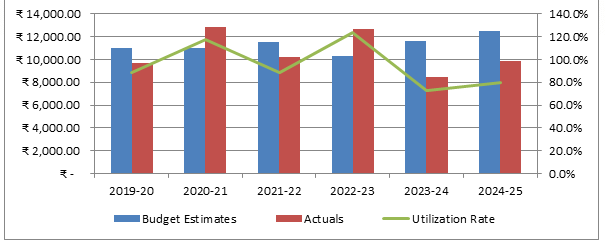
Budget execution fluctuates heavily, dipping to a 72.9% utilization rate in 2023-24 before recovering slightly to 79.4% in 2024–25.
Table- 6: PM POSHAN: Budget Estimate(BE) and Actuals (in Rs crore)
Samagra Siksha Abhiyan Underutilization
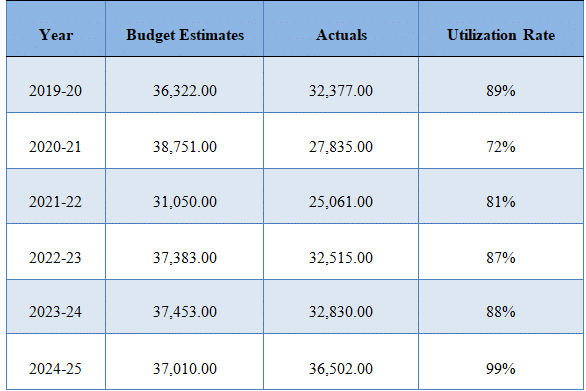
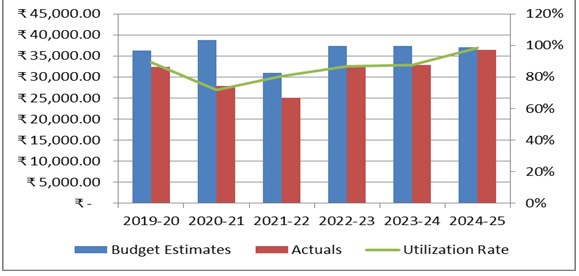
Persistent under-spending occurs across most years (e.g., 72% in 2020–21, 81% in 2021–22). Although it reaches 99% in 2024–25, multi-year spending gaps historically constrain long-term capacity building.
Table- 7: Samgra Siksha: Budget Estimate(BE) and Actuals (in ₹ crore)
7.3.3. The Input Deficits: Infrastructure, Digital, and Pedagogical
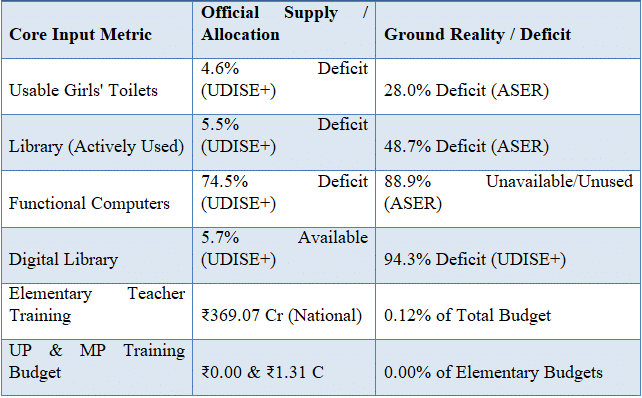
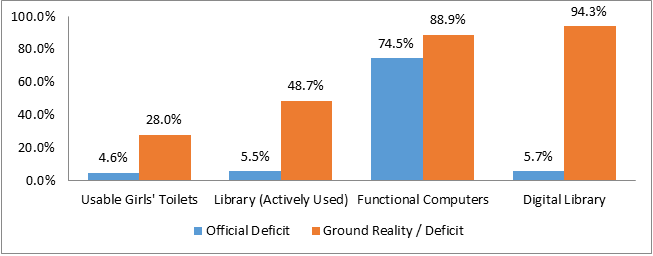
Infrastructure Gaps: Official UDISE+ metrics understate ground-level shortages compared to field assessments like ASER. Active libraries show a 48.7% deficit under ASER vs. a 5.5% deficit under UDISE+. Digital Infrastructure Deficit: Functional computers show a 74.5% to 88.9% gap/unavailability, and digital libraries face a 94.3% deficit. Pedagogical Neglect: Elementary teacher training accounts for only 0.12% (₹369.07 crore) of the total budget. Major states like UP and MP allocated 0.00% and ₹1.31 crore respectively toward elementary training.
Table- 8: Unified Input Deficits (Infrastructure & Pedagogical)
7.3.4. Human Outcomes: Learning, Enrolment, and Health
Gross Enrolment Ratio (GER) Educational Funnel (2019–2024)
Table- 9: Macro-Level Gross Enrolment Ratio (GER) Progression (2019–2024)
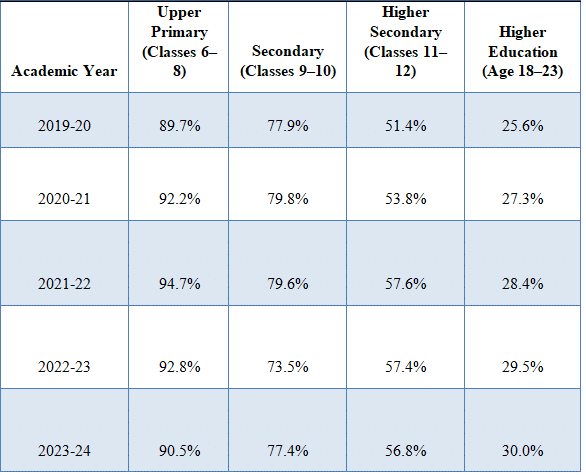
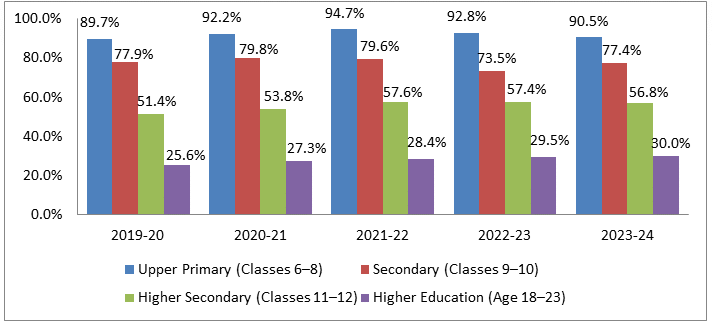
Upper Primary (Classes 6–8): Peak at 94.7% (2021-22), settling at 90.5% (2023-24). Secondary (Classes 9–10): Peak at 79.8% (2020-21), settling at 77.4% (2023-24). Higher Secondary (Classes 11–12): Peak at 57.6% (2021-22), settling at 56.8% (2023-24). Higher Education (Age 18–23): Increases continuously from 25.6% (2019-20) to 30.0% (2023-24).
8. Findings
- Indian education budgets shows generally high utilization, but the budget-expenditure gap fluctuates significantly across years, highlighting inconsistencies in covering allocation into actual expenditure.
- Despite consistently high utilization rates, the year wise budget expenditure gap fluctuated, with the smallest gap in 2023-24 and the highest in 2021-22.
- At the central level the budget expenditure gap was large during the COVID affected years and subsequently became smaller.
- The center state analysis shows that while the central gap declined after 2021-22, state level variations remain significant, with Uttar Pradesh and Bihar reporting larger gaps and Tamil Nadu, Maharashtra and Karnataka showing higher utilization; since States/UTs account for 89.3% of public education expenditure, their utilization is crucial to understanding India’s overall budget expenditure gap.
9. Discussion
Analyzing the budget-expenditure cycle reveals that India’s educational challenges are not simply the result of a funding shortage. The Indian education budget has been steadily increasing. Although official Budget Estimates grew by 29.13% (from ₹56,537 crore in 2019–20 to ₹73,008 crore in 2024–25), this growth coexists with execution hurdles and delays in fund utilization by the states. The data shows an average absorption of 85–90%; yet, ₹7,849 crore of funds remained unutilized as of 2024–25.
These findings align closely with the existing literature. As Sai Archana (2026) and Ravde (2026) noted, rising allocations are frequently constrained by administrative hurdles, delayed fund releases, and execution bottlenecks. The persistent gap between Budget Estimates and Actual Expenditure indicates that administrative and implementation challenges can prevent allocated resources from being fully translated into interventions at the ground level. This suggests that the challenge is not confined to the size of allocations but also concerns the institutional mechanisms through which resources are released, managed, monitored, and spent effectively. Although States and UTs account for 89.3% of total education expenditure, the scale of unspent funds varies considerably across states. For example, Uttar Pradesh utilized 90.05% of its total allocated budget, yet ₹7,796.01 crore remained unspent, illustrating how utilization gaps can result in substantial unspent amounts in large states. Additionally, flagship schemes such as PM POSHAN and Samagra Shiksha Abhiyan showed utilization gaps, leaving ₹3,142 crore and ₹4,623 crore unspent, respectively, as of 2023–24.
These fiscal bottlenecks coexist with significant physical, digital, and pedagogical deficits. With only 3% of the total education budget directed towards capital expenditure, the composition of public spending provides an important context for persistent infrastructure gaps. The discrepancy between UDISE+ administrative records, reporting a 5.5% library deficit, and ASER findings indicating a 48.7% deficit highlights differences between reported infrastructure availability and conditions observed through different data sources. Similarly, UDISE+ reports significant gaps in digital facilities, including internet access (36.9%), functional desktops (74.5%), and mobile phones (74.8%). In an era where information is increasingly accessible, educators are increasingly required to guide students in applying knowledge to real-world challenges. Yet, the Centre allocates only 0.12% of its elementary education budget towards teacher training, raising concerns regarding investment in pedagogical capacity. While schemes such as PM POSHAN are intended to support nutrition, attendance and school participation, uneven enrolment and progression patterns continue to coexist with these challenges.
To improve the education quality and better educational outcome, government should address both funding adequacy and utilization efficiency. First, the central government should increase the share of investment in education sector, focusing more on capital expenditure, more investment on schools infrastructure; including digital infrastructure and teachers training program- critical inputs for systemic reforms. These inputs need various activities like- stronger fiscal governance, effective release of funds, improved procurement, real-time monitoring of funds utilization and yearly teachers training. These activities will lead to various outputs like- better flow of funds from center to states, improved utilization of funds, increased teacher’s quality, quality infrastructure, equipped with better digital infrastructure for new age education. All these output will lead to mid-term outcome; better learning outcome, decrease under-utilization of funds for various government schemes, improved digital education and digital literacy, skilled teachers and increase quality of schools and colleges. At last these will lead to long arching goal of improving quality of education and achieve the Sustainable Development Goal (SDG) 4- Quality Education, which will strengthen the human capital for the country.
10. Conclusion
The study concludes that the gap between budget allocation and expenditure in the Indian education system is systemic and structural, rather than accidental. Despite the National Education Policy (NEP) 2020 proposes an educational targets of 6% of GDP, the combined spending of the Central and State governments rests stagnated at around 4.1% and even budgeted assets go underutilized — central under spending peaked at 14–15% during COVID (2020–22), narrowing to about 5% by 2023–25. States bear approximately 89% of total education spending and Centre accounts for the rest. Scheme-level statistics displays sharp variation: while school and higher learning utilization improved to over 90%, flagship programs like PM-USHA saw just 16% utilization, with vocational training and teacher-training mechanisms constantly lagging. The reasons – late fund reliefs, operational blockages, educator positions, and inadequate supervision; point to a power failure alongside the economic one. Disasters like the 2024 Bihar floods further strain allocated resources. At last, we can say that we have Budget-Expenditure Gap but it’s not exponential and also if we do effective implementation of various schemes and budget allocation then we can achieve overall education quality.
References
- Archana, (2026, March 31). Funds unspent: What India’s school education spending tells about learning gaps. BW Education. Retrieved September 21, 2026, from https://www.bweducation.com/article/funds-unspent-what-india-s-school-education-spending-tellsabout-learning-gaps-600146 (Archived at https://web.archive.org/web/2026/https://www.bweducation.com/)
- ASER Centre. (2024). Annual Status of Education Report (Rural) 2023: Beyond Basics. Pratham Education Foundation.https://asercentre.org/annual-status-of-education-report-rural-2023/
- Bite, D. M. (2024). Special issues on tribal culture, literature and language. Galaxy International Multidisciplinary Research Journal. https://share.google/ahYPNzwoJl21BZwTK
- Comptroller and Auditor General of India. (2024). Performance audit on Pradhan Mantri Poshan Shakti Nirman (PM POSHAN) in school education (Report No. 12 of 2024). Office of the Comptroller and Auditor General of India.
- Ghosh, J. (2025). Current status of inclusive education across Indian states after NEP 2020. Journal of Advance and Future Research, 3(12), 471–476. https://share.google/GD0autvSILTmWBrUS
- Hamini, Mulawarman, W. G., & Haryaka, U. (2025). Smart budgeting for future-ready schools: Strategies for efficiency and financial accountability in education funding. Journal of Pedagogy and Education Science, 4(2), 259–273. https://doi.org/10.56741/IISTR.jpes.00964
- Hota, S. P., & Acharya, S. K. (2023). Education infrastructure, expenditure, enrolment & economic development in Odisha, India. International Journal of Educational Development, 103, Article 102903. https://doi.org/10.1016/j.ijedudev.2023.102903
- Iqbal, M. A. (2026, May 24). Corruption in the education sector – An analysis. India Tomorrow. Retrieved September 21, 2026, from https://indiatomorrow.net/2026/05/24/corruption-in-the-education-sector-an-analysis/
- Kaur, N., & Vasundhra. (2022). Analysis of malpractices in the Indian education system. ResearchGate.
- Mehta, A. C. (2026, February 1). School education in the Union Budget 2026–27. Education for All in India. Retrieved September 21, 2026, from https://educationforallinindia.com/school-education-in-the-union-budget-2026/
- Ministry of Education, Government of India. (2020). National Education Policy 2020. Department of School Education & Literacy.
- Ministry of Education, Government of India. (2021). Samagra Shiksha: An integrated scheme for school education – Revised framework for implementation. Department of School Education & Literacy. https://samagra.education.gov.in/framework.html
- Ministry of Education, Government of India. (2023). Analysis of budgeted expenditure on education 2019–20 to 2021–22. Planning, Monitoring and Statistics Bureau.
- Ministry of Education, Government of India. (2024). Unified District Information System for Education Plus (UDISE+) 2023–24 annual report. Department of School Education & Literacy.
- Ministry of Finance, Government of India. (2025). Economic Survey 2024–25: Social infrastructure and employment. Department of Economic Affairs.
- Motkuri, V., & Revathi, E. (2024). Private and public expenditure on education in India: Trend over last 7 decades and impact on economy. Indian Public Policy Review, 5(1), 1–28. https://ippr.in/index.php/ippr/article/view/246
- Muralidharan, K., Das, J., Holla, A., & Mohpal, A. (2017). The fiscal cost of weak governance: Evidence from teacher absence in India. Journal of Public Economics, 145, 116–135. https://doi.org/10.1016/j.jpubeco.2016.11.005
- PRS Legislative Research. (2026). Demand for Grants analysis: Education 2026–27. PRS Legislative Research. https://prsindia.org/budgets/parliament/demand-for-grants-analysis-education-2026-27
- Ravde, C. H. (2026). Public expenditure on education in India: A systematic review of trends, patterns and impacts. International Journal for Multidisciplinary Research, 8(2), 114–128.
- Singh, A. (2025). Bridging the gender gap: Assessing India’s progress on girls’ education and sustainable development goals. ResearchGate.
- Swargiary, K., & Roy, K. (2024). A systematic review of the Samagra Shiksha Abhiyan: Evaluating access, quality, inclusivity, digital education, and implementation challenges. International Journal of Advances in Applied Sciences. https://share.google/xcvfwjIffgfkZAYpn
- Varanasi, R. A., Vashistha, A., & Dell, N. (2024). Saharaline: A collective social support intervention for teachers in low-income Indian schools. arXiv. https://doi.org/10.48550/arXiv.2402.14292
- Kundu, P. (2020). Inclusivity in School Education and the Budget: Case of Children with Disabilities. CBGA.https://share.google/lZOJAWhzCoLP3YBV3