Authors: Twinkle Chopra and Niharika Jha
Abstract
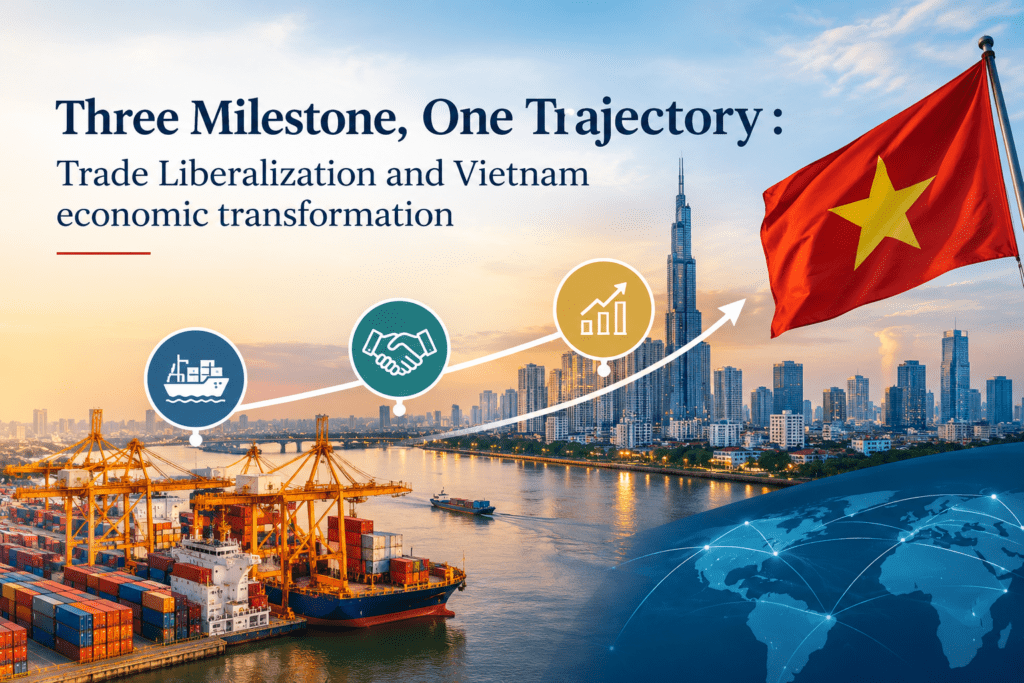
This study examined the relationship between trade agreement and volume influence in economic growth of Vietnam From 1986 to 2008, Vietnam rapidly evolved from one of the poorest and most closed economies to become one of Southeast Asia’s fastest-growing exporters and leading destinations for foreign direct investment. Vietnam’s ascent has typically been credited to greater integration with the international economy as a whole. But the timing and sequencing of Vietnam’s growth suggest that in reality development was predicated on a consecutive series of three trade-specific milestones that served distinct roles. The Đổi Mới economic reforms of 1986 ended legal restrictions on market entry; the 2001 US–Vietnam Bilateral Trade Agreement fueled export-led growth by offering preferential access to US markets; and accession to the World Trade Organization in 2007 consolidated trade gains via multilateral rules while diversifying Vietnam’s exports and sources of foreign investment. Using trade, GDP, and FDI statistics at each of these three critical junctures, I argue that each trade milestone served as a necessary platform for Vietnam’s subsequent economic takeoff by building domestic capacity and credibility for the next stage of development. Together they created a multiplier, rather than linear, effect on Vietnam’s development. This conclusion sheds light on how other developing economies might approach trade-oriented development strategies, especially as global manufacturing supply chains continue to reallocate internationally.
Key Words : FDI , International Trade , Economic growth , Vietnam
Introduction :
This paper works on how Vietnam’s economic condition has transformed from the effect of three milestones. The main aim of this report is to prove that the thesis of the three milestones of Đổi Mới (1986), US-Vietnam Bilateral Trade Agreement / BTA (2001), and the WTO Accession (2007) combined led to Vietnam having the highest real GDP Growth in Southeast Asia .
Đổi Mới (1986) led to economic reform by transforming a centrally planned economy into a market-oriented one that works for the customer rather than under government command. The direct impacts led to an increase in participation of private businesses, a reduction in barriers to trade, and FDI was invited into the domestic economy.
The US-Vietnam Bilateral Trade Agreement / BTA (2001) led to the foundation of a strong bilateral trade, where Vietnam was exposed to the opportunity to have a share in the world’s largest consumer market. The market was open with no to very few tariffs for Vietnamese exports. Earlier, the tariffs used to be around 40%, and after the trade, 3-4%.
The transformation studied in this report ranges from 1986 to 2008, which is around 22 years. We will be looking step-by-step from each major changes that took place between these years, we will be covering the beginning of the reunification of vietnam to the beginning of Đổi Mới (1986 ) to joining ASEAN/AFTA; WTO application initiated (1995 ) to signing of the US-Vietnam BTA (2000) to WTO accession all the way to 2025, the year which observed the highest real GDP growth, that is, 8%. The WTO diversified trade by transforming Vietnam into a multilateral, user-based system that attracted significant foreign investment, while the US-Vietnam BTA concentrated trade by paving the way for highly valued bilateral access to the world’s largest consumer market. After numerous incidents, Vietnam spent nearly two decades building its economy.
FDI provides capital sources, promotes technology transfers, improves the human business climate, and benefits the economy (Anwar & Nguyen, 2020; Hobbs et al., 2021). Exchange rates and their implications are crucial for transitioning nations (Ghosh et al., 2024; Weinshambang, 2010; Rose, 2011). Vietnam, with its rapid economic expansion in South Asia, offers a compelling case study.
Vietnam’s economic transformation is not merely a story of increased GDP or trade volumes; it is an example of how strategic policy reforms can reshape a nation’s economic future. The country’s success demonstrates that trade liberalization, when accompanied by institutional reforms and international cooperation, can create long-term economic resilience and global competitiveness. Vietnam has emerged as a major manufacturing and export hub in Southeast Asia, attracting multinational corporations and becoming an integral part of global supply chains. Its experience provides valuable lessons for developing economies seeking sustainable growth through economic integration and policy innovation.
Furthermore, Vietnam’s journey highlights the importance of balancing domestic economic priorities with international commitments. While economic liberalization has generated significant benefits, it has also presented challenges such as income inequality, dependence on foreign investment, and increased competition in domestic markets. Understanding both the achievements and challenges of Vietnam’s economic trajectory is essential for assessing the true impact of its trade liberalization policies.
The Vietnamese model illustrates that economic transformation is a gradual and multifaceted process. It requires not only access to international markets but also continuous policy adaptation, investment in human capital, and effective governance. As globalization continues to reshape the world economy, Vietnam’s experience offers meaningful insights for policymakers, researchers, and developing nations aiming to achieve inclusive and sustainable economic development.
In recent decades, Vietnam has been recognised as one of the fastest-growing economies in Southeast Asia. Its remarkable transition from a war-affected and economically isolated nation to a globally integrated economy has attracted the attention of economists and policymakers worldwide. Through consistent economic reforms and strategic trade policies, Vietnam has significantly improved its industrial output, export capacity, and living standards. The country’s ability to adapt to changing global economic conditions makes it an important case study for understanding the role of trade liberalisation in national development.
Economic transformation in Vietnam has not only influenced domestic markets but has also strengthened its position in international trade networks. The expansion of manufacturing industries, increased employment opportunities, and rising foreign investments have contributed to long-term economic stability. Moreover, Vietnam’s participation in regional and international trade agreements has enhanced its competitiveness in the global market, demonstrating how developing countries can successfully integrate into the world economy.
Vietnam’s experience further highlights that economic development is a continuous process that requires policy innovation, institutional support, and sustainable growth strategies. While trade liberalisation has accelerated economic progress, it has also created challenges that require effective governance and economic planning. By examining Vietnam’s transformation, this study aims to provide a comprehensive understanding of the opportunities and complexities associated with economic liberalisation in emerging economies.
Research question: “How did significant trade turning points ( Đổi Mới , the US- Vietnam BTA 2001, and WTO accession 2007 ) gradually after Vietnam’s growth trajectory into the modern era?”
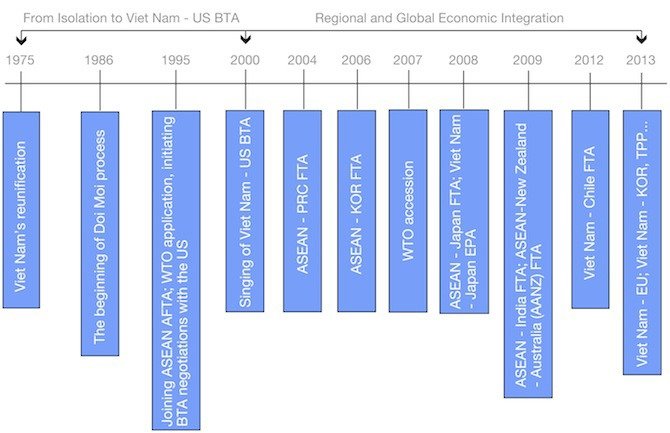
Source: Synthesized by the author, information available at wtocenter.vn and www.wto.org
Methodology:
Research Design of this research is quantitative descriptive research design. The main objective of this research is to understand the contribution of the three major trade milestones of Vietnam in its economic transformation- Đổi Mới Reforms (1986), US–Vietnam Bilateral Trade Agreement (2001), and WTO membership (2007). To achieve the objectives, government policies , reports related to trade development, FDI and economic growth and research papers and official secondary data are analysed, rather than conducting primary surveys or statistical modelling. This research follows a case study approach. It is using Vietnam as a case to understand how trade liberalization affects economic growth. This research is based on secondary data collected from :
- World Bank
- WTO
- General Statistics Office of Vietnam
- Government reports
- Published journal articles
- Research papers
This research covers the timeline between 1986 and 2008, which begins with Đổi Mới reforms and ends after Vietnam joined the WTO. Thematic analysis is used to analyse the information for this research. The analysis focuses on 3 themes:
- Đổi Mới reforms (1986)
- US–Vietnam Bilateral Trade Agreement (2001)
- WTO Membership (2007)
Each of them is analysed to understand its influence on:
- Trade expansion
- Foreign Direct Investment (FDI)
- Industrial development
- Export growth
- Economic growth
Literature Review:
Vietnam, with its rapid economic expansion in South Asia, offers a compelling case study. Over the past two decades, Vietnam has experienced significant economic transformations driven by trade liberalization, FDI, and exchange rate reform. This literature review aims to systematically identify and analyze existing research on these interrelationships in Vietnam and other countries during the same period.
The changes in Vietnam had been taking place from 1986 onwards. The economy of the country is always linked with external economic activity such as foreign investment and foreign trade. There have been many thinkers that have discussed different approaches. In this research results may not be completely consistent ,but the common point is that they both are interrelated to each other. Before the reforms of 1986, which resulted in multiple positive economic benefits, Vietnam was a war-torn, agrarian society( as earlier mentioned) recovering from decades of conflict. The two factors that led to the poor or worsening of conditions in Vietnam’s economy are 30 continuous years of war which led to the accumulation of physical and economic devastation and the latter were the economic model imposed after reunification to put Vietnam into crisis. The economic reform of 1986, became a turning point in the history of Vietnam.
Hieu Huu Nguyen’s study explores how foreign direct investment (FDI) and international trade influenced Vietnam’s economic growth from 2000 to 2018. It examines the relationship between trade and GDP growth, focusing on the positive impacts of FDI, exports, and imports. The regression model, using the Ordinary Least Square (OLS) method with secondary data, is expressed as GDP=β1+β2⋅FDI+β3⋅EXP+β4⋅IMP+u. Here, GDP stands for Gross Domestic Product, FDI for Foreign Direct Investment, EXP for exports, and IMP for imports.
Lee (2023), in his study, examined the impact of six major Free Trade Agreements (FTAs) on Vietnam’s economic transformation. He found that these agreements increased international trade and improved Vietnam’s export performance, he also explained that foreign-invested enterprises (FIEs) have mainly produced high-value products such as electronics and machinery , while state-owned enterprises (SOEs) have mainly focused on low-value-added products. Lee concluded that trade liberalization has contributed to Vietnam’s economic growth, but strengthening domestic industries and improving technological capabilities is important for long-term economic development.
After 2007, Vietnam’s economy continued to grow as international trade expanded, especially after joining the WTO. McCaig and Pavcnik (2018) examine how these trade changes are connected with employment patterns in the country. As exports increase and industries expand, more jobs are created in the formal sector, particularly in manufacturing and factory-based work. Many workers start moving from informal jobs, such as small-scale or unregistered work, to more stable and formal employment. This shift happens because trade liberalisation increases production demand and requires a more organised workforce. At the same time, foreign investment also increases as Vietnam becomes more open to global markets. This helps in creating more employment opportunities and improving working conditions. However, these changes are not equal for all workers, and some people in informal sectors may still face challenges. Overall, trade expansion is helping Vietnam to transform its labour market and strengthen its economic growth.
Vietnam joined the World Trade Organization (WTO) in 2007, which enabled it to connect and became a trade partner for the global community. Vietnam has entered into a number of free trade agreements (FTA) since then and is currently signatory to 17, bilateral and multilateral, active and planned Free Trade Agreements which covers more than 60 countries globally.
Between 1986 and 2008, Vietnam’s economic development was one of the most successful economic reforms in Southeast Asia. Before 1986, Vietnam followed a centrally planned economy in which the government decided what would be produced, how much would be produced, what the prices would be, and how much the country would trade with other countries. Due to this economic plan, the freedom of private businesses was very limited. Some problems included low productivity, high inflation, and limited international trade. To solve these problems, the Vietnamese government introduced Đổi Mới (Renovation) reforms.
This policy was introduced to convert Vietnam’s economy from a centrally planned economy to a market-oriented economy. To make this work, the government took some steps i.e. giving permission to private businesses, reducing government control over prices and production, allowing foreign direct investment (FDI), encouraging international trade and removing trade barriers. After transforming the economic system, Vietnam signed trade agreements with many countries. The government also promoted export-oriented industries like agriculture, textiles and garments, and manufacturing. By introducing these reforms, Vietnam’s economy became more connected to global markets and created a strong foundation for long-term economic growth. The reforms were successful, but the country still faced some challenges.
In 1986, Vietnam started increasing trade with other countries which increased its economy. Đổi Mới reforms played a crucial role in the country’s economic development. When exports increased on a large scale, the country earned more foreign exchange which helped it to increase its production, and reduced unemployment due to the increase in workload. Vietnam was not only exporting but also importing machinery, advanced technology, and raw materials. Imports helped factories with better machinery, production became faster and more efficient, and product quality was improved. In Vietnam, the cost of labour was low and there were business-friendly policies set by the government. Due to this policy, the country became a preferred destination for foreign direct investment (FDI). FDI is when a foreign company invests in a country and opens a factory or business. Many foreign investors established businesses in Vietnam which helped the country to grow its economy by increasing exports and giving employment. For example, Tran Nhuan Kien and Yoon Heo examined Vietnam’s economy from 1986 to 2005 and concluded that the Đổi Mới reforms contributed to increased economic growth, opened Vietnam to international trade, reduced poverty, and improved human development. However, they also stated that Vietnam faced several problems such as corruption, an underdeveloped banking system, and some businesses under the government’s control. The researchers pointed out that if these problems were not solved, they would slow down economic growth in the future. These findings show that trade liberalisation alone was not enough. Vietnam also needed institutional reforms for long-term development.
After 2007, Vietnam changed a lot as it began to trade internationally when it joined the WTO, which is not just to be a member of that organisation as Vietnam began making these economic changes when it began its reforms in 1986 and started exporting goods in a major way. Vietnam was to benefit from entering the WTO due to more trading opportunities for exports, and due to investor confidence of trading with Vietnam. This, along with more foreign investment helped Vietnam to export many more goods to other countries, and the total monetary amount from this investment increased substantially between 2007 and 2008. These were all factors that contributed to Vietnam being a country that exports and imports goods.
Overall joining of World Trade Organization in Jan. 2007, has been very successful in enhancing growth, reducing poverty and speeding up trade liberalization. Accession to the WTO, initiated multiple reforms and integration into the world economy. Between 2007-2019, there has been a slight decline in consolidated, agricultural and non-agricultural tariffs. Vietnam is committed to speed up its privatization programme. A wide set of multiple liberal policy measures makes Vietnam even more attractive to FDI for business environment, after the WTO accession. From 1990 to 2006, there has been a gradual shift in share of different sectors into the GDP, from agricultural leading to its lowest share, industry is the leading and largest sector of Vietnam. WTO membership has strengthened Vietnam’s position at global level while also demonstrating its strong presence to international economic integration.
Limitations or Challenges :
In order to draw strategic investors and encourage multinational corporations to invest in large-scale projects in Vietnam, Vietnam should have a number of exceptional preferential and international competitive policies. The reasons for the decline in Vietnam’s economy, one was the cost of the wars and international isolation that the US had cut off Vietnam western market, aid and investment .Vietnam signed a bilateral trade agreement (BTA) with the USA in 2000, leading to reduced tariffs on goods by the USA.
Conclusion:
Forecasts for Vietnam greatly underestimated the results and impact, had made so far. Trade agreements have both resulted in faster trade and growth. The whole process of WTO accession by Vietnam in 2007 and Doi Moi’s 1986 restructuring has generated rapid economic growth, increasing international trade and impressive poverty reduction. Understood the general role of trade in economic development. There also exist trade agreements which have not had a large impact but Vietnam’s success following bilateral agreements is rather presenting cases typically found across the developing world. The government changed its structures to reforms in trade and financial policies. Vietnam is also a founding member of the Comprehensive and Progressive Trans-Pacific Partnership (CPTPP) and a party to the recently concluded negotiations on the Regional Comprehensive Economic Partnership (RCEP). Vietnam is one of the fastest-growing countries in ASEAN and is estimated to continue growing at similarly strong rates. While also being geographically, one of the most vulnerable countries to get affected from climate change, it urges their government to protect the environment and biodiversity. Vietnam is the world’s fourth biggest producer of fish and aquaculture products making major contributions into trade. In terms of changed impact, sensitivities, effects of trade, further researches and agreements, also more closely would explore the impacts of FDI’s in future.
Acknowledgment:
This research paper is a result of the collective efforts of its members, we are really grateful for their writing and support throughout this journey. We would like to acknowledge all their efforts as it had added a lot more value to this research paper.
We express our gratitude towards Lavisha Bhuttan, Vanshika Sharma, Mantra and Roshni Prabhakar for their valuable contribution and analysis in writing this research paper.
We would also like to express our gratitude towards The International Institute of SDGs and Public Policy Research (IISPPR) for this wonderful opportunity, constant support and guidance throughout the whole internship.
References
https://www.isdp.eu/india-and-vietnam-forging-a-forward-looking-strategic-partnership/
Indo-Vietnam relation – Wikipedia indo Vietnam relation wiki
Research Gate https://share.google/SqUm37o7lSwAfrjk0
Joint Declaration 2007 on the strategy (Paragraph 15) joint declaration 2007 on the strategy Vietnam