
Authors:
1. W.V.N.Akshayasri
2. Ruchi Kolariya
3. Ayana N K
4. Hema Kiran Mallipudi
5. Koushani Pramanik
6. Ashika Jain
1. ABSTRACT
International trade has long been recognized as one of the most powerful engines of economic growth, allowing countries to exchange goods, services, technology, and capital in ways that boost productivity and raise living standards. This study looks at how trade agreements, trade openness, and trade volume relate to economic growth, drawing on both established theory and recent empirical evidence. The topic matters because nations are more dependent than ever on international trade to strengthen productivity, attract foreign investment, and improve overall economic wellbeing. Using secondary data from reputable international databases and published research, the study applies a quantitative approach, relying on statistical analysis to test the relationships between trade-related variables and growth indicators. The findings indicate that while trade openness and trade agreements are associated with economic performance, the relationship is not uniform across countries. Aggregate trends often mask substantial cross-country variation, suggesting that the economic impact of trade depends on factors such as institutional quality, economic structure, and policy effectiveness rather than trade openness alone. The study concludes that trade policy works best when it’s well-designed and consistently implemented, and that under those conditions, trade can contribute to long-term, sustainable development.
2. INTRODUCTION
Trade between nations has become one of the defining forces behind economic growth and structural change in the modern world. As economies have grown more interconnected, trade has opened the door to greater specialization, faster productivity gains, technology diffusion, and access to markets that would otherwise be out of reach (Frankel & Romer, 1999; Grossman & Helpman, 1991). When countries lean into their comparative advantages and plug into global value chains, the result is typically a more efficient allocation of resources and stronger overall economic performance.
None of this is new territory for economists. Ricardo’s (1817) theory of comparative advantage laid the groundwork by showing that countries gain when they specialize in what they can produce at the lowest opportunity cost. The Heckscher–Ohlin model built on this by explaining trade patterns through differences in factor endowments (Heckscher & Ohlin, 1991), and more recent endogenous growth theory has added another layer arguing that trade fuels long-run growth through innovation, knowledge spillovers, and R&D-driven technological progress (Romer, 1990; Grossman & Helpman, 1991).
Trade agreements are formal arrangements between two or more countries designed to reduce barriers like tariffs and quotas, making cross-border business easier and more predictable. Common forms include Free Trade Agreements (FTAs), Regional Trade Agreements (RTAs), and Preferential Trade Agreements (PTAs). Over the past few decades, globalization has driven a sharp rise in the number of these agreements, and their scope has expanded well beyond tariffs now covering services, digital trade, intellectual property, competition policy, environmental standards, and labor rules (World Trade Organization, 2023). This broader coverage has turned regional trade blocs into major players in global trade and investment flows.
Two indicators are typically used to measure how deeply a country engages with the global economy: trade volume, which is simply the total value of exports and imports, and trade openness, usually calculated as total trade relative to GDP. Higher openness tends to go hand-in-hand with stronger competition, more technology transfer, greater foreign direct investment, and productivity improvements (Sachs & Warner, 1995; Dollar & Kraay, 2004). But openness isn’t without risk; it can also leave economies, especially developing ones with weaker institutions, more exposed to external shocks and financial volatility.
The empirical picture, however, is far from settled. Frankel and Romer (1999) found that trade meaningfully lifts income levels, and Dollar and Kraay (2004) credited globalization with driving substantial growth across many developing economies. Others push back on this narrative Rodríguez and Rodrik (2001) challenged the strength of the earlier evidence, suggesting the trade-growth link hinges heavily on institutional quality and macroeconomic stability rather than trade alone. More recent work echoes this, pointing out that the payoff from trade liberalization depends on governance, infrastructure, financial market development, and human capital (Freund & Ornelas, 2010; World Bank, 2020).
There’s also disagreement over which types of trade agreements actually work best. Deep agreements that include investment rules and regulatory cooperation tend to generate bigger productivity gains than shallow ones focused mainly on cutting tariffs. And regional agreements carry their own trade-off: they can create trade by displacing inefficient domestic production, but they can just as easily divert trade away from more efficient countries outside the bloc leading to welfare effects that are genuinely mixed (Viner, 1950; Baier & Bergstrand, 2007).
Despite the volume of research in this area, relatively few studies bring trade agreements, trade openness, and trade volume together in a single analytical framework and this is the gap the present study aims to fill. The goal here is to examine how these three factors relate to economic growth, whether different types of trade integration produce different growth outcomes, and how institutional quality shapes these relationships. Using secondary data and appropriate statistical methods, the study aims to offer evidence that’s useful not just academically, but practically for policymakers trying to design trade policy that actually delivers sustainable, long-term growth.
3. LITERATURE REVIEW
3.1 Overview
International trade plays an important role in economic growth and development. With increasing globalisation, countries have adopted trade agreements and policies to improve market access, promote exports, attract investment, and strengthen their position in the global economy. However, studies show mixed results regarding the effects of trade liberalisation and regional integration, with outcomes varying across countries due to differences in economic conditions, institutions, policies, and time periods.
The literature review is divided into four major themes to examine these relationships and provide the conceptual and empirical foundation for the present study.
3.2 Trade Agreements and Trade Performance
The expansion of global commerce has been closely associated with the growth of international trade and the increasing use of trade agreements. Trade agreements reduce trade barriers, improve market access, encourage investment and innovation, and can support economic growth. By the early 2000s, Regional Trade Agreements (RTAs) had become an important part of the global trading system. The European Union (EU), NAFTA, MERCOSUR, and ASEAN together accounted for approximately 57% of world exports and 63% of world imports (Matsushita, 2010).
The importance of trade agreements is supported by classical trade theory, which emphasises specialisation and comparative advantage. Countries can focus on goods and services they can produce relatively efficiently and trade for others. For example, within ASEAN, countries such as Vietnam and Cambodia have specialised in labour-intensive industries, while Singapore and Malaysia have developed more capital-intensive sectors such as electronics and financial services. The reduction of intra-regional tariffs through AFTA has helped these differences in comparative advantage contribute to increased trade among member countries (Plummer et al., 2011).
The rapid growth of RTAs since the early 1990s has also raised questions about their role in the multilateral trading system. While regional agreements were initially viewed as a way of supporting gradual trade liberalisation, their increasing number has raised concerns about fragmentation and coordination difficulties. Modern trade barriers also include regulatory standards, investment rules, and non-tariff measures, which can sometimes be addressed more easily through regional agreements than through multilateral negotiations (Pal, 2004). Bhagwati (1993), Panagariya (1996), and Bergsten (1996) also associate the expansion of regionalism with changes in the United States’ approach to international trade policy. For developing economies, regional agreements can additionally provide greater bargaining power in the international trading system (Pal, 2004).
Viner’s (1950) concepts of trade creation and trade diversion provide an important basis for assessing the effects of RTAs. Trade creation occurs when lower-cost imports from member countries replace inefficient domestic production, while trade diversion occurs when imports shift from more efficient non-member countries to less efficient member countries because of preferential treatment. Therefore, the economic effects of an agreement depend partly on whether it creates new and efficient trade or mainly diverts existing trade.
Empirical studies have produced mixed results regarding the relationship between trade agreements and economic growth. Hur (2012) finds that FTAs do not have a statistically significant effect on economic growth and reports increasing differences in per capita GDP growth among member countries. This suggests that the benefits of integration may not be equally distributed. However, the study mainly captures relatively short-term changes in growth and may not fully reflect benefits that develop over a longer period.
In contrast, Grossman and Helpman (1991) and Feenstra (1996) argue that trade agreements can support long-term growth through technology diffusion, knowledge spillovers, and improvements in productivity. These effects generally take time to develop and may differ across countries depending on their ability to absorb new technologies. Thus, the different findings may partly result from differences in the time period considered and the way growth effects are measured.
Liu (2016) provides another explanation for these differences by showing that the impact of RTAs depends on WTO membership. According to the study, RTAs have stronger growth effects for non-WTO members because they provide these countries with additional market access. For WTO members, the additional benefits may be smaller because they already receive wider trade liberalisation through WTO commitments. This suggests that the effect of an RTA also depends on the level of trade openness that existed before the agreement.
Trade performance is also affected by infrastructure and logistics. Wang and Choi (2018) find that improvements in the Logistics Performance Index (LPI) increase export volumes, with stronger effects in developed economies. Efficient customs, transportation, and cargo-tracking systems can therefore determine how effectively countries use the market access created by trade agreements.
Overall, the literature shows that trade agreements can increase trade, but their effects on economic growth vary across countries and circumstances. Differences in trade creation and diversion, time periods, WTO membership, institutional capacity, technology, and logistics can influence the results. Therefore, the mixed findings in previous studies suggest that the impact of trade agreements should be examined in relation to the conditions under which they operate. These factors provide the basis for the present study.
3.3 Trade Openness and Economic Growth
The relationship between trade openness and economic growth remains contested. Although greater integration can expand market access, facilitate investment and technology transfer, and improve productivity, empirical findings vary across countries depending on development level, institutional quality, domestic policies, and research methods.
Yanıkkaya (2003), examining developed and developing countries using alternative measures of openness, found that greater trade intensity was generally associated with stronger economic performance. However, the study also found that trade barriers could be compatible with growth, particularly in some developing-country contexts. This challenges the assumption that trade liberalisation necessarily produces higher growth and indicates that the effects of trade policy depend on domestic economic conditions.
In contrast, Karras (2003), using panel data covering more than 100 countries over several decades, found a positive and statistically significant long-run relationship between trade openness and real GDP per capita growth. The study estimated that a 10-percentage-point increase in openness was associated with approximately a 0.25–0.30 percentage-point increase in growth, linking the relationship to productivity, investment, and technology transfer.
The difference between these findings is important. While Karras (2003) identifies positive long-run effects, Yanıkkaya (2003) demonstrates that protection may also be associated with growth under particular conditions. Differences in country composition, measures of openness, development levels, policy environments, and estimation methods may explain these contrasting results. Thus, the literature does not support a uniform effect of liberalisation across economies.
More recent studies further qualify this relationship. Sowrov (2024) reports a positive relationship between openness and growth in 11 G20 countries while also identifying domestic investment and other economic factors as important contributors. Nguyen and Bui (2021) find a positive but nonlinear relationship in six ASEAN economies, with the contribution of additional openness declining beyond certain thresholds. Çevik, Atukalp and Korkmaz (2021) similarly find that the benefits of openness are stronger in developed economies. Collectively, these findings suggest that the effects of trade openness depend on the conditions under which economies integrate into international markets.
This body of literature is particularly relevant to the present study, which examines 15,104 country-year observations covering 267 countries and territories from 1960 to 2024. The diversity of the sample provides a basis for examining whether the relationship between trade openness and GDP growth is consistent across countries and periods.
3.4 Regional Integration and Economic Performance
The relationship between regional integration and economic growth is supported by classical, neoclassical, and modern growth theories. Adam Smith and David Ricardo emphasised specialisation and comparative advantage, suggesting that reducing trade barriers allows countries to focus on industries in which they are relatively more efficient. New Trade Theory, associated with Paul Krugman, further explains that integration expands market size and allows firms to achieve economies of scale by serving a larger regional market. Endogenous growth theories developed by Romer and Lucas also suggest that integration can support long-term growth through technology transfer, knowledge spillovers, human capital, and Foreign Direct Investment (FDI). A larger market may also encourage firms to invest more in research and development, contributing to productivity and innovation (Krugman et al., 2018).
However, empirical studies do not provide a uniform conclusion about the effects of regional integration. Schiff and Winters (2003), in a World Bank study, find that regional integration can improve economic performance and contribute to long-term development through increased trade and economic cooperation. This supports the view that removing trade barriers can encourage specialisation, competition, and productivity improvements.
Other studies suggest that the benefits of integration depend on the conditions within member countries. Strong institutions, infrastructure, policy stability, and productive capacity can influence how effectively countries benefit from increased market access. More developed members may gain greater benefits because they are better equipped to compete in larger markets, while less developed members may struggle to adjust to increased competition. As a result, integration can sometimes produce uneven outcomes instead of convergence between member economies. These differences in economic capacity help explain why studies based on different regional blocs can reach different conclusions.
The depth of integration is another factor that can influence economic outcomes. Earlier regional agreements mainly focused on reducing tariffs and other border barriers, while newer agreements increasingly cover services, investment, regulatory standards, and competition policy. Mattoo et al. find that deeper agreements generate greater trade creation and less trade diversion than shallow agreements. This suggests that the effects of integration may depend not only on whether an agreement exists but also on the areas it covers. The growth effects of newer and deeper agreements may therefore differ from those of earlier agreements that focused mainly on tariff reductions.
The increasing number and scope of preferential trade agreements also reflects this shift towards deeper integration. The number of PTAs increased from 20 in 1990 to 279 in 2015, while their coverage expanded to include a wider range of economic policies (Pal, 2004). Therefore, differences in the depth of agreements, economic development, institutional capacity, and infrastructure can help explain the mixed findings in the literature.
Overall, regional integration can support economic performance through increased trade, larger markets, investment, technology transfer, and productivity improvements. However, these benefits are not equally experienced by all countries. The economic conditions of member states and the depth of integration are important in determining the outcomes of regional integration. These factors are therefore relevant to understanding the relationship between regional integration and economic performance in the present study.
3.5 Comparative Analysis and Synthesis of Literature.
The literature indicates that international trade does not produce uniform economic outcomes. Differences among studies can be explained by variations in time horizon, development level, institutional capacity, type of integration, and domestic economic conditions.
Viner’s (1950) distinction between trade creation and trade diversion provides a theoretical basis for understanding these differences. Trade creation can improve efficiency by replacing relatively costly domestic production with lower-cost imports from partner countries, whereas trade diversion can shift imports away from more efficient non-member producers. Therefore, increased trade following an agreement does not necessarily imply equivalent economic benefits.
This helps explain differences in empirical findings. Hur (2012) finds that free trade agreements do not necessarily generate significant improvements in economic growth, whereas Grossman and Helpman (1991) and Feenstra (1996) emphasise longer-term benefits through technology diffusion, knowledge spillovers, and productivity improvement. The difference may partly reflect time horizons, since trade flows can respond relatively quickly while investment and productivity effects may emerge over longer periods.
Similar differences appear in the trade-openness literature. Karras (2003) identifies a positive long-run relationship, while Yanıkkaya (2003) finds that trade barriers may also be compatible with growth in particular developing-country contexts. Nguyen and Bui (2021) identify nonlinear effects, while Çevik et al. (2021) show that benefits vary according to development level. These differences indicate that the effect of openness depends on the conditions within which international integration takes place.
Institutional capacity and infrastructure provide further explanations. Economies with stronger institutions, productive capacity, and infrastructure may be better positioned to convert international market access into productivity gains. Wang and Choi (2018) similarly demonstrate the importance of logistics performance for export activity, suggesting that reducing trade barriers may have limited effects where transport, customs, and logistics systems remain inadequate.
The synthesis is directly relevant to the present study, which analyses 15,104 country-year observations from 267 countries and territories over 1960–2024. The Pearson correlation coefficient of r = 0.012 indicates an extremely weak positive linear association between trade openness and GDP growth at the aggregate level. Positive relationships observed in particular countries or over longer periods may be obscured when economies with different institutional capacities, development levels, and economic structures are pooled together. The correlation therefore represents a statistical association rather than a causal effect.
Overall, the literature indicates that the relationship between trade openness and economic growth is conditional rather than universal. Differences in development levels, institutional capacity, economic structure, integration strategies, and time horizons help explain why empirical studies report different outcomes. This provides a basis for interpreting the present study’s aggregate findings within the broader context of heterogeneous trade-growth relationships
4. RESEARCH METHODOLOGY
The above study is based on secondary data. It was collected from the World Bank’s World Development Indicators (WDI). The dataset contains annual observations on GDP growth and trade openness (measured as trade as a percentage of GDP) for 267 countries and territories over the period 1960 to 2024. After the data cleaning, the data consisted of 15,104 country observations with no potential missing values.
The main objective of this study is to understand the impact of international trade on the economic growth of the countries while simultaneously understanding the broader concept of the role of international trade and agreements. Since direct information on trade agreements was not available in the dataset, the analysis interprets their impact through long-term changes in global trade openness and major historical developments such as the expansion of GATT, the establishment of the WTO, regional trade agreements, the 2008 Global Financial Crisis, and the COVID-19 pandemic.
The study uses four key variables, Country, Year, GDP Growth (annual %), and Trade (% of GDP). These variables were selected to analyse the distribution of economic growth , to compare trade openness across countries,to identify long-term global trends, and examine the statistical relationship between trade and economic growth.
The dataset was analysed using Python 3 in Google Colab. Data loading, cleaning, and processing was done using the Pandas library, whereas statistical visualization was done using Matplotlib and Seaborn libraries. Followed by descriptive statistical techniques including summary statistics, frequency distributions, and trend analysis that were employed to understand the characteristics of the data. Pearson’s correlation coefficient was calculated to measure the relationship between trade openness and GDP growth across all observations.
Graphical representations, including histograms, scatter plots, line charts, correlation heatmaps, and bar charts, were used to visualise the distribution of the variables,further analysis of their relationships, identify long-term trends, and compare trade intensity across countries. These visualisations complemented the statistical analysis by facilitating a clearer interpretation of patterns and trends observed in the dataset.
The analysis focuses on identifying trends, patterns, and relationships between trade openness and economic growth instead of proving a cause-and-effect relationship. This provides a better understanding of how international trade has influenced economic growth across countries over the last six decades.
5. DATA ANALYSIS
5.1 How Is GDP Growth Distributed?
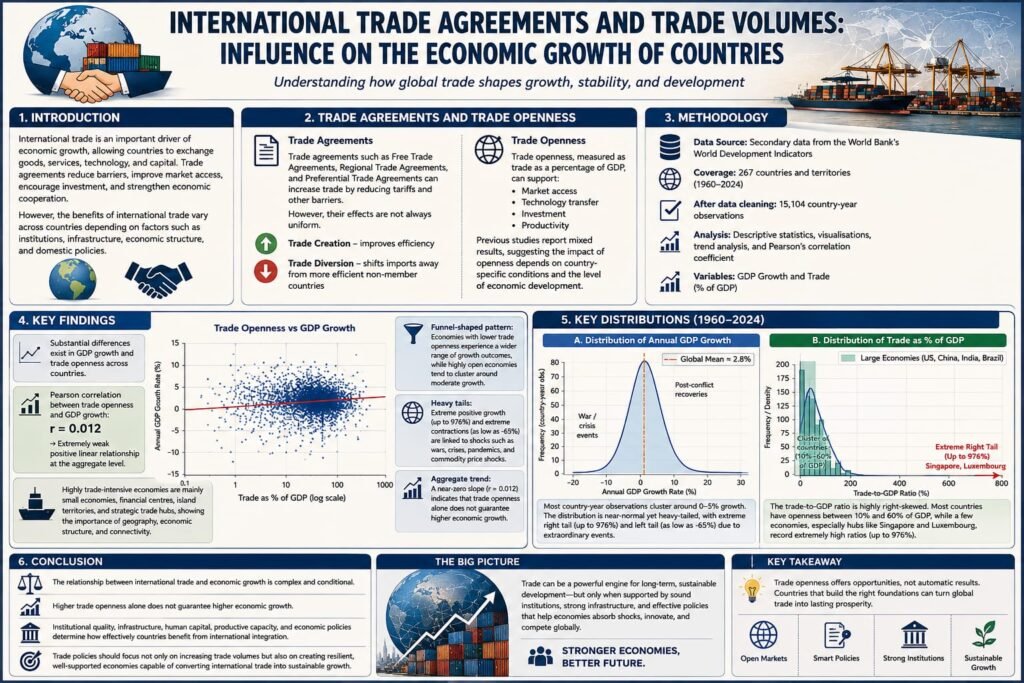
The above graph shows the shape of global GDP growth. Most country year observations are clustered around 0-5% growth, forming a tall peak in the centre like a leptokurtic distribution, a pattern broadly consistent with economies that have matured enough to grow along a stable long-run trend rather than swing sharply from year to year.
The observation concludes heavy tails on both sides. The right tail is showing extreme higher Annual GDP growth rate owing to episodes like Kuwait’s post-Gulf War recovery and Equatorial Guinea’s oil-led boom, where growth rate had temporarily gone as high as 50%. Conversely, the left tail captures severe contractions reaching an annual growth rate as low as -65%. This negative number is often associated with small island economies or war-torn nations in the grip of acute economic crises like South Sudan’s internal conflict and disruptions to oil production or Syria’s prolonged Civil War or Maldives’ due to COVID-19. These observations suggest that while the world’s average GDP growth is moderate and relatively stable, individual countries’ growth trajectory could be dramatically different due to extraordinary events such as wars, pandemics, conflicts, natural disasters, or commodity price shocks.
The near-normal yet heavy-tailed distribution of GDP growth demonstrates that averages can be misleading. Although most countries experience moderate growth, outlier events like wars, pandemics or resource discoveries can alter a country’s economic trajectory that global averages can’t capture. Notably, the countries driving these extreme values tend to share a common structural feature: a narrow economic base, whether built around a single export commodity, a small domestic market, or limited institutional and fiscal buffers, that leaves them with little cushion when such events occur. Diversified, larger economies rarely appear in either tail, which suggests that economic structure, not just the nature of the shock itself, shapes how extreme a country’s growth outcome becomes.
5.2 How Trade-Open Are Most Economies?
The trade-to-GDP ratio serves as the working measure of openness: total exports plus imports, set against GDP. A crude instrument. But a functional one, in that it reflects how much of a country’s economic output moves across a border rather than staying home.
The distribution across countries skews right, and skews hard. Most nations land somewhere between 20% and 60% of GDP; ordinary exposure, nothing remarkable. A small cluster departs from that range entirely, climbing to ratios near 870% of GDP. That cluster produces the tail.
Size explains much of the split. The United States, China, India, Brazil, these sit low on the ratio not from trading sparingly but from possessing domestic markets large enough to absorb most of their own output. Trade happens at scale in each case; it simply gets diluted by the size of the base against which it’s measured.
Singapore, Luxembourg, Djibouti occupy the far end, and for the mirror reason. Domestic demand cannot sustain these economies alone, so trade becomes structural rather than incidental. Singapore functions as a logistics node. Luxembourg, a financial one. Djibouti sits astride a shipping corridor near the Bab-el-Mandeb Strait, and that geography does most of the explanatory work.
Size, location, structure, these three variables account for more of the pattern than trade policy does on its own. Economists call this a market-size effect: a large internal market absorbs its own demand without crossing borders, so trade’s share of GDP contracts even while its absolute value expands. Small economies get no such cushion. Limited internal demand forces specialization, exporting a narrow slice of goods, importing the remainder, and that specialization pushes the ratio upward almost automatically. The skew follows from this logic, not from any policy variable at all.
5.3 The Funnel Effect: Trade vs. GDP Growth
A scatter plot of trade openness against GDP growth across all 15,104 observations does not show the upward-sloping relationship one might expect. Instead, it produces something closer to a funnel. At low trade openness (0–100% of GDP), growth outcomes are scattered widely, from severe contractions to sharp booms. As trade openness rises, that spread narrows considerably, and highly trade-open economies end up clustered tightly around a modest 0–5% growth. Fitting a regression line to this data yields a correlation of just r = 0.012, essentially negligible in linear terms.
Taken at face value, a coefficient this close to zero could be read as trade having little to do with growth. But that reading misses what the funnel shape is actually telling us. A near-zero slope is really an averaging effect, one that flattens out a real pattern sitting in the variance rather than the mean. Trade openness does not seem to push average growth up so much as it narrows the range of possible outcomes. That fits with the idea that economies plugged into diverse export markets and global value chains are better cushioned against domestic shocks, while economies trading very little are left more exposed to whatever conflict, commodity swing, or local disruption comes their way.
Correlation on its own, then, can understate trade’s role whenever the real relationship runs through volatility rather than through the average. It is a distinction worth testing directly in future work, using growth volatility itself as the outcome variable.
5.4 Correlation Matrix
A Pearson correlation analysis was conducted on 15,104 country-year observations spanning 267 countries between 1960 and 2024, testing the relationship between GDP growth and trade openness, measured as trade (exports plus imports) as a percentage of GDP.
The result: r = 0.012. At the aggregate level, this is close enough to zero to say the two variables show almost no linear relationship year to year, once every country and every year get pooled into a single figure.
That should not be read as proof that trade openness has no bearing on growth. A more likely explanation is that the relationship varies too much by country, behaves non-linearly, and depends on conditions specific enough to particular economies that no single global coefficient could capture it. A few factors probably contribute to this.
Pooling 267 economies into one dataset flattens real differences across income levels, regions, and economic structures. Trade openness in all likelihood affects growth differently depending on whether an economy is advanced or developing, and averaging the two together tends to erase both signals rather than reveal either one.
There is also a timing problem. Trade liberalization pays off gradually, through investment, productivity gains, and technology transfer, over years rather than within a single fiscal cycle. Annual growth figures may simply be too narrow a window to register what increased openness eventually delivers.
Reverse causality complicates matters further. Growing economies import more and become more competitive exporters, which means growth generates trade about as readily as trade generates growth. That feedback loop works against any clean, one-directional correlation.
Economic size distorts the picture too. The United States, China, and India post relatively low trade-to-GDP ratios despite driving a large share of global growth, while small, highly open economies show no reliable growth premium as a result of that openness. This asymmetry alone can pull an aggregate correlation toward zero.
One pattern in the underlying scatter data is worth noting regardless: economies with higher trade openness tend to show less volatility in growth, a funnel-shaped pattern rather than a linear one. This suggests trade openness may do more for growth stability, through export diversification and deeper integration into global value chains, than for raising short-term growth rates across the board.
A coefficient of 0.012 is a starting point, not a conclusion. It says little about causality, timing, or the structural differences between economies, and a bivariate correlation of this kind was never built to capture those dynamics. Isolating the actual relationship between trade and growth would require panel-data analysis with appropriate control variables, work that falls outside the scope of a simple correlation matrix.
5.5 Six Decades of Trade and Growth
Global trade volume, as a share of GDP, rose from roughly 65% in 1960 to nearly 95% by 2008, five decades of near-uninterrupted climb, the kind of trajectory globalization textbooks like to point to. Then 2008 hit. The climb broke. Trade volume fell sharply under the financial crisis; the 2010s brought recovery, but a slow one, grinding rather than sharp. A second blow landed in 2020 — COVID-19 shredded production networks and supply chains across the globe. Trade has since climbed back, 2022 through 2024, though it still sits below its pre-crisis high. That gap matters. It points toward integration proceeding at a duller pace going forward.
GDP growth follows nearly the same contour, dipping at the identical two moments: the crisis, the pandemic. Co-movement during shocks. The data leaves little doubt on that point. Yet this pattern does not translate into a strong relationship overall — the Pearson correlation across the full dataset lands at a mere 0.012, a figure that erases almost everything the crisis years seem to suggest. What the crisis-period alignment more plausibly reveals is trade acting as a transmission line, a route through which external shocks travel into domestic economies, rather than any consistent engine driving growth under ordinary conditions.
5.6 The Most Trade-Intensive Economies in the World
Rank countries by average trade-to-GDP ratio across 1960–2024, and the resulting list bears little resemblance to a ranking by export volume. Intensity is not scale. One measures reliance relative to economic size; the other measures raw trading muscle.
The top ten, Djibouti, Singapore, San Marino, the U.S. Virgin Islands, Hong Kong SAR, Luxembourg, American Samoa, Bahrain, Macao SAR, Guyana, share a profile: city-states, island territories, financial centers, transit points. Small economies. Large trade flows relative to their own size.
Singapore and Hong Kong SAR built their positions on port infrastructure, liberal trade regimes, and deep supply-chain integration. Luxembourg and Bahrain owe their standing to financial-center status more than to physical goods trade. Djibouti’s position near the Bab-el-Mandeb Strait turned geography into economic function, regional shipping, re-export activity. Guyana breaks the pattern entirely; its recent climb traces almost wholly to expansion in its oil sector.
Structure, geography, network integration, these explain the ranking far better than raw trading success does. Small economies post extreme ratios because their domestic markets are limited, not because they outperform larger economies at trade itself. That distinction, intensity against scale, explains why high openness fails to translate proportionately into higher growth; it explains, too, why the aggregate correlation between the two variables stays as weak as it does.
| Rank | Country / Territory | Avg. Trade (% GDP) | Economic Characteristic |
| 1 | Djibouti | 335% | Strategic Horn of Africa port and re-export hub |
| 2 | Singapore | 330% | Global entrepôt; world’s busiest container port |
| 3 | San Marino | 323% | Landlocked microstate embedded in Italy’s economy |
| 4 | Virgin Islands (U.S.) | 298% | Oil refinery and tourism-driven trade flows |
| 5 | Hong Kong SAR | 258% | Asia’s premier financial and trade gateway |
| 6 | Luxembourg | 235% | EU financial hub with large financial services exports |
| 7 | American Samoa | 200% | U.S. territory; tuna canning dominates exports |
| 8 | Bahrain | 170% | Gulf financial centre and oil transit point |
| 9 | Macao SAR | ~168% | Gaming & tourism-driven services exports |
| 10 | Guyana | ~165% | Recent oil discovery dramatically boosted trade flows |
6. DISCUSSION
The funnel pattern in Figure 5.3 suggests that the relationship between trade openness and GDP growth is reflected more in the distribution and volatility of growth than in average growth rates. Economies with lower levels of trade openness show wider variations in GDP growth, while more open economies appear to cluster around relatively moderate growth rates. This may partly explain the near-zero aggregate correlation (r = 0.012), as the overall relationship is influenced by substantial differences across countries. The finding is consistent with Wang and Choi’s (2018) emphasis on logistics infrastructure and the role of trade-related capacity in strengthening economic resilience. It also complements Yanıkkaya (2003) and Karras (2003), whose findings highlight that the relationship between openness and growth is not necessarily uniform across economies. Nguyen and Bui’s (2021) finding of a nonlinear relationship further supports the view that greater openness does not automatically result in proportionately higher economic growth.
The six-decade trend in Figure 5.5 provides a further perspective on this relationship. Trade openness and GDP growth declined simultaneously during the 2008–09 Global Financial Crisis and the COVID-19 pandemic, when disruptions in international production, demand and supply chains affected economic activity. This suggests that while international trade can support economic integration during normal periods, it can also transmit external shocks during periods of global disruption. The findings therefore highlight the conditional nature of the trade-growth relationship, where the role of trade may differ depending on the broader economic environment.
The findings from the most trade-intensive economies further highlight the importance of country-specific conditions. Economies such as Singapore and Hong Kong SAR record exceptionally high trade-to-GDP ratios due to their strategic locations, developed logistics infrastructure, business-friendly policies and integration into global supply chains. However, these conditions are not directly comparable with those of larger or less strategically positioned economies. This indicates that high trade openness is influenced not only by trade policies but also by geographical location, economic structure and domestic capacity.
Furthermore, the analysis shows that aggregate measures can conceal considerable differences across countries. Some economies exhibit high trade openness alongside modest GDP growth, while others achieve relatively strong growth with lower trade-to-GDP ratios. This variation is consistent with the literature suggesting that the benefits of trade depend on factors such as institutional quality, human capital, infrastructure, industrial structure and macroeconomic conditions. Therefore, the near-zero aggregate correlation should not be interpreted as evidence that trade is irrelevant to economic growth. Rather, it suggests that the relationship cannot be adequately explained through a single linear association across countries and time periods.
Overall, the findings support the view that trade openness is one of several factors influencing economic performance rather than a standalone determinant of growth. The benefits of greater international integration are more likely to be realised when supported by efficient infrastructure, strong institutions, skilled labour and adequate domestic productive capacity. This also explains why the empirical literature reports differing results across countries and periods, and reinforces the need to consider country-specific conditions when evaluating the relationship between trade openness and economic growth.
7.1 CONCLUSION
The analysis of 64 years of global commerce and GDP data shows that the relationship between international trade and economic growth is more complex than a simple statistical correlation suggests. Over the post-war period, trade openness has increased substantially, approximately doubling as a share of GDP. And simultaneously, the world experienced a sustained period of global economic development in human history.
However, the correlation of r = 0.012 shows a negligible overall linear association between trade openness and economic growth, while the result shows considerable differences across countries and periods. The data show that the benefits of trade are not the same everywhere or at every point in time. Factors such as institutions, infrastructure, human capital, and the level of economic development can influence how effectively a country converts greater trade into economic growth. A high trade-to-GDP ratio does not automatically mean better economic performance, and a low ratio does not mean weak participation in global trade.
Funnel effect in our analysis shows economies with higher trade openness tend to exhibit lower volatility in GDP growth. This indicates that trade openness may contribute more to economic stability through export diversification and participation in global value chains.
During the two major global crises of 2008 and 2020, there was a simultaneous decline in Trade volume and GDP growth. This provides further evidence of a strong relation between international trade and economic growth. When global trade expands, economic growth also boosts whereas international trade is disrupted, it is associated with slower economic growth.
The economies that are recording the highest average trade-to-GDP ratios (as high as 335%) over the study period are observed to be predominantly city states, island territories, financial centres, or strategic transit hubs. These economies facilitate large volumes of trade despite of having relatively small domestic size. This indicates that geographic location, connectivity, specialised economic activities, and integration into global value chains play a major role in determining the intensity of international trade.
Trade is most beneficial when it is supported by good governance, efficient infrastructure, skilled workers, and strong economic institutions and determines how effectively a country converts greater trade into economic growth.
7.2 LIMITATIONS
This study uses only secondary data from sources anyone can access, so everything depends on how solid those external datasets are. Trade openness acts as a stand-in for international trade integration, but it doesn’t actually tell us how specific trade deals, tariffs, or non-tariff barriers play out. The study mainly leans on descriptive stats and correlation analysis, which spot patterns or links between variables, but they can’t prove one thing causes another. There are other big influences on economic growth—things like how good a country’s institutions are, the level of governance, technology, infrastructure, human capital, and political stability—but this study leaves those out. And by looking at data from all kinds of countries with different economic setups and income levels, the study risks hiding the unique ways trade and growth interact in specific countries or regions.
7.3 FUTURE SCOPE
The present study provides a descriptive analysis of the relationship between trade openness and economic growth using secondary data. The future research can build upon this study by applying panel regression models with country fixed effects to better understand the impact of trade openness while controlling for country-specific characteristics. The application of the Gravity Model of International Trade can further help explain bilateral trade flows by considering factors such as economic size and geographical distance between countries. An event study approach may also be adopted to examine the economic effects of major trade-related events, such as a country’s accession to the World Trade Organization (WTO) or the implementation of regional trade agreements.
Furthermore, machine learning techniques such as Random Forest and XGBoost can be explored to identify complex and non-linear relationships between trade openness, institutional quality, and economic growth, thereby providing deeper insights into the factors influencing long-term economic development.
8. POLICY IMPLICATIONS
Trade frameworks should move beyond traditional physical goods and give greater priority to services and digital commerce. As global trade becomes more diverse, including these sectors can help countries expand market opportunities and participate more effectively in the changing global economy.
Trade liberalization should be balanced with measures that strengthen resilience against global disruptions such as financial crises and public health emergencies. The decline in both trade and GDP growth during the 2008 financial crisis and the COVID-19 pandemic shows the need for trade policies that can better withstand external shocks.
Supply chains should be diversified to reduce excessive dependence on a single trading partner. Greater diversification can help economies manage disruptions in international markets and reduce the risks associated with relying heavily on particular countries or regions.
Developing economies should invest in efficient customs procedures, transport infrastructure, ports, and logistics networks to improve trade facilitation. The findings and existing literature suggest that trade openness alone may not produce better outcomes when countries lack the infrastructure and capacity needed to participate effectively in global trade.
The trade-to-GDP ratio should not be used as the sole measure of trade openness; export diversification and other broader indicators should also be considered. The study shows that countries can have very different trade-to-GDP ratios because of their economic size, geographical position, and economic structure, making the ratio insufficient on its own.
The rise of “slowbalisation” and increasing geopolitical uncertainty require adaptive and forward-looking trade strategies. Since the growth of global trade has slowed following major disruptions, countries need policies that can respond to changing global markets, supply chains, and geopolitical conditions.
Greater emphasis should be placed on sustainable and resilient global economic integration rather than simply increasing trade volumes. The near-zero aggregate correlation between trade openness and GDP growth shows that higher trade alone does not guarantee stronger economic performance. Trade policies should therefore focus on building the institutional, infrastructural, and productive capacity needed to convert international integration into sustainable development.
9. REFERENCES
- Mattoo, A., Mulabdic, A., & Ruta, M. (2022). Trade creation and trade diversion in deep agreements. Canadian Journal of Economics, 55(4), 1598–1637. https://thedocs.worldbank.org/en/doc/328491559591517896-0050022019/original/TradeCreationanfTradeDiversion.pdf
- Türkcan, K., & Saygılı, H. (2018). Economic integration agreements and the survival of exports. Journal of Economic Integration, 33(1), 1046–1095. JEI_33_1_1046_1095_2013600152.pdf
- Yao, X., Zhang, Y., Yasmeen, R., & Cai, Z. (2021). The impact of preferential trade agreements on bilateral trade. Economic Analysis and Policy, 69, 108–120.
- https://journals.plos.org/plosone/article/file?id=10.1371/journal.pone.0249118&type=printable
- Goswami, P. (2025). Catalysts of economic growth: An in-depth analysis of free trade agreements and their impact on global trade dynamics. SSRN.
- https://sl1nk.com/16eteda
- Bergsten, C. F. (1996). Competitive Liberalization and Global Free Trade: A Vision for the Early 21st Century. Institute for International Economics, Asia Pacific Working Paper SeriesNo.96-15
- https://www.piie.com/publications/working-papers/competitive-liberalization-and-global-free-trade-vision-early-21st
- Bhagwati, J. (1993). Regionalism and Multilateralism: An Overview. In A. Panagariya & J. d. Melo (Eds.), New Dimensions in Regional Integration. CambridgeUniversity Press. https://academiccommons.columbia.edu/doi/10.7916/D89313Z1/download
- Feenstra, R. C. (1996). Trade and Uneven Growth. Journal of Development Economics.49(1),229-256
.https://www.sciencedirect.com/science/article/abs/pii/0304387895000593?via%3Dihub
- Grossman, G. M., & Helpman, E. (1991). Innovation and Growth in the Global Economy.MITPress.https://mitpress.mit.edu/9780262071369/innovation-and-growth-in-the-global-economy
- Hur, J., & Department of Economics, Sogang University. (2012). Do Free Trade Agreements Increase Economic Growth of the Member Countries? 40(7). https://www.sciencedirect.com/science/article/abs/pii/S0305750X11003093?via%3Dihub
- Liu, X. (2016). Trade Agreements and Economic Growth. Southern Economic Association,82(4),1374-1401.
https://onlinelibrary.wiley.com/doi/10.1002/soej.12113
- Matsushita, M. (2010). Proliferation of Free Trade Agreements and Development Perspectives. In (p. 1). Law and Development Institute Inaugural Conference. https://www.lawanddevelopment.net/img/matsushita.pdf
- Pal, P. (2004). Regional Trade Agreements in a Multilateral Trade Regime: An Overview. Indian Instituteof ForeignTrade.
https://ptas.mcgill.ca/Bibliography/Biblio%20pdfs/Pal.pdf
- Panagariya, A. (1996, September). The Free Trade Area of the Americas: Good for Latin America?TheWorldEconomy,19(5),485-515. https://ideas.repec.org/a/bla/worlde/v19y1996i5p485-515.html
- Plummer, M. G., Petri, P. A., & Zhai, F. (2011). Assessing the Impact of ASEAN Economic Community. ASEAN Secretariat.
https://ideas.repec.org/p/osp/wpaper/11e002.html
- Viner, J. (1950). The Customs Union Issue. Carnegie Endowment for InternationalPeace.preview-9780199389513_A23607386.pdf https://share.google/PTxORqkU Ocw1NbNfm
- Wang, M. L., & Choi, C. H. (2018, March). How logistics performance promote the international trade volume? A comparative analysis of developing and developed countries. International Journal of Logistics Economics and Globalisation., 7(1). https://www.inderscienceonline.com/doi/abs/10.1504/IJLEG.2018.090504
- My-Linh Thi Nguyen, Toan Ngoc Bui (2021), ‘Trade Openness and Economic Growth: A Study on ASEAN-6’ https://share.google/rLLorQzy1aUQz3NKd
- S M Toufiqul Huq Sowrov (2024) Trade Openness, Tariffs and Economic Growth: An Empirical Study from Countries of G-20 https://share.google/6Did1UwwKmtQ5KChm
- Halit Yanıkkaya (2003) Trade Openness and Economic Growth: A Cross-Country Empirical Investigation https://share.google/0XUT2z5NLb0X72cpD
- Georgios Karras (2003) Trade Openness and Economic Growth: Can We Estimate the Precise Effect? https://share.google/kNufgGod5QauwsQv4
- Cevat Bilgin, Ayberk Şeker (2021) Trade Liberalization, Openness and Economic Growth: A Panel Time Series Analysis for the Global Economy https://share.google/9qW5hllg2qrih43qJ
- Mehmet Mercan, Ismet Gocer, Sahin Bulut, Metin Dam (2013) Trade Openness and Economic Growth in BRIC-T Countries (Brazil, Russia, India, China, and Turkey): A Panel Data Analysis https://share.google/4j4pFf4GBBYJ5RREh
- Arena, G., Bregoli, D., Ferreira, R., Liscio, M. C., & Sospiro, P. (2026). Interregional trade estimation as a case for economic integration. Regional Science Policy & Practice, 18, 100269 https://www.sciencedirect.com/science/article/pii/S175778022500099X
- Krugman, P. R., Obstfeld, M., & Melitz, M. J. (2018). International Trade: Theory and Policy. Pearson https://eclass.duth.gr/modules/document/file.php/OPE01137/International%20trade%20_%20theory%20%26%20policy%20%28%20PDFDrive%20%29.pdf.
- Pal, P. (2004). Regional Trade Agreements in a Multilateral Trade Regime: An Overview. Indian Institute of Foreign Trade.
Regional Trade Agreements in a Multilateral Trade Regime
- Schiff, M. W., & Winters, L. A. (2003). Regional Integration and Development. World Bank. World Bank Document
- Altenberg, P. (2018). Economic integration works: The trade effects of regional trade agreements. National Board of Trade Sweden (Kommerskollegium). https://www.kommerskollegium.se/globalassets/publikationer/rapporter/2019/publ-economic-integration-works.pdf
- DiCaprio, A., Santos-Paulino, A. U., & Sokolova, M. V. (2017). Regional trade agreements, integration and development (UNCTAD Research Paper No. 1, UNCTAD/SER.RP/2017/1 Rev.1). United Nations Conference on Trade and Development https://unctad.org/system/files/official-document/ser_rp2017d1_en.pdf
- Borin, A., Mancini, M., & Taglioni, D. (2021). Economic Consequences of Trade and Global Value Chain Integration: A Measurement Perspective. Policy Research Working Paper No. 9785, World Bank. World Bank Document
- Dennis, A., & Shepherd, B. (2011). Trade facilitation and export diversification. The WorldEconomy.https://developing-trade.com/wp-content/uploads/2014/11/DTC-Article-Chapter-2011-7.pdf
- Sharma, U. (2024). International Trade Policies & Economic Development. Indian Journal of Applied Business and Economic Research. https://www.arfjournals.com/image/catalog/Journals%20Papers/IJABER/2024/No%201%20(2024)/7-Urvi%20Sharma-IJABER.pdf
- Panagariya, A. (2000). Preferential trade liberalization: The traditional theory and new developments. Journal of Economic Literature. https://www.iatp.org/sites/default/files/Preferential_Trade_Liberalization_The_Traditio.pdf