Author: Bhavana V G
Abstract
Cities are central to achieving Sustainable Development Goal 11 (SDG 11), which envisions inclusive, safe, resilient, and sustainable human settlements. While many rapidly urbanising nations, such as India, have adopted robust environmental laws and invested heavily in green
technologies, systemic environmental degradation persists. Existing literature frequently attributes these failures to financial deficits or technological gaps. This paper challenges that assumption, arguing that the primary barrier is institutional fragmentation and poor policy integration. By integrating Environmental Policy Integration (EPI) and urban governance theory, this study explores how overlapping institutional mandates undermine sustainability. Through a comparative analysis of Singapore, a global benchmark for integrated governance, and the Indian cities of Delhi and Indore, the study identifies specific governance mechanisms that dictate success or failure. Furthermore, this paper defines and operationalises the “illusion of sustainability”, a phenomenon where isolated, highly visible success in a single sector (e.g., public transit or waste management) masks systemic ecological deterioration. The paper concludes that achieving SDG 11 requires moving beyond project-based implementation toward legally mandated, cross-sectoral metropolitan governance reform.
- Introduction
The twenty-first century is unequivocally the urban century. As engines of economic growth and hubs of innovation, cities also represent the frontline of the global environmental crisis, responsible for a significant share of global greenhouse gas emissions and resource consumption (United Nations, 2016). Sustainable Development Goal 11 (SDG 11) was established to navigate this paradox, urging nations to foster sustainable urbanisation.
However, the translation of global commitments into local realities has been uneven. In rapidly urbanising countries like India, municipal and state governments have aggressively invested in metro rail systems, smart city infrastructure, and waste management campaigns. Yet, paradoxical outcomes remain: cities with world-class public transit systems still choke on hazardous air pollution, and cities celebrated for surface-level cleanliness face severe groundwater contamination.
The Research Gap: While existing urban sustainability literature extensively covers technological transitions, ecological footprints, and financial mechanisms, it often treats governance as a static backdrop rather than an active determinant. Specifically, current literature fails to adequately explain why robust legal frameworks and massive capital investments frequently fail to yield corresponding environmental improvements in the Global South.
This paper argues that the core issue is not a deficit of technology or capital, but rather a profound failure of governance coordination. By examining the institutional mechanisms that drive urban policy, this paper explores how governance architecture influences SDG 11 outcomes, and why fragmented authority fosters an “illusion of sustainability.”
-
Literature Review
Scholarly discourse on urban sustainability has traditionally been dominated by the paradigm of ecological modernisation, which posits that environmental crises can be resolved through technological innovation and market mechanisms (Mol, 2001). However, critical governance scholars argue that technology alone is insufficient without appropriate institutional structures.
A central debate in the literature revolves around how power and authority should be distributed to achieve sustainability. Ostrom (2010) advocates for polycentric governance, arguing that multiple, overlapping authorities at different scales can foster innovation, resilience, and tailored local responses to environmental change. Similarly, Bulkeley and Betsill (2004) highlight the necessity of multi-level governance in climate politics, demonstrating that cities do not operate in a vacuum but within a complex web of transnational and national networks.
Conversely, scholars focused on Environmental Policy Integration (EPI) challenge the unbridled optimism surrounding polycentricity. Hodson and Marvin (2010) argue that without strict, institutionalised mechanisms forcing cross-sectoral alignment, multiple authorities simply lead to fragmented, siloed policymaking. In the context of the Global South, where institutional capacity is already strained, polycentricity often degrades into chaotic, overlapping jurisdictions (Baud et al., 2014).
This paper engages critically with this disagreement. It posits that polycentric governance is only effective when anchored by strong EPI mechanisms; without them, the diffusion of authority actively undermines environmental outcomes.
-
Theoretical Framework
To analyze why certain governance models succeed while others fail, this study integrates two theoretical perspectives: Environmental Policy Integration (EPI) and Urban Governance Theory. These theories are not merely parallel; they interact analytically to explain institutional behavior.
- Environmental Policy Integration (EPI) is the normative goal. It requires the systematic incorporation of environmental objectives into all stages of policymaking across non-environmental sectors, such as transport, housing, and land use (Hodson & Marvin, 2010).
- Urban Governance Theory provides structural reality. It maps the institutional arrangements, power relations, and mandates of the actors (state agencies, municipalities, parastatals) tasked with managing the city.
- The Analytical Interaction: Governance theory dictates who has the power, while EPI dictates how that power should be aligned. When a city features highly dispersed governance authority (many agencies) but lacks statutory EPI mechanisms (no legal requirement for them to coordinate), the result is institutional friction. Transport departments optimize for traffic flow, while environmental departments fight a losing battle against the resulting emissions. EPI acts as the critical binding agent in complex urban governance networks.
-
Defining the “Illusion of Sustainability”
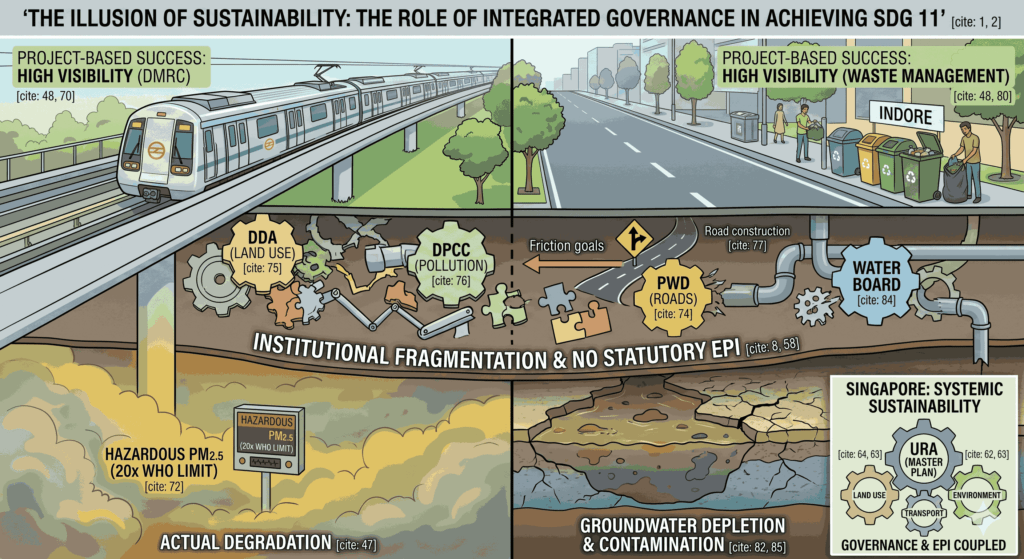
A core contribution of this paper is the conceptualisation of the “illusion of sustainability.” This is defined as a governance phenomenon where isolated, highly visible success in a single urban sector (e.g., waste collection, public transit expansion) creates a public and political perception of environmental progress, while masking systemic ecological degradation driven by a lack of cross-sectoral policy integration. This illusion is sustained by project-based governance, where political capital is invested in highly visible infrastructure projects (like a new metro line) rather than the invisible, complex work of institutional coordination (like integrating bus routes, pedestrian access, and emission controls). It allows administrations to claim progress on SDG 11 indicators superficially while core environmental health continues to decline.
-
Methodology
This study employs a qualitative comparative methodology. Case selection was deliberate, contrasting a global benchmark of integrated governance with specific Indian cities exhibiting rapid urbanisation but fragmented governance.
- Global Benchmark: Singapore. Selected for its internationally recognized, highly centralized, and integrated urban planning architecture.
- Indian Cases: Delhi and Indore. Selected because both exhibit strong sector-specific investments (transit in Delhi, waste management in Indore) but face persistent, contradictory environmental crises, making them ideal subjects for analyzing the “illusion of sustainability.”
Variables Compared:
- Institutional Authority: The number of agencies responsible for overlapping urban domains (e.g., transport and air quality) and their respective legal mandates.
- Policy Integration Mechanisms: The presence or absence of binding, statutory master plans that force cross-departmental compliance.
-
Comparative Analysis
The Global Benchmark: Systemic Sustainability in Singapore
Singapore demonstrates how systemic sustainability is achieved when Urban Governance and EPI are tightly coupled.
- Institutional Mechanism: The Urban Redevelopment Authority (URA) acts as the central statutory board. It is legally empowered to formulate and enforce the “Concept Plan” and “Master Plan.”
- Outcomes: Land use, transport, and environmental limits are entirely integrated. When the Land Transport Authority (LTA) expands transit, it is legally bound to the URA’s land-use zoning. There are no competing parastatals overriding local environmental goals. Consequently, Singapore maintains high economic density alongside strict air quality controls and expanding green cover. Success here is systemic, not isolated.
Delhi: The Transport vs. Pollution Mismatch
Delhi exemplifies the “illusion of sustainability” born from institutional fragmentation. The city has built one of the world’s largest and most advanced urban transit systems, the Delhi Metro (DMRC). From an isolated technological standpoint, this is a massive sustainability win.
- The Mismatch: Despite the metro, Delhi consistently records hazardous PM2.5 levels, often exceeding WHO safety guidelines by 20 times.
- Institutional Failure: The governance structure is highly fractured. The DMRC manages the trains; multiple Municipal Corporations (MCD) manage local parking and roads; the Public Works Department (PWD) manages arterial roads; the Delhi Development Authority (DDA, a federal agency) controls land use; and the Delhi Pollution Control Committee (DPCC) monitors air quality.
- Evaluative Conclusion: Because there is no legally binding Metropolitan Transport Authority integrating these bodies (a lack of EPI), the DDA zones commercial hubs without consulting the DMRC, the PWD builds flyovers that encourage private car use, and the DPCC is left with no power to dictate urban planning. The success of the Metro masks the catastrophic failure of the wider urban mobility and ecological system.
Indore: The Waste vs. Water Mismatch
Indore has been consistently ranked as India’s cleanest city under the national Swachh Bharat (Clean India) mission, recognized for its highly efficient municipal solid waste collection and segregation.
- The Mismatch: While the surface is clean, Central Ground Water Board (CGWB, 2022) data reveal severe groundwater depletion and heavy metal contamination in the region’s aquifers.
- Institutional Failure: The municipal corporation has vast power and funding for waste management (a highly visible, politically rewarding metric). However, the regulation of industrial effluent, real estate development over natural drainage basins, and groundwater extraction fall under separate state-level water and industrial boards with weak enforcement capacity and no integration with municipal solid waste planning. The visible cleanliness creates an “illusion of sustainability,” hiding the degradation of the foundational water table.
-
Policy Recommendations
To dismantle the illusion of sustainability and operationalise SDG 11, governance structures, particularly in India, must evolve. The following evaluative recommendations focus on institutional mechanisms:
- Legally Mandated Metropolitan Sustainability Authorities: Voluntary coordination committees fail because they lack teeth. Cities must establish statutory metropolitan bodies with veto power over sector-specific projects (transport, housing) if they violate integrated environmental master plans.
- SDG-Linked Urban Performance Budgeting: Currently, urban fiscal transfers in India are largely project-based (e.g., funding for a water plant). Funding should be tied to cross-sectoral outcomes. An agency should only receive transit funding if it demonstrably links its project to reduced localized emissions and integrated land-use.
- Mandatory Policy Integration Audits: Just as financial audits are legally required, cities should undergo independent, statutory audits assessing whether new infrastructure policies conflict with existing environmental goals, exposing fragmented policymaking before implementation.
- Conclusion
The persistence of urban environmental crises despite advanced technologies and robust laws highlights a fundamental truth: achieving Sustainable Development Goal 11 is not primarily an engineering challenge, but a political and institutional one.
This study has demonstrated that when urban governance is fragmented and devoid of Environmental Policy Integration, polycentricity devolves into chaos. The resulting “illusion of sustainability”, where shiny metro trains run through toxic smog and clean streets sit atop poisoned aquifers, serves only to delay meaningful reform. To transition from the illusion of sustainability to systemic resilience, governments must aggressively dismantle institutional silos, legally mandate cross-sectoral coordination, and recognize that the environment cannot be managed as a standalone sector, but must be the foundation of all urban governance.
References
- Baud, I., Scott, D., Pfeffer, K., Sydenstricker-Neto, J., & Denis, E. (2014). Spatializing urban poverty and inequality: Methodologies, contexts and data in the Global South. International Journal of Urban and Regional Research.
- Bulkeley, H., & Betsill, M. (2004). Rethinking sustainable cities: Multilevel governance and the urban politics of climate change. Environmental Politics, 14(1), 42-63.
- Central Ground Water Board. (2022). Groundwater quality assessment for urban areas. Government of India.
- Hodson, M., & Marvin, S. (2010). Can cities shape socio-technical transitions and how would we know if they were? Research Policy, 39(4), 477-485.
- Mol, A. P. (2001). Globalization and environmental reform: The ecological modernization of the global economy. MIT Press.
- Organisation for Economic Co-operation and Development. (2020). Metropolitan governance: A framework for policy reform. OECD Publishing.
- Ostrom, E. (2010). Polycentric systems for coping with collective action and global environmental change. Global Environmental Change, 20(4), 550-557.
- United Nations. (2016). New Urban Agenda. UN-Habitat.